
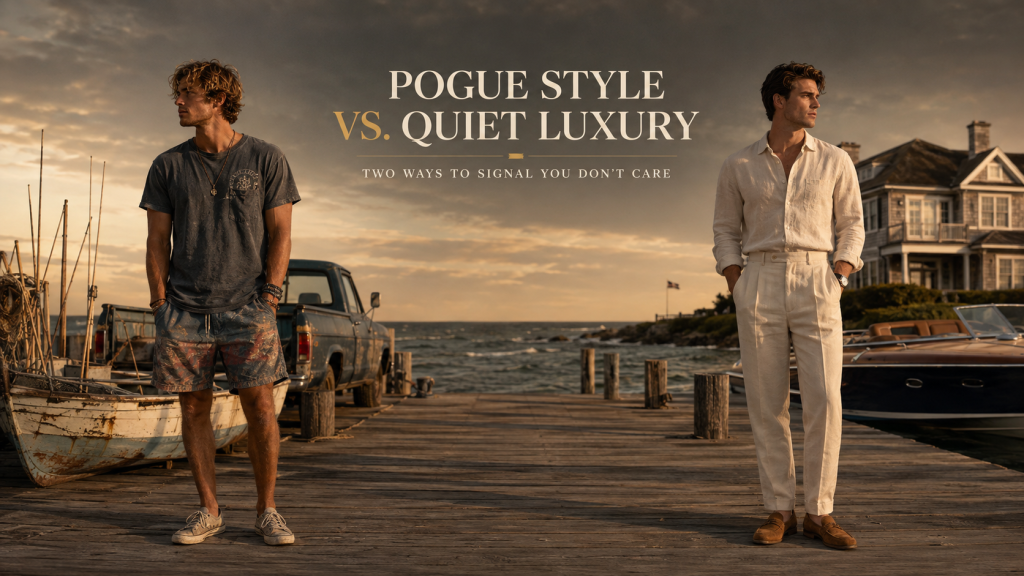
Two men stand near the bar at a Bridgehampton party in July. One wears a washed tee that cost $195 and a pair of jeans distressed by hand in a factory in Japan. The other wears an unbranded cashmere crewneck from The Row that cost $1,690, over trousers with no visible hardware at all.
They look nothing alike. Pogue style and quiet luxury are, in fact, the same argument delivered from opposite ends of a bank balance.
Both men are performing indifference. Both spent real money to look like they did not consider the question. Neither one is wearing a logo, since a logo would name the thing they are each working to leave unnamed.
Netflix ends Outer Banks on August 20, 2026, which closes out five years of the most legible costume design on television. The show dressed its class war so clearly that viewers learned to read a character’s standing before anyone spoke. That skill transfers directly to a lawn party in Sagaponack, and the mechanics are worth spelling out.
Pogue Style and Quiet Luxury Run the Same Play
Strip both wardrobes down to the intention and they collapse into one sentence. Do not let anyone see me trying.
Surf culture invented the insult that the show now runs on. A kook buys the full kit and cannot ride, so the offense was never spending. It was spending visibly, without the standing to justify it.
Loud labels announce arrival. A monogram belt or a logo-printed hoodie says that a purchase happened and that the purchaser wanted it known.
Quiet labels assume arrival instead. No monogram, no hardware, no visible proof, because proof is only required from people whose position is still in question.
Pogue style makes the identical claim from underneath. The faded tee says money was never the point here, which is a claim only somebody with money can afford to make.
So the two aesthetics are not opposites. They are the same refusal to be priced, filed under different budgets. One refuses by looking like it never had it, the other by looking like it never counted it, and both refusals cost more than the alternative.
The Mechanics of Pogue Style
Break the look into parts. A washed cotton tee with a broken-in collar, board shorts, a work shirt with the sleeves cut, boat shoes with the leather gone soft, a hat from a bait shop.
Now price the reproduction. Buck Mason, Velva Sheen and Whitesville sell that tee between $95 and $220, since loop-wheeled cotton runs slow on old machines and slow is expensive.
Hats deserve a line of their own, since the bait shop cap is the single most counterfeited item in the category. Original examples from shops that closed in the nineties trade above $200 online.
Hand-distressed denim from a serious label sits between $250 and $400. Somebody is paid hourly to simulate five years of a life the buyer never had.
Add a vintage truck, because pogue style is not only clothing. A clean 1972 Ford Bronco clears $60,000 at auction, and a running Vanagon trades between $25,000 and $45,000.
The genuine article costs $4 at a Goodwill on Route 158 and does not fit. That gap between $4 and $195 is the entire product, and everyone paying it knows exactly what they are buying.
The Mechanics of Quiet Luxury
Now run the same exercise on the other side of the room. Loro Piana Summer Walk loafers, roughly $975. A Brunello Cucinelli knit, comfortably past $1,500. The Row for anything that needs to look like nothing.
Materials carry the whole signal. Baby cashmere, vicuña, long-staple cotton, unlined suede, all of which read at three feet and vanish at thirty.
That distance rule matters, since it is the actual design brief. A logo works across a room. Quality only works in a conversation, so quiet luxury is engineered for people who are already close enough to matter.
Construction does the rest. Hand-finished buttonholes, a collar that holds its shape after five years, a shoulder seam that sits correctly without padding. None of it photographs, though all of it is why the ticket looks the way it does.
Nothing here is subtle about cost. A Loro Piana overshirt runs past a mortgage payment in most of the country, and the label is inside the collar.
Notice how that mirrors pogue style precisely. Both looks are illegible to strangers and perfectly legible to the small group whose opinion the wearer actually cares about. Broad legibility is what both are paying to avoid.
Loud Labels Announce, Quiet Labels Assume
Volume is the real variable, and it tracks recency rather than wealth. New money is loud, since new money still needs the room to know.
Recency is the variable that neither look can fake, though both are built to try.
Money that has settled goes quiet, because everyone who matters already knows and repeating it would be strange. Nobody announces their own address at their own dinner table.
Watch what happens at a club dinner when someone names a price. The table goes briefly quiet, because pricing an object announces that the price was considered at all.
Between those two positions sits a third, which is the interesting one. People who want to skip the whole announcement stage buy the quiet version immediately, hoping to look settled before they are.
That shortcut rarely works, and the reason is instructive. Settled people wear one quiet piece with three ordinary ones, while the shortcut buys the full outfit at once.
Pogue style suffers from the same failure mode in reverse. Somebody arrives in the complete costume, perfectly worn, all of it from the last eighteen months. Real wardrobes accumulate over a decade and never coordinate, which is the flaw that no budget can buy.
Who Is Actually Buying Each One
Here is the part that reorders the conversation. Both aesthetics are bought by the same customer.
Pogue-coded product moves through Free People, Aritzia and Urban Outfitters, at $128 for a gauzy dress meant to read as a girl who lives on a boat. Nobody living on a boat is that customer.
Resale confirms the pattern. The same accounts listing a worn Loro Piana knit are frequently listing surf-shop tees from the same closet, so the wardrobes coexist rather than compete.
Quiet luxury moves through Bergdorf, Mr Porter and the second floor of a few specific stores, at ten times the ticket. Yet the demographic overlaps heavily, separated mostly by the decade of the buyer’s life.
Age does most of the sorting. The instinct arrives early and the budget arrives late, so the same person expresses it twice.
A thirty-year-old associate buys pogue style for the weekend. Fifteen years later, the same person, with the same instinct about not being seen trying, buys the cashmere.
So the two markets are not rivals. They are stages, and the underlying anxiety never changes. What changes is only how much money is available to express it, which is why one look scales into the other so cleanly.
Why the Two Aesthetics Converged Around 2023
The timing was not a coincidence. Three things happened at once, and they happened fast.
First, Succession ended its run with a wardrobe built on unlabeled outerwear, plain knitwear and one much-discussed baseball cap. Second, the Gwyneth Paltrow trial in March 2023 put logo-free outfits in front of an enormous audience for a week.
Third, and least discussed, inflation made loud spending socially awkward. Nobody wanted to be photographed announcing a purchase in the year everybody was reading grocery receipts out loud.
Search behavior spiked accordingly, and so did the retail response. Brands that had spent a decade enlarging their monograms started quietly shrinking them again within two seasons.
Meanwhile Outer Banks dropped season three in February 2023, and its Pogue wardrobe entered the same conversation from below. The season pushed well past two billion minutes watched, which put a lot of thrifted-looking cotton in a lot of feeds.
Fashion week followed within a season, since the trade always does. By autumn the two registers were being styled into the same editorial spreads, usually on the same model.
Both looks answered one question that year. How do you spend without appearing to spend? Pogue style answered it downward and quiet luxury answered it upward, and by that autumn the two were being styled together in the same editorials.
Sarah Cameron Wears the Whole Argument
The show makes this legible through one character. Sarah Cameron never wears a visible logo, and the absence is a deliberate costume decision rather than a budget one.
Her clothes barely change when she moves to The Cut, and that is the point. She reads as a Kook in a Pogue setting because the signal was never the garment.
Posture carries it. The teeth, the ease, the assumption that a door will open, none of which comes off with the sweater.
John B carries the inverse. His clothes are legitimately old, so nothing about them is a statement, and the show never lets him style his way across the bridge.
Compare that to a Pogue in genuinely worn clothing and the difference is visible in seconds. Pogue style on Kiara reads as inheritance from a family restaurant. The same silhouette on Sarah reads as a choice.
Even her hair does class work, since the sun-bleached texture requires three or four salon visits a year to look untouched. Nothing about that maintenance appears on screen.
Madelyn Cline has since been named Revlon’s global brand ambassador, which is the market confirming the read. Legacy beauty did not buy reach alone. It bought a specific aspirational register, and we break the wardrobe down in our Kook girl style analysis.
The Tell That Separates Real Indifference From the Purchased Kind
There is a reliable test, and it takes about four seconds. Real indifference does not match.
An accumulated wardrobe is incoherent. The shirt is from 2011, the shorts came from a chain that closed, the shoes were resoled once by a guy in town. Nothing was bought together, so nothing coordinates.
Purchased indifference arrives as a set, degrading at a uniform rate in a single palette from about three labels. Uniform wear is the one thing real wear never produces.
Fit is the third giveaway. Genuinely old clothing fits its owner strangely, because bodies change while cotton does not, so the shoulders sit slightly wrong.
Second, check the shoes. Distressing stops at the ankle in almost every case, which is why the sneakers are new and usually $400.
Last, listen for pricing. Anyone who volunteers what the truck or the coat cost has told you the object is a purchase rather than an inheritance. Pogue style and quiet luxury both collapse the second their owner explains them, which is the only rule both share without exception.
What This Means If You Sell Anything
Brands keep getting this backwards, so it is worth stating operationally. Neither aesthetic is about modesty, and treating them as modesty produces bad product.
Both are about control of information. The customer wants to decide who reads the signal, which means the signal has to be withheld from everybody else.
Withholding is a harder brief than shouting, and most marketing departments are staffed for shouting. That mismatch is why so many quiet product launches read as loud anyway.
Practically, that means construction over branding. Fabric weight, seam quality, a palette that does not photograph loudly, and no logo doing work the garment should be doing.
Pricing follows from that. A product built for this customer cannot be discounted publicly, since a public discount is itself a loud signal and undoes the work.
It also means the placement matters more than the reach. A brand that wants this customer needs to appear where the customer already is, in front of the small audience whose recognition counts.
Pogue style is the entry version of that instinct and quiet luxury is the graduate version. Anyone selling into the East End is selling to people running one or both, frequently in the same weekend. The wider fantasy underneath it sits in our piece on what the Pogue look actually costs, and the opposite side is mapped in the Kook style breakdown.
Where The Conversation Continues
Social Life Magazine covers how status is worn on the East End, at the level of fabric, price and placement. Who signals up, who signals down, and what each move actually costs.
Our readers are founders, brand owners and the people who dress them. They buy both looks, usually without naming either one.
The final season lands August 20, and our style and status coverage runs through September. Category exclusivity on the package is open now.
If your brand belongs in that conversation, the door is open. After the twentieth, it is your competitor in the story instead.
Start the conversation with Social Life Magazine
Related reading: the class war the show is actually about, and the Revlon deal and what it bought.
Author

Written by
Recent Posts
How to Pick a Homecoming Dress for Your Body Type and Feel Amazing in It
How to Prepare a Home for Sale When Major Repairs Are Not Affordable
From Everyday Comfort to Personal Style: My SHEIN Slipper Habit
5 Best Mitsubishi Heat Pump Companies in Seattle
Tech Gadgets as Modern Corporate Gifts: Useful Ideas for Employees and Clients
Categories
- Art
- Articles
- Business of Luxury
- Celebrities
- Culture
- Entertainment
- Events
- Faces of Summer 2026
- Fashion
- Fashion & Style
- Featured
- Finance
- Food, Spirits, Wine
- Hamptons
- Hamptons Celebrities
- Health
- Health & Beauty
- Lifestyle
- Luxury Lifestyle
- Press
- Profiles
- Real Estate
- Technology
- The Chronicles
- Travel
- Uncategorized
- Weddings