
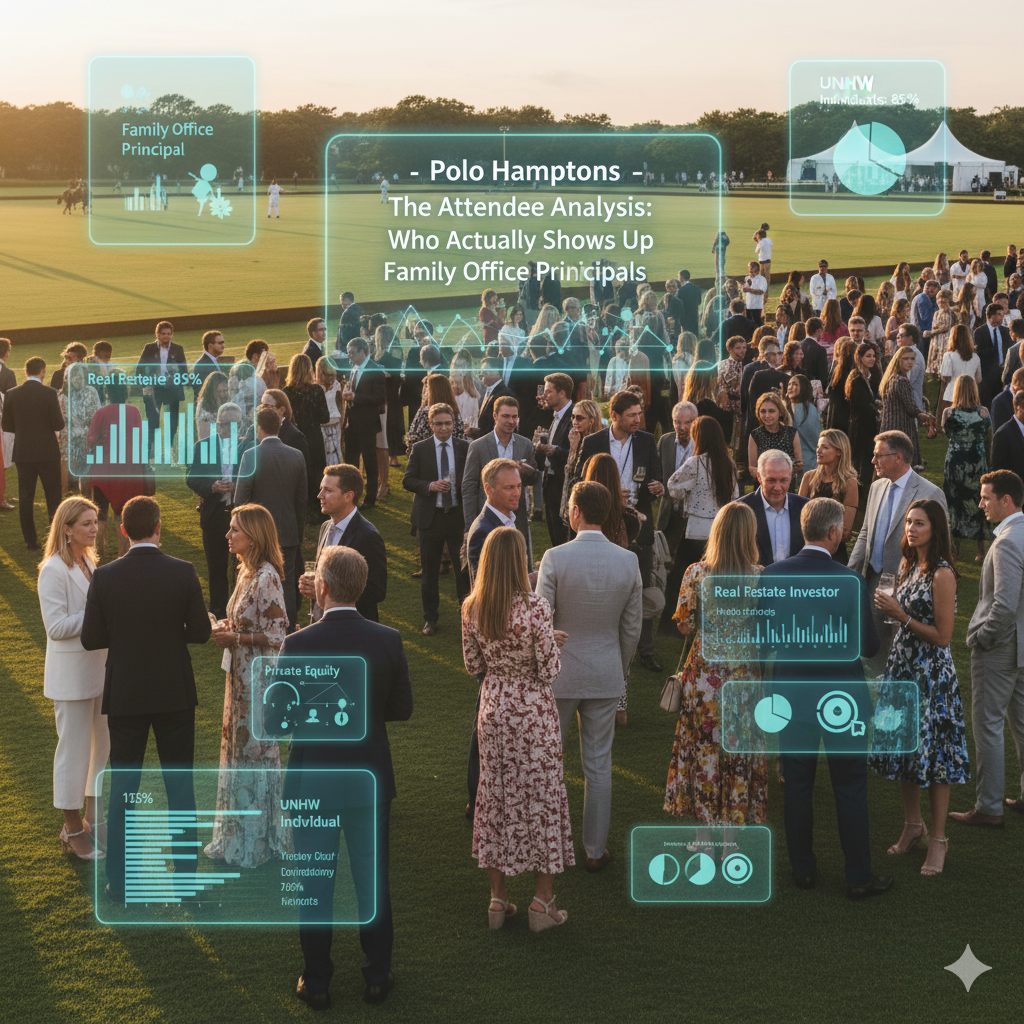
Two events. Same weekend. One draws 3,000 attendees. The other draws 300. A founder attends both, working the first with business cards and practiced introductions, drifting through the second with a glass of rosé and no particular agenda.
At the first event, he collects contacts. At the second, he meets his Series B lead.
The value of a gathering isn’t measured in headcount. It’s measured in the authority concentrated in the room. This distinction separates events that generate social media content from events that generate actual capital formation—and principals understand it intuitively before they’re consciously aware of understanding anything.
Decision-Makers vs. Decision-Influencers
Principals sign checks. Everyone else requests meetings to reach principals. The hierarchy seems obvious when stated directly, yet most events optimize for influencer attendance while treating principal presence as a happy accident.
The incentives explain the pattern. Influencer attendance generates immediate visibility. Posts appear. Coverage multiplies. Marketing reports show impressive reach metrics. Principals don’t post. They don’t generate coverage. They attend quietly, observe carefully, and leave without anyone photographing their departure.
Polo Hamptons inverts the optimization. The environment attracts principals specifically because it doesn’t perform for external audiences. No step-and-repeat. No press line. The incentive to document presence for followers who weren’t invited simply doesn’t exist here. The absence of performance creates the safety principals require to actually attend.
Harvard Business Review’s analysis of organizational influence distinguishes between positional authority and networked influence. Both matter in different contexts. For capital formation, positional authority—the actual ability to deploy capital—matters more than any influencer’s reach.
The Math That Matters
One conversation with an allocator who deploys $500 million annually is worth more than 500 conversations with people who manage nothing. Most networking advice ignores this arithmetic because it’s uncomfortable. Building relationships with principals requires access most people don’t have and patience most people can’t sustain.
Polo Hamptons solves the access problem through composition. The environment attracts principals because other principals attend. The social proof is self-reinforcing. Family offices see other family offices. PE partners see their peers from competing firms. The presence of one validates attendance by all.
The patience problem remains unsolved. Principals don’t transact with people they’ve just met. Relationships require multiple exposures across multiple seasons before business becomes appropriate. Brands and individuals expecting immediate return will be disappointed. Those willing to build over time will find no more efficient starting point.

What Principals Look Like When They’re Not Working
The family office head wears linen the color of unbleached cotton. His sleeves are rolled to the elbow. He hasn’t checked his phone in two hours because his phone is in the car, and the car is parked somewhere he’d have to think about to remember. A baseball cap shadows his eyes—no logo, slightly faded, obviously worn rather than purchased for the occasion.
His wife stands nearby, talking with someone neither of them knew before today. Their conversation involves summer plans and teenage children and a restaurant in Sag Harbor that changed chefs since last season. Nothing about the discussion suggests either participant manages generational wealth. That’s the point.
The PE partner arrived with his daughter. She’s sixteen, more interested in the horses than the humans, already calculating whether she can convince her father to add riding lessons to her schedule. He watches her watching the match and feels something he rarely permits himself during business hours: unguarded contentment.
His firm closed a $3 billion fund last quarter. The deployment pressure is constant. Here, for an afternoon, it recedes. The deals will still exist on Monday. This Saturday belongs to something else.
The founder who exited for $400 million sits alone on a bench near the paddock. He’s been wealthy for eighteen months and still hasn’t adjusted to the silence. No board meetings. No investor updates. The employees who once depended on his decisions now depend on someone else. The emptiness should feel like freedom. Instead, it feels like waiting.
He came to Polo Hamptons because someone told him the right people attend. What he’s discovering is that the right people don’t announce themselves. They simply exist, unremarkably, in linen and faded caps, watching horses they couldn’t evaluate and discussing restaurants they haven’t tried.

What They’re Not Wearing
No lanyards. The conference habit of name-tagged identification has no equivalent here. If you need to know someone’s name, you ask. If you need to know their role, you discover it through conversation or mutual acquaintance. The absence of labels forces actual interaction.
No pitch decks. The founder who brings a USB drive loaded with his Series B materials marks himself as someone who doesn’t understand the environment. Business materials exist in offices. This is not an office. The categories remain separate.
No branded polo shirts from the startup seeking visibility. Corporate swag signals employee, not principal. The distinction matters enormously in rooms where authority determines relevance. A person wearing their company’s logo is advertising. A person wearing unremarkable clothes is attending.
The absence of performance is its own signal. Hamptons wealth patterns demonstrate consistent preference for understatement. Obvious displays indicate recent arrival. Quiet confidence indicates permanent belonging.
How the Room Self-Selects
Polo Hamptons doesn’t filter attendance through gatekeeping. The filtering happens through environment design. Certain people feel comfortable. Others don’t. The difference determines who returns.
Timing matters. Saturday afternoon during summer. Principals have weekends free. Employees often don’t. Those still building careers rarely possess the schedule flexibility to attend events that conflict with work. Those who’ve already built careers can arrange their time differently.
Location matters. The Hamptons, not Manhattan. Reaching the event requires being in the Hamptons already or traveling specifically to attend. Both indicate either residence or intention—neither characteristic of casual attendees seeking free champagne and networking opportunities.
Format matters. Unstructured time with no programmed networking sessions. Those optimizing for contact volume—business card collectors, LinkedIn connection seekers—find the format frustrating. No one is corralled into conversation circles. No one is introduced systematically. Relationships form organically or not at all.
Social context matters. Families present. Children visible. Spouses included. The professional performance that dominates conferences becomes impossible when personal lives are on display. Pretense collapses when your teenager interrupts to ask about the horses.
The Stanford White estate where $3 billion summers illustrates location functioning as filter. Geographic selection determines social composition more reliably than any invitation list could manage.

What This Means for Positioning
Brands seeking impressions choose crowds. Brands seeking relationships choose rooms. The distinction determines strategy, allocation, and expected timeline for return.
Impression-focused brands optimize for reach. Largest possible audience. Maximum eyeballs. CPM calculations that treat all viewers as equivalent. The approach works for products purchased impulsively by large populations. It fails for offerings that require relationship-based sales to concentrated buyers.
Relationship-focused brands optimize for composition. Smallest viable audience with highest decision-making authority. Quality of attention rather than quantity of exposure. The approach requires patience and repeated presence but generates returns that impression-based strategies cannot match.
Polo Hamptons serves the second approach. A brand that hosts a cabana for three consecutive summers becomes known to the principals who attend across those seasons. Not known as an advertiser—known as a presence, a host, part of the environment rather than interruption to it.
The mathematics favor patience. One principal relationship that generates $1 million in business over five years outperforms thousands of impressions that generate nothing. Brands capable of thinking in those terms find Polo Hamptons invaluable. Brands requiring immediate conversion find it frustrating.
Both responses are correct. The environment serves specific purposes. Knowing whether your purposes align determines whether attendance makes sense.
Part of the Polo Hamptons Series
For the complete strategic framework, read: How Polo Hamptons Became a Meeting Point for Capital, Culture, and Luxury Brands
Continue the 1 Series:
Related: Why the Hamptons Becomes a Temporary Capital City Every Summer
For features, advertising, and partnership opportunities with Social Life Magazine, visit sociallifemagazine.com/contact. Experience where capital meets culture at Polo Hamptons. Subscribe to our print edition or support independent luxury journalism with a $5 donation.
Author

Written by
Recent Posts
Where Can You Find the Best Made-to-Measure Bespoke Suits in NYC
The Financial Habits Every Successful Entrepreneur Swears By
What Happens If You Delay Hemorrhoid Treatment in New York City

James Franco Net Worth — A $30 Million Career Interrupted

Selena Gomez Net Worth — How a Disney Kid Built a $1.3 Billion Empire
Categories
- Art
- Articles
- Beauty & Skincare
- Celebrities
- Celebrities|Movies
- Celebrities|The Chronicles
- Chronicles
- Culture|Television
- Entertainment|Culture
- Event Photos
- Events
- Fashion
- Fashion & Style
- Featured
- Food & Beverage
- Food, Spirits, Wine
- Hamptons
- Hamptons Celebrities
- Hamptons Celebrities|Celebrities|The Chronicles
- Health
- Health & Beauty
- Lifestyle
- Luxury Lifestyle
- Movies
- Movies|Culture
- Movies|Hamptons Lifestyle
- Press
- Profiles
- Real Estate
- Technology
- The Chronicles
- Travel
- Uncategorized
- Weddings