
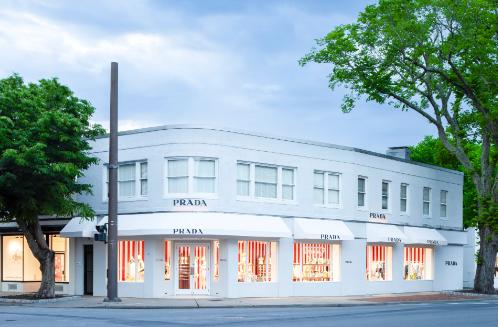
The Boutique That Doesn’t Need You to Understand
What separates this Prada East Hampton moment from a thousand other luxury transactions happening simultaneously across the Hamptons is what the woman doesn’t know. Or rather, what she doesn’t need to know. The neon triangle glowing against those cabana stripes isn’t just a logo. It’s an invitation to a very particular club—one where the entrance exam isn’t money but the willingness to find beauty in what others dismiss as ugly.
Pierre Bourdieu, the French sociologist who spent his career dissecting how taste functions as class warfare, would recognize this scene instantly. Furthermore, he’d understand why Prada chose this precise location—steps from Main Street, visible to anyone wandering East Hampton’s pristine sidewalks, yet requiring a certain cultural fluency to truly enter. The question isn’t whether you can afford to shop here. The question is whether you understand why you should.
The Prada Genesis: From Steamer Trunks to Subversive Style
Milan, 1913. Inside the Galleria Vittorio Emanuele II—that soaring glass-roofed arcade where Europe’s aristocracy promenaded—Mario Prada and his brother Martino opened Fratelli Prada. They sold leather goods, imported English steamer trunks, and travel accessories designed for a clientele who spent months crossing oceans on luxury liners. By 1919, the quality attracted the Italian Royal Household, granting Prada the privilege of incorporating the House of Savoy’s coat of arms into its logo.
Here’s where the mythology gets interesting. Mario Prada believed women had no place in business. He wanted his son to inherit the enterprise. His son had no interest. Consequently, Mario’s daughter Luisa took over and ran the company for twenty years. And then Luisa’s daughter—a PhD in political science, a former member of the Italian Communist Party, a woman who studied mime at Milan’s Piccolo Teatro—inherited a modest leather goods shop with annual sales around $450,000.
Her name was Maria Bianchi. Her family called her Miuccia. She was legally adopted by her aunt to carry the Prada name. And she proceeded to transform a respectable Milanese boutique into one of fashion’s most intellectually provocative houses.
The Mythology Machine
The official Prada narrative emphasizes heritage, craftsmanship, and the Galleria Vittorio Emanuele II’s mahogany shelving. What it typically glosses over is more revealing. Miuccia Prada was, by her own admission, “ashamed of thinking about fashion.” She was a feminist in the 1970s, a period when fashion obsession was considered politically suspect. “Being a feminist in the 1970s, you can imagine how inappropriate it was to talk about fashion,” she once told the press. “But I loved it so much that I did it.”
This tension—between intellectual seriousness and aesthetic desire, between rejecting bourgeois values and running a luxury empire—became Prada’s signature. The brand sells contradiction. It invites you to want what you’re supposed to be above wanting. And in doing so, it transformed fashion from mere consumption into something approaching philosophy.
Prada’s Four Capitals: Decoding Luxury’s Hidden Currency
Economic Capital
Prada’s price architecture tells a specific story. The entry point—a nylon pouch or small leather accessory—hovers around $500-800. The middle tier, where most serious shoppers operate, spans $1,500-3,500 for bags like the Re-Edition 2005 or Cleo. The Galleria, Prada’s answer to heritage bags at other houses, commands $4,600 or more. Special editions and runway pieces climb into five figures.
The Prada Group reported €5.4 billion in net revenues for 2024, up 17% year-over-year. Net income rose 25% to €839 million. These figures matter because they reveal something crucial: Prada isn’t merely surviving in the luxury slowdown affecting competitors. It’s thriving. Meanwhile, Miu Miu—Miuccia’s “younger sister” brand—recorded a staggering 93% retail growth.
Nevertheless, the most interesting economic data concerns resale. Unlike Hermès Birkins or Chanel Flaps, Prada bags don’t typically appreciate. A used Galleria in excellent condition fetches roughly $1,500 on The RealReal—about one-third of retail. This isn’t a flaw. It’s a feature. Prada doesn’t sell investment pieces. It sells intellectual credibility. And intellectual credibility, unlike leather goods, cannot be resold.
Cultural Capital
To properly consume Prada requires knowing things.You need to recognize that the black nylon backpack—a piece that might retail for $1,200—is actually a reference to military spec fabric Mario Prada used as trunk linings. The brand expects familiarity with Miuccia’s 1996 “Banal Eccentricity” collection, which invented “ugly chic” by combining avocado greens with muddy browns and prints borrowed from 1950s suburban tablecloths. And proper appreciation of Prada demands knowing that the Fondazione Prada in Milan—designed by Rem Koolhaas, featuring a bar designed by Wes Anderson—represents one of fashion’s most serious commitments to contemporary art.
In other words, Prada requires homework. The brand assumes familiarity with its intellectual references. It doesn’t explain itself. Alexander Fury, the fashion critic, captured this dynamic precisely: “The clothes Miuccia Prada makes aren’t sanitized, or elegant, or even necessarily attractive. But they still create a desire. We don’t like them, but we want them.”
This is Bourdieu’s “cultural capital” in action. Institutionalized knowledge—about fashion history, about aesthetic theory, about the subversive pleasure of embracing what’s “wrong”—becomes a prerequisite for authentic engagement. Anyone can buy a Prada bag. Understanding why it matters requires different resources entirely.
Social Capital
The Prada customer belongs to a specific network. She’s read Susan Sontag on Camp (even if Prada “is rarely Camp—and never sincerely Camp,” as critics note). She’s attended museum exhibitions—perhaps the Metropolitan’s 2012 “Schiaparelli and Prada: Impossible Conversations.” She likely works in creative industries or adjacent fields where intellectual fashion signals professional credibility.
Celebrity endorsement at Prada follows different rules than at competitors. When Uma Thurman, Gary Oldman, Adrien Brody, or Emile Hirsch appeared in campaigns, the message wasn’t aspirational glamour. It was intellectual seriousness with charismatic edges. Prada customers recognize each other not by logo prominence but by the particular way they’ve assembled references—the nylon with the cashmere, the ugly shoe with the refined coat.
In the Hamptons specifically, carrying Prada signals something different than carrying Chanel or Louis Vuitton. It suggests you’re wealthy enough to afford anything but discerning enough to choose this. It implies familiarity with Milan beyond shopping—perhaps you’ve visited the Fondazione, seen the gold-leaf “Haunted House” building, had an espresso at Bar Luce. The social network Prada activates is cultural elite, not merely economic elite.
Symbolic Capital
Where does Prada sit in the luxury hierarchy? This question reveals the brand’s genius. Economically, Prada prices below Hermès and Chanel but above Coach or Tory Burch. Symbolically, however, Prada occupies a different axis entirely. It’s not about expense. It’s about taste.
“Taste as social weapon,” Bourdieu called it. Prada weaponizes taste by making you question what taste means. The Mary Jane platforms from 1996—widely judged “the ugliest shoes in the world”—sold out immediately. Fifty pairs available in the UK. Gone. This is symbolic capital operating at its purest: the ability to make others desire what they previously dismissed, thereby demonstrating superior aesthetic understanding.
Owning Prada says you’ve transcended the need for conventional beauty. You’ve arrived at a place where intellectual confidence permits aesthetic risk. In Bourdieu’s terms, you’ve accumulated enough legitimate cultural capital to spend some on apparent illegitimacy. That’s a flex no Birkin can match.
Why Prada Chose East Hampton—And What It Reveals
Prada opened its East Hampton boutique in July 2022 at 2 Newtown Lane—just steps from Main Street’s traffic, yet positioned with characteristic precision. The 1,600-square-foot space features those massive windows flooding the interior with natural light. A neon triangle glows against striped walls. Larch wood étagères display the latest collections with gallery-like restraint.
The store’s design has evolved since opening. Initially featuring green-and-white cabana stripes, it transitioned to blue-and-white for 2023, invoking coastal themes while maintaining unmistakable Prada DNA. Each season brings exclusive products available only in the Hamptons—a strategy borrowed from the pop-up playbook but executed with permanence.
Moreover, this is Prada’s only Hamptons location. No Southampton outpost. No Sag Harbor presence. Just East Hampton. The choice signals the village Prada considers its natural habitat—the one historically associated with artists, writers, and creative industry players rather than purely financial wealth.
The Field Analysis
Consider Prada’s competitive positioning. Louis Vuitton’s Bernard Arnault purchased his East Hampton building for $22 million at $4,400 per square foot. Chanel operates an ephemeral boutique. Cartier established presence on Main Street. These brands compete for Hamptons visibility with traditional luxury logic: heritage, exclusivity, recognizable status markers.
Prada competes differently. Its presence suggests not mere affluence but cultural sophistication. The customer who chooses Prada over competitors isn’t choosing cheaper (it isn’t) or more recognizable (it isn’t). She’s choosing the brand that assumes she reads, thinks, and has opinions about beauty more interesting than “pretty.”
In Bourdieu’s framework, this is field positioning through distinction. Prada doesn’t try to out-heritage Hermès or out-glamour Chanel. It creates a separate hierarchy where intellectual engagement trumps traditional status markers. And the Hamptons—where Manhattan’s creative class escapes, where galleries outnumber banks—provides the perfect stage.
Playing the Field: Prada vs. the Competition
The distinction game Prada plays operates on multiple levels. Against mass luxury (Louis Vuitton’s ubiquitous monogram, Gucci’s double-G), Prada offers near-invisible branding. The triangle logo exists but rarely dominates. Against quiet luxury competitors (The Row, Brunello Cucinelli), Prada offers intellectual provocation. Quiet luxury whispers wealth; Prada quotes it ironically.
The “ugly chic” aesthetic deserves deeper examination here. When Miuccia Prada sent those brown-and-avocado prints down the 1996 runway, she wasn’t merely being contrarian. She was exposing the arbitrariness of taste hierarchies. What made brown “ugly” and navy “elegant”? Who decided? And what did it mean to choose ugly deliberately?
These questions matter for the Hamptons customer because they address the central anxiety of new wealth: taste verification. Old money supposedly possesses effortless good taste, absorbed through generations of exposure. New money worries about getting it wrong. Prada resolves this anxiety not by providing “correct” taste but by questioning whether correct taste exists. If ugly can be chic, if nylon can be luxury, if a Communist feminist can run a fashion empire—then maybe the rules aren’t what you thought. Maybe the only wrong choice is playing it safe.
The Nylon Question
Consider Prada’s signature material. When Miuccia introduced black nylon backpacks in 1984, the fashion world didn’t immediately respond. Nylon was military fabric, utilitarian, definitively not-luxury. Learning to work with the material took years. The bags lacked branding initially, contributing to slow sales.
Then Miuccia added the triangle logo and chain straps. The “Vela” backpack became an icon. Now, nearly forty years later, Prada nylon commands prices that exceed leather alternatives from competitors. The material that shouldn’t be luxury became proof of conceptual sophistication.
This transformation illustrates what Bourdieu called “misrecognition”—the process by which arbitrary cultural choices become naturalized as inherent quality. Prada doesn’t hide this mechanism. It foregrounds it. The brand essentially says: “Yes, this is nylon. Yes, it costs $1,200. Yes, you’re paying for the idea. And isn’t that more honest than pretending leather inherently deserves premium pricing?”
The Prada Investment: Cultural Arbitrage or Conscious Consumption?
Prada East Hampton welcomes visitors at 2 Newtown Lane, though hours vary seasonally—the boutique typically operates from late spring through early fall, closing for winter months. Appointments are available through Prada’s website. The store stocks women’s and men’s ready-to-wear, leather goods, footwear, and accessories, with Hamptons-exclusive pieces dropping throughout the season.
Who should shop here? The customer who already owns enough “safe” luxury. The person who wants to make a different statement than the Chanel double-C or LV monogram crowd. The intellectual who happens to have resources—or the newly wealthy person seeking legitimacy beyond financial metrics. Prada rewards those who’ve done their homework but doesn’t punish those still learning. The sales staff, characteristic of Prada’s approach, treats customers as peers rather than supplicants.
What Prada really sells at this Prada East Hampton location isn’t Italian leather or military-grade nylon. It sells the resolution of a specific modern anxiety: the fear that your success is visible but your depth is not. In a Hamptons landscape crowded with obvious wealth markers—the house, the car, the club membership—Prada offers something rarer. Evidence of thought. Proof you’ve considered what beauty means rather than simply consuming what others declared beautiful.
Bourdieu might call this cultural arbitrage: leveraging intellectual capital to enhance social position. Or he might recognize something more subversive—a luxury brand that actually wants you to question luxury itself. Either interpretation confirms what that woman circling the Galleria bag already suspects. At Prada, understanding matters more than owning. And in the Hamptons, where everyone can afford to own, understanding might be the last true distinction.
Continue Your Luxury Education
Explore more from Social Life Magazine’s luxury brand series:
- Best Hamptons Fashion Boutiques You Must Visit — Discover where East End insiders actually shop, from The Row’s quiet opulence to emerging designers making waves.
- Best of the Hamptons 2026: Insider Secrets Revealed — The complete guide to restaurants, beaches, and power scenes worth your time.
Stay Connected with Social Life Magazine
Author

Written by
Recent Posts
The Family Brand Is the New Admissions Strategy
Tips For Selecting Drawer Dividers That Match Demanding Shop Conditions
From Hamptons Weekends to Cross-Country Escapes: Making Luxury Travel Easier with Reliable Auto Transport
Navigating Sexual Assault Law in Ontario: A Guide to Justice and Recovery
Judicial Standards and Protecting the Vulnerable
Categories
- 2025 Social Life Events
- Access to Digital + Physical Magazine
- Art
- Articles
- Beauty & Skincare
- Beauty & Wellness
- Business Strategy
- Celebrities
- Chronicles
- Design History
- Design History|Design Trends
- Design History|Hamptons
- Design Process
- Design Process|Luxury Living
- Design Trends
- Design Trends|Hamptons
- Event Photos
- Events
- Family
- Fashion
- Fashion & Style
- Featured
- Food & Beverage
- Food, Spirits, Wine
- Hamptons
- Hamptons Celebrities
- Hamptons Design
- Hamptons Design|Design Process
- Hamptons Design|Luxury Living
- Hamptons|Luxury Living
- Health
- Health & Beauty
- Home & Design
- Home & Living
- Lifestyle
- Luxury Home Design|Design Process
- Luxury Home Design|Design Trends
- Luxury Home Design|Hamptons Design
- Luxury Home Design|Interior Design
- Luxury Lifestyle
- Luxury Living
- Luxury Living|Design Process
- Luxury Living|Hamptons
- Luxury Living|Hamptons Design
- Press
- Profiles
- Real Estate
- Technology
- The Chronicles
- Travel
- Trending
- Uncategorized
- Weddings
- Wellness