
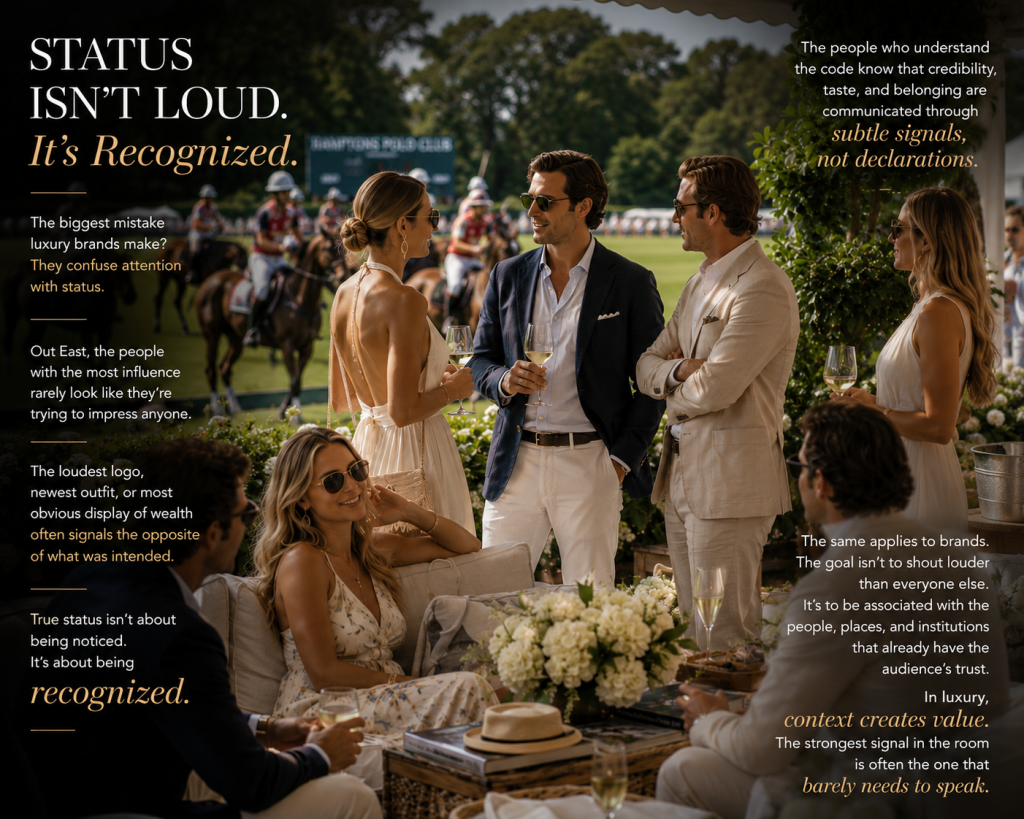
The brand exec scanned the party for the richest person in the room. She guessed wrong. The man she dismissed in the faded polo and ten-year-old loafers owned half the block. The woman she fawned over, draped in this season’s everything, had rented her whole look for the weekend. Out East, old money does not announce itself. It signals, quietly, in a code the exec had never been taught to read.
This is the problem every fashion brand hits the moment it arrives in the Hamptons. The loud playbook that works everywhere else backfires here. The codes that signal status Out East are visible, but they whisper. And a brand that cannot read them cannot speak them either.
So consider this your field guide. It catalogs the tells, the small visible signals that mark real old money, and explains why the loud version repels the exact people it means to attract. By the end, you will read the room she misread, and you will know how a brand earns a place inside the code instead of shouting at it.
Old Money Doesn’t Announce, It Signals
Begin with the central rule. Old money communicates through restraint, not display. The flex is the absence of obvious flex, the deliberate refusal to try. So the richest person in the room is often the plainest, because plainness is a luxury only the secure can afford.
This sits at the heart of the whole system we mapped in the pillar on the luxury status codes Out East. The tells are simply that system made visible, worn on the body and carried in the hand. Read the tells and you read the hierarchy.
The logic is almost backward to an outsider. More is less. Newer is lower. The pristine, the branded, the obviously expensive all read as effort, and effort reads as new. Meanwhile the worn, the unbranded, the quietly correct read as inherited. So the code rewards what looks like indifference.
There is a quiet brutality to all this. The code punishes effort precisely because effort is what the strivers have to offer. So the people working hardest to look rich are the easiest to place at the bottom. The ones who stopped working sit at the top, which is exactly why they could stop.
The Tells Are a Language, Not a List
Before the catalog, one warning. The tells are not a checklist you can copy item by item. They are a language, with grammar and accent, and copying the words without the grammar produces gibberish the room hears instantly.
This is the same reason cramming fails at the dinner table. A tell worn correctly looks unconscious. The same tell worn as a costume looks studied, and studied is the giveaway. So fluency matters more than any single item.
For a brand, this is the crucial lesson up front. You cannot just put the right object in an ad and expect the code to transfer. The object has to sit in the right context, worn the right way, or it reads as a costume too. So context is everything, which is the whole argument this hub builds toward.
The Tells, Catalogued
Now the field guide itself. The tells cluster into three groups. What they wear, what they carry, and how they move. Each group speaks the same quiet sentence, that the person has nothing to prove.
What They Wear
Start with the clothes, since they speak first. The tells here are softness and age. Faded cotton, a sweater with a real history, a jacket cut beautifully but ten years old. No visible logos, because the logo is a receipt and old money does not show receipts. This is the whole engine behind why quiet luxury was always a con, and behind the hidden premium we named in the logo tax. The clothes cost plenty. They just refuse to say so.
What They Carry
Next, the objects. A watch sits under a cuff, not over it. The tote is canvas, not leather, and a little frayed at the handle. Bags run expensive but anonymous, legible only to people who already know. Every carried object is ranked, and the ranking rarely matches the price. We broke down that whole hierarchy in what the tote and the watch actually say. The rule holds, though. The quieter the object, the higher it sits.
How They Move
Finally, the body itself. Old money moves slowly and takes up space without apology. No rushing, no scanning the room for someone better to talk to, no reaching for the phone to fill a silence. The posture says the room can wait. Reading these signals live is its own skill, which we taught in how to read a room in Southampton. The body tells the truth the clothes only imply.
Why Loud Always Reads as New
Here is the inversion a brand most needs to understand. Loud does not read as rich Out East. It reads as new. The bigger the logo, the louder the announcement, the more the room hears someone who still needs to prove the point.
Think about what a logo actually does. It outsources your status to a third party. It says, in effect, this brand vouches for me, please be impressed. But old money does not borrow status from a label, because old money is the thing the label is imitating in the first place.
So loud branding sorts you instantly, and not upward. The newcomer reaches for the boldest signal available and lands at the bottom of the code. Meanwhile the quiet object, the one nobody can identify across a room, climbs. This is the exact trap that swallows brands as fast as it swallows people.
This is why a logo can date a brand the way it dates a person. The bolder the mark, the louder the era it belongs to. So the brands that endure Out East tend to shrink their logos over time, not grow them. They learn, eventually, that the audience trusts the whisper and suspects the shout.
The One Place Loud Still Works
There is a single exception worth naming. Loud can work, but only when the wearer already has the standing to make it ironic. The old-money heir in a garish vintage tee reads as playful, not desperate, because the room knows the status is secure.
So the loudness lands as a wink, not a plea. The signal underneath is unmistakable. I can wear this badly on purpose, because nobody doubts where I sit. That is a privilege, and privilege is exactly what the newcomer does not have yet.
For a brand, the lesson is sharp. Do not borrow the wink before you have earned the standing. Loud without backing reads as need. So establish the quiet credibility first, and only then can a louder gesture register as confidence rather than panic.
What This Means for a Brand
Now the part for the brand desperate for relevance. The instinct is to shout louder, to plaster the logo bigger, to scream the value. Out East, that instinct is lethal. The audience you want is the one most repelled by the shout.
The people who set taste here read loud advertising the way they read a loud guest. As trying too hard. So a brand that screams for Hamptons relevance signals that it has none, the same way a person who name-drops signals they do not belong.
The move is counterintuitive but simple. Speak the quiet code instead of fighting it. Show restraint, context, and association rather than volume. A brand that whispers correctly Out East earns more standing than one that shouts perfectly, because the whisper is the native language and the shout is a foreign accent.
There is a cost to ignoring this, and brands pay it constantly. They buy the loudest placement available, congratulate themselves on the reach, and wonder why the right people never bite. The reach was real. The respect was not, because volume bought the eyes but repelled the taste.
Borrowing the Code Through Placement
So how does a brand actually speak the quiet code? Through placement. You cannot manufacture old-money fluency overnight. But you can place the brand inside a context that already has it, and let the context do the speaking.
This is exactly what the right page in the right magazine does. A full page surrounded by the codes the audience trusts borrows those codes, quietly. The brand stops shouting from outside the room and starts appearing inside it, vouched for by the company it keeps.
Context is the whole game, because the audience reads the setting before the product. A loud billboard screams from the highway. A considered placement, woven into the season’s own pages, whispers from within. So the same brand can read as new in one frame and arrived in another, and the frame is the part you actually buy.
None of this is about hiding the brand. It is about choosing the company the brand keeps. Put it beside the codes the audience already trusts, and trust transfers by association. So placement is not just a cost line. It is the cheapest way to buy a fluency money cannot otherwise rent.
What Speaking the Code Looks Like
Picture two brands chasing the same Hamptons summer. One buys the biggest, loudest spread it can afford and stamps the logo across it. The other places a quiet, beautiful page inside the editorial the audience already reads, and lets the proximity carry it.
Guess which one the room respects. The loud brand gets noticed and dismissed in the same glance. The quiet brand gets absorbed into the season, mentioned the way you mention a place you assume everyone knows. One paid for attention. The other earned a place in the code.
So the playbook is not louder. It is righter. Choose restraint over volume, context over claim, association over assertion. Do that, and a brand stops being the new money of the fashion world and starts reading as a name that simply belongs Out East. That is the whole prize, and it is for sale to whoever speaks the language.
None of this asks a brand to be timid. It asks the brand to be confident enough to whisper. The loudest thing in any Hamptons room is usually the most insecure, and the audience knows it. So speak softly and let the right setting amplify you, because the room rewards the brand that trusts it to listen.
Where The Conversation Continues
There is an old story about two young fish who get asked how the water is. They have no answer, because they have always swum in it. The tells work the same way. The people who speak them fluently cannot even see them, while a brand trying to enter feels every code as a wall. Now that you can read the tells, you can decide how to speak them.
If your brand wants to enter the code instead of shouting at it, start the conversation here. The right placement begins with the right introduction.
If you want the room to read your brand as already belonging, look at a paid feature or full page in Social Life Magazine. A page inside the code borrows the code, which is something no loud ad anywhere else can do.
If you would rather study the tells before you spend a dollar, join the Social Life email list and learn the language from the inside first. The list is where the quiet intelligence goes out first.
If you want to see the codes worn in the open, the gates open in July at polohamptons.com. BMW takes the title spot, Christie Brinkley hosts, and the cabanas go the way scarce things always go.
If you want the magazine itself, in your hands and in the right buildings, take out a subscription. Five summer issues, the season documented exactly as it is ranked.
And if the work itself is something you want to keep alive, you can support it directly. Independent eyes on the codes are rarer, and more necessary, than they have ever been.
Author

Written by
Recent Posts

Everyone Called Him a Genius. But He Felt Like a Fraud.
The Two-House Year: What Seasonal Residents Learn After the First Season
Trade Show Booth Decisions: What to Rent, What to Build, and What to Skip
Find Your Ideal Solar Battery Size in Minutes

How to Explore Rome Comfortably Between Check-In and Departure
Categories
- Art
- Articles
- Business of Luxury
- Celebrities
- Culture
- Entertainment
- Events
- Faces of Summer 2026
- Fashion
- Fashion & Style
- Featured
- Finance
- Food, Spirits, Wine
- Hamptons
- Hamptons Celebrities
- Health
- Health & Beauty
- Lifestyle
- Luxury Lifestyle
- Press
- Profiles
- Real Estate
- Technology
- The Chronicles
- Travel
- Uncategorized
- Weddings