
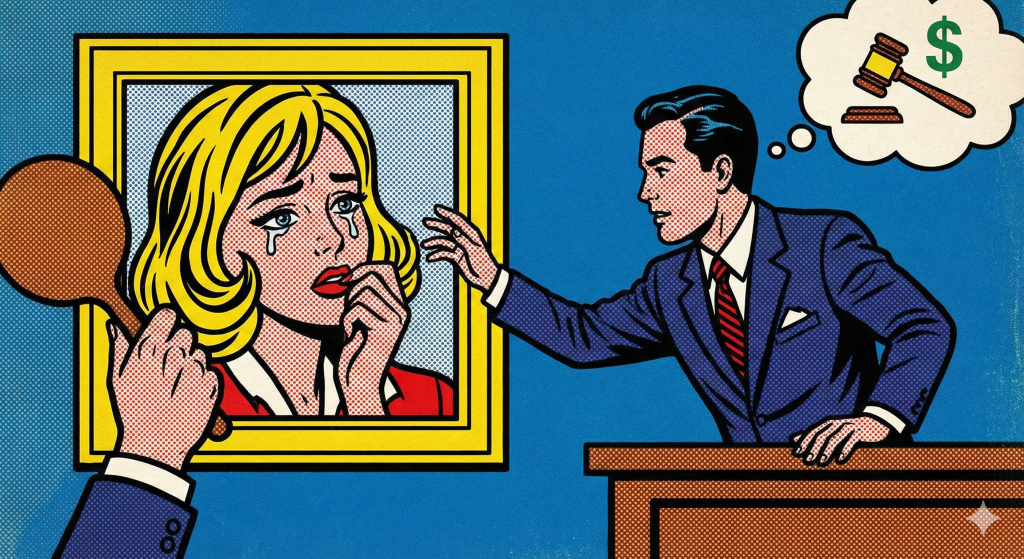
The auctioneer’s gavel falls at Sotheby’s New York, and the room exhales. A collection of Roy Lichtenstein pop art from the artist’s own holdings has just realized $27 million—nearly double its estimate. Every lot found a buyer. A small enamel pendant estimated at $3,000 sold for $101,600. Two prints tripled their estimates within minutes. The September 2025 sale confirmed what serious collectors already knew: Lichtenstein’s market isn’t cooling. It’s accelerating.
The Southampton Years: Where Roy Lichtenstein Pop Art Matured
Lichtenstein purchased his Gin Lane residence in 1970, the same year he left his first Southampton home at 65 Wooley Street. The 1897 carriage house, once part of financier Henry M. Day’s Meadow Beach estate, became his primary residence rather than mere summer retreat. “We came for several summers,” Lichtenstein once explained, “and one fall just didn’t leave.”
That decision to stay transformed both artist and property. Lichtenstein added a dedicated studio building with adjoining two-car garage, creating a working compound on the prestigious stretch of Southampton real estate. The 5,825-square-foot main house sits on nearly two acres, with beach access codified in the deed. Previous Gin Lane residents include fashion designer Vera Wang and former New York Times chairman Arthur Ochs Sulzberger Jr.
Following Dorothy Lichtenstein’s death in July 2024, the property hit the market for $20 million—its first listing in 54 years. The asking price has since been reduced to $17.95 million. Meanwhile, the Lichtensteins’ previous Southampton home at 65 Wooley Street sold in April 2024 for $3.4 million, and the couple’s West Village townhouse went for $6.5 million in May 2025.
Understanding the Ben-Day Dot: Lichtenstein’s Signature Technique
No discussion of Roy Lichtenstein pop art can proceed without understanding Ben-Day dots—the technique that became synonymous with his name. Developed in 1879 by illustrator Benjamin Henry Day Jr., the printing method uses small colored dots to create shading and secondary colors inexpensively. Comic books of the 1950s and 1960s relied on Ben-Day dots to produce gradients using only cyan, magenta, yellow, and black ink.
Lichtenstein appropriated this mechanical process, hand-painting enlarged dots that mimicked and simultaneously critiqued mass production. He used stencils and small brushes to apply dots with meticulous precision, creating works that appear mechanically reproduced yet required tremendous craft. The uniformity suggests industrial manufacture while the scale—often monumental—insists on fine art status.
This tension between high and low culture defines Roy Lichtenstein pop art. By borrowing imagery from romance comics and war panels, then rendering them at gallery scale with visible dots, he forced viewers to confront assumptions about artistic authenticity. The technique also ensured instant recognizability, making his works among the most identifiable in contemporary art.
Market Position: Where Lichtenstein Stands Today
Lichtenstein’s auction record remains £63.4 million ($95.4 million) for Nurse (1964), achieved at Christie’s in November 2015. That single-bidder sale generated speculation about third-party guarantees, but the work’s provenance was impeccable: consigned by Boston collector Barbara Lee, who had purchased it for just $1.7 million in 1995.
According to MyArtBroker analysis, 34 Lichtenstein works have exceeded $10 million at auction. His print market peaked at £9.5 million in sales value in 2019, with 249 lots sold. Since then, values have fluctuated slightly, but increased volume has maintained a stable average selling price around £285,000 in 2023.
The 2024-2025 estate releases have intensified collector appetite. Sotheby’s November 2024 sale of 11 works from the Dorothy and Roy Lichtenstein collection totaled nearly $25 million—with 10 of 11 lots exceeding high estimates. April 2025 brought another consignment: over 40 works with a combined estimate exceeding $35 million. The Nudes series from 1994, representing some of Lichtenstein’s final significant prints, has shown particular strength, with Nude With Yellow Pillow realizing $1.2 million.
Entry Points: Building a Roy Lichtenstein Pop Art Position
Unlike some blue-chip artists whose accessible works feel like consolation prizes, Lichtenstein’s prints command genuine respect. His technical mastery of printmaking produced editions that rival paintings in complexity—some requiring over a dozen lithographic plates to achieve final images. Collectors can build meaningful positions across several price tiers.
At $5,000 to $25,000, authenticated posters and smaller offset lithographs offer entry. These pieces, while not hand-signed limited editions, provide genuine Lichtenstein imagery at accessible prices. Look for works with clear provenance and condition reports. Museum exhibition posters from major retrospectives carry particular appeal.
Between $25,000 and $100,000, signed limited-edition prints become available. The Brushstroke series, Reflections prints, and various pop imagery works fall in this range. Condition matters significantly here—pristine examples with original documentation command premiums that expand during uncertain markets. Works from the artist’s Southampton period (1970-1997) carry additional collector interest.
Above $100,000, significant prints and works on paper compete for attention. The Nudes series, late-career Interiors, and major prints from iconic series like As I Opened Fire occupy this territory. At these levels, provenance becomes paramount. Works exhibited at major institutions or published in significant catalogues outperform those without documented history.
The Private Sale Reality
Lichtenstein’s private market operates on different terms than public auctions. His 1962 painting Masterpiece, depicting a blonde woman admiring a painter’s work, reportedly changed hands for $165 million in 2017—a private transaction between collector Agnes Gund and hedge fund manager Steven Cohen. Gund used the proceeds to establish the Art for Justice Fund, addressing mass incarceration.
That transaction illustrates several market realities. First, Lichtenstein’s major paintings rarely surface publicly; private sales dominate the high end. Second, blue-chip holdings can serve purposes beyond aesthetic appreciation—in this case, philanthropic legacy. Third, the gap between public auction records and private sale prices can be substantial. Collectors pursuing major Lichtenstein paintings should cultivate dealer relationships and remain patient.
Phillips Southampton has mounted Roy Lichtenstein pop art exhibitions during summer seasons, bringing important works to the East End audience. The 2022 presentation of Diana and Ajax—two Greco-Roman inspired paintings originally commissioned by Gianni Versace—demonstrated how Southampton venues can access museum-quality material. Building relationships with such galleries creates advantages unavailable to casual auction participants.
The Lichtenstein Foundation: Authentication and Legacy
Dorothy Lichtenstein founded the Roy Lichtenstein Foundation in 1999, two years after her husband’s death. The organization has facilitated donations of over 1,000 works to institutions worldwide, with the Whitney Museum of American Art receiving particular attention. In 2022, Dorothy donated Roy’s New York studio building to the Whitney’s Independent Study Program, transforming his workspace into an educational facility.
For collectors, the Foundation provides essential authentication services. Given Lichtenstein’s market values, verification matters enormously. Works without Foundation documentation face significant skepticism, potentially affecting both insurability and resale prospects. Acquiring through established dealers who maintain Foundation relationships reduces authentication risk.
The Foundation’s catalogue raisonné project continues organizing Lichtenstein’s archives. Completion of this comprehensive documentation will likely clarify attribution questions and could affect valuations for works currently lacking full documentation. Collectors should monitor Foundation announcements regarding catalogue progress.
Southampton Context: Why Location Matters
Lichtenstein’s Southampton studio produced some of his most significant late works. The Interiors series, the Nudes, the Landscapes in the Chinese Style—these bodies of work emerged from the studio he built on Gin Lane. The 2025 Bonhams auction of items from the Southampton home, totaling $1.1 million with every lot selling, included a paint-splattered armchair from his studio and wood shelves used as canvas drying racks.
Art from Lichtenstein’s personal collection included works by artist-friends: Jasper Johns, Henri Matisse, Ellsworth Kelly, Robert Rauschenberg. Books from the couple’s library featured Wayne Thiebaud, Jean-Michel Basquiat, and Andy Warhol. These connections illustrate Lichtenstein’s position within broader art-world networks—relationships that Southampton’s social geography facilitated.
The East End’s artist community welcomed Lichtenstein alongside neighbors like Willem de Kooning in Springs and, later, Eric Fischl in Sag Harbor. This concentration of significant artists—drawn by the legendary light and relative quiet—created both creative community and market dynamics. Works produced in this environment carry associations that enhance collector appeal.
Collecting Strategy: Lessons from Market Momentum
The wave of estate releases in 2024-2025 offers strategic lessons. When Sotheby’s Vice Chairman David Galperin discussed releasing over 40 additional Lichtenstein works after November’s success, he cited “unmet demand” and “a lot of underbidders.” The market absorbed fresh supply while registering price increases—a bullish signal suggesting genuine collector appetite rather than speculative froth.
However, concentration carries risk. Lichtenstein’s print market depends substantially on recurring buyers, and oversupply could compress margins. Smart collectors diversify across series and periods rather than concentrating in single themes. The Nudes currently attract premium attention, but works from the Brushstroke series or Landscapes offer value at potentially lower competition.
Furthermore, condition separates winners from regrets. Lichtenstein prints, often produced on delicate papers, require careful storage and handling. Fading, foxing, or handling marks substantially reduce values. Works with original gallery labels, authentication materials, and documented exhibition history command premiums that widen during market uncertainty. The discipline to reject compromised examples prevents costly mistakes.
The Southampton Legacy Continues
Roy Lichtenstein pop art represents a particular intersection of craft, concept, and cultural critique. His transformation of comic book panels into monumental paintings challenged hierarchies separating high from low culture. His Southampton studio, now available for purchase by collectors seeking both residence and history, produced works that continue setting auction records decades after his death.
Understanding this legacy requires recognizing that Lichtenstein never merely copied source material. “The difference is often not great,” he acknowledged, “but it is crucial.” Every dot placed slightly differently than its commercial original, every scale transformation that forced viewers to see familiar imagery anew—these choices elevated mechanical reproduction into artistic statement.
For collectors building positions in Roy Lichtenstein pop art, the Southampton connection provides more than biographical interest. It offers entry into networks, access to provenance, and understanding of context that strengthens acquisition decisions. Works from the Gin Lane studio carry associations that enhance value. Relationships with East End dealers create opportunities unavailable elsewhere.
The market’s current momentum suggests sustained interest rather than speculative peak. Institutional support remains strong, with major retrospectives continuing through 2025. Print prices, while elevated, remain accessible compared to paintings that rarely surface below seven figures. For collectors seeking blue-chip holdings with genuine craft credentials, Lichtenstein offers both aesthetic satisfaction and investment foundation.
Continue Your Collecting Journey
Social Life Magazine connects discerning collectors with the Hamptons art world.
- Inquire About Gallery Partnerships
- Subscribe for Art Market Updates
- Experience Polo Hamptons
- Print Subscription
More from The Collector’s Guide to Pop Art
- Previous: Pop Art Artists: 12 Names Collectors Are Watching Now
- Next: Hamptons Art Galleries: The Insider’s Guide to Buying Pop Art on the East End
Author

Written by
Recent Posts

Diana Taurasi Net Worth: The Greatest Player Who Left the Country to Get Paid

Sabrina Ionescu Net Worth: The Star the WNBA Chose And The Audience Disagreed

Paige Bueckers Net Worth: The Heir Who Enters the WNBA

A’ja Wilson Net Worth: The $5 Million MVP Who Was Invisible Until…

Angel Reese Net Worth: The $7 Million Rival Who Needs the Hero to Exist
Categories
- Art
- Articles
- Beauty & Skincare
- Celebrities
- Celebrities|Entertainment
- Celebrities|Television
- Celebrities|The Chronicles
- celebrities|the-archive
- Chronicles
- Entertainment|Culture
- Event Photos
- Events
- Fashion
- Fashion & Style
- Featured
- Food & Beverage
- Food, Spirits, Wine
- Hamptons
- Hamptons Celebrities
- Hamptons Celebrities|Celebrities|The Chronicles
- Health
- Health & Beauty
- Lifestyle
- Luxury Lifestyle
- Press
- Profiles
- Real Estate
- Technology
- The Chronicles
- Travel
- Uncategorized
- Weddings