
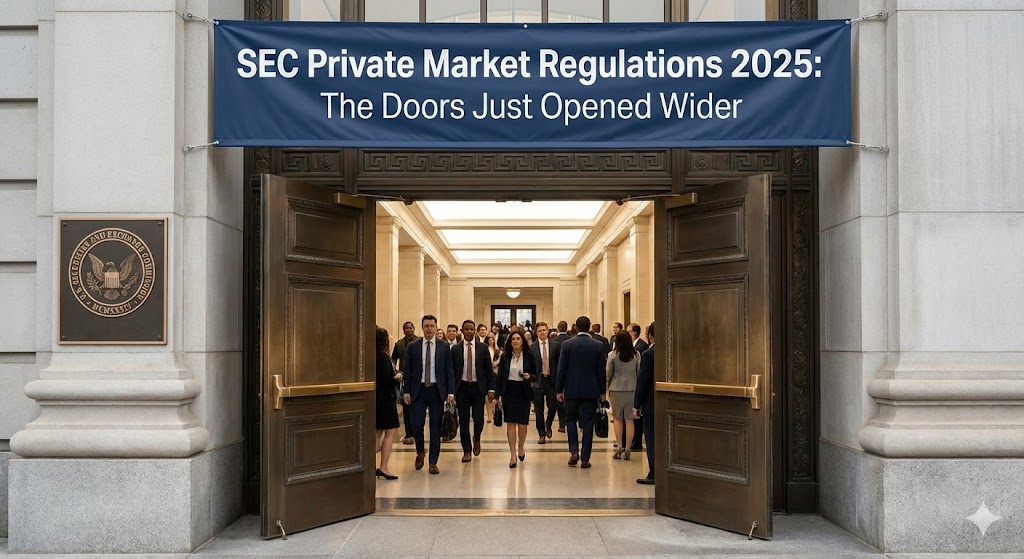
The March 12 Letter That Changed Everything
For twelve years, a single regulatory friction point kept private markets marketing in the shadows. Fund managers could raise unlimited capital from accredited investors, but they couldn’t advertise. The moment they ran an ad, sent a mass email, or posted on social media, verification requirements became so burdensome that most managers simply avoided public outreach entirely.
Then on March 12, 2025, the SEC’s Division of Corporation Finance issued a no-action letter that effectively removed that friction. The guidance confirmed that fund managers can now verify accredited investor status through self-certification paired with minimum investment thresholds—$200,000 for individuals, $1 million for entities. Tax returns are no longer required. Bank statements became unnecessary. The invasive documentation that made sophisticated investors uncomfortable and managers hesitant simply vanished from the process.
This wasn’t the only shift. Chair Paul Atkins announced plans to eliminate a 23-year-old policy restricting closed-end fund investments in private markets. Congress advanced bipartisan legislation to expand who qualifies as an accredited investor based on knowledge rather than just wealth. The SEC withdrew fourteen proposed rules from the prior administration, signaling a philosophical pivot toward capital formation over regulatory prescription.
For investors and fund managers operating in private markets, 2025 represents the most significant regulatory liberalization since the JOBS Act. Here’s what changed, what it means, and how to position accordingly.
Rule 506(c) Finally Becomes Usable
Understanding the March 12 guidance requires context on why Rule 506(c) existed but nobody used it.
When Congress passed the JOBS Act in 2012, Section 201 directed the SEC to lift the prohibition on general solicitation in private offerings. The resulting Rule 506(c), adopted in 2013, allowed issuers to advertise private placements publicly—but required them to take “reasonable steps” to verify that all purchasers were accredited investors.
The verification requirement created a fatal problem. The SEC’s non-exclusive list of acceptable verification methods included reviewing two years of tax returns, obtaining bank statements or brokerage records, and securing written confirmations from attorneys or accountants. These procedures were invasive for investors and expensive for issuers. Most sophisticated investors refused to provide sensitive financial documentation just to participate in a fund. As a result, between July 2020 and June 2021, issuers raised approximately $1.9 trillion under Rule 506(b) but only $124 billion under Rule 506(c). The rule that was supposed to democratize access remained essentially unused.
The March 2025 no-action letter solved this by establishing a practical verification pathway. If an issuer requires a minimum investment of $200,000 for individuals or $1 million for entities, and obtains written self-certification that the investor is accredited and the investment isn’t third-party financed, that satisfies the “reasonable steps” requirement. No tax returns. No bank statements. Just commitment size and representation.
The logic is straightforward: if someone can write a $200,000 check without third-party financing, they’re almost certainly accredited. The verification burden was preventing legitimate marketing without meaningfully protecting anyone. Now that burden is removed for offerings meeting the thresholds.
What This Means for Fund Managers
The practical implications for private fund sponsors are substantial.
Marketing becomes permissible. Fund managers can now post about offerings on LinkedIn, run targeted advertising, host public webinars, and send broad email campaigns. The historical prohibition on general solicitation under 506(b) forced managers to rely on existing networks and warm introductions. Rule 506(c) with simplified verification allows genuine marketing for the first time.
Emerging managers gain advantage. Established funds with deep LP networks had little reason to advertise—their relationships provided sufficient capital. Emerging managers without those networks faced a cold-start problem: they couldn’t reach new investors at scale. The 506(c) changes level this playing field somewhat, allowing new managers to build LP bases through direct outreach rather than purely through relationship leverage.
Minimum investment thresholds matter. The $200,000 individual threshold creates practical implications. SPVs and syndicates with lower minimums—common in angel investing platforms—don’t qualify for simplified verification. They’ll need to either raise minimums or continue with traditional verification methods. Fund managers already requiring $200,000+ commitments can immediately benefit from the new guidance.
Documentation requirements persist. The no-action letter doesn’t eliminate paperwork. Issuers must still obtain written self-certification, confirm investments aren’t third-party financed, and maintain records demonstrating compliance. The burden reduced, but compliance obligations remain. Managers should update subscription agreements to include required representations.
Marketing Rule compliance continues. Registered investment advisers must still comply with the SEC Marketing Rule, which restricts advertising using hypothetical performance, testimonials, and other potentially misleading content. The 506(c) changes permit outreach but don’t override content restrictions. Managers should ensure marketing materials satisfy both Regulation D and Advisers Act requirements.
The Closed-End Fund Revolution
Perhaps even more significant than the 506(c) changes, Chair Atkins announced plans to eliminate informal restrictions that have prevented retail investors from accessing private markets through registered funds for over two decades.
Since 2002, SEC staff had required closed-end funds investing more than 15% of assets in private funds to restrict sales to accredited investors and impose minimum investments of $25,000. This wasn’t a formal rule—it was a staff position enforced through the registration review process. But the practical effect was to wall off private equity, venture capital, and hedge fund exposure from ordinary investors.
At the May 2025 SEC Speaks conference, Chair Atkins called for ending this “23-year-old practice,” framing the change as “common-sense” that would balance financial innovation with investor protection. Division of Investment Management Director Natasha Greiner confirmed shortly after that SEC staff would no longer impose these restrictions during registration reviews.
In August 2025, the Division formalized this through ADI 2025-16, officially eliminating the accredited investor and minimum investment requirements for closed-end funds investing in private markets.
Why this matters: Retail investors can now potentially access private equity, venture capital, and credit strategies through registered closed-end funds without meeting accredited investor thresholds. The funds remain subject to Investment Company Act protections—board oversight, adviser fiduciary duties, leverage limits, and disclosure requirements—but the wealth gate has been removed.
For family offices and HNW investors already deploying into private markets directly, this creates competition. Capital that previously could only access private strategies through direct fund commitments may now flow through registered vehicles with lower barriers, different liquidity terms, and simplified tax treatment. The structural advantages of direct private fund investment—particularly around fees and access to top-tier managers—remain, but the exclusivity has diminished.
Accredited Investor Expansion: Congress Gets Involved
While the SEC implemented administrative changes, Congress pursued legislative expansion of who qualifies as an accredited investor in the first place.
Currently, individual accredited investor status requires either $200,000 annual income ($300,000 joint) for two consecutive years, or $1 million net worth excluding primary residence. Only about 19% of U.S. households qualify under these thresholds, according to SEC estimates. The definition effectively restricts private market participation to the already wealthy.
In June 2025, the House passed the Fair Investment Opportunities for Professional Experts Act (H.R. 3394) by a bipartisan 397-12 vote. The legislation directs the SEC to expand the accredited investor definition to include individuals with “demonstrable education or job experience” related to private market investing. Practically, this means professionals with relevant credentials—licensed brokers, securities lawyers, financial advisors—could qualify regardless of personal wealth.
Separately, the House approved the Equal Opportunity for All Investors Act, directing the SEC to create a test that individuals can pass to qualify as accredited investors without regard to income or net worth. This competency-based approach would allow sophisticated-but-not-wealthy investors to access private markets by demonstrating understanding of the risks.
Both bills now await Senate consideration. If enacted, they would represent the most significant expansion of the accredited investor definition since its creation. For existing accredited investors, the practical impact is more competition for allocation in desirable deals. For fund managers, it means a larger addressable market of potential LPs.
The Rule Withdrawals: What Isn’t Happening
Understanding what the SEC chose not to do reveals as much as understanding what changed.
In June 2025, the SEC formally withdrew fourteen proposed rules from the prior administration. Among them: mandated ESG disclosure requirements, cybersecurity incident reporting rules, and enhanced private fund adviser regulations that would have imposed quarterly statements, annual audits, and restrictions on certain fee arrangements.
The withdrawals signal a philosophical shift from prescriptive regulation toward principles-based oversight. Chair Atkins has suggested the SEC will focus less on rulemaking and more on enforcement of existing anti-fraud provisions. For private fund managers, this means reduced prospective compliance burden but maintained accountability for accurate disclosure and fair dealing.
However, the underlying risks these rules addressed—cybersecurity vulnerabilities, fee transparency concerns, and ESG substantiation—haven’t disappeared. They’ve shifted from regulatory mandates to market expectations. Institutional LPs increasingly require cybersecurity documentation, detailed fee disclosure, and ESG reporting regardless of SEC requirements. The compliance burden may be similar in practice, just enforced by capital allocators rather than regulators.
Practical Positioning for 2025 and Beyond
The regulatory shifts create both opportunities and adjustments for participants across private markets.
For Fund Managers
Evaluate whether Rule 506(c) now makes sense for your offering. If you already require $200,000+ commitments from individuals, the simplified verification path removes the primary obstacle to public marketing. Update subscription documents to include required self-certification language. Develop marketing strategies that comply with both Regulation D and the Advisers Act Marketing Rule. Consider whether broader outreach could meaningfully expand your LP base.
For managers with lower minimums, the calculus is different. Either raise thresholds to benefit from simplified verification or continue operating under 506(b) with its traditional limitations. The hybrid approach—using 506(b) for existing relationships and 506(c) for new investor outreach—isn’t viable since offering exemption status can’t be changed retroactively once advertising occurs.
For Investors
Expect more outreach from fund managers previously constrained by marketing restrictions. Develop frameworks for evaluating solicitations that will become more common. The fact that a manager now advertises doesn’t make them better or worse than managers relying purely on relationships—but it does change how opportunities will reach you.
Monitor the closed-end fund space for new products providing private market access through registered structures. For investors not meeting current accredited thresholds, these vehicles may provide meaningful portfolio diversification previously unavailable. For accredited investors, compare terms carefully—registered fund structures carry different fee arrangements, liquidity provisions, and tax treatment than direct private fund commitments.
Watch Congressional action on accredited investor expansion. If knowledge-based qualification passes, it may affect deal dynamics as more investors become eligible for private offerings.
For Emerging Managers
The 506(c) changes specifically benefit managers building LP bases without established networks. Develop content marketing strategies, build public profiles, and create educational materials that demonstrate expertise. The ability to advertise means the ability to compete on insight rather than purely on relationships. Use this window while established managers haven’t yet adjusted their marketing approaches.
The Regulatory Direction Is Clear
The 2025 regulatory shifts share a common theme: expanding access to private markets while maintaining basic investor protections. Chair Atkins has framed this as removing paternalistic restrictions that prevented investors from making their own informed decisions about risk.
Whether this philosophy proves correct will emerge over time. Critics argue that private market risks justify access restrictions. Proponents counter that wealth-based gates prevent ordinary investors from participating in the asset class generating the highest returns over recent decades.
For practical purposes, the direction is clear. Private markets are becoming more accessible, while marketing restrictions loosen across the board. The definition of who can participate is expanding, and capital formation now takes priority over regulatory restriction.
Position accordingly. The doors just opened wider, and the capital flows are adjusting.
Go Deeper
- SPV Investing: The Complete Guide for Private Wealth — Master the structures now operating under simplified rules.
- Angel Syndicate Investing: Your Entry Point to Private Deals — How minimum investment thresholds affect syndicate operations.
- The Secondary Market Boom — How regulatory changes affect GP-led transactions.
- SPV Tax Strategies — 506(c) verification implications and K-1 compliance.
The Next Move
Regulatory shifts create windows. Position yourself before the market fully adjusts:
- Feature Inquiry — Profile your fund or platform for 50,000+ HNW readers navigating the new landscape
- Polo Hamptons — Where allocators meet operators. Sponsorship and attendance inquiries.
- The Insider Brief — Weekly intelligence on Hamptons wealth, deal flow, and regulatory developments
- Print Subscription — The magazine that’s already on their coffee table
- Support Independent Coverage ($5)
Author

Written by
Recent Posts
Where Can You Find the Best Made-to-Measure Bespoke Suits in NYC
The Financial Habits Every Successful Entrepreneur Swears By
What Happens If You Delay Hemorrhoid Treatment in New York City

James Franco Net Worth — A $30 Million Career Interrupted

Selena Gomez Net Worth — How a Disney Kid Built a $1.3 Billion Empire
Categories
- Art
- Articles
- Beauty & Skincare
- Celebrities
- Celebrities|Movies
- Celebrities|The Chronicles
- Chronicles
- Culture|Television
- Entertainment|Culture
- Event Photos
- Events
- Fashion
- Fashion & Style
- Featured
- Food & Beverage
- Food, Spirits, Wine
- Hamptons
- Hamptons Celebrities
- Hamptons Celebrities|Celebrities|The Chronicles
- Health
- Health & Beauty
- Lifestyle
- Luxury Lifestyle
- Movies
- Movies|Culture
- Movies|Hamptons Lifestyle
- Press
- Profiles
- Real Estate
- Technology
- The Chronicles
- Travel
- Uncategorized
- Weddings