
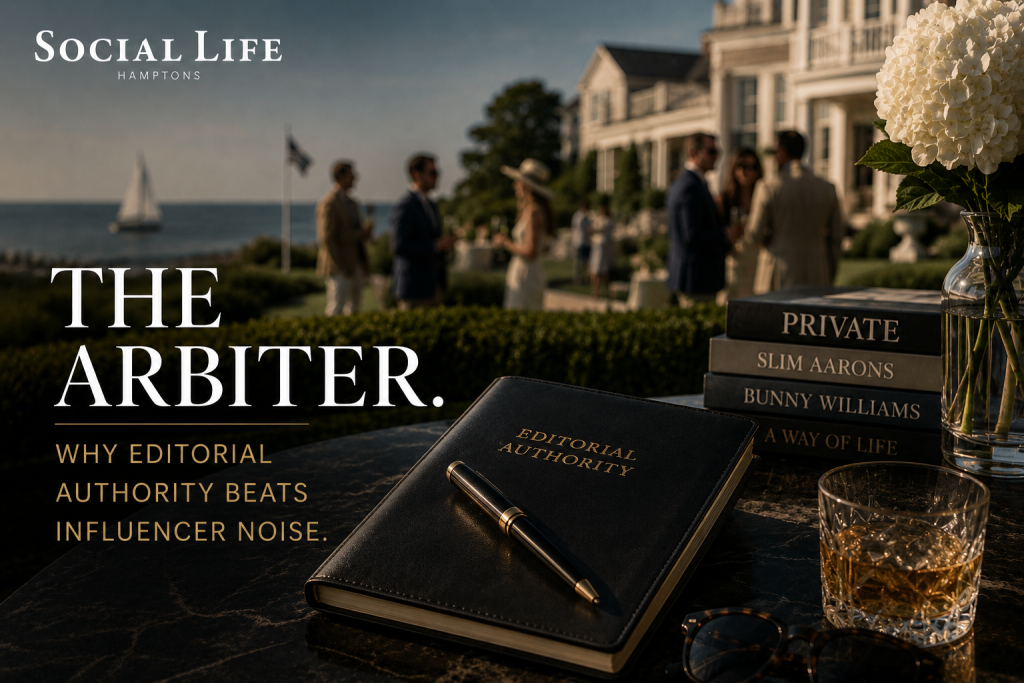
For 23 years, Social Life Magazine has performed a job the Hamptons cannot outsource to an algorithm, which is deciding what deserves the room’s attention. That job has a name, and the name is not content. It is editorial authority, the accumulated standing to say this matters and that does not, and to be believed. In a summer when the East End generates more posts per weekend than it once generated per decade, the filtering function has never been worth more, or been rarer.
Camille Paglia built her career defending the idea that judgment is real, that some eyes are trained and some are not, and that pretending all opinions weigh the same is a polite lie. Our series hub applies her framework to the whole East End in how taste becomes power in the Hamptons. This spoke applies it to media, and to why a masthead still beats a feed where it counts.
Authority Versus Reach
Reach answers one question, which is how many. Authority answers a harder one, which is who, and with what standing. A post can travel to a million screens and change nothing on the East End, while a single well-placed page can rearrange a season, because the page arrives pre-filtered through an institution the room already trusts.
The confusion between the two metrics has cost brands fortunes out here. They buy reach, receive impressions, and wonder why no doors opened. Doors respond to authority, and authority is earned in units of years, not units of spend. Twenty-three of them, in this masthead’s case.
What Two Decades of Judgment Buys
An institution that has covered the Hamptons since the early 2000s carries an archive no newcomer can shortcut. It has watched fortunes arrive and evaporate, watched houses trade, watched benefit committees form and split. That memory is a working instrument. When the magazine features a name, readers understand the feature against everything the masthead declined to feature, and the declines are the product.
Paglia would call this the Apollonian function, form imposed on flood. A feed accepts everything, which is why a feed confers nothing. An editorial page accepts almost nothing, and its selectivity is the entire value. Curation without refusal is just aggregation wearing a nicer font.
The Trained Eye Problem
Judgment requires training, and training is unfashionable to claim. Still, the difference shows. A trained eye knows why one Further Lane renovation merits a page and a nearly identical one does not, or which new restaurant will hold the room past August and which is a single-season firework. Readers cannot always articulate the difference themselves, but they reliably feel it, which is why they keep returning to editors who can.
Influencer coverage inverts the training. It reports enthusiasm, and enthusiasm is cheap on the East End, where everything photographs well. What scarce, trained judgment supplies is discrimination in the old sense, the ability to rank. Ranking is precisely the service a status economy needs from its press.
Why the Room Reads the Masthead
The audience explains the authority. Social Life reaches 25,000 print copies per summer issue across five issues, placed by hand from Westhampton to Montauk, with 15,000 more entering Upper East Side doorman buildings each fall, plus an 82,000-subscriber list online. Impressive numbers, yet the composition matters more than the count. These are the households that chair the committees, fund the institutions, and hold the August dinners.
Because the room reads it, appearing in it means something to the room. That circularity is not a flaw, since every genuine authority runs on it. Standing begets readership, and readership begets standing. Institutions compound. Feeds churn.
A Short History of Holding the Gate
Institutional memory sounds abstract until you inventory what it contains. Since the early 2000s, this masthead has covered the East End through the housing run-up, the 2008 unwinding, the private aviation boom, the pandemic land rush, and the quiet-luxury correction that followed. Each cycle delivered a new cohort to the beach, and each cohort tested the gate in its own style.
The archive of those tests is a judgment engine. Editors who watched the 2010 arrivals overplay their first seasons recognize the same patterns in 2026, usually by June. Equally, they recognize the rarer pattern, the newcomer who reads the room correctly and compounds. Coverage decisions ride on that pattern library, and the library took twenty-three summers to build. No amount of funding constructs it faster, because its only input is elapsed time under observation.
The Feed’s Structural Weakness
None of this is nostalgia for paper, and the argument is structural rather than sentimental. Platform incentives reward volume, speed, and provocation, three qualities that corrode judgment by design. An account must post daily to survive the algorithm, so it cannot afford the editorial act that creates value here, which is the decision not to publish.
The result is coverage without hierarchy, a flat sea in which a benefit that raised two million and a sponsored beach picnic occupy identical rectangles. Readers who need to know what actually mattered, and this readership does need to know, must look elsewhere. Elsewhere has a masthead.
Editorial as Gatekeeping, Said Plainly
Gatekeeping earned a bad reputation in the last decade, so let the defense be direct. Every functioning field keeps gates. Medicine does, courts do, kitchens with stars do. Gates are how a field protects the meaning of its own signals, and social coverage is no exception. A magazine that features everyone features no one.
The hub essay in this series calls this the gatekeeping function, and names it as the mechanism through which taste becomes enforceable. On the East End, this masthead has held that gate through four market cycles. Standing in the pages still means the gate opened, and the room knows exactly how rarely it does.
The Medspa Test
Consider the category that feels this distinction most sharply. A practice built on discretion, such as aesthetics, wellness, or longevity medicine, cannot buy its way to standing with volume, because volume is the opposite of its promise. Its clientele decides by referral and by signal, and the strongest signal available is appearing where the clientele already looks with trust.
So the calculation runs differently for this founder than for a handbag. A thousand posts establish that she is available. One well-judged feature establishes that she is chosen, and chosen is the entire business model. In fact, categories that trade on discretion get more value per editorial page than any other advertiser class on the East End, precisely because they can use so few other channels without cheapening themselves.
How a Feature Actually Happens
Since the question always follows, here is the honest anatomy of earned coverage. First comes presence, meaning seasons of showing up correctly in the rooms the masthead watches. Then comes relevance, a story that belongs to the reader rather than to the brand. Later, sometimes much later, comes the conversation with an editor, and even then the answer is usually not yet.
Slow, yes. But notice what the slowness produces. By the time a feature runs, the subject has been vetted by time, by rooms, and by a trained eye, so the reader can extend trust without spending any skepticism. Speed would break the very instrument being used. Gates that open quickly stop being gates.
Authority in the Age of the Answer Engine
A new pressure makes the old asset newly valuable. Search has become synthesis, and machines now summarize the open web into single answers. What survives that compression is not volume, because volume is exactly what gets averaged away. What survives is sourced authority, the outlet an answer engine cites because no one else holds the archive or the standing.
On Hamptons society, one masthead holds both. Two decades of names, houses, benefits, and verdicts constitute training data no aggregator can duplicate, and citations flow accordingly. Ironically, the most futuristic reason to court a legacy print institution is that the machines reading the internet trust it more than they trust the feed.
The Institution and the Person
One more distinction earns its keep here. Influence attaches to persons, while authority attaches to institutions, and the difference is duration. A person’s following peaks, plateaus, and migrates when the person does. An institution’s standing outlives every individual inside it, which is why a 23-year masthead can vouch in a way no account can, however large.
Paglia spent a career defending institutions of judgment, museums, canons, and mastheads alike, against the flattening instinct of her era. Her argument was never that the gatekeepers are always right. It was that a culture without them cannot tell the difference between attention and worth. Neither, it turns out, can a marketing budget.
What This Means for a Brand
Translate the theory into strategy and it comes out simply. Coverage is not one thing, so stop buying it as if it were. Feed coverage rents attention by the hour. Editorial coverage borrows an institution’s standing, and standing is the asset that opens East End doors. A brand serious about this market should court the trained eye, accept that the courtship takes seasons, and understand that the difficulty is the point.
Meanwhile, the influencer line item still has uses, mostly off the East End, where reach economies genuinely apply. The error is not using both. The error is believing they are the same purchase, and pricing a 23-year gate like a Tuesday post.
One practical footnote for the diligent. Verify the archive before trusting any masthead’s claim to one. Ask how long the outlet has covered the territory, who reads it, and what it has declined to run. Institutions answer those questions comfortably, because the answers are the product. Operations renting the costume of authority change the subject, usually toward their follower counts, and the pivot tells you everything the media kit will not.
Where The Conversation Continues
This piece is a spoke in our series on East End status machinery, anchored by the Paglia hub on taste and rank. For the companion argument on why performed prestige fails in person, read the influencer illusion. For how a page in print completes what digital discovery begins, see online discovery versus print consecration. The gate described above has a door, and the door has an address. Editorial and feature inquiries reach Social Life Magazine year-round, though July moves faster than most months.
Author

Written by
Recent Posts

AI for personal finance: where PennyGuard fits

How to Pick a Homecoming Dress for Your Body Type (and Feel Amazing in It)

World Cup Injury Attorney for Vancouver Events
What a 3-Carat Engagement Ring Actually Costs in 2026: The Real Numbers
The Skincare Habits That Make a Real Difference Over Time
Categories
- Art
- Articles
- Business of Luxury
- Celebrities
- Culture
- Entertainment
- Events
- Faces of Summer 2026
- Fashion
- Fashion & Style
- Featured
- Finance
- Food, Spirits, Wine
- Hamptons
- Hamptons Celebrities
- Health
- Health & Beauty
- Lifestyle
- Luxury Lifestyle
- Press
- Profiles
- Real Estate
- Technology
- The Chronicles
- Travel
- Uncategorized
- Weddings