
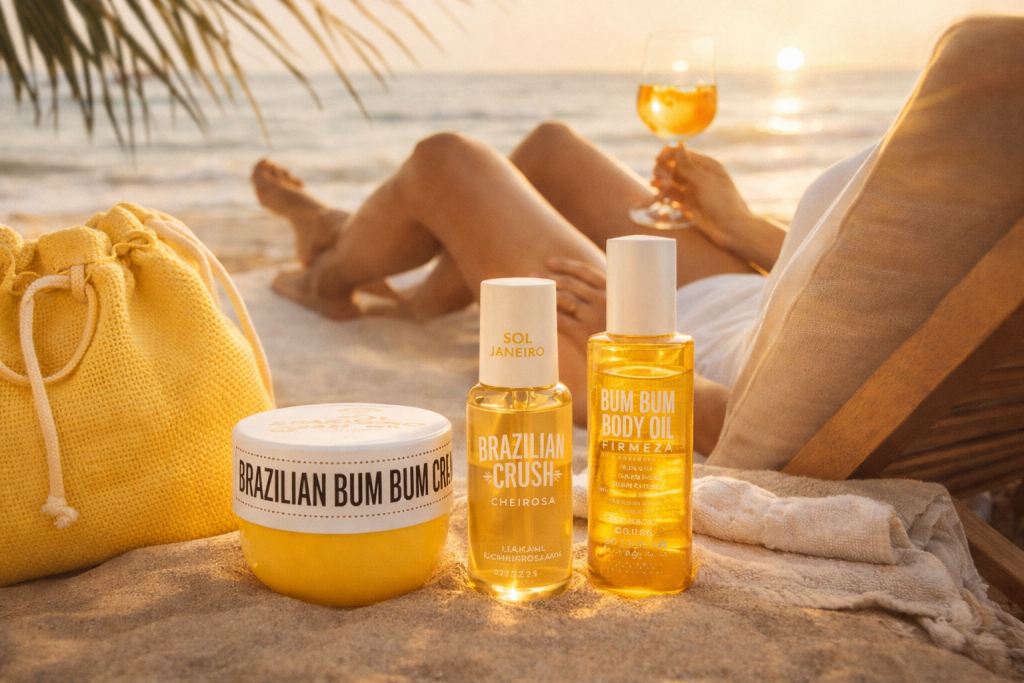

Heela Yang was pregnant, barefoot, and terrified on Copacabana Beach. It was 2008. Just weeks earlier, she had left behind a thriving corporate career in New York to follow her husband to Brazil. Meanwhile, her body was changing in ways she couldn’t control. Standing on the sand in a tiny Brazilian bikini, she felt exposed and self-conscious.
Then something shifted. The women around her weren’t hiding or apologizing for their curves, their cellulite, their imperfections. Instead, they were rubbing creams and oils onto their skin with an almost ceremonial joy. Laughter filled the air. Life was happening without apology. Remarkably, nobody cared that Yang was pregnant or Asian or pale. In that moment, she decided to bottle that feeling.
Seventeen years later, Sol De Janeiro sells one jar of its signature Bum Bum Cream every four seconds. Notably, the brand hit $1.35 billion in global retail sales in 2023. Celebrities like Blake Lively, Dua Lipa, and Selena Gomez swear by it. Furthermore, if you’ve spent any time on a Hamptons beach this summer, you’ve almost certainly caught its unmistakable scent of pistachio, salted caramel, and Brazilian sunshine.
The Immigrant’s Daughter Who Built a Beauty Empire
Before Sol De Janeiro, before Harvard Business School, before the corner office at Lancôme, Heela Yang was a child caught in political exile. Born in Seoul, Korea, she watched her world collapse when her father, a prominent politician, refused to cooperate with the military regime. Consequently, he was blacklisted, and the family’s comfortable life evaporated overnight.
In 1981, her father fled to the United States. Heela and her mother followed a year later, arriving in a country where their education meant nothing and their social networks had vanished. According to the Paul & Daisy Soros Fellowship, the family rebuilt their lives from scratch. The wound of displacement never fully healed.
Naturally, Yang excelled academically because that’s what immigrant children do. They convert parental sacrifice into achievement. First, she graduated magna cum laude from Harvard College, then earned a master’s from Yale, and later returned to Harvard for her MBA. Subsequently, she spent years at Goldman Sachs and climbed the beauty industry ladder at Lancôme and Clinique. By every traditional measure, she had made it.
Yet something was missing. “Many of us have experienced moments in life where we thought we had it all figured out,” Yang told Tatler, “only to have our plans turned completely upside down.”

How Brazilian Beach Culture Changed Everything
When Yang moved to Brazil with her husband in 2008, she expected culture shock. However, she didn’t expect a complete rewiring of how she thought about beauty. In the United States, beauty was about fixing flaws. By contrast, in Brazil, beauty was about celebration. The difference was profound.
“People were rubbing creams and oils on their bodies and hair, then jumping in the ocean and rubbing on something else,” Yang told MECCA. “There was music and food, and no one cared that I was pregnant or Asian with pale skin.” This wasn’t polite tolerance. It was genuine indifference to the things American beauty culture obsesses over.
The insight that would eventually become Sol De Janeiro crystallized in those months. Clearly, Brazilians didn’t have better bodies than Americans. Rather, they simply had better relationships with their bodies. The beach wasn’t a place to hide imperfections. Instead, it was a place to honor yourself, exactly as you were.
Meanwhile, Yang noticed something else entirely. Brazilian women were obsessed with body care in ways American women weren’t. Specifically, they had entire rituals devoted to their skin from the neck down. Moreover, the products were sensory experiences, not functional afterthoughts. Surprisingly, this category barely existed in prestige American beauty.
Sol De Janeiro Bum Bum Cream Becomes a Phenomenon
In 2015, Yang and her co-founders Marc Capra and Camila Pierotti launched Sol De Janeiro with just three products. Admittedly, the timing was audacious. After all, premium body care was essentially a non-category. When they pitched to retailers, one buyer told them bluntly, “We don’t know what to do with you guys.”
Then she added something that changed their trajectory: “I think Sephora might be really into you.”
Remarkably, she was right. Sephora gave Sol De Janeiro a chance, and the brand exploded. The Brazilian Bum Bum Cream became a viral sensation long before TikTok made that phrase cliché. Essentially, customers weren’t just buying a moisturizer. They were buying a feeling, buying permission to celebrate their own bodies.
Importantly, the scent was revolutionary. While most prestige creams used safe, forgettable fragrances, Sol De Janeiro went with something almost edible: pistachio, salted caramel, a warm vanilla base. The brand called it Cheirosa 62, Portuguese for “smells delicious.” Notably, the number referenced 1962, when Brazilian culture burst onto the global stage with Bossa Nova at Carnegie Hall and “The Girl from Ipanema.”
Why Sol De Janeiro Conquered the Hamptons
East End tastemakers discovered Sol De Janeiro around 2019, and subsequently the brand spread through the Hamptons like wildfire through beach grass. The reasons are obvious once you understand the product’s DNA. Essentially, this is a brand built for women who have spent their lives achieving, women who needed permission to simply enjoy themselves.
The Sol De Janeiro Hamptons connection goes deeper than demographics. Specifically, the East End attracts people who have worked obsessively to create beautiful lives. Many of them spent decades postponing pleasure for success. Consequently, they understand, perhaps better than anyone, the revolutionary act of slowing down to take care of yourself.
Indeed, walk into any high-end bathroom from Montauk to Southampton and you’ll find that distinctive gold-lidded jar. Interestingly, the scent has become a kind of insider signal. When you catch it on someone at a polo match or a benefit gala, there’s an instant recognition. “Oh, you’re one of us.”
According to Glossy, the brand’s digital business tripled during the pandemic, and that growth hasn’t slowed. Summer 2024 saw Sol De Janeiro expand into suncare with Sofia Richie, capturing another slice of the Hamptons market.

The Celebrity Endorsements That Weren’t Paid For
Here’s what makes Sol De Janeiro different from most “celebrity-loved” brands: the endorsements are real. For instance, Blake Lively lists the Bum Bum Cream on her Amazon storefront. Similarly, Dua Lipa has mentioned it in interviews, while Hilary Duff reportedly can’t live without it. Crucially, these aren’t sponsored posts. These are women who actually use the product.
Ultimately, that authenticity matters in a market saturated with paid partnerships. When someone spots the Bum Bum Cream in a celebrity’s bathroom selfie, it carries weight. In other words, it means this product actually works and actually smells as good as everyone claims.
Additionally, the brand has mastered TikTok in ways that feel organic rather than desperate. According to Highsnobiety, Sol De Janeiro became “TikTok’s favorite fragrance brand” through genuine user enthusiasm rather than influencer budgets. Evidently, the iconic Cheirosa mists went viral because people genuinely wanted to share them.
Surprisingly, even the occasional controversy fueled growth. In December 2023, a viral claim suggested the cream attracted spiders because it contained pheromones. Although the brand clarified this wasn’t true, the bizarre theory only amplified awareness. Sometimes the algorithm rewards absurdity.
From $450 Million Valuation to Billion-Dollar Brand
In 2021, L’Occitane Group acquired an 83% stake in Sol De Janeiro, valuing the company at $450 million. Since then, growth has been exponential. Currently, the brand represents nearly a third of L’Occitane’s total revenue. Remarkably, it grew 184% in the last fiscal year alone.
Fast Company named Sol De Janeiro to its 2024 list of Most Innovative Companies. Likewise, TIME100 included it among the Most Influential Companies. Incredibly, the little brand that started in Heela Yang’s dining room now sells products in over 30 countries.
Nevertheless, the founding philosophy remains unchanged. “In Brazil, beautiful isn’t a standard to achieve,” co-founder Camila Pierotti told interviewers. “It’s a feeling. Feeling comfortable in your own skin and feeling happy in your own skin.” Clearly, that message resonates with women who’ve spent lifetimes chasing external validation.
Accordingly, the product line has expanded thoughtfully. Shower gels, body mists, lip balms, and sunscreens all carry the brand’s signature sensory experience. Predictably, each new launch sells out quickly, and the waiting lists are real.
What Sol De Janeiro Means for Hamptons Beauty Culture
Undoubtedly, the rise of Sol De Janeiro signals something larger about how Hamptons women relate to self-care. For decades, East End beauty meant minimalism: understated, almost apologetic. Traditionally, you weren’t supposed to look like you were trying.
Yet Sol De Janeiro breaks that code entirely. This is unapologetic sensory pleasure, gold-lidded jars, tropical scents, and products named after body parts. Admittedly, it’s almost camp. And that’s precisely why it works.
Fundamentally, the brand gives sophisticated women permission to enjoy themselves without irony. After all, you can be a serious person who built a serious career and still take genuine pleasure in how your skin smells after a shower. These things aren’t contradictions; rather, they’re components of a well-lived life.
Heela Yang understood this because she lived it. For years, she worked in corporate beauty, creating products for other people’s visions. However, when she finally built something for herself, joy became the foundation. Warmth infused every detail. Brazilian spirit flowed through every product.
The Wound That Became a Gift
Consider Yang’s story carefully. A child of political exile. An immigrant who watched her parents rebuild everything from nothing. A woman who achieved conventionally and still felt unfulfilled. Then came a pregnancy that made her feel foreign in her own body. And finally, Brazilian women showed her another way.
Ultimately, every jar of Bum Bum Cream contains that journey. Certainly, the pistachio-caramel scent is escapism. But it’s also integration, the fusion of Korean-American achievement culture with Brazilian body acceptance. It’s what happens when an outsider sees something beautiful in another culture and brings it home.
Today, Yang still runs the company as CEO. Interestingly, she still talks about her mother’s Korean skincare rituals in the same breath as Brazilian beach culture. She understands that the best beauty brands don’t just sell products; instead, they sell permission. Permission to take up space, to smell delicious, to celebrate every curve, every fold, every truth.
That’s what you’re really buying when you twist open that gold lid. That’s what lingers on your skin after a day at Cooper’s Beach. Essentially, it’s the feeling Heela Yang discovered pregnant and barefoot on Copacabana, now packaged in a jar. The feeling that you’re exactly enough, exactly as you are.
Get the Inside Story
Feature Your Hamptons Brand or Property: Contact Social Life Magazine — We connect luxury beauty and lifestyle brands with the audiences that matter.
Polo Hamptons VIP Experiences & Brand Partnerships: Explore Polo Hamptons — Where tastemakers and brands converge for unforgettable summer moments.
Join the Hamptons Insider List: Get Our Newsletter — Beauty trends, product launches, and summer social coverage before anyone else.
Social Life Magazine Subscription: Subscribe Now — 23 years of Hamptons authority, delivered to your door.
Support Independent Hamptons Coverage: Donate $5 — Keep the real stories coming.
Related Stories
Search Social Life Magazine for more beauty coverage, lifestyle trends, and summer essentials for the East End.
Hamptons Summer Beauty Essentials: Sol De Janeiro
The Best Spas in the Hamptons for Ultimate Relaxation
Celebrity Hamptons Style: What the A-List Do Out East
Author

Written by
Recent Posts

James Franco Net Worth — A $30 Million Career Interrupted

Selena Gomez Net Worth — How a Disney Kid Built a $1.3 Billion Empire

Spring Breakers A24 Cast Net Worth — Disney Kids Gone Dangerous

Women’s History Month
Must-Have Items for Your Wedding Gift Registry
Categories
- Art
- Articles
- Beauty & Skincare
- Celebrities
- Celebrities|Movies
- Celebrities|The Chronicles
- Chronicles
- Culture|Television
- Entertainment|Culture
- Event Photos
- Events
- Fashion
- Fashion & Style
- Featured
- Food & Beverage
- Food, Spirits, Wine
- Hamptons
- Hamptons Celebrities
- Hamptons Celebrities|Celebrities|The Chronicles
- Health
- Health & Beauty
- Lifestyle
- Luxury Lifestyle
- Movies
- Movies|Culture
- Movies|Hamptons Lifestyle
- Press
- Profiles
- Real Estate
- Technology
- The Chronicles
- Travel
- Uncategorized
- Weddings