
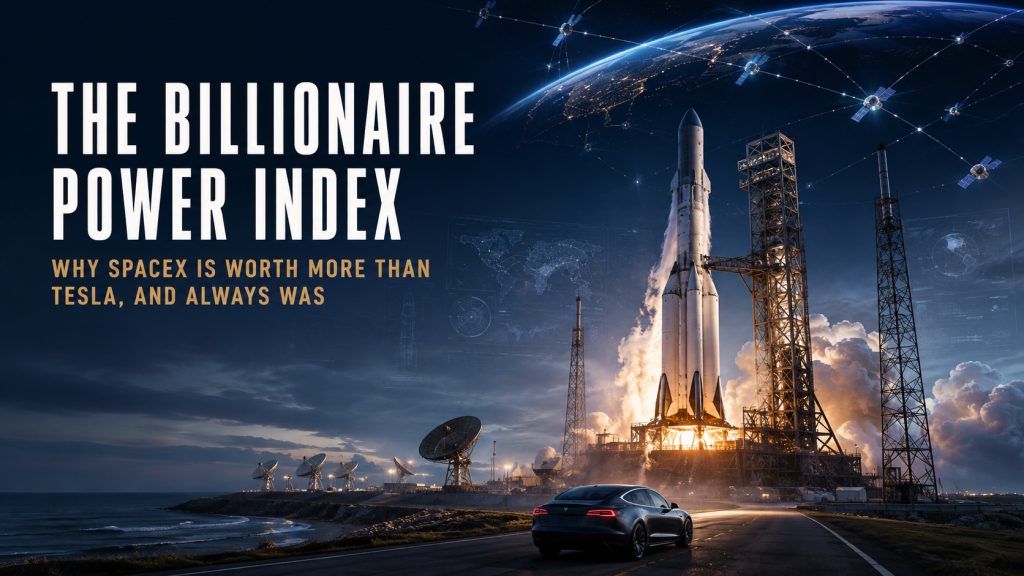
For fifteen years the argument was theoretical, because only one of Musk’s companies had a share price. Now both do, and so the market has finally ruled.
SpaceX closed Friday, August 14, at $140.00 a share, a market capitalization of $1.844 trillion. Tesla, by contrast, closed at $342.27, worth $1.352 trillion. The SpaceX valuation currently sits about 36% above the car company that made Musk famous.
Eighth most valuable company on earth, roughly two months after listing.
Yet the interesting part is not that SpaceX won. It is what SpaceX had to become in order to win, because the business trading at $1.8 trillion is no longer primarily a rocket company.
What the SpaceX Valuation Is Actually Pricing
Second-quarter results, reported August 4, split cleanly into three segments. Read them side by side and the thesis reveals itself.
Connectivity delivered $4.29 billion of revenue and $1.66 billion of operating income, a 38.6% operating margin. Starlink now serves 12 million subscribers across 167 markets, having added a record 1.7 million in the quarter. Enterprise and government revenue, notably, doubled to $1.8 billion.
AI, meaning the absorbed xAI business, delivered $2.56 billion of revenue, up 247%, against an operating loss of $1.26 billion. Compute capacity, meanwhile, grew from 0.4 gigawatts to 1.4.
Space, the actual rockets, delivered $962 million and lost $542 million at the operating line, with about $1.1 billion of research spending going mostly to Starship.
Total revenue reached $7.81 billion, up 92%, beating consensus by nearly a billion dollars. Backlog, in addition, stands at $47.5 billion.
So Starlink funds everything. Launch loses money, AI loses more money, and a satellite broadband subscription business pays for both. Anyone buying this stock is buying a broadband utility that is financing an AI bet, with a rocket company attached.
Tesla’s Problem Is Not Growth
Tesla had a genuinely good quarter, which makes the comparison more instructive rather than less.
Revenue hit $28.24 billion, up 26%, an all-time record and the first real growth in over a year. Deliveries reached 480,126, also a record. Energy storage also climbed to 13.5 gigawatt-hours.
Margins, though, tell the other story. Automotive gross margin excluding credits fell to 16.3% from 19.2% one quarter earlier. Operating income, however, came in at $398 million, an operating margin of just 1.4%. Adjusted earnings of $0.33 missed expectations by roughly a third.
Capital spending jumped 142% to $5.79 billion, and free cash flow turned negative for the first time since early 2024. Full-year capex guidance now exceeds $25 billion.
Context matters here. Tesla’s 2025 revenue of $94.8 billion was a 3% decline, the first annual drop in company history, and deliveries fell 9% for a second straight yearly decrease. BYD outsold Tesla on battery-electric vehicles again in the second quarter, 557,090 to 480,126.
Growth returned. Pricing power did not.
Why SpaceX Was Always the Better Asset
Strip away the share prices and compare the businesses structurally.
Tesla competes. Roughly a dozen serious manufacturers build electric cars, Chinese producers build them cheaply, and every price cut lands directly on gross margin. Cars are a competitive industry with capital intensity and no moat that lasts a decade.
SpaceX largely does not compete. It flew 165 Falcon 9 missions in 2025, about 51% of all orbital launches worldwide and roughly 85% of every satellite put into space that year. Its main rival’s rocket has been grounded since February, and the other rival’s rocket exploded in May.
Starlink faces a similar imbalance. Amazon Leo had 396 satellites in orbit by July against roughly 10,400 for Starlink, a gap of about 26 times.
Government revenue widens the difference further. National Security Space Launch Phase 3 now carries a ceiling near $30 billion, and SpaceX has won every Lane 1 task order awarded. Our breakdown of how deep the Pentagon relationship runs covers the full ledger.
One company sells a consumer product into a crowded market. The other sells infrastructure into a market where the buyer has no realistic second option. Those are different asset classes wearing the same founder.
The Starlink Engine Underneath It All
Zoom out to full years and the dependency inside this company becomes unmistakable.
SpaceX generated $18.7 billion of revenue in 2025, up 43%. Starlink contributed $11.4 billion of that, growing 48%, while launch services added $4.1 billion on 8% growth. So the broadband division was already the company by the end of last year.
Profitability follows the same line. Starlink produced roughly $4.4 billion of operating profit in 2025, the only segment in the black. Adjusted EBITDA for the whole company reached $6.6 billion, yet the GAAP result was a net loss of $4.9 billion once capital spending, stock compensation and merger costs landed.
Average revenue per user is the metric to watch. It has fallen to about $66 a month from roughly $85, because growth now comes from cheaper markets rather than affluent ones. Subscriber counts rise while unit economics soften, which is the classic scaling tradeoff.
Still, a 38.6% operating margin on a subscription business with 12 million customers and no serious competitor is a rare thing to own. Investors are effectively buying that annuity and accepting the losses attached to everything else.
The Bear Case Deserves a Fair Hearing
Nothing above makes the SpaceX valuation cheap, and the stock’s own trading tells you the market is unconvinced.
Shares spent much of August below the $135 IPO price, touching $108 at one point. That happened after a revenue and earnings beat, which is unusual and worth understanding.
Capital spending is the reason. Second-quarter capex hit $18.37 billion against roughly $13.2 billion expected, and $15.83 billion of that went to AI compute. First-half free cash flow ran to approximately negative $25 billion. Full-year capex guidance now exceeds $45 billion.
Analysts split accordingly. Consensus sits near $231, with Morgan Stanley overweight at $300 and a bull case of $600 that implies roughly $8 trillion. InvestingPro, by contrast, pegs fair value at $111 and notes the stock trades near 49 times expected revenue.
The lockup added pressure. On August 6 roughly 911.5 million shares became eligible for sale in staged tranches, about $99 billion of potential supply against a small public float.
So the honest framing is this. SpaceX is the better business. Whether $1.844 trillion is the right price for it is a completely separate question, and the market is currently arguing about the answer in public.
What This Means for Musk
Follow the personal balance sheet and the shift becomes obvious. Most of the SpaceX valuation is now his own net worth.
Musk holds roughly 38% of SpaceX and about 11% of Tesla, and Forbes put his net worth at $864.2 billion in mid-August, first in the world. The bulk of that fortune now sits in the space company rather than the car company.
His Tesla compensation package, approved in November 2025 and worth up to a trillion dollars, requires Tesla to reach an $8.5 trillion market capitalization. From $1.352 trillion that is roughly a sixfold climb.
Meanwhile the SpaceX structure gives him something Tesla never did. Class B shares carry ten votes each, he controls about 93.6% of them, and he holds more than 80% of total voting power. Nasdaq classifies the company as controlled, which we examine in who owns Starlink and who actually controls it.
Merger chatter followed naturally. Musk declined to rule out combining the two companies on Tesla’s July call, and Gene Munster of Deepwater puts the odds of an eventual combination at 90%.
What a Merger Would Mean
Speculation about combining the two companies is no longer idle, so treat it seriously.
Musk declined to rule out a Tesla and SpaceX merger on Tesla’s July call, citing overlap in batteries, manufacturing and AI chips. Gene Munster of Deepwater puts the odds of an eventual combination at 90%, while JPMorgan flags Chinese regulatory exposure and governance conflicts as real obstacles.
Logic exists on both sides. Tesla brings mass manufacturing, an energy storage business growing 26% and a robotaxi program that needs enormous compute. SpaceX brings the AI cluster, the satellite network and a balance sheet holding roughly $100 billion after the listing and a $25 billion bond sale.
Shareholders would face a harder question. Tesla’s single-class structure gives holders real votes, whereas the SpaceX arrangement does not. Merging the two almost certainly means Tesla investors trading governance for exposure.
Whether that trade is worth taking depends entirely on how much you believe the AI thesis. Certainly the market has not settled it.
The Status Reading
Strip the SpaceX valuation down to what it really represents and a status question appears. Tesla made Musk famous, rich and culturally enormous. Every valet in East Hampton knows what a Model S is.
SpaceX made him something else entirely. Fame is economic and cultural capital, and both are perfectly nice to have. Being the company a government cannot replace is a different form of capital, and until June it was not for sale at any price.
That is the quiet reason this listing mattered. A car company is a consumer brand, so its value rises and falls with taste, tariffs and interest rates. A launch monopoly with a satellite network and a classified defense arm is closer to a toll road that happens to orbit.
Our Billionaire Power Index scores the men accumulating exactly that kind of position, and the ranking looks nothing like the wealth lists already in circulation.
Where The Conversation Continues
Social Life Magazine covers the people who own the systems, not merely the people who own the houses. Our summer issue reaches 25,000 in print across the East End, plus 82,000 on the list.
Every July the Polo Hamptons lawn assembles the founders and allocators who read earnings releases for pleasure. If your brand belongs beside them, the conversation starts here.
Author

Written by
Recent Posts
How to Reduce Frown Lines: Treatments, Habits, and Long-Term Strategies

French Heritage Society
The Rise of Premium Supplement Brands

Manocha Bespoke

5 Ways To Make Money From Items You Already Own
Categories
- Art
- Articles
- Business of Luxury
- Celebrities
- Culture
- Entertainment
- Events
- Faces of Summer 2026
- Fashion
- Fashion & Style
- Featured
- Finance
- Food, Spirits, Wine
- Hamptons
- Hamptons Celebrities
- Health
- Health & Beauty
- Lifestyle
- Luxury Lifestyle
- Press
- Profiles
- Real Estate
- Technology
- The Chronicles
- Travel
- Uncategorized
- Weddings