
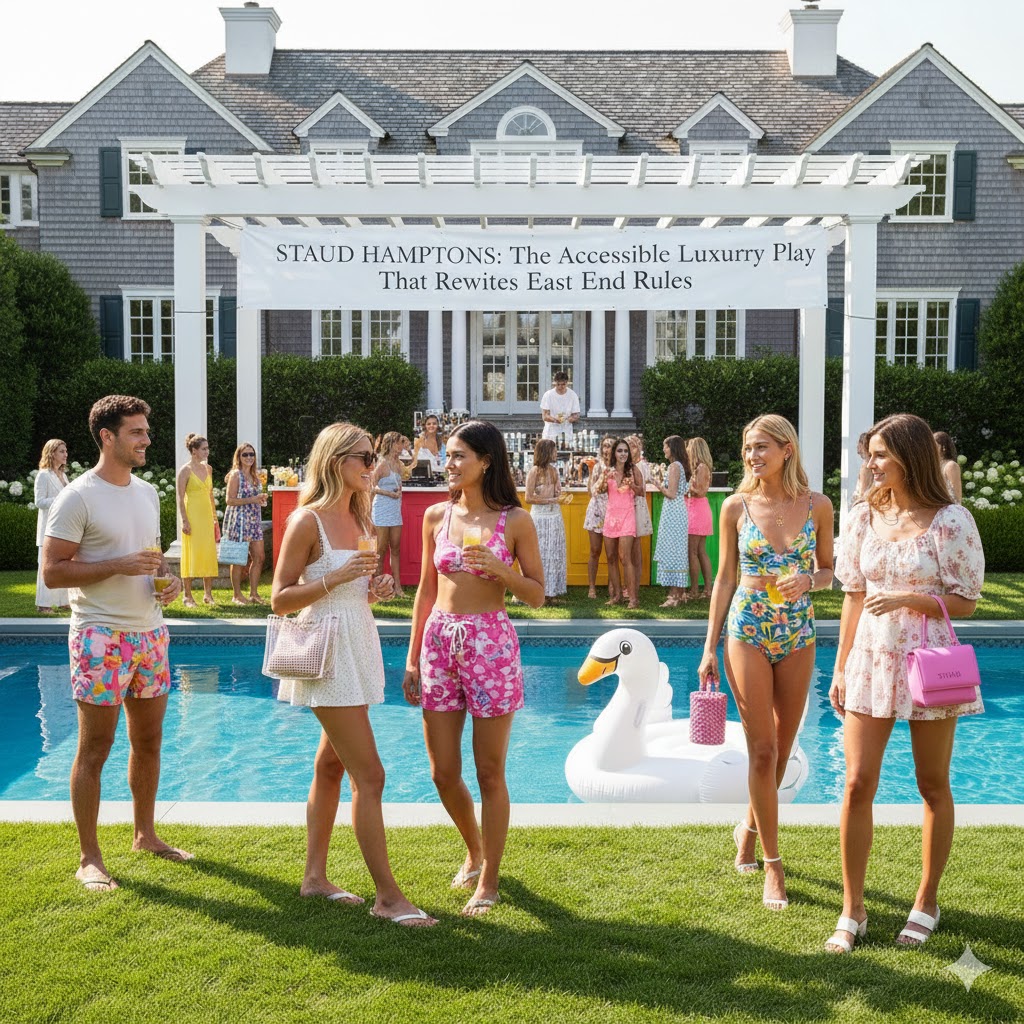
The woman examining the Moon Bag doesn’t hesitate. Clearly, she knows exactly what she’s looking at: a crescent-shaped silhouette in buttery leather, priced at $325. In the language of Newtown Lane, where Hermès commands $10,000 and Gucci hovers at $3,500, this number reads like a misprint. However, it isn’t. At Staud’s East Hampton flagship, the math is the message.
Memorial Day Weekend 2024 brought something unprecedented to East Hampton’s luxury corridor. Specifically, Sarah Staudinger opened not one but two storefronts on Newtown Lane. The main boutique at 66 Newtown Lane houses ready-to-wear and the cult handbags. Meanwhile, directly across the street at 23 Newtown Lane, sits Staud Sea—the brand’s first dedicated swimwear outpost. Together, the dual presence signals something larger than retail expansion.
Pierre Bourdieu spent his career dissecting how taste functions as social currency. Indeed, the French sociologist understood what most shoppers would prefer not to examine: personal style operates as class strategy. Consequently, the Staud Hamptons stores represent a fascinating case study in how a brand can accumulate cultural capital while deliberately rejecting traditional luxury’s gatekeeping mechanisms.
The Staudinger Genesis: From Reformation to Revolution
Sarah Staudinger was born in 1989 in Los Angeles to fashion lineage that reads like a novel. Notably, her mother Joanna ran a fashion label. In addition, her godmother is Cher. Furthermore, her maternal grandfather worked in shoes. As a result, fashion wasn’t a career choice but an inheritance.
The story takes an interesting turn at Reformation. Initially, Staudinger joined the sustainable fashion brand as a buyer. Subsequently, she rose to fashion director within two years. During this period, she watched the company become a cult phenomenon. More importantly, she identified what the market still lacked.
“There was nothing at our price point that felt aesthetically elevated but not over-the-top,” Staudinger told Coveteur. Therefore, in 2015, she partnered with George Augusto to launch Staud from downtown Los Angeles.
The Mythology Machine
The origin story Staud tells itself matters considerably. Unlike heritage luxury invoking nineteenth-century trunk makers or Parisian ateliers, this founding myth centers on a gap. Essentially, it’s about an opportunity identified and a problem solved. Furthermore, the emphasis falls on accessibility rather than exclusivity.
Initially, the brand launched as a customization platform where customers could adjust sleeve lengths and hems. However, within a month, Augusto and Staudinger pivoted dramatically. As it turned out, shoppers wanted the bags and clothes as designed. In other words, they wanted the point of view more than the personalization.
What followed was explosive growth. Between year one and year four, the brand saw 3,000% financial growth. Additionally, Forbes named Staudinger to its 30 Under 30 list in 2019. Meanwhile, the Moreau bucket bag, with its distinctive macramé netting, became one of fashion’s most photographed accessories.
Staud’s Four Capitals: Decoding the Currency of Cool
Bourdieu identified four forms of capital that determine social position. First, economic capital measures monetary resources. Second, cultural capital encompasses taste and knowledge. Third, social capital maps network access. Finally, symbolic capital confers prestige and recognition. Accordingly, Staud’s positioning reveals a deliberate strategy across all four dimensions.
Economic Capital
The price architecture tells the clearest story. For instance, entry-level bags start around $200. Similarly, the signature Moon Bag ranges from $250 to $400 depending on size and material. In addition, ready-to-wear dresses hover between $195 and $595. Moreover, swimwear from Staud Sea runs $85 to $350.
By comparison, consider the neighbors on Newtown Lane. For example, Gucci’s East Hampton store sells handbags starting at $1,500. Meanwhile, Hermès doesn’t list prices because the question itself signals you shouldn’t be asking. Likewise, Prada’s refreshed boutique positions leather goods in the $2,000 range.
Staud occupies what the industry calls “accessible luxury” or “contemporary.” Essentially, the price point requires disposable income but not significant wealth. Consequently, the economic barrier to entry remains low relative to traditional luxury.
Cultural Capital
Here the dynamics grow particularly interesting. Certainly, Staud demands a specific kind of cultural fluency. For instance, you need to know that the Moreau bag references mid-century craft traditions. Similarly, you should recognize the Moon Bag’s debt to vintage silhouettes. Additionally, the clear PVC Shirley tote that launched in 2018 requires understanding that transparency itself became the statement.
Yet importantly, the brand doesn’t punish newcomers. Unlike heritage houses that weaponize insider knowledge, Staud’s cultural codes remain learnable. In fact, a scroll through Instagram educates quickly. Overall, the aesthetic telegraphs itself: vintage-inflected, California-casual, playfully architectural.
“I have always had a love for vintage, and I try to incorporate a certain level of timelessness in all our designs,” Staudinger explained to Harper’s Bazaar. Notably, this positioning matters. After all, timelessness counters fashion’s usual disposability while remaining more approachable than “heritage.”
Social Capital
The celebrity ecosystem surrounding Staud reads like a casting director’s dream. For example, Kendall Jenner carried the Moon Bag during New York Fashion Week 2019. Additionally, Meghan Markle wore the brand’s Shoko dress. Furthermore, Alexa Chung, Dakota Fanning, Selena Gomez, Hailey Bieber, and Kylie Jenner have all been photographed in Staud pieces.
However, the most significant social capital development came in May 2022. At that time, Staudinger married Ari Emanuel, CEO of Endeavor and one of Hollywood’s most powerful agents, in a Saint-Tropez wedding officiated by Larry David. Notably, the guest list included Elon Musk, Emily Ratajkowski, Sean Combs, Mark Wahlberg, and Tyler Perry.
Undoubtedly, the marriage positioned Staudinger at the intersection of fashion, entertainment, and real power. Nevertheless, the brand’s social capital predates the wedding. In fact, the earliest adopters—Leandra Medine and Lisa Aiken—were fashion insiders who chose Staud before the celebrity cascade began.
Symbolic Capital
This is where Staud makes its most interesting play. Traditionally, symbolic capital in fashion flows from scarcity, heritage, and price. However, Staud inverts this logic entirely. Instead, the prestige comes from recognition of taste rather than demonstration of wealth.
Carrying a Staud bag in the Hamptons signals something specific: essentially, you know what’s happening culturally without needing to prove economic dominance. As a result, the message reads as confident rather than aspirational. In other words, you chose this aesthetic deliberately rather than simply buying the most expensive option available.
As Business of Fashion noted in their profile: “Her innovative approach—blending high-end aesthetics with accessible pricing—has made the brand a cult favourite.”
Why Staud Chose the Hamptons—And What It Reveals
The Hamptons represents a particular kind of competitive field. Specifically, Newtown Lane in East Hampton functions as a concentrated luxury marketplace where global houses, designer contemporaries, and emerging brands compete for the same customers.
Staud’s neighbors include Prada at 2 Newtown Lane and Gucci at 17 Newtown Lane. Additionally, Khaite operates a pop-up at 47 Newtown Lane. Meanwhile, The Row opened in the former Tiina the Store space in Amagansett. Furthermore, Veronica Beard, Zimmermann, and Brunello Cucinelli maintain seasonal presences nearby.
The Dual Boutique Strategy
Opening two stores across from each other makes a bold statement about category ambition. Specifically, the main Staud boutique houses the ready-to-wear collection, signature handbags, and footwear. In contrast, Staud Sea focuses exclusively on swimwear, coverups, and beach accessories.
“We design our stores to feel like you’re at a friend’s house: simple, clean, and unpretentious with homey details,” Staudinger told Cultured Magazine. “Staud Hamptons started with our DNA, and then we played with textures like raffia fabric and coastal colors like deep blues and tan.”
Importantly, the design language matters. Where luxury competitors often create intimidating retail temples, Staud opts for warmth instead. Ultimately, the strategy aligns with the brand’s broader positioning: come in, touch things, you belong here.
Collaborations as Social Proof
The 2024 Hamptons launch included collaborations that extended the brand’s reach significantly. For instance, Staud partnered with Keds to reimagine the classic Champion sneaker in four colorways. Additionally, a collaboration with Business & Pleasure produced limited-edition beach goods, including chairs, umbrellas, and towels in Staud’s signature green Breton stripe.
These partnerships serve multiple functions simultaneously. First, they lower the entry price point further. Second, they create Instagram moments. Most importantly, they position Staud as a lifestyle rather than merely a fashion brand. Essentially, the beach umbrella says you’ve bought into an aesthetic universe, not just a handbag.
Playing the Field: Staud vs. the Competition
The contemporary fashion space has grown considerably crowded since 2015. For example, By Far, Danse Lente, and Wandler all emerged in Staud’s wake, pursuing similar market positioning. Meanwhile, Reformation—Staudinger’s former employer—remains a formidable competitor in ready-to-wear.
Yet Staud has cultivated a distinctive position nonetheless. Where By Far leans minimalist and ’90s-referential, Staud embraces bolder palettes and architectural playfulness instead. Similarly, where Reformation emphasizes sustainability messaging, Staud foregrounds design point of view.
The Old Money, New Money Dance
Bourdieu observed that taste preferences often mask class anxieties. Typically, old money tends toward understatement. Conversely, new money frequently overcorrects toward obvious display. Interestingly, Staud threads this needle with precision.
The brand’s aesthetic reads as knowing without being obvious. For instance, the bags are recognizable to insiders but don’t scream brand identity to casual observers. Notably, there’s no dominant logo or monogram pattern. Instead, the distinction comes from shape and color rather than external signifiers.
This positioning makes Staud a safe choice for both camps. On one hand, old money appreciates the restraint. On the other hand, new money appreciates the cultural credibility. Meanwhile, the price point means neither group risks significant capital on the bet.
What Gets Misrecognized
Bourdieu’s concept of misrecognition describes how economic motivations disguise themselves as cultural or aesthetic ones. Accordingly, Staud’s marketing emphasizes “timelessness” and “quality craftsmanship.” Primarily, the discourse centers design philosophy and founder vision.
What remains unspoken, however, tells a different story. Essentially, Staud identified a market inefficiency and exploited it brilliantly. The gap between fast fashion and traditional luxury left space for brands offering design credibility at accessible prices. In this context, the aesthetic elevation was the product while the price point was the innovation.
The Staud Investment: Cultural Arbitrage in Action
The East Hampton stores at 66 and 23 Newtown Lane operate seasonally, aligned with the Hamptons’ summer calendar. Notably, Vogue Scandinavia’s editor-in-chief Martina Bonnier co-hosted the July 2024 opening celebration. Among the attendees were illustrator Mats Gustafson, designer Lisa Perry, and art world power player Chris Mack.
For those visiting, the main Staud store offers the full ready-to-wear collection alongside handbags ranging from the Tommy beaded styles to the sculptural Moon silhouettes. Meanwhile, Staud Sea across the street showcases the swimwear line launched in 2023, including the signature color-blocked bikinis and swim dresses.
When asked about Hamptons style, Staudinger offered a revealing answer: “Nancy Meyers. Clam bakes. Bike rides. Easy breezy, smart separates. Effortless beauty. Sophisticated and relaxed. Diane Keaton.”
Significantly, the references matter here. Nancy Meyers films depict aspirational but attainable domesticity. Similarly, Diane Keaton represents accessible sophistication. Importantly, neither reference invokes European aristocracy or jet-set glamour. Instead, the frame is American, comfortable, earned rather than inherited.
What Staud Actually Sells
Bourdieu would likely argue that Staud sells resolution to a specific anxiety: namely, the fear that your taste might not be legitimate. Traditional luxury solves this through price. After all, if you paid $10,000 for a bag, the market has validated your choice. However, Staud offers a different validation entirely: cultural credibility through design recognition.
The customer who carries a Moon Bag into Sant Ambroeus in East Hampton signals something distinct from the Birkin carrier. Certainly, both communicate wealth. Nevertheless, the Staud choice adds a layer of editorial awareness. Essentially, it says you’re tracking what’s interesting, not merely what’s expensive.
Whether this distinction ultimately matters depends on whose opinion you value. In the Hamptons field, where old money, new money, and cultural capital compete for dominance, Staud has carved out territory that serves multiple masters simultaneously.
Continue Your Luxury Education
Explore our guide to the best Hamptons fashion boutiques for more insider shopping destinations. Additionally, for beach essentials, discover our curated selection in the best Hamptons beaches guide.
Stay Connected with Social Life Magazine
Author

Written by
Recent Posts

Aaron Paul Net Worth — His Character Was Supposed to Die in Season One. Instead He Made $30 Million.

Bryan Cranston Net Worth. He Played a Sitcom Dad for Seven Years. Then He Became the Most Dangerous Man on Television.

Breaking Bad Cast Net Worth. $130 Million Cooked in Five Seasons of Perfect Television

Cailee Spaeny Net Worth — From Springfield, Missouri to A24 and Alien in Three Years Flat

Wagner Moura Net Worth — He Learned Spanish to Play Escobar. Then He Learned English to Take Hollywood.
Categories
- Art
- Articles
- Beauty & Skincare
- Celebrities
- Celebrities|Movies
- Celebrities|The Chronicles
- Chronicles
- Entertainment|Culture
- Event Photos
- Events
- Fashion
- Fashion & Style
- Featured
- Food & Beverage
- Food, Spirits, Wine
- Hamptons
- Hamptons Celebrities
- Hamptons Celebrities|Celebrities|The Chronicles
- Health
- Health & Beauty
- Lifestyle
- Luxury Lifestyle
- Movies|Culture
- Movies|Hamptons Lifestyle
- Press
- Profiles
- Real Estate
- Technology
- The Chronicles
- Travel
- TV
- Uncategorized
- Weddings