
The Five Star Weekend premiered on Peacock on July 9, 2026, all eight episodes at once, and inside a week it had cleared roughly 861 million minutes viewed. That made it the most-watched scripted series the platform has ever released. Peacock ordered a second season by the first week of August.
Every outlet covered the number. Almost nobody covered the mechanism, which is a shame, because the mechanism is the interesting part and it has very little to do with television.
This article is the argument. Underneath it sits Summer People, a twelve-chapter book Social Life published all at once, on the theory that a story about a weekend should be consumable in one. Read this page and you have the case. Follow the chapter links and you have the evidence.
What the show is actually about
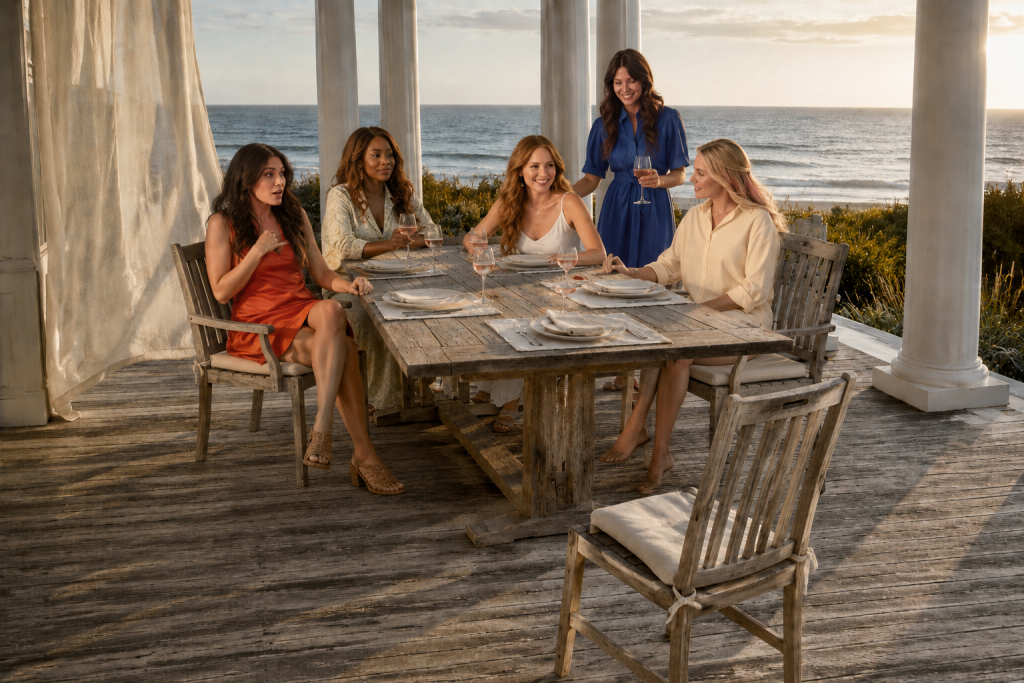
Hollis Shaw is a food writer on Nantucket whose husband dies in a car accident. In the wreckage she does something oddly specific. She invites one friend from each chapter of her life to the island for a weekend.
Four guests. One house. Three days. That is the whole premise, and it fits on an index card.
Why that premise works like a thriller
A finite guest list turns every name into a verdict. Because each name is a verdict, every omission is one too, and the audience starts doing that math within ten minutes.
Nobody has to explain the hierarchy. You simply watch where each woman sleeps, and the show has told you everything.
Prestige drama usually needs a body to generate that much tension. Netflix proved as much in 2024 with The Perfect Couple, also adapted from an Elin Hilderbrand novel, also set on Nantucket, and structured as a murder mystery so viewers had permission to watch. This one removed the corpse and the tension held anyway.
The misreading everyone ran with
The trade explanation was demographic. Streaming had underserved women over forty-five, so here was proof of appetite.
That reading is not wrong. Still, it is thin, since plenty of shows have been made for that audience and most of them died politely.
What this one delivered was not representation. Instead, it was a fantasy of infrastructure: a house on the water, a guest list one woman controls, and an invitation that carries actual weight. Chapters one and two take the record and the finale apart in detail.
The ending, briefly
Spoilers follow, so skip ahead if you have not finished.
Matthew, Hollis’s husband, was having an affair with Gigi, the friend she knew only online. Yet the finale complicates the betrayal rather than resting on it. Gigi reveals that Matthew had canceled their plans and was driving home when he crashed, telling Hollis: “He was going to choose you.”
Hollis then forgives her out loud, saying she does not want the anger in her life or the example it would set for her daughter. Immediately afterward she adds: “Don’t ever contact me again.”
Those two moves together are the most honest thing in the series. Among women who run households and guest lists, forgiveness and banishment are not opposites. Instead, they are the same instrument at two volumes, since you absolve someone precisely so you never have to see her again.
Elsewhere, Tatum learns her lump was not benign and begins treatment. Brooke leaves her husband. Dru-Ann quits to start her own agency. Caroline, the daughter, stays on Nantucket. Hollis and Jack, her boyfriend at seventeen, agree to start with dinner.
The guest list is the asset
Here is the thesis of the entire book, stated once so everything else can lean on it.
Hollis does not invite three friends. She invites three asset classes, and a fourth arrives from the island itself.
Four women, four kinds of capital
Dru-Ann is money and professional standing, a sports agent arriving freshly canceled. Her capital converts directly into rooms and phone calls.
Brooke is ordinary social capital, and the show refuses to sneer at it. She is the mom friend, and her currency is availability without conditions.
Gigi is symbolic capital with nothing behind it. Hollis knows her only from the internet, which is why she is glamorous, unplaceable, and dangerous inside a house.
Tatum is the rarest kind. She knew Hollis before any of it, and as a year-rounder she holds the one claim to the island money cannot manufacture. Chapter three runs the full portfolio.
Why the metaphor is not a metaphor
Women at a certain altitude genuinely manage friendship as an allocation problem. There is a fixed budget of weekends and a fixed number of guest rooms, each carrying a real annual cost.
Nobody says this out loud, of course, because saying it out loud is considered vulgar. Yet the seating chart at any Bridgehampton dinner is a portfolio statement, and so is the group text with your name in it.
The Five Star Weekend simply put the allocation on a calendar. That is the innovation, and it is the reason the show traveled far past its target audience.
The house that started a real estate search
The most desired object in the series is Hollis Shaw’s house. Viewers paused on the kitchen. Half the internet went hunting for the listing.
There is no listing, because there is no house. Interiors were built on a Los Angeles sound stage, while Nantucket got location work in September 2025 covering exteriors, town, beach, and light.
Why the fake house beats a real one
Real houses have real owners, and owners make compromises. They keep a wall because moving it costs money, so every genuine beach house carries at least one flaw that reads on camera.
A production designer builds the argument rather than the residence. Sightlines run where the story needs them, and the island seats exactly as many women as the scene requires.
Still, the deception is forgivable, since every luxury market on the coast sells the same constructed image. Walk into a staged Bridgehampton open house and count the books bought by the yard. The show merely skipped the pretense of a deed.
What it would cost on the East End
In the second quarter of 2026 the Hamptons posted a median sale price of $2.5 million, up nearly 32% year over year, across 378 sales worth roughly $1.45 billion. The average sale reached $3.84 million, and brokers now treat $3 million as the floor of the luxury tier.
Hollis’s house is not median anything. Waterfront, five adults, a working kitchen, privacy on every side: that combination is the most expensive on the East End.
A defensible range for the same property in Sagaponack or Water Mill runs $18 million to $30 million. Sag Harbor, where you trade acreage for a walkable village, would run roughly $7 million to $14 million. Chapter four shows the work.
Two islands, one argument
Nantucket and the Hamptons get compared constantly by people who have not checked the numbers. The numbers are surprising.
Nantucket costs more. The Hamptons is bigger.
Through mid-2026 the median Nantucket home sold for $3,675,000, up 11% year over year, with an average of $4,506,000. Only 89 homes traded, down 19%, on total volume near $401 million.
Compare a single Hamptons quarter: 378 sales, roughly $1.45 billion, at a $2.5 million median.
So the typical Nantucket house costs about 47% more than the typical Hamptons house. Yet the East End moved more than three times the dollar volume in half the time.
What the gap means
Scarcity and scale are different products. Nantucket sells scarcity, which produces a higher per-unit price in a thin market. The East End sells scale, which produces liquidity.
One figure settles it. On Nantucket the median asking price sits at $5,295,000 against a $3,675,000 median sale, a gulf of $1.62 million. That is not mispricing. Instead, it is a population of sellers who do not need to sell.
Money buys the Hamptons. Time buys Nantucket. Chapter five makes the full case, and chapter seven pairs every filming location with its East End equivalent.
Why the show could not have been set here
Proximity would have destroyed the premise. Anyone can drive out from Manhattan for one night and leave before breakfast.
Distance is what makes a guest list binding. Ferries and flights impose commitment, and commitment turns a dinner party into a verdict.
The island is therefore not the setting. Rather, it is the enforcement mechanism, and the East End does not have one.
Who actually pays for the weekend
Chloë Sevigny plays Tatum, and Tatum is the reason this show deserved a book rather than a recap.
She is the year-rounder. Still on the island in February, when the restaurants close and the ferry turns ugly. Everyone else flies in.
The character summer colonies never write
American wealth drama has a standard local. He fixes something, says something wise, and exits the frame having authenticated the protagonist’s taste.
Tatum declines that job. She arrives mid cancer scare, she is not grateful for the invitation, and the finale gives her a plot that has nothing to do with the rich people.
Everyone on the East End knows her. She runs the front of house in Sag Harbor from April to October, her grandfather framed half the houses now listed at $9 million, and a $2.5 million median means she cannot buy where she was born. Chapter six is the one to read if you read only one.
The labor nobody prices
Every seasonal house needs opening and closing, landscaping, plumbing, a caretaker, and somebody who will drive over during a nor’easter. Multiply that across thousands of houses.
The result is an economy that exists to keep empty buildings ready, staffed by people commuting from further west each year because they cannot live near the work.
Because that knowledge is invisible, it gets priced at nothing. Because it is priced at nothing, it keeps leaving, and response times lengthen every season.
The business hiding inside the drama
Hollis is a food writer with a large audience and a beautiful house. In 2026 that is a media company with one employee.
She performs a life other women want and converts the wanting into revenue. Recipes are the product surface. The actual product is the house, the light, and the sense that all of it is manageable.
Why widowhood is a business event
Her husband dies, and the product breaks. Nobody in her position gets to grieve off camera, since the camera is how the mortgage gets paid.
The beach house is not the reward for the career. Instead, it is the factory, and chapter nine runs the economics.
Any brand manager watching should recognize the asset. Trust at scale is the only inventory that has not been commoditized, and it does not live on a media plan. Chapter eight reads the same argument through the clothes, where four women from four economies get sorted without a line of dialogue.
The joke inside the casting
On February 5, 2026, Once Upon a Farm went public at a $724 million valuation. The company raised nearly $198 million at $18 a share, and the stock jumped roughly 40% on day one.
Jennifer Garner co-founded it and serves as chief brand officer. She joined in 2017, and the company reported $157 million in annual sales for 2024.
So an actress who turned domestic competence into a public company was cast as a woman who turned domestic competence into a media business. Garner has been clear-eyed about the category too, noting there is “an eight out of 11 chance that you will lose your money in a celebrity IPO.” Chapter ten separates the documented figures from the invented ones.
The woman who built the island’s narrative
Thirty-two novels. Twenty million copies sold. Twenty-seven of them set on one island thirty miles off the Massachusetts coast.
Elin Hilderbrand has, over roughly twenty-five years, built a pipeline converting fiction into tourism, tourism into real estate demand, and demand into an island economy. Nantucket’s Chamber of Commerce named her Tourism Advocate of the Year in 2022, and filming The Five Star Weekend alone generated more than $2 million in town revenue.
Founder work by any definition
Nine of her books sit in screen development. She produced The Perfect Couple for Netflix and The Five Star Weekend for Peacock, with projects moving at Amazon and Apple.
She announced her retirement in 2021 and published seven more books. Since then she has turned down a lucrative publisher contract, explaining that “the more money you give me, the more I’m gonna say no, because I don’t want the pressure.”
That is the moment an operator stops optimizing for revenue and starts optimizing for control. Chapter eleven treats her as the founder nobody calls one.
What the East End should take from it
The Hamptons has produced more writers, more artists, and more money than Nantucket ever will. What it has never produced is one author whose work functions as the region’s operating narrative.
Nantucket has that. So a Peacock series set there felt like documentary rather than tourism.
Narrative is infrastructure. Places that own their story get to charge for it, and places that do not end up starring in somebody else’s.
The format is the product
Everything above builds to one observation. The five-star weekend is not a plot device. It is a format, and formats can be run.
Why it beats a dinner party
A dinner party is horizontal. Everyone comes from the same current chapter, which is why the conversation stays pleasant and forgettable.
This format is vertical. You put a woman’s whole timeline in one kitchen and let the versions of her meet. The childhood friend remembers who she was before the money, while the professional friend has never seen her cook.
Television dramatized the result as betrayal, because television needs a body. In life it usually arrives as recognition, which is better and harder to film.
What Social Life is doing about it
Beginning next season this magazine hosts an annual East End edition at its Sag Harbor guest house. One host, four guests drawn from four chapters of her life, three days, documented properly and published in print and online.
Hosts are women who built something here. Founders, operators, restaurateurs, physicians, gallerists. Fame is not the requirement. A real life with real chapters is.
Partners get presence inside a documented weekend, coverage in print and online, distribution to 82,000 readers, and photography they can use for a year. Nobody gets the guest list, since a weekend you can buy into is a party and one you cannot is a story. Chapter twelve has the full shape.
What season two changes
Peacock confirmed the renewal in early August 2026. No premiere date exists yet, and no episode order has been made public.
Season one was shot in 2025 with Nantucket location work in September of that year. A comparable schedule would put the next season on the platform around summer 2027, though treat that as inference rather than confirmation.
Why the second season matters commercially
Caroline staying on the island is the load-bearing decision. A daughter in the house converts Hollis from a widow into a matriarch, which is a different job with different plot available to it.
Dru-Ann’s new agency creates a second business inside the story. Brooke’s fresh start supplies comedy, while Tatum’s treatment supplies a clock.
For anyone selling into this audience, the timing is the point. Interest in Nantucket, in the East End, and in the whole summer colony question will spike again when the next season lands, and the brands positioned before that happens will pay considerably less than the ones scrambling after it.
Who this book was written for
Three readers, specifically, and each one takes something different out of it.
The founder who wants the credibility
If you made money recently and are trying to convert it into standing, chapters three and six are your chapters. Because the show maps the conversion so precisely, you can see which moves read as arrival and which read as effort.
The short version: nobody out here is impressed by the house. They are counting the guest rooms and noting who is in them.
The operator selling something premium
Medspa founders, boutique hospitality, private wealth advisors, and anyone charging a number that requires belief should read chapters eight and nine together. Both describe the same asset from different angles.
You are not selling a procedure or a portfolio. Rather, you are selling the conviction that the person delivering it has judgment, and that conviction takes years to build and one bad partnership to spend.
The brand looking for East End relevance
Fashion, spirits, beauty, automotive, and outdoor design all want a credible position out here, and most of them buy it wrong. Sponsorship that looks like sponsorship converts poorly, since the audience is unusually good at spotting purchase.
Chapter twelve lays out what actually works, which is presence inside a story rather than adjacency to one. Ultimately the difference is whether anyone would have written about the moment if you had not paid for it.
How to read Summer People
All twelve chapters are live now. Nothing is gated and nothing arrives next week.
For the show itself, read chapters one through three. Readers who came for the island and the real estate should start at four and run through seven. The money, the labor, and the status math live in eight through twelve.
Most people will eventually read all of it, because the pieces only fully explain each other in combination. That is also why it was published in one drop rather than twelve.
Where The Conversation Continues
Social Life runs the East End edition of this format every season, in print and online. Hosts are selected editorially, and the guest lists are not for sale.
Brands interested in the weekend, the guest house, or the July print issue should reach out early. Partner categories are limited to one per season by design, since exclusivity that is shared is not exclusivity.
Everyone else, come find us on the lawn. Bring the friend from your second chapter.
Author

Written by
Recent Posts
The Two-House Year: What Seasonal Residents Learn After the First Season
Trade Show Booth Decisions: What to Rent, What to Build, and What to Skip
Find Your Ideal Solar Battery Size in Minutes

How to Explore Rome Comfortably Between Check-In and Departure

Beyond the Beauty Template: Why Modern Cosmetic Surgery Is Moving Beyond the One-Size-Fits-All Face
Categories
- Art
- Articles
- Business of Luxury
- Celebrities
- Culture
- Entertainment
- Events
- Faces of Summer 2026
- Fashion
- Fashion & Style
- Featured
- Finance
- Food, Spirits, Wine
- Hamptons
- Hamptons Celebrities
- Health
- Health & Beauty
- Lifestyle
- Luxury Lifestyle
- Press
- Profiles
- Real Estate
- Technology
- The Chronicles
- Travel
- Uncategorized
- Weddings