
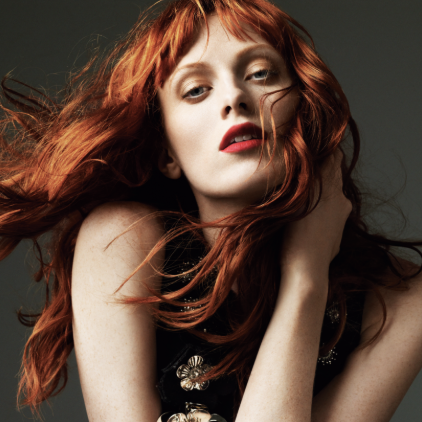
Supermodels Who Reinvented Themselves on Their Own Terms
The supermodels who reinvented themselves refused an industry script written for them. Bookings would slow. Phone calls would get less frequent. A younger face appeared on the cover that had been yours. Lucky ones had saved enough. Smart ones had built something. Everyone else found the drop steep and public. This is the script the fashion industry wrote for every model who ever stood on a runway, and it ran on schedule for most of them.
The four women in this article declined to follow it. Carolyn Murphy, Karen Elson, Gemma Ward, and Alek Wek each arrived at the exit point that the industry had mapped for them — and stepped sideways instead. Not into empires. Not into television franchises or billion-dollar brands. Into something harder to quantify and, for that reason, more interesting: lives built entirely on their own terms, with their own definitions of what success looked like after the runway.
Each of these supermodels who reinvented themselves found a different path. Their stories don’t mirror the Transcenders in Social Life Magazine’s Tier 1 hub — the Crawfords and Campbells who converted fame into compounding financial infrastructure. They don’t mirror the cautionary tales in the Tier 3 hub either. They occupy the most nuanced category in the series — people who survived with their identity intact and their priorities reordered. That is, in its own way, the rarest outcome of all.
Carolyn Murphy: The Art of the One Right Relationship
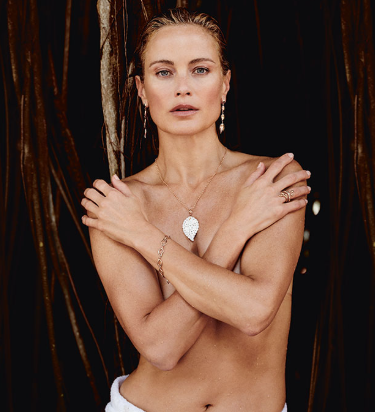
Notably, Carolyn Murphy grew up between the Gulf Coast of Florida and her family’s farm in Virginia, which is not the kind of origin story the fashion industry normally produces. Discovered at a modeling convention just before graduation, she briefly attended college and arrived in Paris in 1995 with the instincts of an artist rather than a businesswoman. The anonymity of being a Vogue girl appealed to her. She resisted the commercial pivot. She didn’t understand, she would admit years later, that her reluctance to brand herself was costing her money she couldn’t see.
The Relationship That Changed Everything
However, what changed her trajectory wasn’t a revelation — it was a relationship. A 1995 Prada campaign shot by David Sims, a short pixie cut, and then Steven Meisel. Once Meisel chose her as a muse, everything shifted into a different register entirely. Seven American Vogue covers. Dozens of French and Italian covers. Chanel Haute Couture. Calvin Klein. Helmut Newton. Irving Penn. The accolades arrived fast. Newsweek named her “The Millennial Supermodel” in 1999. She won the VH1 Vogue Model of the Year award the same year. The industry had decided she was its next canonical face.
The Estée Lauder Decade: One Contract, Twenty Years
Then, in 2001, she signed with Estée Lauder. What followed was not a pivot so much as a settling — the discovery of the one relationship that aligned with everything she actually valued. Twenty-plus years as the face of the brand. The longest cosmetics contract in industry history. Campaigns for Advanced Night Repair, Beautiful, Pleasures, Double Wear — the backbone products of a beauty institution that has sold aspiration to American women for seven decades. She would describe the Estée Lauder family in terms that no one uses about a corporate relationship: gratitude, loyalty, love.
Above all, the strategic lesson Murphy’s career offers is about alignment over volume. Indeed, she didn’t build an empire. She built one extraordinary, exclusive, sustained partnership — and structured her entire professional identity around protecting it. The Estée Lauder contract provided stability in an industry defined by transience — and identity in an industry that tends to consume identities. And it provided income that compounded quietly while she pursued the things that mattered to her: single motherhood, surfing, ocean conservancy, literary studies, creating art, riding horses. Murphy is, by her own description, the “invisible supermodel” — present enough to remain culturally relevant, private enough to remain fully herself.
The Honest Reckoning
“I wish I would have known to be more of a businesswoman at a young age,” she has said. The admission is honest and, if you look closely at what she actually built, also slightly off. Murphy became a businesswoman — just on her own schedule and terms, through a single relationship most people in her position would have considered insufficiently diversified. She was right and the conventional wisdom was wrong.
Karen Elson: The Model Who Hid Songs in a Cupboard
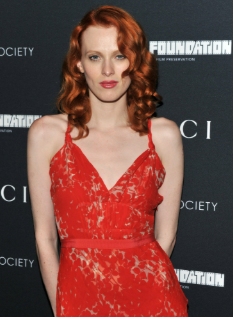
Steven Meisel photographed Karen Elson for the cover of Italian Vogue on her eighteenth birthday. Her eyebrows were shaved. Her hair was a severe bob. Karl Lagerfeld cast her for Chanel and called her “a mixture of something from the Middle Ages and a mutant from another planet.” The nickname was “Le Freak.” She walked out of Oldham, Greater Manchester — a mill town with more factory than fashion — into top-tier international modeling in under two years. The industry loved her because she looked like nothing it had ever seen before.
What the industry didn’t know, and what Elson was careful not to reveal for years, was that she had been writing songs in secret since she was a teenager. In New York in the late 1990s, between shoots for Italian Vogue and Dior ad campaigns, she was recording quietly with musicians from the Chicago alternative scene. After marrying Jack White of the White Stripes in a ceremony on the Amazon, she moved to Nashville. There, she locked herself in a room with an acoustic guitar, writing songs too afraid to share with anyone. “I would lock the bathroom door and hide,” she said. “I would play my songs really in isolation.”
The Ghost Who Walks: Music as the Real Pivot
White eventually overheard her singing and refused to let it go. The result was The Ghost Who Walks, released in 2010 on Third Man Records. The debut — haunting murder ballads and storm-clouded folk — earned serious attention from both music and fashion press. The title came from the nickname her childhood bullies had given her: the ghost who walked the school halls, too tall, too thin, too pale, too strange to belong anywhere. She converted the wound into the work, and the work was extraordinary.
Two more albums followed. Fifty Vogue covers accumulated in parallel. In 2023, Enninful put her on his final British Vogue cover — alongside Oprah, Evangelista, and Moss. Not as a model filling a slot. As a figure of genuine cultural significance. Her daughter Scarlett walked the Paris Fashion Week runways in 2025 — a second generation entering the industry her mother had never quite left, never quite stayed in.
Moreover, Elson’s pivot is the most creatively complete in the series. Specifically, it required her to dismantle the identity — the otherworldly, untouchable, silent model — that had made her commercially valuable, and replace it with something messier and truer. Specifically, the industry wanted “Le Freak.” Instead, she gave it a woman from Oldham who had feelings and wrote them down. Notably, the industry accepted the trade.
Gemma Ward: What Disappearing Taught the Industry About Itself
In September 2004, sixteen-year-old Gemma Ward appeared on the cover of American Vogue — the youngest model in the magazine’s history. Steven Meisel photographed her as one of nine “Models of the Moment.” Within eighteen months she was the face of Prada, Alexander McQueen, Versace, and Dior simultaneously. Forbes ranked her tenth on its list of the world’s highest-earning supermodels in 2007, with estimated earnings of $3 million in twelve months. Allure‘s creative director called her “ethereal, not earthy.” A photographer said she was “an exotic blonde, the rarest of creatures.” The industry had decided she was the defining face of the mid-2000s.
The Departure Nobody Managed
Then, in early 2008, her boyfriend Heath Ledger died of an accidental overdose in a New York apartment. That relationship had not been public. Her grief was entirely private, absorbed inside the same industry schedule that had been consuming her since she was a teenager. She kept working for a few months. Then she stopped. Not quietly — the industry was so accustomed to her ubiquity that her absence became its own kind of event. Eventually, her agent announced her retirement. The tabloids published commentary on her weight. The machinery that had defined her adult life from age fourteen tried to manage her departure the way it managed everything — as a story to be controlled.
The Return: What Absence Actually Built
However, Ward didn’t engage with any of it. A daughter arrived in 2013. Gradually, healing followed. Her return came in 2014 on her own schedule. She opened for Prada — the same house that had launched her — welcomed back as a deliberate aesthetic choice, not a product of necessity. The return trended globally — confirming what the industry had inadvertently proved: her value had increased during the years she wasn’t available. Scarcity had done what no PR campaign could manufacture.
Ultimately, Ward’s lesson is the one every model afraid of the exit should study. She did not manage her departure strategically. She left because she needed to. The industry interpreted her survival as a pivot, but she would probably describe it differently — as a period of becoming a person before returning to being an image. That distinction matters. A return built on wholeness is always more powerful than one built on calculation. You cannot fake it, and the industry cannot produce it.
Alek Wek: The Model Whose Existence Changed the Definition of Beauty
Alek Wek: When Presence Becomes Political
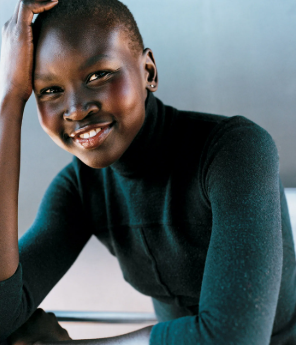
In 1991, however, Alek Wek fled South Sudan with her family during a civil war that would kill nearly two million people. She was fourteen years old. She arrived in London speaking no English, with eight siblings, in a country unlike anything she had known. Four years later, a model scout spotted her at an outdoor market in Crystal Palace and gave her a card. At the time, she was attending the London College of Fashion and had no framework for what modeling was. “There was no concept of fashion and catwalk shows where I came from,” she has said. “There were no magazines. I never saw women in makeup, or with different hairstyles. Absolutely not.”
Consequently, what followed redrew the boundaries of what the industry considered beautiful — not incrementally, but decisively. In the mid-1990s, high fashion operated with a near-total exclusion of dark-skinned Black models. Naomi Campbell had cracked the wall. However, the industry’s response had been to treat her as an exception rather than an opening. Wek arrived with Dinka features, close-cropped hair, and the deepest complexion the European runway had ever centered. She did not arrive quietly. She opened and closed Ralph Lauren shows, walked Chanel head to toe, and appeared in Victoria’s Secret. The work was everywhere. MTV named her Model of the Year. iD Magazine named her Model of the Decade. And the letters arrived from Black women and girls worldwide — saying, for the first time, they had seen themselves in a fashion image.
Fame as Access: The Wek Equation
Wek’s pivot is unlike any other in this series. It was never a pivot away from modeling — rather, it was a move toward meaning that ran parallel to modeling from the start. Since 2002, she has served on the U.S. Committee for Refugees Advisory Council. As a UNHCR Goodwill Ambassador, she has traveled to Sierra Leone, the Ivory Coast, and back to South Sudan to document the stories of displaced people. She also wrote an autobiography in 2007 — Alek: From Sudanese Refugee to International Supermodel — that was described as having “substance and political punch” by Kirkus Reviews. A handbag line followed. Selective modeling, meanwhile, has continued alongside all of it.
Furthermore, Wek’s reinvention is the most structurally unusual of the four. She never treated modeling and humanitarian work as separate tracks to balance against each other. They are the same work expressed differently. The visibility she earned on the runway became the leverage she deploys in every room where decisions about refugees and representation are made. The face the industry once found radical is now the credential that gets her into rooms where she can say what needs to be said. She understood that fame is not a destination — it is access. The question is always what you do with it once you’re in the room.
What These Supermodels Who Reinvented Themselves Share — and Why It Matters
Ultimately, these four supermodels who reinvented themselves do not share a strategy. They share a refusal: the refusal to let the industry’s timeline for them become their own. Murphy refused transience by building one permanent relationship. Elson refused silence by making music that required her to be fully heard. Ward refused managed departure by being absent until she was ready. Wek refused the decorative function of modeling by using it as leverage for something that mattered more.
Above all, each refusal required something the industry cannot give you — a clear sense of your own values. Specifically, enough clarity to recognize when the industry’s terms are no longer compatible with them. Each of these supermodels who reinvented themselves made at least one such refusal. The Transcenders — Crawford, Campbell, Moss, Banks, Klum — succeeded by mastering the industry’s rules, then rewriting them. The Smart Pivoters succeeded by something quieter. In some ways, harder. Instead, they identified what the industry wanted, acknowledged what they were and weren’t willing to give, and built accordingly.
The Third Option the Industry Never Offered
The full Golden Decade series examines what the 90s supermodel era produced, lost, and left behind — across every category from Anna Nicole Smith and Gia Carangi to Carolyn Murphy and Alek Wek. The Smart Pivoters are neither the cautionary tales nor the empire builders. They are the ones who found the third option — the one the industry never offered them and they had to build themselves.
Continue the Golden Decade series:
The Last Supermodels: What the 90s Taught Us About Fame — Series Pillar
The Transcenders: Five Supermodels Who Used the 90s as a Launchpad
Beauty Without Business: The Early 2000s Models Who Vanished
Anna Nicole Smith: The Model America Made and Broke
Gia Carangi: The First Supermodel Fashion Forgot
Jodie Kidd: The Supermodel Who Walked Away on Her Terms
Social Life Magazine covers Hamptons luxury lifestyle, culture, and business intelligence for 25,000 readers each summer issue. Advertise, partner, or pitch a feature here. Polo Hamptons tickets and sponsorships at polohamptons.com.
Author

Written by
Recent Posts
Breaking Bad Cast Net Worth. $130 Million Cooked in Five Seasons of Perfect Television

Cailee Spaeny Net Worth — From Springfield, Missouri to A24 and Alien in Three Years Flat

Wagner Moura Net Worth — He Learned Spanish to Play Escobar. Then He Learned English to Take Hollywood.

Robert Eggers Net Worth — He Made a $3.5 Million Film in Puritan English and Hollywood Listened
Brie Larson Net Worth — A $6 Million Indie Film Won Her an Oscar. Marvel Paid Her the Rest.
Categories
- Art
- Articles
- Beauty & Skincare
- Celebrities
- Celebrities|Movies
- Celebrities|The Chronicles
- Chronicles
- Entertainment|Culture
- Event Photos
- Events
- Fashion
- Fashion & Style
- Featured
- Food & Beverage
- Food, Spirits, Wine
- Hamptons
- Hamptons Celebrities
- Hamptons Celebrities|Celebrities|The Chronicles
- Health
- Health & Beauty
- Lifestyle
- Luxury Lifestyle
- Movies|Culture
- Movies|Hamptons Lifestyle
- Press
- Profiles
- Real Estate
- Technology
- The Chronicles
- Travel
- TV
- Uncategorized
- Weddings