
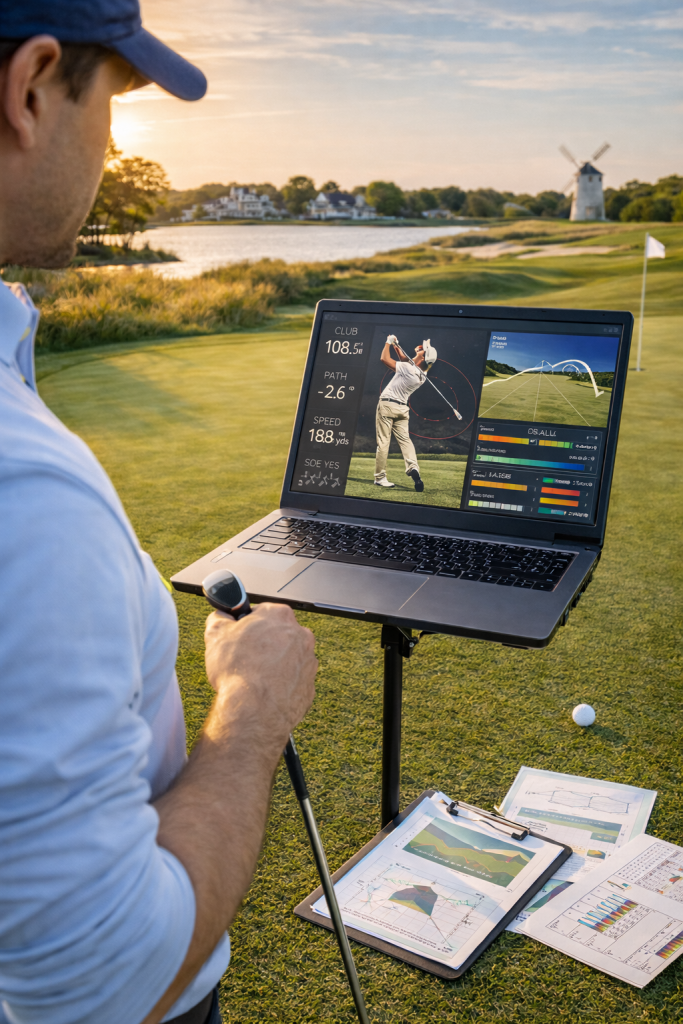
Most golf tips fail smart people. Not because they’re wrong—because they’re incomplete. Here’s what the best instructors actually tell their clients who run companies.
The Learning Problem: Why Smart People Struggle
Intelligence creates specific obstacles in golf that instructors rarely acknowledge. First, analytical minds want to understand causation before executing actions. This creates paralysis—you’re processing mechanics while you should be swinging. Second, successful professionals typically learn new skills quickly, setting unrealistic expectations for a game that resists rapid mastery. Third, pattern recognition that serves you professionally can backfire when you’re identifying and reinforcing the wrong patterns in your swing.
The solution isn’t dumbing down your approach. It’s channeling your analytical capacity toward the right variables at the right times. Pre-swing: analyze everything. During swing: analyze nothing. Post-swing: analyze selectively. This rhythm matters more than any specific technique.
Driver Mechanics Decoded
The driver confounds more golfers than any other club. Understanding why requires basic physics that most instruction ignores.
The Impact Variables That Actually Matter
Key Driver Metrics
- Club Head Speed: Determines potential distance. More speed = more distance, but only if other factors cooperate.
- Attack Angle: Whether you’re hitting up or down on the ball. Driver efficiency requires hitting up—typically 3-5 degrees positive.
- Face Angle: Where the face points at impact. This controls roughly 75% of initial ball direction.
- Club Path: The direction the club is traveling at impact. This influences both direction and spin.
- Strike Location: Where on the face you hit the ball. Off-center hits lose distance and change spin rates significantly.
Notice what’s not on this list: head position, follow-through shape, or any of the other focal points that fill golf magazines. Those elements may influence the impact variables, but they’re second-order concerns. Understanding the actual impact physics helps you filter advice—keep what affects these variables, discard what doesn’t.
The Practical Application
Golf swing tips that actually improve driver performance focus on achievable changes to impact variables.
For attack angle: Ball position matters enormously. Move the ball forward in your stance—inside the left heel for right-handed players. Tee height affects attack angle as well; higher tees encourage upward strikes. Feel like you’re hitting the ball on the upswing, because you should be.
For face angle: Grip pressure and forearm rotation determine face position at impact. Most slicers hold the club too tightly, preventing natural face closure. Experiment with lighter grip pressure in the last three fingers of your top hand.
For strike location: Centeredness of contact improves with consistent setup and tempo. The common advice to “swing slower” actually helps here—not because slower is inherently better, but because consistent tempo produces consistent contact.
The Putting Equation
Putting appears simple but involves complex optimization that analytical minds often overcomplicate. Let’s simplify by focusing on what research actually shows.
Green Reading as Data Analysis
Putting tips typically emphasize stroke mechanics while neglecting the more important skill: reading greens accurately. Your stroke can be excellent, but if you’ve aimed at the wrong spot, excellent execution produces poor results.
AimPoint, a green-reading system used by tour professionals, provides a structured approach that appeals to analytical golfers. The method involves feeling slope with your feet, categorizing it on a numbered scale, and using that number to determine aim point. It’s learnable, repeatable, and removes guesswork from the read.
The key insight: most amateur golfers underread break significantly. If you think a putt breaks four inches, it probably breaks six. Train yourself to aim outside your instinct—the data consistently supports this adjustment.
Speed Control: The Overlooked Variable
Distance control determines putting success more than direction. A putt on perfect line that’s three feet short misses; a putt slightly off line at perfect speed often finds the hole or finishes close enough for a tap-in.
Practice speed control specifically. On the practice green, place tees at 10, 20, and 30 feet from a hole. Hit putts trying to stop them within a three-foot circle around the hole regardless of direction. This drill builds the feel for distance that actually saves strokes.
Technology Stack for the Measurement-Driven Golfer
Several technology tools accelerate improvement for golfers willing to track data.
Launch Monitors
Trackman and FlightScope represent the professional standard—these devices capture every relevant impact and ball flight variable with exceptional accuracy. Access typically requires visiting a fitting studio or instructor with the equipment. Sessions cost $100-200 but provide data worth the investment, particularly for driver and iron optimization.
Consumer-grade alternatives like Garmin R10 and Rapsodo MLM2 Pro bring launch monitor capability home for $500-700. Accuracy slightly trails professional units, but for practice purposes, the data is actionable and the convenience of home use matters.
Shot Tracking
Arccos sensors attach to your club grips and automatically track every shot during rounds. The system then provides analytics on your game: average distances, accuracy by club, strokes gained analysis, and recommended strategy adjustments. For analytical golfers, this data illuminates weaknesses that feel-based assessment misses.
Shot Scope offers similar functionality with a watch-based interface some golfers prefer. Both systems require subscription fees after initial purchase but deliver genuine insight for those who review the data.
Swing Analysis Apps
High-speed video capability now lives in your smartphone. Apps like V1 Golf and OnForm allow recording swings in slow motion, drawing lines for analysis, and comparing your positions to professionals. Combined with remote instruction, these tools enable improvement between in-person lessons.
Noyack’s Practice Facilities
Effective practice requires appropriate facilities. Noyack Golf Club offers the infrastructure serious golfers need.
The range emphasizes quality over volume—well-maintained turf from which you can work on ball-striking with genuine feedback. Hitting off perfect range mats teaches bad habits; natural grass tells you truth.
The short game area provides bunkers, chipping zones, and multiple putting greens with varying speeds and contours. Structured short game practice here addresses the shots that actually determine scores.
The putting green offers sufficient size to practice long lag putts—the distance control work that matters most. Arrive early for your tee time and use these facilities to calibrate for the day’s conditions.
Structured Practice Protocols
Analytical golfers benefit from structured practice more than aimless ball-beating. Here’s a protocol that works:
The 45-Minute Effective Session
Minutes 1-5: Short wedge shots. Half swings with sand wedge, focusing purely on solid contact. This warms up the fundamentals without stress.
Minutes 6-15: Mid-irons (7-iron or 8-iron). Full swings with specific targets. Track your dispersion—how far offline are your misses? Work on reducing that spread.
Minutes 16-25: Woods and driver. Ball position forward, upward attack angle, committed swings. Quality over quantity—ten good drives beats forty rushed ones.
Minutes 26-35: Short game. Variety matters—different lies, different distances, different shot types. This is where strokes are actually saved.
Minutes 36-45: Putting. Start with speed control drills. Finish with pressure putts—give each one consequence by counting makes and misses.
This session builds skills efficiently without the diminishing returns that plague longer practice sessions. Your brain learns better in focused bursts than extended marathons.
Connect with Social Life
- Contact us about features, advertising, and partnerships at sociallifemagazine.com/contact
- Explore Polo Hamptons events and sponsorships at polohamptons.com
- Book a technology-enhanced lesson at Noyack Golf Club
- Subscribe to our email list for weekly Hamptons insider updates
- Support our journalism with a $5 contribution
Author

Written by
Recent Posts

Jack Quaid Net Worth: Hollywood Royalty Playing Normal

Karl Urban Net Worth: The Anti-Hero Who Burns It All Down

Antony Starr Net Worth: The Villain Everyone Loves to Hate

Erin Moriarty Net Worth: Starlight Was the Role She Earned

The Boys Season 5: Required Viewing for the Hamptons
Categories
- Art
- Articles
- Beauty & Skincare
- Celebrities
- Celebrities|The Chronicles
- Chronicles
- Entertainment|Culture
- Event Photos
- Events
- Fashion
- Fashion & Style
- Featured
- Food & Beverage
- Food, Spirits, Wine
- Hamptons
- Hamptons Celebrities
- Hamptons Celebrities|Celebrities|The Chronicles
- Health
- Health & Beauty
- Lifestyle
- Luxury Lifestyle
- Press
- Profiles
- Real Estate
- Technology
- The Chronicles
- Travel
- Uncategorized
- Weddings