
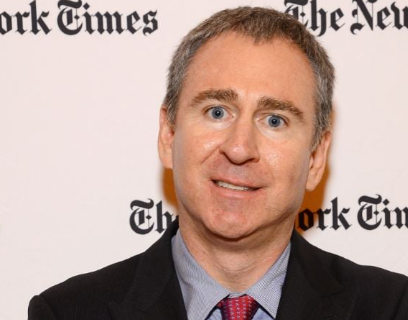
Ken Griffin net worth stands at approximately $49.6 billion as of early 2026, according to Forbes — and the Bloomberg Billionaires Index has placed the figure as high as $51.2 billion. Those numbers, however, are not the story. Rather, the story is a nineteen-year-old in a Harvard dormitory, a satellite dish on the roof, and a grandmother’s savings invested during the worst single trading day in American history.
The Hamptons address came later. Indeed, everything about Ken Griffin comes later than you expect, and larger than the version you heard.
The Room Before the Room
He was born in Daytona Beach in 1968. His father worked in aerospace, keeping the family adjacent to a culture of precision and high-stakes consequence. The family settled in Boca Raton, Florida — a town that sits at the precise margin where middle-class comfort and visible wealth rub together long enough to leave marks on the people who grow up there. Griffin was not rich. Rather, he was adjacent to rich. That distance became the engine.
Even in high school, he ran a mail-order educational software company out of his parents’ house — not a lemonade stand, but a business with inventory and margins. By the time he arrived at Harvard to study economics, he already understood that money was a system with rules, and that most people never bothered to learn them.
The Dorm Room Trade
At nineteen, he installed a satellite dish on the roof of Cabot House dormitory to receive real-time stock quotes. He raised $265,000 from friends and family — his grandmother among them — and began trading convertible bonds. In October 1987, the stock market fell 22.6% in a single session, wiping out careers that had taken decades to build. Griffin made money. By graduation in 1989, he held a degree in economics and more than $1 million to his name. He had not yet turned twenty-one.
The dormitory is still there; the satellite dish is not. Still, the trade that started everything happened during a crash that destroyed fortunes across Wall Street. Griffin later told Bloomberg that he thought about the risk of the trade, not the money. That distinction is the whole biography.
The Belief System — Shown, Not Told
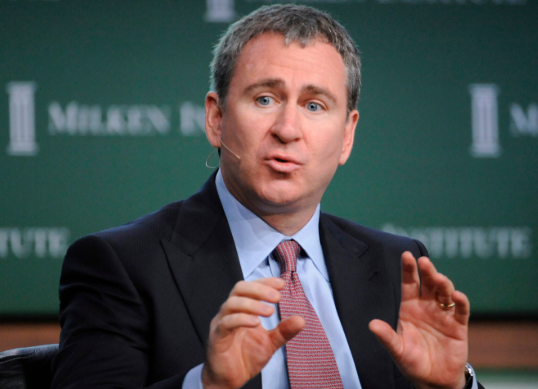
Ultimately, the trade that explains Ken Griffin is not 2022, when Citadel’s flagship Wellington fund returned 38.1% — the best single-year result in hedge fund history. It is 2008.
That year, Citadel lost $9 billion. Not a rounding error — nine billion dollars, over a period of months, as the financial system dissolved around every leveraged position on earth. Griffin was worth approximately $3 billion at the start of 2008. By year’s end, however, he was worth roughly $500 million. He locked investors out of their capital for months — a decision that earned him legal threats and sustained hatred from clients who needed liquidity in the worst moment since 1929.
He held. Instead of liquidating at the bottom, he refused the exit that would have reduced short-term pain and destroyed the long-term portfolio. Consequently, by January 2012, Citadel had recovered every dollar lost. All $9 billion.
The behavior pattern is consistent across 35 years: Griffin buys what others cannot hold. Meanwhile, he builds infrastructure when competitors are cutting it, and charges fees historically among the highest in the industry — up to 30% of profits — without apology. Rather than treating the fee structure as a concession, he has argued that talent compounds and that Citadel employs more of it than anyone else. The fee structure is not arrogance. Instead, it is a statement about relative value.
The GameStop Episode
The friction point arrived in January 2021. During the GameStop short squeeze, Citadel Securities was accused of coordinating with Robinhood to restrict retail trading. Griffin testified before Congress, and the SEC ultimately found no evidence of coordination. However, the episode revealed something Griffin had never chosen to highlight: Citadel Securities now handles roughly 25–30% of all U.S. equity trading volume daily. That concentration of power was entirely intentional. Indeed, he did not consider it a problem worth explaining.
The Timeline: Wins, Wreckage, and What Came Next
| Period | What Happened | Net Worth / AUM |
|---|---|---|
| 1987 | Trades convertible bonds during Black Monday crash from Harvard dorm. Turns $265K into $1M+. | ~$1M personal |
| 1990 | Founds Citadel LLC in Chicago with $4.6 million in seed capital. Names it after the fortress in Ayn Rand’s The Fountainhead. | $4.6M AUM |
| Late 1990s | Citadel crosses $1 billion AUM. Griffin becomes the youngest person on the Forbes 400 in 2003, at 34 years old. | ~$650M personal |
| 2008 | Global financial crisis. Citadel loses $9B. Griffin locks out investor redemptions. Personal net worth drops 80%+ peak to trough. | ~$500M personal |
| 2012 | Citadel recovers all 2008 losses. Full recovery confirmed January 2012. Griffin begins aggressive expansion of Citadel Securities. | ~$3B personal |
| 2019 | Purchases four-floor NYC penthouse at 220 Central Park South for $238 million — the most expensive home sale in U.S. history. | ~$15B personal |
| 2020 | Acquires 650 Meadow Lane, Southampton — Calvin Klein’s oceanfront compound — for $84 million, off-market. | ~$15B personal |
| 2021 | GameStop short squeeze. Congressional testimony. Outbids crypto collective to purchase rare first-edition U.S. Constitution for $43.2M. | ~$21B personal |
| 2022 | Wellington fund returns 38.1% — best single-year return in hedge fund history. Relocates Citadel HQ from Chicago to Miami. Donates $60M to political causes, third-largest donor in the cycle. | ~$35B personal |
| 2025–2026 | Wellington returns 10.2% in volatile market. Citadel returns ~$5B in profits to investors. Begins 2026 with ~$67B AUM. | ~$49.6B personal |
The Hamptons Chapter: 650 Meadow Lane
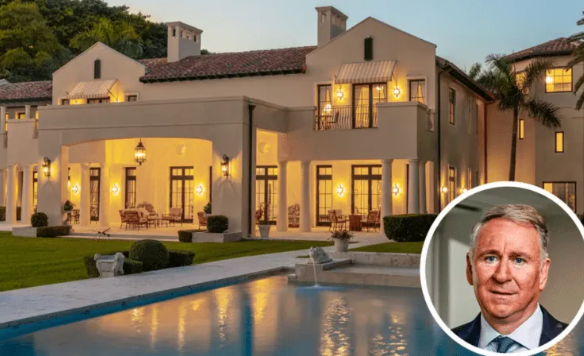
In 2020, Ken Griffin paid $84 million for 650 Meadow Lane — the oceanfront compound that Calvin Klein spent three decades and an estimated $45 million building. The deal was off-market, and the transaction surfaced only after it closed, which is how significant real estate moves on Meadow Lane typically work. Griffin did not need to be seen buying it. He needed to own it.
The compound sits on three acres of Southampton oceanfront. Klein’s minimalist architecture — glass, concrete, deliberate restraint — was his statement about what American luxury could look like when freed from ornamentation. Rather than renovating the aesthetic, Griffin moved finance where fashion had been. That is, in compressed form, the story of the Hamptons over the past thirty years.
At time of purchase, Griffin’s net worth was approximately $15 billion. For context, the $84 million represented 0.56% of his wealth — he had paid $238 million for a Manhattan penthouse the previous year. The Hamptons property was not a splurge. Rather, it was a location decision.
Griffin helicopters in from Miami and, unlike many Hamptons regulars, does not circulate at benefit galas or require the social performance that the address demands from people who still need it. His neighbors on Meadow Lane — Leon Black, Robert Kraft, Henry Kravis — operate on the same social physics. The estate is not the destination. Rather, it is the base. Among Hamptons power players, Griffin occupies the address that signals you have stopped arriving and started simply being there.
What Ken Griffin Built — and the Math Behind It
To understand Ken Griffin net worth accurately, you have to separate two businesses that most people treat as one. They are not the same.
First, Citadel LLC — the hedge fund — manages approximately $67 billion in assets under management as of early 2026, following a $5 billion profit distribution to investors. The fund’s flagship Wellington strategy has delivered average annualized returns placing it among the most consistently profitable multi-strategy funds in history. According to Forbes, Griffin owns approximately 85% of the fund management business.
Citadel Securities: The Bigger Machine
Additionally, Citadel Securities — the market-making arm — is the larger wealth engine. It was valued at $22 billion in a January 2022 funding round with Sequoia Capital and Paradigm. In 2024, Citadel Securities generated a record $9.7 billion in trading revenue. Griffin owns approximately 80% of it, and that stake alone accounts for roughly $17 billion of his total net worth — built not on bets, but on infrastructure.
This is the belief system from 1987 running to its logical conclusion. Rather than just trading markets, he built the plumbing through which markets run. The Bloomberg Billionaires Index places his net worth as high as $51.2 billion as of January 2026, making him the 34th-wealthiest person on earth.
The peer comparison is instructive. Steve Cohen — also a Hamptons billionaire, also a hedge fund titan from the same era — built his fortune primarily through trading prowess and now manages approximately $35 billion at Point72. Griffin, by contrast, built his through trading first, then through owning the infrastructure that everyone else’s trading runs on. Same era. Completely different theory of the game.
Public Reputation vs. What the Room Goes Quiet About
On the surface, the public narrative reads cleanly: Ken Griffin is the most successful hedge fund manager in history. A self-made billionaire from a Florida middle-class family who started from a dorm room and built a global financial empire through discipline, talent acquisition, and quantitative rigor. Philanthropist. Harvard’s largest individual donor at the time of his 2014 gift. A man who paid $43.2 million at Sotheby’s for a first-edition copy of the U.S. Constitution — outbidding a crypto collective that had crowdfunded $40 million — so that Americans could see it in public spaces.
The insider correction is more textured. Former employees describe Citadel’s culture as operating at a performance standard that most people cannot sustain long-term. The firm compensates extraordinarily well; however, it also turns over people who cannot maintain the standard. Notably, the two facts are not in conflict — they are the same policy. That policy is deliberate and is not presented as anything other than what it is.
Off the Record
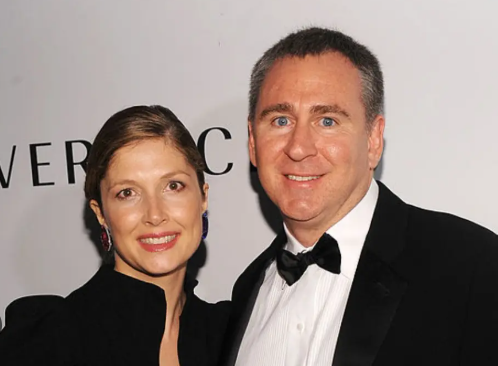
His 2003 marriage to Anne Dias at the Palace of Versailles was covered as a society event. The 2014 divorce, however, generated court filings detailing $300,000 in monthly family expenses — private aviation, household staff, art conservation, security infrastructure — as evidence in a custody and financial dispute. Court documents of this kind were not unusual for someone of his wealth. Rather, they were a precise, public, court-documented accounting of what $15 billion looks like as a daily life. Furthermore, the settlement was reached confidentially in 2015.
In 2022, Griffin relocated Citadel’s headquarters from Chicago to Miami, citing crime and the business climate. Chicago’s political establishment — which had received hundreds of millions in his philanthropy over two decades — was not pleased. In the same year, Griffin donated $60 million to political causes, making him the third-largest political donor in the cycle. He identifies as a Reagan Republican and has publicly argued that wealthy individuals have too little influence in politics.
Ultimately, the room does not go quiet about his intelligence. It goes quiet about what he intends to do with it.
Contribution: To Whom, and at What Scale
Ken Griffin has donated more than $1.56 billion to charitable causes, according to Forbes’s philanthropy tracking. Time magazine included him in its 100 Most Influential People in Philanthropy for 2025. Moreover, the giving pattern is entirely consistent with the investment philosophy: he funds institutions, not movements.
Specifically, the donations break down as follows:
- Harvard University — $150 million (2014) for financial aid, at the time the largest single gift in the university’s history
- University of Chicago economics department — $125 million (2017), now named the Kenneth C. Griffin Department of Economics
- Museum of Science and Industry, Chicago — $125 million (2019), the largest gift in the museum’s history, now the Kenneth C. Griffin Museum of Science and Industry
- American Museum of Natural History, New York — $40 million (2022)
- National Medal of Honor Museum — $30 million (2023)
- University of Florida Hamilton School — $5.5 million (2025) for classical and civic education, Griffin Fellows, and Griffin Scholars
- U.S. Navy SEAL Foundation — $10 million (2020)
- Baptist Health Miami Neuroscience Institute — $50 million (2024), facility named the Kenneth C. Griffin Center
Each major gift carries naming rights. This is not vanity — it is a consistent theory of philanthropy as institutional investment, where legacy and naming are part of the expected return. Consequently, instead of building a foundation with a social mission, Griffin funds excellence at institutions he considers worth backing, and expects those institutions to carry his name forward.
What the Giving Record Doesn’t Include
Notably absent: direct community funding, operational support for under-resourced neighborhoods, or giving that operates outside elite institutional frameworks. The $1.56 billion has moved almost exclusively through the most endowed institutions in America. In fact, the gap between the scale of the fortune and the reach of the giving is, itself, a statement.
Of all the entries, the Constitution purchase remains the most complicated in the ledger. Griffin paid $43.2 million to own something he then displayed publicly. Whether that is the most patriotic thing a billionaire has done with $43 million, or a demonstration of what individual capital can accomplish that collective effort cannot, depends entirely on what you think money is for.
The East End Verdict on Ken Griffin Net Worth
Ultimately, Ken Griffin’s arrival on Meadow Lane in 2020 was not a real estate transaction. It was a succession.
Calvin Klein built 650 Meadow Lane as a monument to a specific idea of American luxury — minimalist, fashion-forward, European in its restraint. Griffin purchased it in an off-market deal, said nothing publicly, did not renovate the aesthetic, and did not hold a housewarming. Subsequently, finance replaced fashion on that three-acre oceanfront plot, which is the condensed history of who lives in the Hamptons now versus who used to.
What the Address Signals
Meadow Lane today is a hedge fund campus. Griffin, Black, Kravis, Kraft — the combined net worth of that five-mile oceanfront stretch exceeds $50 billion. The real estate market responds accordingly: the $84 million Griffin paid in 2020 established a new comparable benchmark, and off-market transactions now dominate the top tier. Each major sale resets the floor for the next one. In effect, the land itself has become an asset class managed by the people who live on it.
Access to these people during summer does not happen through cold introductions or charity circuit proximity alone. Instead, it happens through the editorial coverage that meets them at their level — that documents the geography they actually inhabit, the events they actually attend, and the social physics that governs who gets close to whom and why.
Ken Griffin net worth
$49.6 billion by Forbes, $51.2 billion by Bloomberg — is the final sentence of a story that began in a Boca Raton house, ran through a Harvard dormitory, survived a $9 billion catastrophe, and landed on three oceanfront acres in Southampton. Social Life Magazine has covered that geography for 23 years. Meanwhile, the hedge fund era of the Hamptons is not approaching. It already arrived.
For the full picture of finance’s presence on the East End, see our Hamptons Hedge Fund Billionaires Net Worth guide.
Social Life Magazine has been operating inside that room for twenty-three years — five summer issues from Westhampton to Montauk, fall delivery to Upper East Side doorman buildings, 25,000 readers who are the demographic every luxury brand is trying to reach by doing things significantly less effective than simply being in the magazine. The brands here are not buying exposure. They are being introduced to people who have already decided to trust the publication that introduced them. If your brand belongs in that introduction: sociallifemagazine.com/contact.
The email list is the year-round version of the same room — 82,000 readers, same zip codes, the winter conversation. Free. Eleven seconds. Join it here.
Polo Hamptons is the event version of the same insight. There are gatherings people attend and gatherings where something actually happens — where the introduction that required six months of mutual adjacency becomes, on a July afternoon, simply a handshake between two people who were always going to meet. Category-exclusive sponsorships from $14,000. Private cabanas from $6,500. One sponsor per category. Most are already claimed. polohamptons.com.
The print subscription is the physical object on the coffee table in the house on Further Lane, handed by the family office principal to the person he is trying to introduce to the concept of your brand before the introduction has technically happened yet. Five summer issues. sociallifemagazine.com/subscription.
And then this, which is the most honest sentence here and therefore the one most likely to be skimmed: independent luxury media with no advertiser leverage and no engagement algorithm is genuinely rare, which is why the judgment, when present, is worth something. You have already formed an opinion about whether it was present here. If yes: paypal.com/donate. The amount is whatever you think that judgment is worth, which is the only honest way to price it.
Related Reading:
Meadow Lane Southampton: Inside Billionaires Row
Hamptons Power Players 2026: The Complete Map
Steven Cohen Net Worth: Point72’s Hamptons Billionaire
Ken Griffin net worth data sourced from Forbes Billionaires List and Bloomberg Billionaires Index. All real estate figures reflect reported transaction records. Social Life Magazine is an independent publication and has no affiliation with Ken Griffin or Citadel.
Author

Written by
Recent Posts
7 Mindful Meal Prep Tips for Stop Food Waste Day

Rebecca Ferguson Net Worth: The Advantage of Not Being the Lead
What Makes a Dinner Party Truly Unforgettable (Hint: It’s Not the Food)
Tips for Managing Grease and Oil in Everyday Dishwashing
Austin Butler Net Worth: The Method Actor in a Post-Method World
Categories
- Art
- Articles
- Beauty & Skincare
- Celebrities
- Celebrities|Entertainment
- Celebrities|Television
- Celebrities|The Chronicles
- celebrities|the-archive
- Chronicles
- Entertainment|Culture
- Event Photos
- Events
- Fashion
- Fashion & Style
- Featured
- Food & Beverage
- Food, Spirits, Wine
- Hamptons
- Hamptons Celebrities
- Hamptons Celebrities|Celebrities|The Chronicles
- Health
- Health & Beauty
- Lifestyle
- Luxury Lifestyle
- Movies
- Press
- Profiles
- Real Estate
- Technology
- The Chronicles
- Travel
- Uncategorized
- Weddings