
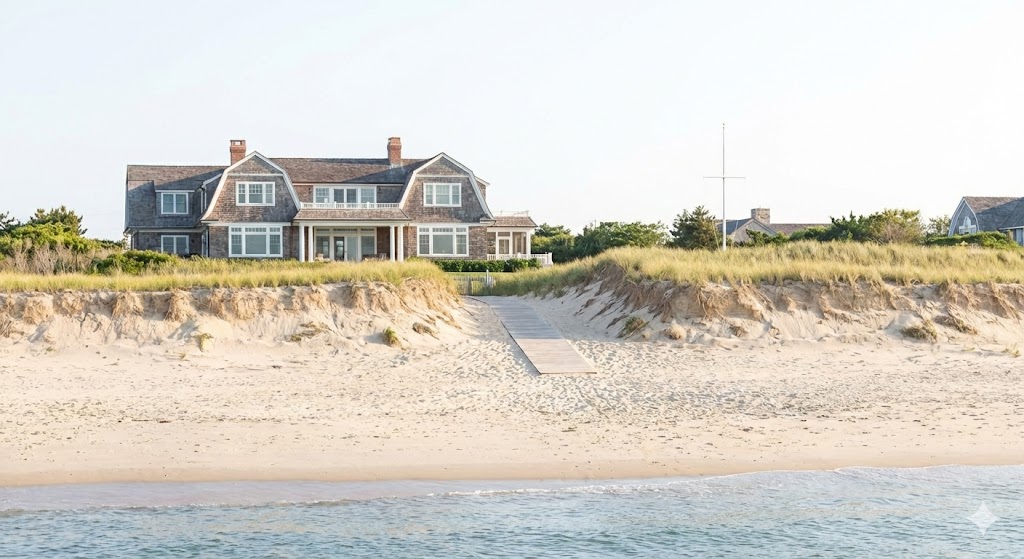
Where Money Moves in 2026: North Fork vs. South Fork, Old Money vs. New, and What Your Zip Code Really Says About You
A helicopter just touched down on Meadow Lane. Inside sits a newly-minted tech billionaire who paid $84 million for Calvin Klein’s former compound. Meanwhile, two miles north, a sixth-generation Bonacker family debates whether to sell their waterfront cottage for what amounts to a lottery win. Welcome to the Hamptons’ great wealth migration, where every address tells a story and every zip code carries a verdict.
This report maps where capital actually flows on Long Island’s East End. Beyond the celebrity tabloid fodder lies a sophisticated market where old money whispers, new money flexes, and the smart money is already positioning for what comes next. Consequently, understanding these dynamics separates informed buyers from tourists.
The Current State of Play: Market Fundamentals
Q1 2025 marked a watershed moment when the median home price in the Hamptons crossed $2 million for the first time in history. According to Douglas Elliman data, that figure represents a 13.3% year-over-year increase. Moreover, sales volume hit $1.465 billion with 423 homes traded. These aren’t bubble numbers. Instead, this is structural repricing driven by permanent demand shifts.
Inventory remains 44% below pre-pandemic levels. Before COVID, the Hamptons typically had 5,000 properties on the market at any given time. However, that number cratered to 1,000 at peak pandemic demand and today hovers around 1,986 total listings. As a result, wealthy owners rarely sell trophy properties anymore. They’re viewing them as multigenerational assets, which tightens supply further and creates artificial scarcity that benefits long-term holders.
The Zip Code Decoder: What Your Address Actually Signals
The $7M+ Club: Sagaponack (11962)
Sagaponack holds the #2 most expensive zip code in America with a median of $7.4 million. Notably, this is where Jimmy Fallon and Drew Barrymore own property. The neighborhood attracts those who want Hamptons prestige without Southampton’s social circuit obligations. Because buyers at this level require discretion and due diligence, listings average 111 days on market.
Finance Money Central: Water Mill (11976) and Bridgehampton (11932)
Water Mill commands a $4.2 million median, while Bridgehampton sits at $3.99 million. Together, these two zip codes house the highest concentration of hedge fund managers and private equity principals outside Greenwich. Specifically, the area between Mecox Road in Water Mill and Town Line Road in Wainscott has become Wall Street’s unofficial campus. Buyers here appreciate equal driving distance to both East Hampton and Southampton villages.
Goldman Sachs executives famously clustered around Sagaponack’s Bridge Lane in the 1990s, seeking privacy among the potato fields. For example, Lloyd Blankfein’s estate still stands on Parsonage Lane. This tradition continues as finance professionals prioritize proximity to their professional tribe, viewing weekend hobnobbing as business development.
Billionaire Lane: Southampton’s Meadow Lane
The five-mile oceanfront stretch known as Billionaires Row represents the single highest concentration of wealth in the Hamptons. To put this in perspective, the median home price reaches $17.6 million, which is twice the next-closest street. Current residents include Ken Griffin (Citadel CEO, $84 million purchase), Henry Kravis (KKR co-founder), Leon Black (Apollo Global Management), and Ian Schrager (legendary hotelier). Interestingly, the street’s private helipad has become a flashpoint between residents who consider helicopter commutes essential and those who value peace.
Old Money Signals: East Hampton Village and Lily Pond Lane
East Hampton feels more old money than Southampton. Historically, Jackie Kennedy Onassis spent summers here, and the Maidstone Club famously didn’t accept Jewish members until the 1970s (rejecting Groucho Marx and Diana Ross). Today, Lily Pond Lane residents include Steven Spielberg and Martha Stewart. These addresses signal lineage and cultural capital over raw purchasing power.
Furthermore, Bernard Arnault, the world’s richest person, paid $22 million for 1 Main Street in East Hampton Village, setting a record $4,400 per square foot for commercial real estate. When LVMH’s chairman plants a flag, it confirms a location’s permanence in the luxury hierarchy.
The Stealth Wealth Zone: North Haven
North Haven posts the highest mean household income in the Hamptons at $370,004 with a median sale price of $3.43 million. Yet most people have never heard of it. There’s no downtown, no shops, and no restaurants. Instead, ultra-wealthy families enjoy privacy without performance through residents-only bay beaches. When amenities are needed, Sag Harbor Village sits just minutes away. Essentially, this is where money goes to avoid being seen.
The Great Migration: Where Money Moves Next
The North Fork Arbitrage
The North Fork hit a record $1.1 million median in Q3 2025, which is roughly half the South Fork median. Smart money recognizes this valuation gap is closing. For instance, Cutchogue saw prices jump 71% year-over-year to $1.9 million average. Similarly, Shelter Island commands a $2.15 million median with 64.4% annual appreciation.
Many South Fork buyers now pivot to the North Fork because they recognize better value and a more laid-back atmosphere. The area offers wine country lifestyle (40+ vineyards), farm-to-table dining culture, and direct access to nature without the scene-seeking weekender crowds. Additionally, cash deals represent about 25% of North Fork transactions versus 75% on the South Fork, indicating a different buyer profile that favors lifestyle over status.
Springs and Noyac: The Emerging Plays
Real estate professionals predict Springs and Noyac will be the “it” destinations over the next five years. Springs maintains its legacy as an artists’ colony where Jackson Pollock and Lee Krasner once worked. Recently, Cindy Sherman and Annabelle Selldorf have moved in. The neighborhood offers Accabonac Harbor access and authentic maritime character while remaining affordable relative to East Hampton proper.
Noyac benefits from proximity to Sag Harbor’s cultural scene without Sag Harbor prices. Both areas attract creative professionals and young families who previously transformed Montauk and Amagansett. The playbook repeats predictably: artists arrive, restaurants follow, property values climb, and early buyers compound returns.
Montauk: Surfer Chic Meets Finance
Montauk occupies a unique position as “boho-chic” compared to East Hampton’s formality. While Ditch Plains maintains its soul as East Coast surf culture’s capital, hedge fund managers have moved into the legendary Montauk Shores trailer park, where an 800-square-foot mobile home sold for $3.75 million in 2023. This juxtaposition is perfectly Hamptons: old-school surfers sharing community amenities with CEOs.
Robert De Niro owns oceanfront property here, inherited from his father. Meanwhile, the Surf Lodge draws Wall Street types who want to feel like they’re in a surf magazine without actually surfing. As a result, Montauk is undergoing a real estate boom while maintaining enough edge to attract buyers who find East Hampton too pretentious.
The Entry Points: Where First-Timers Land
Hampton Bays: The Gateway Drug
Hampton Bays offers the most budget-friendly entry to the Hamptons proper. In Q1 2025, the area saw a 65% jump in homes sold year-over-year and a 130% increase in sub-$500K transactions. East Quogue’s median sits at $874,000, the lowest in the region. Although prices are up 12.8%, properties still move 5 days faster than last year.
The area attracts boat lovers with nearby water access and offers legitimate Hamptons addresses for commuters who can tolerate the drive. Additionally, first-time buyers purchasing off-season find meaningful savings. Ultimately, this is where you build equity before trading up to prime locations.
Westhampton Beach: Community Plus Commute
Westhampton Beach prices jumped 51.5% year-over-year in 2025. New developments like The Gables offer 2,000-square-foot condos with turnkey finishes starting under $2 million. The village maintains charming boutiques, restaurants, and a vibrant main street. Because it’s closest to New York City of all Hamptons villages, weekend commutes remain manageable for professionals.
The Intelligence Layer: What Separates Smart Buyers
Cash Dominates
More than 75% of South Fork sales close cash. At the ultra-luxury tier ($10M+), assume 100% cash. These buyers understand that rate cycles create opportunities. When mortgage rates hover near 7%, leveraged competition disappears. Consequently, cash offers close faster, win bidding wars regardless of price, and demonstrate seriousness that sellers reward with favorable terms.
The Renovation Opportunity
Move-in-ready properties command premiums, whereas homes needing work sit longer with fewer offers. Wealthy buyers increasingly purchase properties specifically for renovation or reconstruction, thereby bypassing inventory constraints while creating custom assets. With almost no vacant land remaining, existing lots become more valuable than completed homes. This strategy separates sophisticated investors from weekend house hunters.
Year-Round Livability
The market has shifted from seasonal lifestyle purchases to year-round livability. Today’s buyers want home offices, home gyms, and dedicated wellness spaces supporting extended use. Therefore, properties offering indoor-outdoor living integration with covered patios, outdoor kitchens, and lifestyle amenities like pickleball courts command premiums. Interestingly, building footprints are getting smaller while on-site amenities expand.
Sustainability as Differentiator
Younger high-net-worth buyers pay closer attention to energy efficiency and eco-conscious design. Geothermal systems, solar panels, and high-efficiency HVAC aren’t just nice-to-haves anymore. Instead, new construction emphasizing sustainability without compromising luxury moves faster. Organic cellulose insulation and triple-pane glass now represent the new luxury baseline.
The Bottom Line: Positioning for 2026
The Hamptons market has permanently repriced. The pre-COVID median of $1 million is now $2 million and holding. Volume is up 10.3% year-over-year with strong momentum continuing into Q4. Most notably, Sag Harbor leads with 200% more sales, 79% higher median prices, and 774% volume increase. The ultra-luxury segment ($10M+) shows the highest activity increase.
Smart positioning for 2026 means understanding that correctly priced properties still move quickly, often with multiple offers. In contrast, overpriced listings languish. The market rewards turnkey condition, prime locations, and compelling narratives. Sellers can no longer overprice with impunity, and buyers must act decisively when quality inventory appears.
For those entering the market, consider Hampton Bays or Westhampton for entry. Look at Springs, Noyac, or the North Fork for value plays with appreciation potential. Remember that finance money clusters in Water Mill and Bridgehampton, old money signals through East Hampton Village, new money performs on Meadow Lane, and stealth wealth hides in North Haven.
The Hamptons remain a solid investment for those with the means and the patience. Real estate here represents a tangible asset you can actually live in and enjoy, a safe harbor when stock markets turn volatile, and an intergenerational wealth transfer vehicle with proven appreciation.
The money keeps moving. The question is whether you’re positioned to capture it.
Connect With Us
For premium content, exclusive event access, and insider market intelligence:
- Contact our editorial team for feature opportunities and advertising partnerships at sociallifemagazine.com/contact
- Join us at Polo Hamptons for luxury networking events: polohamptons.com
- Subscribe to our print edition for quarterly market reports delivered to your door
- Support independent luxury journalism with a $5 contribution to sustain quality coverage
Related Reading
Author

Written by
Recent Posts

Cynthia Erivo Net Worth: The Voice That Was Always There

Inside Out 2, Wicked, and the Emotional Blockbuster That Ate 2024
7 Mindful Meal Prep Tips for Stop Food Waste Day

Rebecca Ferguson Net Worth: The Advantage of Not Being the Lead
What Makes a Dinner Party Truly Unforgettable (Hint: It’s Not the Food)
Categories
- Art
- Articles
- Beauty & Skincare
- Celebrities
- Celebrities|Entertainment
- Celebrities|Television
- Celebrities|The Chronicles
- celebrities|the-archive
- Chronicles
- Entertainment|Culture
- Event Photos
- Events
- Fashion
- Fashion & Style
- Featured
- Food & Beverage
- Food, Spirits, Wine
- Hamptons
- Hamptons Celebrities
- Hamptons Celebrities|Celebrities|The Chronicles
- Health
- Health & Beauty
- Lifestyle
- Luxury Lifestyle
- Movies
- Press
- Profiles
- Real Estate
- Technology
- The Chronicles
- Travel
- Uncategorized
- Weddings