
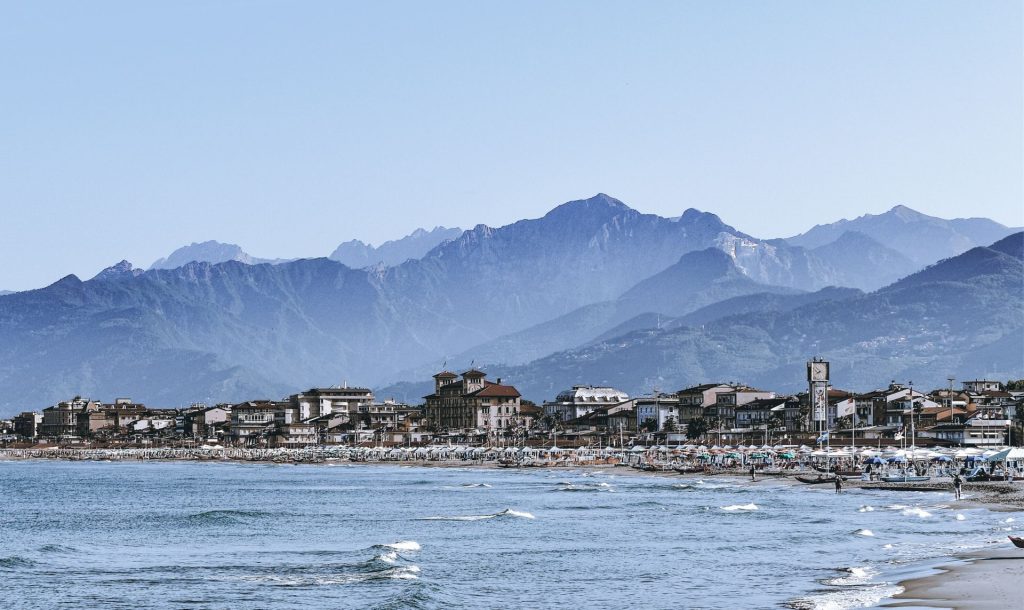
Between the Apuan Alps and the Ligurian Sea, a corner of Tuscany offers something the postcard hill towns cannot – a real coastline, a working hospital network, an airport thirty minutes away, and a property market that still has an entry point. Here is what an American pension actually buys in Lucca and Versilia, and what the paperwork really demands.
The idea, and the arithmetic behind it
From the walled city of Lucca across a coastal plain to a twenty-kilometre stretch of shoreline known as Versilia, then up into the marble mountains of the Apuan Alps and the chestnut valleys of the Garfagnana. You can be at a beach club at ten, in a Renaissance city at noon, and in a mountain village at three.
What makes it worth a serious look for someone in their late forties, fifties, or sixties planning a second act is not romance. It is real estate opportunities and infrastructure. Tuscany runs one of the best-performing regional health systems in Italy. Pisa’s international airport is close. The rail line along the coast is frequent and cheap.
The visa: Elective Residency, and what it actually requires
The relevant instrument is the Visto per Residenza Elettiva, the Elective Residency Visa (ERV). It was designed for people who can support themselves without working, which describes most retirees precisely.
The core requirements
| Requirement | What it means in practice |
| Passive income | Pensions, Social Security, annuities, dividends, rental income, investment returns. Must be stable and recurring. |
| Income threshold | Approximately €31,000–32,000/year for a single applicant; roughly €38,000–40,000 for a married couple. Consulates commonly require more than the minimum. |
| No work of any kind | This includes remote work for a US employer, freelance consulting, and self-employment. The prohibition is broad and strictly applied. |
| Accommodation in Italy | A registered long-term lease or a deed of purchase, secured before you apply. Hotels and short-term rentals do not qualify. |
| Health coverage | Private policy valid across the EU, minimum €30,000 coverage, for the first year. |
| Where you apply | The Italian consulate with jurisdiction over your US state of residence. |
| Processing time | Typically 60–90 days. |
| After arrival | Apply for the permesso di soggiorno (residence permit) within 8 working days of entering Italy. |
Two structural features matter more than the numbers. First, the income must be genuinely passive. A 62-year-old who plans to keep doing a few consulting projects for a Boston firm from a laptop in Viareggio does not qualify for this visa, no matter how modest the income. Second, consulates exercise wide discretion. Applications are refused not usually for missing paperwork but for a judgment that the income is insufficiently stable, the housing insufficiently permanent, or the overall file insufficiently convincing. This is the single most common reason Americans are turned down.
Money: what Italy taxes, what America still taxes, and the Tuscany asterisk
This is the section most articles get wrong, so it is worth being precise.
The 7% flat tax does not apply here
You have probably read about Italy’s 7% flat tax for foreign pensioners. It is real, it is generous, and it is not available in Tuscany.
Eligibility is geographic: the municipality must sit in one of eight southern regions – Sicily, Sardinia, Calabria, Campania, Basilicata, Puglia, Abruzzo, Molise.
What applies instead: ordinary IRPEF
| Taxable income (2026) | Rate |
| Up to €28,000 | 23% |
| €28,001 – €50,000 | 33% |
| Above €50,000 | 43% |
Regional and municipal surcharges are added on top, typically adding one to three percentage points. The 33% band was reduced from 35% by the 2026 Budget Law.
The high-net-worth alternative
New residents who just deal with real estate assets, who have not been Italian tax residents in nine of the previous ten years can elect a flat substitute tax on all foreign-source income, for up to fifteen years, with exemption from Italian wealth taxes and foreign-asset reporting.
The cost rose sharply on 1 January 2026: €300,000 per year for the principal taxpayer (up from €200,000) and €50,000 per qualifying family member (up from €25,000). Those who established residence before that date are grandfathered at the old figures. The arithmetic works only above a certain level of foreign income – but for those it fits, Versilia is a plausible base in a way that a Calabrian village is not.
The places: six towns, six different lives
The province is small enough to know well and varied enough that the choice genuinely matters. Here you can find many real estate opportunities but you also need to have your own local English-speaking legal consultants.
Lucca (pop. ~89,000) – The provincial capital and the intellectual centre. Its Renaissance walls survive complete, four kilometres of them, now a tree-lined promenade circling the old town; on any weekday morning it is full of residents walking, running, and cycling. Inside is a working city, not a museum: Roman amphitheatre turned oval piazza, Puccini’s birthplace, the Mercato del Carmine, a serious opera and concert calendar. Ten kilometres from the sea, thirty minutes from Pisa airport, eighty minutes by train from Florence. The choice for people who want urbanity, culture, and a reason to leave the house in February.
Viareggio (pop. ~61,000) – The largest coastal town and the most genuinely year-round. A Liberty-style seafront promenade, a working fishing port, a shipyard industry that builds some of the world’s most recognised yachts, and a February Carnevale of enormous papier-mâché floats that draws hundreds of thousands. Torre del Lago, on the shore of Lake Massaciuccoli within the municipality, hosts the summer Puccini Festival in an open-air theatre beside the composer’s villa. Practical, unpretentious, well-served, with a real winter.
Forte dei Marmi (pop. ~6,600) – The most expensive residential address in Tuscany and one of the most expensive in Italy. Villas behind pine hedges, private beach clubs, a Wednesday market that people drive from Milan to attend, and a summer population several times the winter one. Extremely quiet from November to April. For buyers with the budget, it remains a liquid, internationally traded market – but it is a lifestyle purchase, not a value one.
Pietrasanta (pop. ~23,000) – The most interesting town in Versilia and the one that most often converts visitors into residents. A marble and bronze town for five centuries – Michelangelo sourced stone in these mountains – it now supports dozens of working studios and foundries, and has drawn sculptors from around the world, Fernando Botero most famously among them. The result is an unusually cosmopolitan small town: galleries, a genuine café culture in Piazza Duomo, and a foreign community that is creative rather than merely wealthy. The beach at Marina di Pietrasanta is three kilometres away.
Camaiore (pop. ~32,000) – The pragmatist’s choice. A medieval town inland, a beach frazione at Lido di Camaiore, and a spread of hillside hamlets in between. It has the province’s hospital on the coast, sound services, and prices meaningfully below its neighbours. Good for those who want Versilia access without Versilia pricing.
Massarosa (pop. ~22,000) – The quietest and cheapest of the coastal-belt municipalities. Hills, olive groves, the Massaciuccoli wetland nature reserve, and the lowest square-metre prices in the Versilia cluster. Fifteen minutes from the sea, twenty from Lucca, twenty-five from the airport. The option for buyers who want land and a garden rather than a promenade.
Beyond these lie Seravezza and Stazzema in the marble mountains, and – further north – the Garfagnana valley, where an eighteenth-century stone house can still be found for the price of a small American car, with the caveats about isolation and winter that come with it.
The property market, in numbers
Asking prices across the province, August 2026:
| Municipality | Sale (€/m²) | Rent (€/m²/month) | Population |
| Forte dei Marmi | 10,450 | 33.2 | 6,879 |
| Pietrasanta | 4,800 | 19.1 | 22,933 |
| Viareggio | 3,800 | 14.9 | 60,890 |
| Camaiore | 3,750 | 18.5 | 31,914 |
| Seravezza | 2,900 | 12.8 | 12,395 |
| Lucca (city) | 2,850 | 12.5 | 89,156 |
| Massarosa | 2,100 | 10.5 | 21,822 |
| Capannori | 1,750 | 8.3 | 46,356 |
| Montecarlo | 1,750 | – | 4,403 |
| Barga (Garfagnana) | 1,050 | – | 9,449 |
| Bagni di Lucca | 900 | – | 5,606 |
Source: Mercato-Immobiliare.info / Caasa, provincial observatory
ILF Law Firm, Versilia and Lucca
For readers who move from reading to planning, the practical question becomes who guides the process on the Italian side.
ILF Law Firm is an Italian practice built specifically around serving foreign clients – individuals, families, and investors – in Italy. Over two decades it has expanded to Rome, Milan, and Lucca, and in 2023 it opened its Viareggio office, covering Versilia and the neighbouring provinces of Pisa, Livorno, and Massa Carrara.
The practice was shaped by Michele Ambrogio around a straightforward proposition: clear guidance, direct personal contact, and full remote capability for clients who are still in Boston, Charleston, or San Diego while their Italian file progresses.
ILF Law Firm – Lucca and Versilia Viareggio office
Author

Written by
Recent Posts
How to Pick a Homecoming Dress for Your Body Type and Feel Amazing in It
How to Prepare a Home for Sale When Major Repairs Are Not Affordable
From Everyday Comfort to Personal Style: My SHEIN Slipper Habit
5 Best Mitsubishi Heat Pump Companies in Seattle
Tech Gadgets as Modern Corporate Gifts: Useful Ideas for Employees and Clients
Categories
- Art
- Articles
- Business of Luxury
- Celebrities
- Culture
- Entertainment
- Events
- Faces of Summer 2026
- Fashion
- Fashion & Style
- Featured
- Finance
- Food, Spirits, Wine
- Hamptons
- Hamptons Celebrities
- Health
- Health & Beauty
- Lifestyle
- Luxury Lifestyle
- Press
- Profiles
- Real Estate
- Technology
- The Chronicles
- Travel
- Uncategorized
- Weddings