
The weeks after Labor Day are the most underrated stretch on the Hamptons calendar. Here is how to spend them.
The weekend after Labor Day, the house finally exhales. The last guests have driven back west. The outdoor shower stopped running at seven in the morning. The kitchen is yours again, and it is very quiet.
This is the part of the year nobody photographs. It is also, quietly, the most useful stretch on the calendar.
Every house keeps a list, and you made yours all summer without meaning to. The drawer that sticks. The closet you stopped opening in front of people. The cushions on the boat that never really recovered from the Fourth of July. You told yourself you would deal with it in the fall. It is the fall.
The advantage of working now is not only that the house is empty. It is that the good people are free.
Between October and April, the cabinetmakers, upholsterers and installers who could not return a call in June will answer on the first ring. Lead times shrink. Nobody is racing a Memorial Day deadline. The same job costs you less stress and, often, less money.
Here is where those months are best spent.
Start with the room that worked hardest
Kitchens absorb the season. Twelve for dinner on Saturday, breakfast for nine the next morning, and a week of houseguests who all want to be helpful at once.
By September the wear shows up in specific places. The counter beside the range. The cabinet door nobody closes gently. And the sink, which is usually the thing people complain about without ever naming it.
Watch yourself do the dishes one evening. If you are rinsing a sheet pan in two awkward stages because it will not lie flat, the fault is not yours. It is a basin too shallow and too divided for the way you actually cook out here.
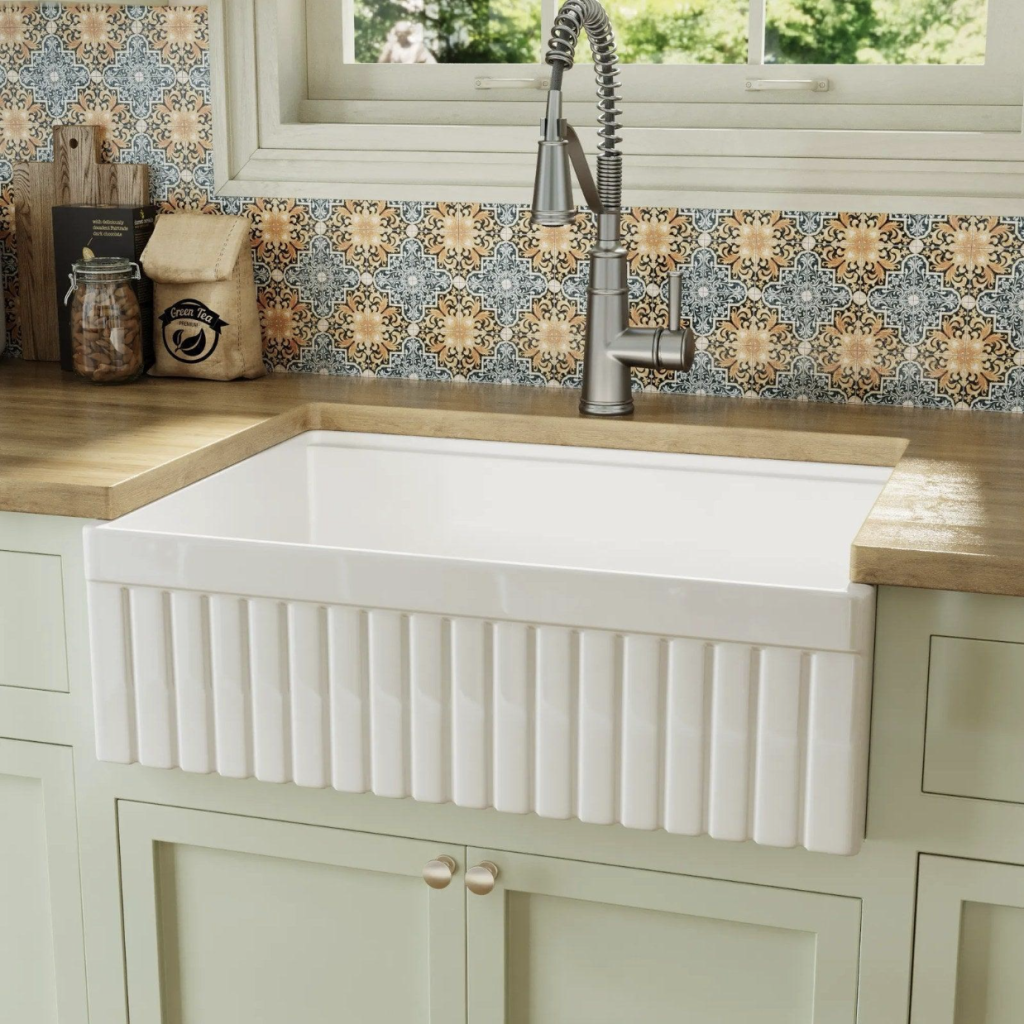
A deep single-bowl farmhouse kitchen sink fixes the sheet pan, and it does something else people tend to underestimate. Because the front panel sits forward of the cabinet line, you lean over less to reach the bottom. You notice that around the tenth plate, not the first.
Two practical notes before you fall for a photograph. Measure the inside of your cabinet rather than the outside, because a 30-inch sink generally wants a 33-inch base and a 33-inch sink wants a 36. And remember that fireclay is heavy: well over a hundred pounds before you add water. The cabinet needs a proper support frame underneath, and the countertop is templated after the sink is set and level, not before.
None of that is difficult. All of it is far easier to schedule in November than in May.
Then the closets, which are rarely a space problem
Summer houses have a particular closet problem, and it is not square footage. It is that the same rail holds four seasons and three people’s idea of what belongs there.
Guest rooms are the worst of it. A closet that works beautifully for one weekend guest collapses when a family of four arrives with wet towels and a week of luggage. Then it stays collapsed until October, because nobody wants to sort a stranger’s shelf in July.
The fix is almost always sequencing rather than joinery. Empty the room completely, put back only what genuinely lives there this season, and box the rest. Most guidance on how to organize closet space makes that point first, and for good reason. Buying storage before you edit just moves the mess into nicer containers.
Once the editing is done, be honest about permanence. A guest room in a seasonal house changes jobs more than you expect. It is an office in October, a nursery in July and a spillover room over Thanksgiving. Built-in millwork commits you to one answer. A freestanding rail or a rolling rack does not, and it can leave the room entirely when the room needs to be a room again.

Book the boat work before the shop fills up
Ask anyone who does marine upholstery when their year really happens, and they will tell you it is the winter.
That is not a slow season for them. It is the only season, because nobody hands over a boat in July.
The work arrives between haul-out and spring commissioning, and the calendar fills from the outside in. Call in February and you take whatever week is left. Call in October and you choose.
Seat cushions are the honest measure of a season. Sun, salt and wet swimsuits do in one summer what a living room sofa takes a decade to show. By September the foam has usually given up before the fabric has, which is why a cushion can look passable and still feel like a folded towel.
If the set is more than a few years old, this is the moment to price custom boat cushions rather than patch the ones you have. Bring measurements and a photograph of the boat, and be specific about how you actually use it. A cockpit that mostly hosts cocktails at the dock asks for something different than one that takes a family offshore every weekend.

Measure first, quote second
Every job on this list goes the same way, and it is worth saying out loud because most autumn projects stall in the same place.
Take the measurements yourself before you call anyone. Not because you do not trust the tradesperson, but because a quote given from a photograph is a guess, and a guess is what you end up arguing about in March.
For the kitchen, that means the interior width of the sink cabinet and the run of the counter on either side. For the closet, the rail height, the door swing and the depth once the door is open. For the boat, the cushion dimensions are taken at the widest point, plus a note on which pieces are hinged and which lift out.
Write it on one sheet, photograph the sheet, and send it with the first email. Every specialist you contact will quote faster, and the quotes will actually be comparable to one another.
What can wait until spring
Not everything belongs on the autumn list, and a good list is mostly a list of things you decided not to do.
Leave exterior paint and anything that needs warm, dry days. Leave the garden design, which you will judge badly in November when nothing is in leaf. Leave large structural decisions that you are only making because the house is empty and the silence feels like an invitation.
The autumn window suits work that happens indoors, on a known budget, with a specialist whose calendar is open. That is a narrower category than it first appears, and keeping it narrow is what makes it get done.
The case for doing it now
There is a version of this house that exists only in your head each May. In that version the closet closes, the sink handles the roasting pan, and the cockpit cushions look the way they did the year you bought them.
The distance between that house and the one you actually walked into this June was not money. It was six unclaimed months and three phone calls nobody made.
Make them this week, while the number is still fresh and the list is still short. By the time the season comes back around, none of this will be on your mind, which is precisely the point.
Author

Written by
Recent Posts
How to Pick a Homecoming Dress for Your Body Type and Feel Amazing in It
How to Prepare a Home for Sale When Major Repairs Are Not Affordable
From Everyday Comfort to Personal Style: My SHEIN Slipper Habit
5 Best Mitsubishi Heat Pump Companies in Seattle
Tech Gadgets as Modern Corporate Gifts: Useful Ideas for Employees and Clients
Categories
- Art
- Articles
- Business of Luxury
- Celebrities
- Culture
- Entertainment
- Events
- Faces of Summer 2026
- Fashion
- Fashion & Style
- Featured
- Finance
- Food, Spirits, Wine
- Hamptons
- Hamptons Celebrities
- Health
- Health & Beauty
- Lifestyle
- Luxury Lifestyle
- Press
- Profiles
- Real Estate
- Technology
- The Chronicles
- Travel
- Uncategorized
- Weddings