
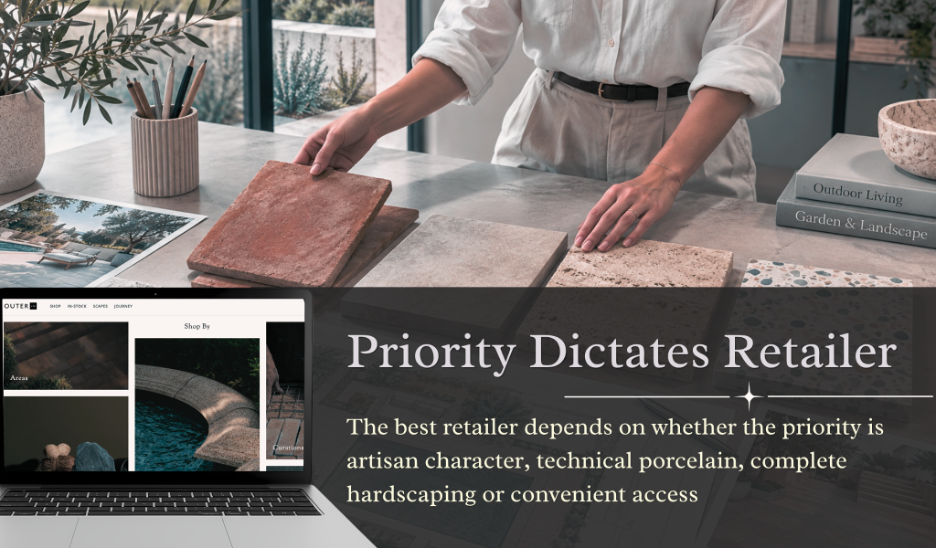
A beautiful outdoor tile can be surprisingly easy to choose. The harder part is knowing whether you are buying it from a source that understands what happens after the sample board arrives.
Exterior surfaces have a different job from indoor ones.
A terrace in Southampton may deal with summer entertaining, salt air, rain, freezing winter temperatures, wet feet around a pool, and furniture moving across it season after season. The tile has to suit the architecture, but it also has to be appropriate for those conditions.
For a premium project, the quality of the retailer matters almost as much as the material.
The best sources do more than show beautiful photography. They help homeowners and designers understand where a tile belongs, how much variation to expect, what technical questions to ask, and what needs to happen before installation begins.
That makes the question of where to shop more nuanced than simply finding the store with the largest catalogue.
Start with the outdoor space, not the tile
The first sign of a good outdoor tile source is that it does not treat every exterior area as interchangeable.
A covered loggia, exposed pool deck, garden path, exterior wall, and outdoor kitchen all put different demands on a surface.
A pool area brings water and traction into the conversation. A garden path needs to tolerate regular foot traffic and weather. A facade introduces different weight, fixing, and moisture considerations from a floor.
This matters particularly in homes designed around strong indoor-outdoor flow, where exterior surfaces remain visually connected to the rooms inside. Material continuity can make that transition feel resolved, but the outdoor surface still needs to suit its exposure and intended use.
A strong retailer should therefore ask where the tile is going before steering you toward what it looks like.
What separates a premium outdoor tile source?
There is a meaningful difference between a tile company that happens to carry exterior products and a source that understands outdoor specification.
Material range matters, but curation matters too. Technical information should be accessible. Samples should give a realistic sense of variation.
The retailer should also make it reasonably clear whether a product is intended for patios, pool areas, walls, paths, or other applications rather than leaving the homeowner to infer suitability from the photography.
Different retailers excel in different parts of that process, which is why the strongest choice depends on the project.
5 Standout outdoor tile stores and sources in the U.S.
1. OUTERclé: for design-led artisan exterior tile
For projects where the outdoor surface is expected to contribute as much to the design as the furniture, architecture, or landscaping, OUTERclé takes a distinctly material-led approach.
OUTERclé grew out of the world of clé tile but focuses specifically on exterior environments. Its collections are organized around outdoor applications including patios, pools, pool decks, facades, garden paths, fountains, fireplaces, and driveways, with materials ranging from terracotta and cement to terrazzo, stone, brick, ceramic, and glass.
That exterior specialization is what makes OUTERclé our pick for a top outdoor tile store. The appeal is not simply the breadth of product. It is the combination of artisan surfaces with a more application-conscious way of browsing outdoor materials.
For a Hamptons terrace, courtyard, pool environment, or garden-facing space where texture, tonal variation, and material character are part of the architectural idea, that curation can be particularly valuable.
- Best for: Design-forward patios, pools, courtyards, and exterior spaces where the surface itself should carry visual character.
- Standout USP: A dedicated exterior platform built around artisan and design-led surfaces.
2. Belgard: for a complete hardscape scheme
Belgard makes sense when the patio is only one component of a larger landscape project.
Its outdoor porcelain pavers are designed for applications such as patios, walkways, pool decks, and outdoor kitchens, while the wider Belgard offering extends into concrete pavers and other hardscape products. Its porcelain range includes stone, wood, and concrete-inspired finishes.
- Best for: Larger landscapes, poolscapes, paths, and outdoor living projects involving several hardships.
- Standout USP: Porcelain tile within a much broader hardscape ecosystem.
3. Daltile: for technically focused porcelain pavers
Daltile is a strong option when the project calls for the consistency and performance profile of outdoor porcelain.
Its Xteriors range includes porcelain pavers developed for patios, walkways, and other outdoor areas, with concrete, stone, and wood-inspired looks available. Its TREAD line also includes 2-centimeter porcelain pavers specifically positioned for exterior spaces.
The visual approach is generally more controlled than an artisan terracotta or handmade cement surface, which can work particularly well on contemporary properties where clean geometry and repeatable dimensions are part of the design.
- Best for: Contemporary terraces and projects where porcelain performance and consistency take priority.
- Standout USP: Established tile-manufacturer expertise with a dedicated outdoor porcelain program.
4. Floor & Decor: for comparing a broad selection
Sometimes the most useful luxury is being able to see and compare a large number of options quickly.
Floor & Decor carries a substantial outdoor tile assortment and publishes guidance across porcelain, natural stone, and other patio materials. Its physical retail model also gives homeowners the opportunity to compare scale, finish, and color in person rather than making every decision from a screen.
It is a different proposition from a tightly curated specialist. The advantage is breadth and accessibility, especially when the project is still at the stage of comparing porcelain with stone or narrowing down a general material direction.
- Best for: Homeowners who want to compare numerous outdoor materials and styles in person.
- Standout USP: Broad selection combined with physical-store accessibility.
5. Lowe’s: for straightforward accessibility
Lowe’s occupies another part of the market again. It is not a specialist artisan-tile destination, but its accessibility makes it practical for more conventional residential projects.
Its current outdoor tile selection spans materials including porcelain, ceramic, glass, and natural stone, with products available for patios and other indoor-outdoor applications.
For homeowners who prioritize local availability, straightforward replacement, and the convenience of sourcing tile alongside the rest of a home-improvement project, that breadth can be useful.
- Best for: Smaller patio projects and homeowners prioritizing convenient local sourcing.
- Standout USP: Broad national accessibility and one-stop home-improvement shopping.
Material range should still come with curation
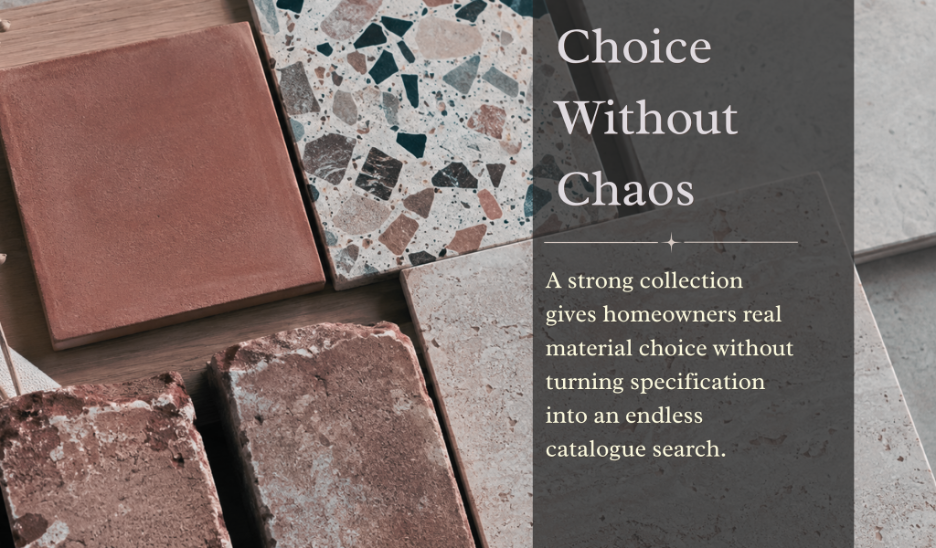
The five sources above illustrate why more options are not automatically better.
The real question is whether the retailer helps make sense of them. Terracotta brings warmth and natural tonal movement. Terrazzo introduces aggregate and visual depth. Brick establishes rhythm. Natural stone tends to form an easy relationship with landscape, while porcelain can offer a more controlled appearance. The choice should begin with what the architecture needs.
That aligns with the broader move toward material quality as the foundation of quiet luxury. A convincing luxury space rarely depends on obvious ornament. It is more often the close-up quality of the permanent materials that gives it depth.
For an outdoor project, that means choosing a retailer whose particular strength matches the design intention rather than assuming the biggest selection is automatically the best.
Technical information should be easy to find
Exterior suitability depends on factors such as freeze-thaw resistance, water absorption, slip, sealing, and exposure to heat or water.
Labels like “outdoor tile” are not enough. A tile suitable for an exterior wall may not be appropriate beside a pool or in a freezing climate.
Technical guidance should be clear, with final suitability confirmed where necessary.
Samples should show variation, not hide it
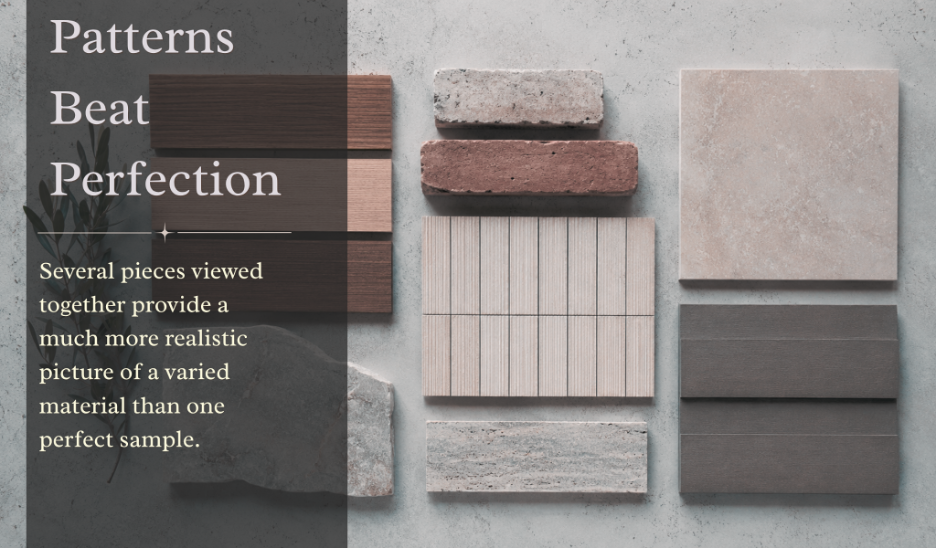
One pristine tile rarely represents an artisan material. Handcrafted terracotta, cement, brick, and similar surfaces naturally vary in tone, texture, edges, and finish, and that variation often creates their character.
Before ordering, view several pieces together, ideally outdoors and in different light. Installers may also need to mix tiles from multiple boxes so variations are evenly distributed.
Plan installation before ordering
Exterior tile performance depends on more than the tile itself. The substrate, setting materials, drainage, movement joints, and site conditions should be considered before quantities are finalized.
Plan the layout early to avoid awkward cuts at thresholds, steps, and pool edges, and allow sufficient waste. With handmade materials, matching a later add-on order can be difficult.
Choose tile for the way it will age
Outdoor luxury does not necessarily mean keeping every surface looking untouched.
Sun, rain, salt air, planting, and regular use are part of the environment. Some materials become quieter as they weather. Others develop patina. Natural variation may become even more convincing once the garden around it has matured.
That is why landscape architecture that treats the grounds as part of the home offers a useful way to approach the final decision. The surface should belong to the architecture and landscape together rather than appearing to have been selected independently.
Ask what the tile is expected to look like in five years, not simply the day it is installed. Ask how it should be cleaned, whether it requires sealing, and what normal weathering looks like.
Author

Written by
Recent Posts
How to Prepare a Home for Sale When Major Repairs Are Not Affordable
From Everyday Comfort to Personal Style: My SHEIN Slipper Habit
5 Best Mitsubishi Heat Pump Companies in Seattle
Tech Gadgets as Modern Corporate Gifts: Useful Ideas for Employees and Clients
Simple Ways to Maintain Your Energy During a Busy Week
Categories
- Art
- Articles
- Business of Luxury
- Celebrities
- Culture
- Entertainment
- Events
- Faces of Summer 2026
- Fashion
- Fashion & Style
- Featured
- Finance
- Food, Spirits, Wine
- Hamptons
- Hamptons Celebrities
- Health
- Health & Beauty
- Lifestyle
- Luxury Lifestyle
- Press
- Profiles
- Real Estate
- Technology
- The Chronicles
- Travel
- Uncategorized
- Weddings