
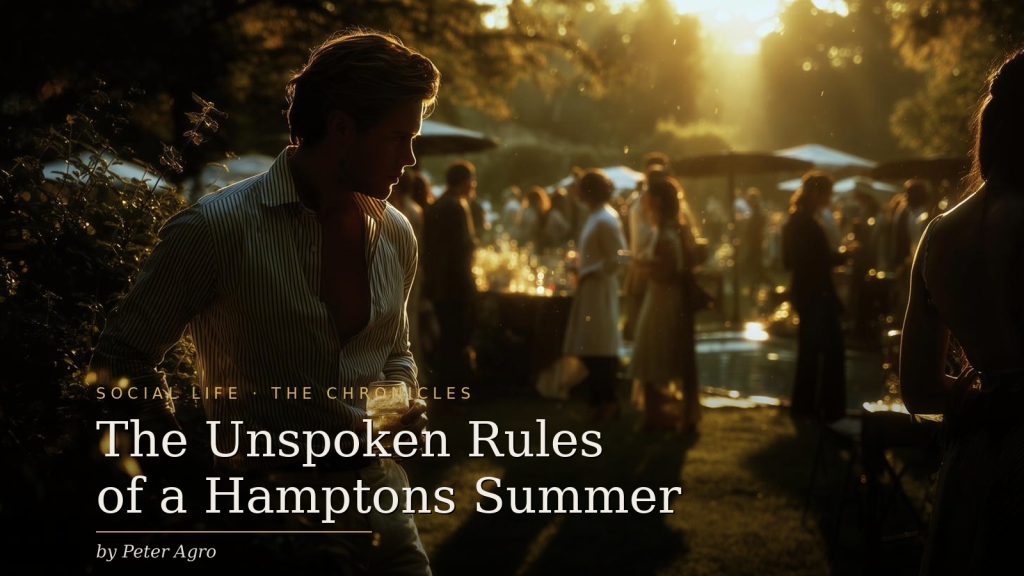
There is a particular silence that falls over a Hamptons dinner table when someone uses the word “networking” without irony. It is the silence of twelve people simultaneously deciding they will not be introducing you to anyone.
The Hamptons in summer is often described as a place. It is more useful to understand it as a grammar — a set of rules nobody prints, everybody knows, and almost no one will explain to you, least of all the people most fluent in it. You can buy the house, the boat, the table at the right benefit, and still spend an entire August feeling like a guest at your own party. The money is the easy part. The grammar is the rest.
What follows is not a calendar. There are excellent calendars elsewhere, and you should read them. This is the other thing — the part that gets transmitted by observation, slowly, usually too late to be useful. Consider it a shortcut, offered in the spirit of a man who has watched the season do its quiet sorting for long enough to find it funny.
July Is for Arriving. August Is for Belonging.
The first rule is temporal. There is a meaningful difference between the person who is out east in July and the person who is out east in August, and it is not the one newcomers assume. July is loud, ambitious, and a little anxious. It is the month of being seen. August is quieter, slower, and considerably more exclusive — not because the events are grander, but because the people still around in late August are the ones who have nothing left to prove by being anywhere in particular.
The newcomer schedules July with the intensity of a campaign. The veteran disappears for the last two weeks of August into a house you will not be invited to, and this is the entire point. Visible effort is the tell. The season rewards those who appear to be doing the least.
The Dinner Party Outranks the Gala. It Is Not Close.
A benefit ticket is available to anyone with a credit card and a reason to want one. That is its function, and it is an honorable one — the causes are real and the money matters. But understand what a gala ticket signals: that you paid for the right to be in the room. It is a door that opens for everyone.
The dinner party is the opposite. Twelve seats, no price, no website, no way to acquire one except to be wanted at the table. This is the actual currency. You can attend every benefit on the South Fork and remain, socially speaking, a tourist. One standing invitation to a particular house in Sagaponack on a Sunday means more than a summer of galas, and everyone at those galas knows it, which is why so many of them are quietly maneuvering for exactly that.
The most expensive thing in the Hamptons is the seat that isn’t for sale.
The Hamlets Are Personalities. Choose Accordingly.
It is a mistake to say you summer “in the Hamptons,” the way it is a mistake to say you are “from Europe.” The hamlets are not interchangeable, and the one you choose says more about you than you may intend.
Southampton is polished, established, and slightly formal — old money that does not need to discuss itself. Sag Harbor is the chic compromise, where the creative class and the moneyed class have agreed to admire each other. East Hampton is the postcard, beautiful and aware of it. And Montauk is where everyone goes to insist they are not the kind of person who cares about any of this, an insistence that is itself a kind of caring. None is better. But they are not the same, and pretending otherwise marks you faster than almost anything else.
Philanthropy Is the One Thing You Cannot Fake
Here is the rule that actually matters, dressed up as the one that matters least. The deepest social proof available out east is not the car, the house, or the table. It is the length of your commitment to a cause that predates your liquidity. The families who have given to the same conservation society or arts institution for thirty years occupy a position no amount of recent generosity can purchase, because the currency is time, and time is the one asset that cannot be acquired in a hurry.
This is genuinely good news, and the only sincere advice in this entire piece: the fastest way into the real Hamptons is also the least cynical one. Pick a cause you actually care about. Show up for it before it is fashionable to, and keep showing up after the photographers leave. It is the rare social strategy that works precisely because it stops being a strategy.
The People With Nothing to Prove
If you watch closely — and the season rewards watching — you begin to notice that the people with the most standing are almost never the ones performing it. They arrive a little early, because they are not worried about an entrance. They introduce other people generously, because their own position is secure enough to spend. They ask you questions and remember the answers. They are, in a word, relaxed, and their relaxation is the most enviable thing in any room.
I have watched a man at a benefit explain, at length, the importance of his foundation to a woman who turned out to have founded three of them. She let him finish. That restraint — that refusal to win a conversation that did not need winning — is worth more out here than anything you can park in a driveway.
The Hamptons sorts everyone, eventually, into the people who needed you to know and the people who never had to mention it. The grammar is learnable. But the first rule, the one underneath all the others, is the hardest for the ambitious to hear: stop trying to be seen, and start being worth knowing. The season takes care of the rest.
Author

Written by
Recent Posts

The New York Women’s Foundation’s 2026 Neighborhood Dinner

Marco Maranghello

The Baker House 1650
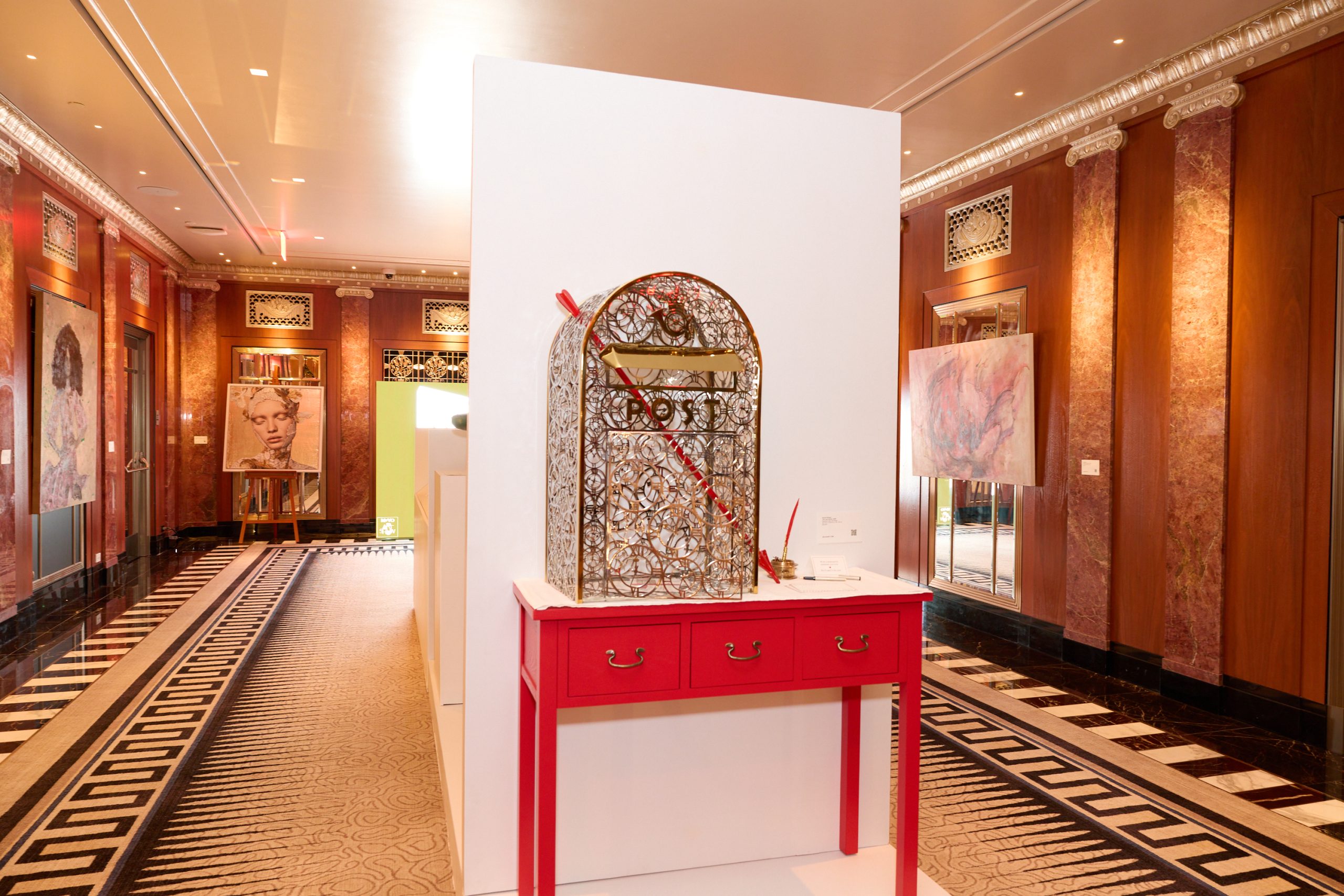
MvVO ART Show

Casita Maria Center for Arts and Education
Categories
- Art
- Articles
- Business of Luxury
- Celebrities
- Culture
- Entertainment
- Events
- Faces of Summer 2026
- Fashion
- Fashion & Style
- Featured
- Finance
- Food, Spirits, Wine
- Hamptons
- Hamptons Celebrities
- Health
- Health & Beauty
- Lifestyle
- Luxury Lifestyle
- Press
- Profiles
- Real Estate
- Technology
- The Chronicles
- Travel
- Uncategorized
- Weddings