
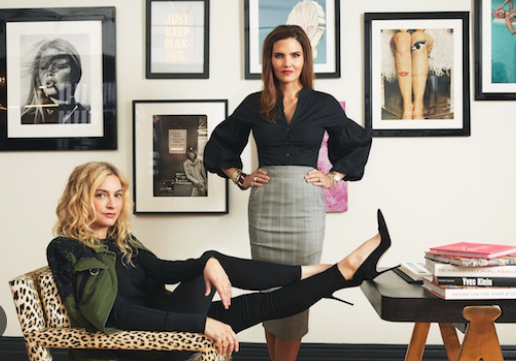
The counterintuitive thing about Veronica Beard net worth — estimated north of $175 million by market analysts tracking the brand’s trajectory toward $250 million in annual sales — is where the founders chose to put their biggest store. Not Madison Avenue. Not Rodeo Drive. And not the Meatpacking District flagship that announces a brand has arrived. Instead, in May 2021, Veronica Miele Beard and Veronica Swanson Beard opened a 2,562-square-foot permanent boutique on Main Street in Southampton. Notably, it was the largest location in their entire portfolio at the time of opening. Yet that decision was not sentimental. It was diagnostic.
The Before
They grew up in different versions of American money, or its absence. Veronica Miele Beard was raised in North Caldwell, New Jersey, by a single mother. She graduated from Franklin & Marshall College, spent a semester in Florence, and moved directly to Wall Street, where she worked equity sales and trading at multiple investment banks. A brief detour through advertising sales at Vogue — for Ron Galotti — ended when Philippe Laffont asked her to help him launch Coatue Management, a technology-focused hedge fund. Eventually, she became partner and COO. Indeed, she understood capital allocation before she owned a single garment.
Veronica Swanson Beard grew up in San Francisco and Naples, Florida, as an heir to the Swanson frozen-food fortune. Subsequently, she attended Tulane, then Parsons School of Design. Later, she worked in wholesale for Narciso Rodriguez and Alberta Ferretti, then became a buyer for Marissa Collections in Florida. Now she says, plainly, that if she were not designing clothes, she would be flipping real estate and designing interiors. The two women had never met. They had the same first name. Neither of them found this significant yet.
The Pivot Moment
They were seated next to each other at a family wedding in 2002. By then, Veronica Swanson Beard had met her future husband and her future business partner at the same table. Indeed, they were brothers. The two Veronicas became sisters-in-law. Subsequently, they started spending time together at family gatherings. Moreover, the conversation kept returning to fashion — specifically, to what was missing from it.
Eventually, the missing thing had a name. For example, men had a uniform: the suit, the tie, the walk into any room fully dressed without twenty minutes of decision-making. Women had nothing equivalent. No garment designed to travel from morning to evening, boardroom to school pickup, without asking its wearer to change first. The two Veronicas sat in Swanson Beard’s New York City apartment with a rack of samples, eight children between them at various stages of infancy, and a concept borrowed from 1840s men’s fashion: the dickey. A detachable shirtfront designed to give the appearance of a full collar without the weight of one. Reimagined as an interchangeable insert zipped into a tailored blazer, it became the Dickey Jacket.
Meanwhile, Miele Beard announced mid-launch that she was pregnant with her fifth child. The rack of samples stood in the apartment. The brand was called Veronica Beard. Both names fit. Neither felt like a compromise.
The Climb
Saks Fifth Avenue was the first major door. Additionally, by 2012, the brand was in 62 stores. By 2013, it was in 82, with year-over-year sales growth of 30 percent. Between 2016 and 2019, sales increased at an average annual rate of 90 percent and headcount tripled. In 2018, revenue crossed $100 million. Furthermore, the brand expanded from a single retail location in August 2016 to 42 stores in under a decade. Notably, retail executive Andrew Rosen backed them. The Business of Fashion projected they would reach $250 million in revenue.
They have eight children between them. Every collection is designed from the perspective of a woman who has six hours to do ten hours of work, and knows it.
The Hamptons Chapter: Permanent Real Estate as Market Statement
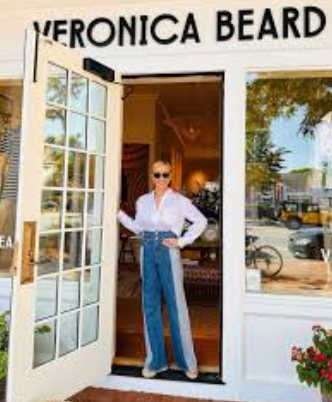
Most fashion brands treat the Hamptons as a summer rental — a seasonal pop-up with a premium address and a Labor Day expiration date. Veronica Beard made a different calculation. On May 20, 2021, they opened a permanent boutique at 84B Main Street in Southampton. The store was 2,562 square feet. Indeed, it was the largest Veronica Beard location in the world at the time of opening, a fact noted by WWD, and not incidental to the decision.
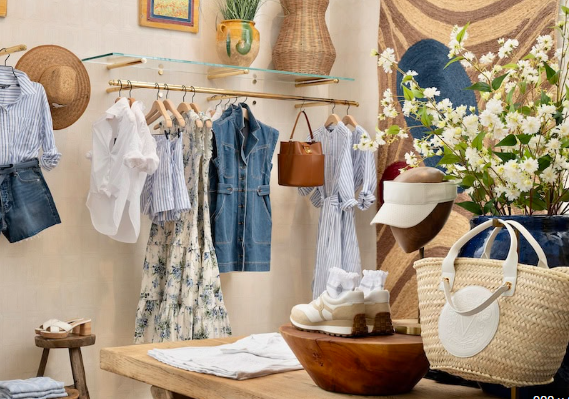
The interior carried floral photographs from Claiborne Swanson Frank’s Flower series throughout. Furthermore, Namay Samay fabrics from India provided the warmth; Samuel & Sons fringe lined the curtains. The store offered the brand’s full ready-to-wear, denim, and footwear collections alongside curated third-party products. It was designed by Carolina de Neufville, the brand’s go-to collaborator. Moreover, it did not look like a seasonal shop hedging its bets. It looked like someone who intended to stay.
The Market That Already Knew Them
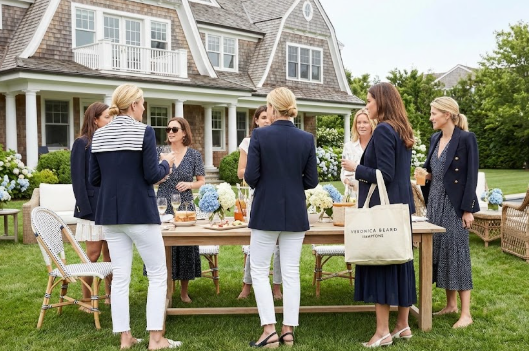
The East Hampton store followed at 66 Newtown Lane in 2024, becoming the brand’s 35th retail location globally. Its interiors — coffered wood wallpaper, vintage pieces, floral textiles — carry the same de Neufville register: coastal warmth without seasonal apology. Both stores host a rotating calendar of trunk shows: Sylvia Toledano, Julia Amory, The Mahjong Line. Rather, the stores are not boutiques that happen to be in the Hamptons. They are community infrastructure.
Veronica Miele Beard has said of the Southampton opening: “Southampton has been our family’s summer destination for the last 20 years.” That line, delivered to press, contains a piece of information most brands spend a decade trying to manufacture. They were already the customer. The store was not research. It was recognition.
The diagnosis the Hamptons offers is this: they did not arrive to be seen in a new market. Instead, they opened their biggest store in a place they already lived. That is a different relationship to a location than any pop-up can simulate — and the Hamptons fashion market knows the difference immediately. Similarly, LoveShackFancy built that same credibility through trunk shows before it had a single storefront. Likewise, Zimmermann built it through private dinners before it had a US flagship. TWP built it by returning after losing everything. The method differs. The prerequisite — showing up as someone who belongs, not someone who bought a ticket — does not.
What Veronica Beard Built — and What It Cost
Veronica Beard net worth, while not publicly disclosed as individual founder figures, reflects a business Growjo estimates at $175 million in annual revenue, with Business of Fashion projecting the brand at $250 million in sales and market observers tracking its approach toward $400 million. Notably, the brand operates 42 stores worldwide. Every one of them is profitable — an assertion Swanson Beard made publicly at the WWD CEO Summit and has not had occasion to retract. Furthermore, the brand is backed by retail executive Andrew Rosen. Additionally, both founders hold CFDA membership. The Madison Avenue flagship opened and Swanson Beard called it “the physical manifestation of all of our hopes and dreams.” She said it to CBS News without apparent irony.
Miele Beard, who left a COO position at a billion-dollar hedge fund to start this company in her sister-in-law’s apartment, does not discuss what the transition cost in the years when it was not yet obvious it would work. She discusses the next collection.
Where They Are Now
The brand now operates 42 stores across the United States, United Kingdom, and Canada, with a Galeries Lafayette Haussmann pop-up in Paris running through late 2025 and a permanent flagship there planned for 2026. Swanson Beard told the WWD CEO Summit that Paris is the “gateway to Asia” — meaning the international expansion she has been building toward since 2021 is now executing on schedule, which is the way she says most things. Miele Beard, for her part, says the handbag business will eventually be as large as the ready-to-wear, possibly larger. She says it the way someone says something they have already stress-tested against five years of inventory data.
In Southampton, the store at 84B Main Street is open year-round, not seasonally. The hours do not shorten after Labor Day. Moreover, the staff is trained in clienteling — the brand’s word for knowing your customer’s sizes, upcoming events, and preferred silhouettes before she walks in. This is retail built for someone whose time is the scarcest resource she has. Indeed, it is structurally the same proposition the Dickey Jacket offered in 2010: do not ask her to do the work. Do it for her, in advance, and have it ready when she arrives.
The Constraint Was Always the Product Brief
A single mother in North Caldwell, New Jersey understood scarcity before she had a word for it. Meanwhile, a daughter of California and Florida understood exactly how women spent their money on clothes, and exactly what they never found. Ultimately, the largest store in the portfolio sits in the town where they already knew everyone. The constraint, it turns out, was always the product brief. It just took fifteen years and forty-two locations to make that legible.
For more on the founders shaping the Hamptons, explore the full celebrity and brand archive at SocialLifeMagazine.com. If this story made you wonder whether Social Life could tell yours — that question is already worth a conversation.
Also in this series: Rebecca Hessel Cohen & LoveShackFancy · Zimmermann Net Worth · Trish Wescoat Pound & TWP · Revolve & Jacquemus in the Hamptons · The Full Challenger Series
Feature your brand: Contact Social Life Magazine — we connect luxury brands with the audiences that close.
The East End’s premier sporting event: Polo Hamptons — sponsorships, VIP access, and brand activations where the Hamptons actually convenes.
Get the Hamptons insider list: Subscribe to Social Life Magazine — 23 years of the East End, delivered to your door.
Support independent Hamptons journalism: Donate $5
Author

Written by
Recent Posts
7 Mindful Meal Prep Tips for Stop Food Waste Day

Rebecca Ferguson Net Worth: The Advantage of Not Being the Lead
What Makes a Dinner Party Truly Unforgettable (Hint: It’s Not the Food)
Tips for Managing Grease and Oil in Everyday Dishwashing
Austin Butler Net Worth: The Method Actor in a Post-Method World
Categories
- Art
- Articles
- Beauty & Skincare
- Celebrities
- Celebrities|Entertainment
- Celebrities|Television
- Celebrities|The Chronicles
- celebrities|the-archive
- Chronicles
- Entertainment|Culture
- Event Photos
- Events
- Fashion
- Fashion & Style
- Featured
- Food & Beverage
- Food, Spirits, Wine
- Hamptons
- Hamptons Celebrities
- Hamptons Celebrities|Celebrities|The Chronicles
- Health
- Health & Beauty
- Lifestyle
- Luxury Lifestyle
- Movies
- Press
- Profiles
- Real Estate
- Technology
- The Chronicles
- Travel
- Uncategorized
- Weddings