
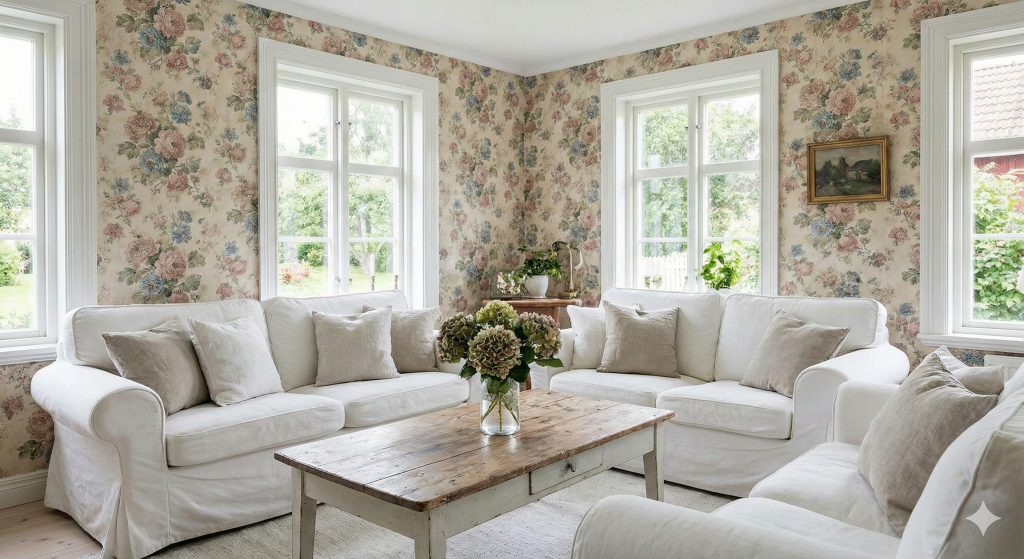
The Southampton designer paused mid-consultation, her finger tracing the faded rose pattern climbing a dining room wall. “This paper,” she said, “was hung in 1962. The family shipped it from London.” Her client wanted to rip it down. Install something fresh. The designer’s response: “Touch this and you erase sixty years of provenance.” That wallpaper—hand-blocked, slightly yellowed at the seams—was worth more than the kitchen renovation budget. Not because of the material. Because of what it signaled.
Vintage floral wallpaper has returned to Hamptons cottages with force. However, this revival isn’t about nostalgia. It’s about information asymmetry. The difference between a room that reads “decorated last season” and one that whispers “inherited this” comes down to specific patterns, specific houses, and specific choices that most decorators get wrong.
The Hidden Market for Vintage Floral Wallpaper
The floral wallpaper market operates on a tiered system that separates casual decorators from serious collectors. At the entry level, digitally printed reproductions run $50 to $150 per roll. Serviceable. Forgettable. Meanwhile, the serious conversation starts around $300 per roll for archival reproductions from heritage manufacturers. Subsequently, hand-painted silk panels from houses like de Gournay or Gracie command $500 to $2,000 per panel—with full room installations routinely exceeding $60,000.
What drives these premiums? Craftsmanship, certainly. Each de Gournay panel requires weeks of work from artisans trained specifically in 18th-century Chinoiserie techniques. Nevertheless, the real premium attaches to provenance and pattern selection. Certain vintage floral wallpaper designs telegraph generational wealth. Others telegraph a trip to HomeGoods.
The grandmillennial trend—celebrating pre-1950s patterns with modern sensibilities—has accelerated this bifurcation. Interior design analysts note that vintage botanical motifs now dominate contemporary wallpaper searches, consistently outperforming geometric and abstract patterns. Consequently, authentic vintage patterns have become investment-grade decorative assets.
What Hamptons Designers Know About Floral Patterns
Walk through any Southampton estate sale and you’ll notice something peculiar. The wallpapers that survive—really survive, across decades and ownership changes—share specific characteristics. First, scale. Patterns with 18-inch or larger repeats photograph beautifully but overwhelm cottage-scale rooms. The papers that endure in Hamptons cottages typically feature 8 to 12-inch repeats, creating visual interest without claustrophobia.
Second, ground color. Cream and ecru backgrounds age gracefully. Bright whites yellow. Pale blues fade. Therefore, experienced Hamptons designers source vintage floral wallpaper with warm ivory or tea-stained grounds that will develop patina rather than damage.
Third, motif selection. Roses translate universally. Peonies signal sophistication. Wisteria suggests Asian influence. However, mixed bouquets without a clear focal flower often read as “grandmother’s attic” rather than “inherited estate.” The distinction matters enormously at resale.
Local designer Betty Wasserman, whose work spans Southampton, East Hampton, and Bridgehampton, emphasizes color harmony between wallpaper and surrounding elements. Her philosophy centers on pulling specific shades from chosen papers to inform paint selections and textile choices throughout a space. This approach transforms vintage floral wallpaper from accent to anchor.
Authentication and Red Flags Every Buyer Must Know
The vintage wallpaper market has a counterfeit problem. Specifically, digital reproductions marketed as “vintage-style” or “heritage-inspired” flood online marketplaces. Distinguishing authentic vintage floral wallpaper from modern imitations requires examining several tells.
First, check the selvedge edge. Authentic vintage papers often feature printed pattern numbers, manufacturer marks, or lot codes along unused edges. Modern reproductions rarely replicate these details. Additionally, vintage papers typically show minor variations in color registration—evidence of hand or early mechanical printing. Perfect alignment suggests digital production.
Second, feel the substrate. Pre-1970 papers used different base materials than contemporary alternatives. Authentic vintage papers often feel slightly thicker and more fibrous. They may also exhibit subtle texture from wood pulp content. Conversely, modern papers feel smoother and more uniform.
Third, verify provenance documentation. Reputable dealers provide authentication paperwork noting approximate age, manufacturer when identifiable, and acquisition history. Subsequently, papers salvaged from notable properties carry significant premiums. Documentation matters.
For authentication services, established auction houses like Christie’s and Sotheby’s maintain decorative arts specialists. Furthermore, specialty dealers at 1stDibs verify items before listing. Expect authentication costs ranging from $100 to $500 for significant pieces.
Where to Source Vintage Floral Wallpaper in the Hamptons
The Hamptons corridor offers multiple sourcing channels for serious collectors. For archival reproductions, Schumacher maintains design relationships stretching back 130 years. Their Chinoiserie collection includes papers originally commissioned for the White House by Jackie Kennedy. Furthermore, their Citrus Garden and Chiang Mai Dragon patterns have become contemporary classics.
De Gournay operates showrooms in New York with bespoke consultation services. Their Nantucket-inspired scenic wallpaper pays homage to the wind-swept aesthetic familiar to East End homeowners. Each commission requires 12 to 16 weeks production time, with prices starting around $600 per panel before customization.
For vintage originals, English Country Antiques in Bridgehampton and Ruby Beets in Sag Harbor occasionally stock salvaged papers from estate clearances. Additionally, estate sales managed by firms like Stair Galleries and Doyle New York feature decorative arts including wallpaper lots.
Local installation requires specialists. On Call Wallpaper, a family-owned operation based in East Hampton, offers concierge services including sourcing assistance and expert hanging for delicate vintage materials. Furthermore, Hampton Craft in Southampton maintains a reputation for precision work on high-end installations.
The Investment Angle: Appreciation Patterns
Vintage floral wallpaper occupies an unusual position in the decorative arts market. Unlike furniture or art, installed wallpaper typically depreciates through wear. However, documented panels, unused rolls, and wallpaper from provenance properties appreciate meaningfully.
According to industry research, the luxury interior design market reached approximately $62.8 billion in 2023 and projects growth to $130 billion by 2033—a compound annual rate exceeding 7 percent. This expansion reflects broader trends toward personalization and heritage aesthetics that favor vintage materials.
Additionally, Bain & Company’s luxury market research indicates consumers increasingly prioritize craftsmanship and durability over novelty. Consequently, hand-produced wallpapers from established houses represent both decorative choices and investment-grade assets.
Storage requirements remain straightforward. Unused rolls should lie flat in acid-free tissue, away from light and humidity fluctuations. Installed papers benefit from UV-filtering window treatments and climate control. Furthermore, professional photography and documentation support future valuation.
The Maximalist Return: Beyond Minimalism
The minimalism that dominated Hamptons interiors from 2015 through 2022 has exhausted itself. White walls. Neutral textiles. Restrained color palettes. These choices initially signaled sophistication. Now they signal a lack of imagination—or worse, a fear of commitment.
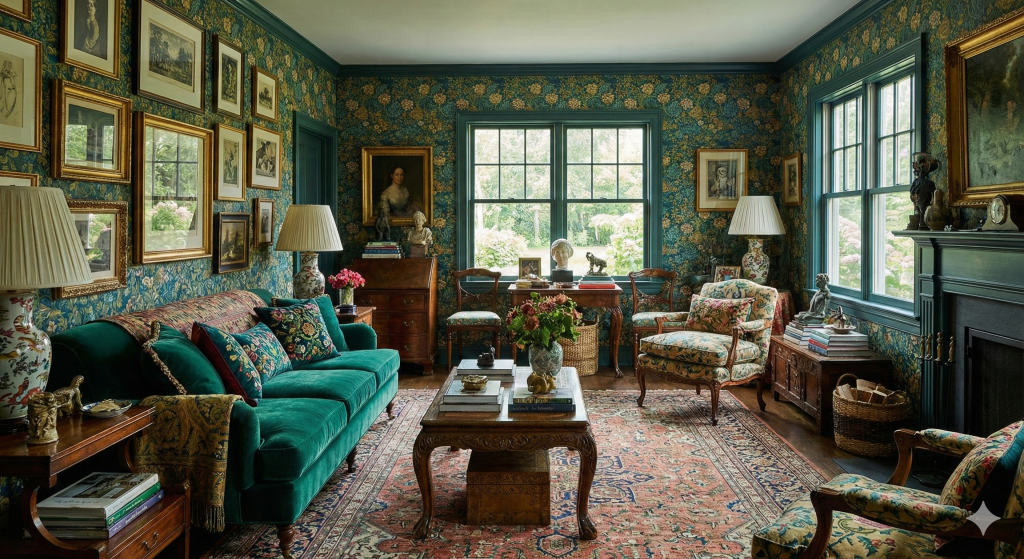
Vintage floral wallpaper anchors the maximalist revival sweeping East End cottages. Design experts describe this shift toward “papers with personality”—illustrative, handcrafted patterns that reflect individual taste rather than algorithm-approved neutrality. Subsequently, the most sought-after interiors layer pattern upon pattern: floral walls meeting striped upholstery meeting botanical textiles.
Farrow & Ball’s Purnon Papers collection exemplifies this trajectory. Inspired by five patterns uncovered at an 18th-century French château, the collection reinterprets historical designs for contemporary spaces. Similarly, traditional block-printed florals from manufacturers like Adelphi Paper Hangings—which fabricates historic reproductions—resonate with homeowners seeking authenticity over trend.
The key to successful maximalism lies in confident curation. Rooms that sing layer complementary patterns without competing focal points. Furthermore, the scale and ground color coordination principles apply doubly when mixing multiple floral patterns within a single space.
Selecting Patterns That Signal Inherited Taste
Not all vintage floral wallpaper patterns carry equal weight in status signaling. Certain designs telegraph generational wealth. Others suggest recent acquisition. The distinction centers on recognition and restraint.
Patterns to embrace: Toile de Jouy featuring pastoral scenes in single colors against cream grounds. Classic damask florals in muted burgundy or forest green. Chinoiserie garden scenes with birds, butterflies, and branching motifs on aqua or ivory silk. Small-scale ditsy prints in heritage colorways. These patterns appear in documented estate photographs spanning decades. Their presence implies continuity.
Patterns to avoid: Large-scale tropical florals better suited to resort hotels. Bright contemporary colorways on traditional motifs. Metallic grounds that scream “recent purchase.” Anything described as “boho” or “farmhouse” in marketing materials. These patterns date quickly and undermine authenticity.
The ultimate test: Does this pattern appear in Architectural Digest archives from the 1970s through 1990s? If yes, proceed. If no, reconsider carefully.
Installation Considerations for Cottage Spaces
Hamptons cottages present specific challenges for vintage floral wallpaper installation. Salt air accelerates adhesive breakdown. Humidity fluctuations cause paper expansion and contraction. Additionally, older plaster walls may require extensive preparation before hanging.
Professional installers recommend Roman Pro 977 Ultra Prime or equivalent primers for glossy or textured surfaces. Furthermore, walls should cure completely after any skim coating before paper application. Rushing this stage guarantees bubbling and seam separation within months.
For valuable vintage papers, consider panel mounting rather than direct wall application. Panels can be removed, transported, and reinstalled without damage—protecting your investment across property changes. Subsequently, this approach also simplifies future restoration if paper damage occurs.
Total installation costs in the Hamptons typically run $8 to $15 per square foot for standard papers, with premium materials and complex patterns commanding $20 to $35 per square foot. Therefore, budget accordingly for both materials and labor.
The Verdict: Decorating for Generations
That Southampton dining room still wears its 1962 roses. The client, initially skeptical, now refers to the paper as her home’s “soul.” She stopped seeing wallpaper as decoration. She started seeing it as inheritance.
Vintage floral wallpaper isn’t about trends. It’s about time—specifically, about creating interiors that appear to have accumulated rather than arrived. The patterns that read “inherited taste” share common traits: appropriate scale, warm grounds, classic motifs, and impeccable installation. Furthermore, they share something less tangible: the confidence to commit to a choice that will outlast fashion cycles.
The Hamptons cottage revival rewards this commitment. Rooms dressed in thoughtfully selected vintage florals appreciate in character as they age. Rooms chasing contemporary trends depreciate the moment tastes shift. Consequently, the smart money—the quiet money—chooses patterns meant for generations. Everything else is just decoration.
For inquiries regarding Hamptons Home Design & Landscaping contact: David Hornung: david@dandjconcepts.com
Related Articles
- Luxury Real Estate Hamptons Trends: The $50M Shift Smart Money Can’t Ignore
- Eco-Friendly Luxury Homes in the Hamptons
- Southampton’s Billionaire Lane: The Ultimate Investment Trophy
Stay Connected with Social Life Magazine
Author

Written by
Recent Posts

Norm MacDonald Net Worth
Sam Kinison Net Worth

Ray Romano Net Worth

Dennis Miller Net Worth

Ellen DeGeneres Net Worth
Categories
- 2025 Social Life Events
- Access to Digital + Physical Magazine
- Art
- Articles
- Beauty & Skincare
- Beauty & Wellness
- Business Strategy
- Celebrities
- Chronicles
- Design History
- Design History|Design Trends
- Design History|Hamptons
- Design Process
- Design Process|Luxury Living
- Design Trends
- Design Trends|Hamptons
- Event Photos
- Events
- Family
- Fashion
- Fashion & Style
- Featured
- Food & Beverage
- Food, Spirits, Wine
- Hamptons
- Hamptons Celebrities
- Hamptons Design
- Hamptons Design|Design Process
- Hamptons Design|Luxury Living
- Hamptons|Luxury Living
- Health
- Health & Beauty
- Home & Design
- Home & Living
- Lifestyle
- Luxury Home Design|Design Process
- Luxury Home Design|Design Trends
- Luxury Home Design|Hamptons Design
- Luxury Home Design|Interior Design
- Luxury Lifestyle
- Luxury Living
- Luxury Living|Design Process
- Luxury Living|Hamptons
- Luxury Living|Hamptons Design
- Press
- Profiles
- Real Estate
- Technology
- The Chronicles
- Travel
- Trending
- Uncategorized
- Weddings
- Wellness