
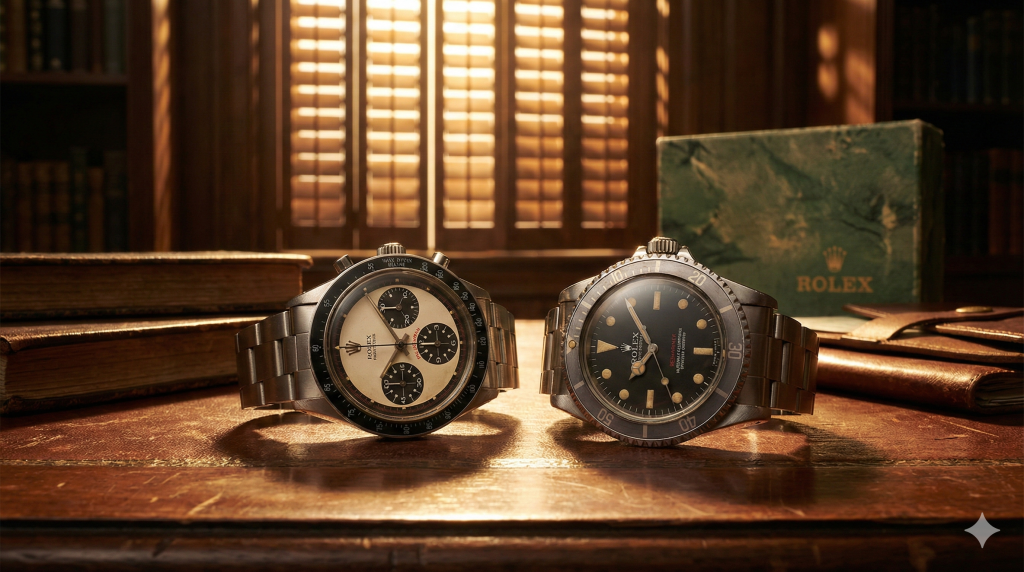
The new Rolex boutique on Newtown Lane draws lines down the block every morning. Celebrities drop by. Wall Street types make pilgrimages. Yet the serious collectors in this town aren’t waiting for allocation on a steel Submariner. They’re hunting something the authorized dealer can’t offer—vintage Rolex watches with provenance that predates Instagram, pieces their fathers wore before the waitlist became a status symbol.
Why Vintage Rolex Watches Perform Like Alternative Assets
The investment case for vintage Rolex watches rests on fundamentals that would satisfy any portfolio manager. According to research from the University of Regensburg published in 2025, luxury watches from brands including Rolex yield significant diversification benefits when added to portfolios comprising stocks, bonds, and gold. Moreover, they can outperform these traditional assets on a risk-adjusted basis. The volatility profile mirrors bonds rather than equities, while maintaining near-zero correlation with broader markets.
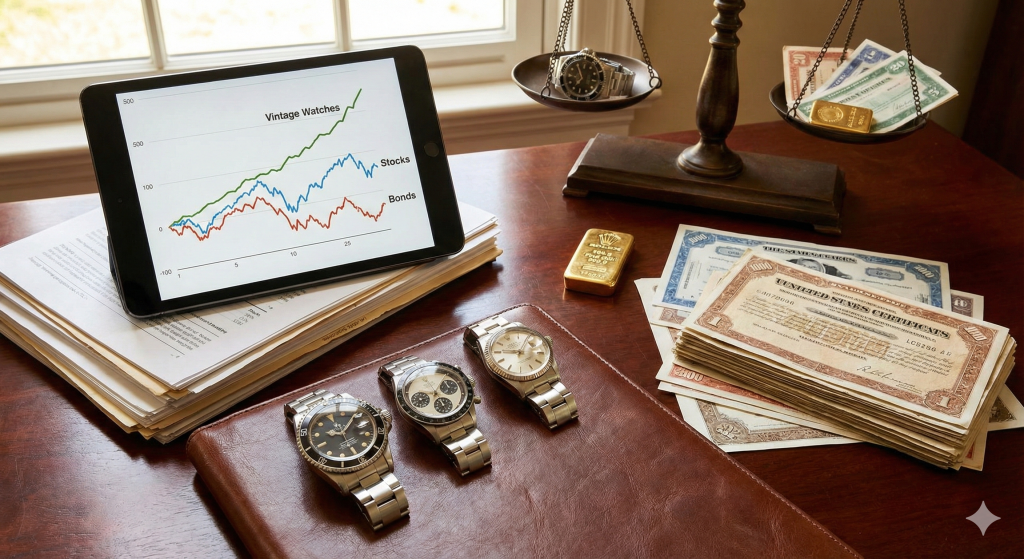
Put differently, vintage watches are largely immune to stock market turbulence. This explains why family offices increasingly view them as tangible stores of value. The Knight Frank Luxury Investment Index tracks watches alongside art, wine, and classic cars. Over the past decade, luxury timepieces appreciated 125 percent. In 2024 alone, watches gained 1.7 percent while fine art dropped 18.3 percent.
The numbers tell part of the story. If you purchased a Rolex Submariner or GMT-Master on the secondary market for around $2,000 in 2010, that same watch could now fetch more than $12,000. That represents a gain exceeding 550 percent, outperforming the S&P 500, real estate, and most conventional investment vehicles during the same period. Consequently, wealth managers who once dismissed watches as toys now recommend selective acquisitions for clients seeking non-correlated assets.
The Paul Newman Daytona: When a Gift Becomes $17.8 Million
No discussion of vintage Rolex watches as investments begins anywhere except with Paul Newman’s personal Daytona. In 1968, his wife Joanne Woodward gave him a Rolex Cosmograph Daytona reference 6239, engraving the caseback with “Drive Carefully Me”—a gentle warning about his racing hobby. Newman wore it constantly for years. Then, in an act of casual generosity that now seems almost absurd, he gave it to James Cox, his daughter’s boyfriend who was building a treehouse at the time.
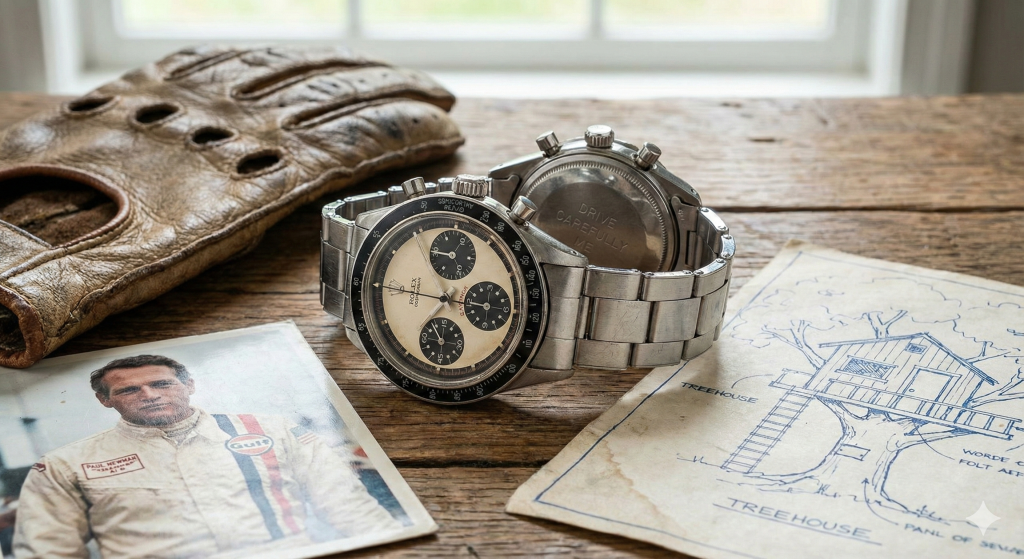
Cox held the watch for decades. At the time Newman handed it over, similar Daytonas sold for roughly $200. When Cox finally consigned it to Phillips auction house in 2017, the watch world held its breath. After a 12-minute bidding war that opened with a staggering $10 million phone bid, the gavel fell at $17,752,500. It remains among the most expensive wristwatches ever sold at auction.
The Newman story illustrates something essential about vintage Rolex watches as investments. The value didn’t derive from gold content or mechanical complexity. It came from provenance, rarity, and cultural resonance. Every collector who pursues a “Paul Newman” dial—those exotic configurations with art-deco numerals and contrasting subdials—chases a piece of that mythology. References 6239, 6241, 6263, and 6265 with these dials now command $150,000 and higher at auction.
What Hamptons Collectors Actually Buy
Walk into London Jewelers new Rolex boutique in East Hampton and you’ll find contemporary references displayed in walnut-paneled elegance. The space occupies a restored 1897 summer cottage, transformed into 4,800 square feet of horological theater. Mark Wahlberg and John Mayer have reportedly stopped by. Nevertheless, the collectors who shape secondary market prices operate in different channels entirely.
Three categories of vintage Rolex watches consistently attract serious Hamptons money. First, pre-ceramic sport references from the 1950s through 1980s—watches with aluminum bezel inserts, tritium lume plots, and movements that predate modern calibers. These include Submariner references 5512, 5513, 1680, and 16800. The “Red Sub” 1680, featuring red “Submariner” text on the dial, currently trades between $17,550 for standard examples and $56,500 for complete sets with original documentation.
Second, vintage GMT-Master references appeal to collectors who value both aesthetics and functionality. The original “Pepsi” bezel GMT-Masters from the 1970s and 1980s, particularly reference 1675, fetch $15,000 to $25,000 depending on condition. The “Root Beer” variants in brown and gold have their own devoted following. These watches tracked multiple time zones for Pan Am pilots before Instagram influencers discovered them.
Third, and most significantly, vintage Daytona chronographs represent the apex of Rolex collecting. Even non-Newman dial examples command substantial premiums. A reference 6263 with standard dial might trade at $40,000, while the “Panda” configuration—white dial with black subdials—pushes significantly higher. The manual-wind Valjoux movements in these watches require expertise to service, which limits supply as fewer watchmakers maintain the necessary skills.
The Provenance Premium
Serious collectors understand that documentation transforms a watch from commodity to collectible. Original boxes, papers, hang tags, and purchase receipts can double a vintage Rolex’s value. A Submariner 16610 with complete kit commands $13,000. The same reference without paperwork might fetch $9,000. For rarer references, this spread widens dramatically.
Estate sales in the Hamptons occasionally surface watches with exceptional provenance—pieces purchased at authorized dealers decades ago by families who maintained meticulous records. These opportunities require expertise and timing. The families often underestimate what they possess. The dealers who specialize in such acquisitions understand exactly what complete documentation means to the secondary market.
Authentication: The Red Flags Every Buyer Must Know
The counterfeit vintage Rolex market has reached alarming sophistication. Modern “super-clone” manufacturers produce fakes that can fool casual inspection. Consequently, authentication expertise separates successful collectors from expensive mistakes.
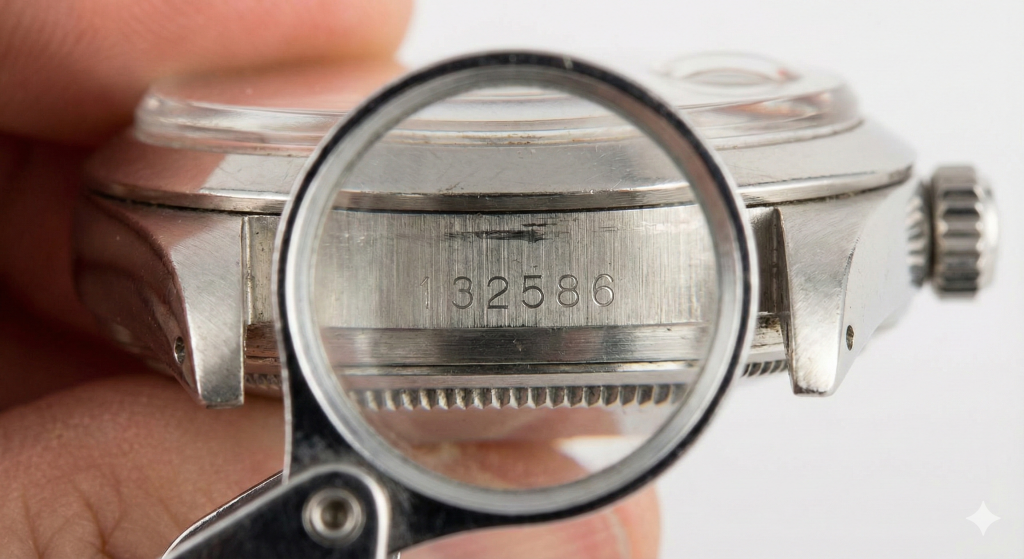
Serial and model numbers provide the first checkpoint. Every Rolex carries these engravings between the lugs at 6 o’clock, behind the bracelet. On post-2008 models, numbers also appear on the rehaut—the inner ring between dial and crystal. Genuine engravings are laser-cut with surgical precision. Fakes often show dotted, shallow, or inconsistent markings. Furthermore, counterfeiters frequently reuse the same serial numbers across multiple watches. A quick Google search of any serial number in quotation marks reveals whether it appears across multiple listings.
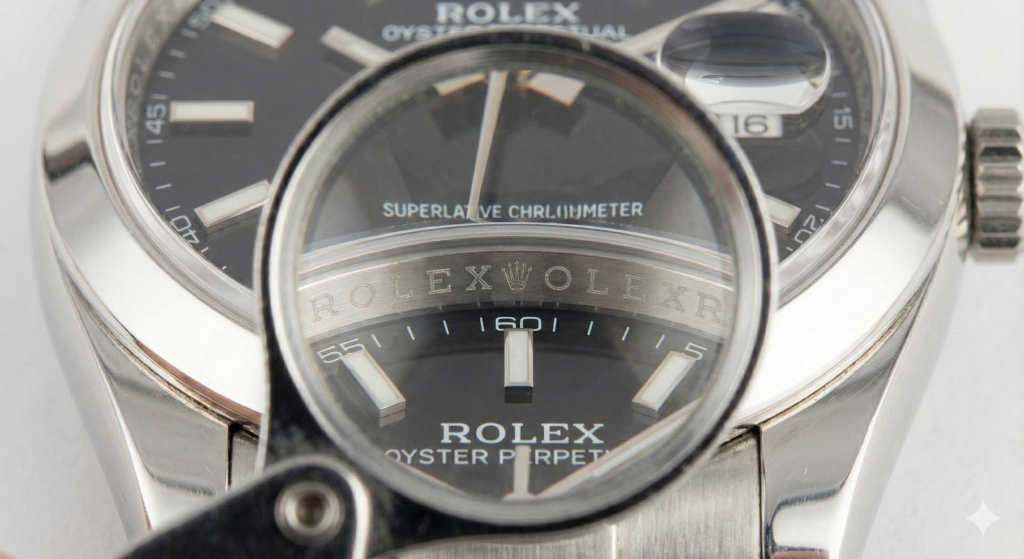
The Cyclops lens over the date window should magnify 2.5 times. Replicas typically achieve only 1.5x magnification. This remains one of the quickest authentication checks available. Additionally, genuine Rolex movements create a smooth sweeping seconds hand, not the tick-tick-tick of quartz movements. While the sweep isn’t perfectly fluid, it should never jump second by second.
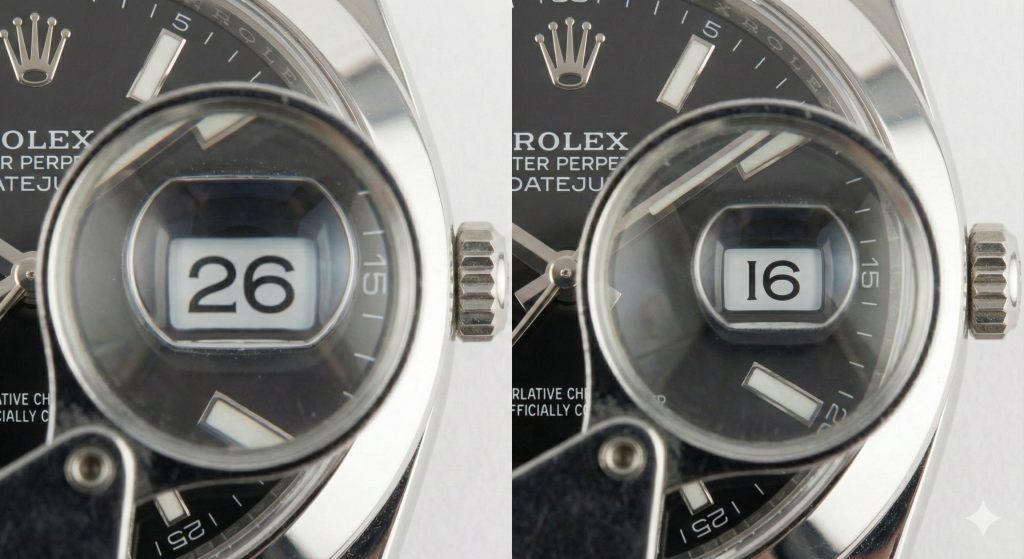
Physical Details That Expose Counterfeits
Weight provides immediate feedback. Rolex uses 904L stainless steel and solid gold construction, creating substantial heft. Stainless models typically weigh 100 to 160 grams, gold versions 190 to 220 grams, and platinum pieces up to 270 grams. A lightweight feel signals hollow construction or inferior materials.
Case backs on authentic Rolex watches are solid, smooth, and typically unmarked. The brand doesn’t produce transparent exhibition backs on standard models. Any see-through caseback is an immediate red flag. Similarly, aftermarket engravings or decorations suggest either a fake or a modified watch with diminished collector value.
The dial demands close scrutiny. Text should be perfectly spaced, straight, and consistent. Misspellings appear more often than you’d expect on counterfeits. Lume plots should be uniform in shape and application. The printing quality on genuine Rolex dials reflects decades of manufacturing refinement—any imperfection warrants suspicion.
For vintage pieces specifically, the date code system evolved over decades. Pre-1980 watches had no codes. The 1980s introduced three to four digit codes indicating year and month. By 2021, Rolex switched to microchips readable only at service centers. Importantly, date code letters must match the “Made in” country stamp. A French factory code with an Italian country stamp indicates either a Frankenwatch assembled from mismatched parts or an outright fake.
Where to Source Vintage Rolex Watches
The Hamptons offers multiple channels for vintage Rolex acquisition, each with distinct advantages and risks. London Jewelers’ Rolex Boutique at 28 Newtown Lane handles contemporary references and certified pre-owned pieces. Their expertise spans 50 years of partnership with Rolex, providing authentication assurance that independent sellers cannot match.
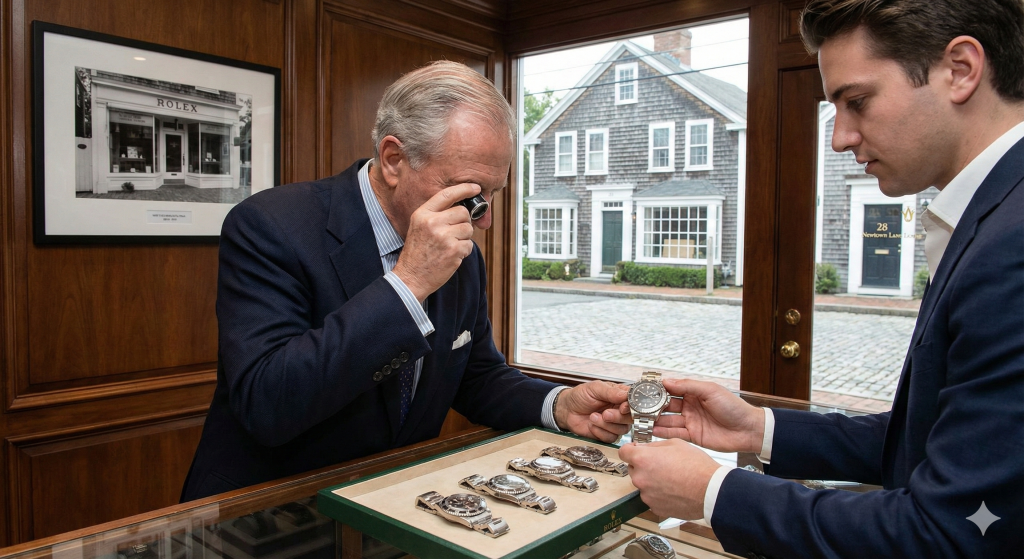
For vintage specifically, estate sales present the deepest value opportunities. Families liquidating collections from deceased relatives often lack market knowledge. A 1970s Datejust purchased for $2,000 at such sales might trade at $6,000 through established dealers. However, this channel requires expertise to assess condition and authenticity without professional support.
Authenticated Platforms and Specialists
Online marketplaces have transformed vintage watch buying. Chrono24 aggregates thousands of listings with buyer protection programs. Hodinkee curates authenticated inventory with editorial authority. Bob’s Watches, founded by Paul Altieri, has built one of the largest private collections of vintage Rolex references while maintaining retail operations.
Each platform offers different trade-offs. Auction houses like Phillips, Christie’s, and Sotheby’s provide maximum authentication rigor but charge buyer’s premiums of 12 to 25 percent. Specialist dealers offer expertise and often take pieces on consignment, but their margins reflect that service. Direct peer-to-peer sales through forums and marketplaces minimize costs but maximize authentication risk.
For collectors building serious positions in vintage Rolex watches, relationships matter enormously. The best pieces never reach public listings. Dealers call preferred clients first when exceptional references surface. Establishing these relationships requires patience, demonstrated expertise, and consistent purchasing behavior over time.
The Investment Thesis for 2025 and Beyond
Several factors support continued appreciation in vintage Rolex watches. Rolex’s retail price increases create a rising floor for secondary market values. In 2025, the brand implemented two price adjustments—a modest January increase followed by a more substantial May hike driven by tariff concerns and gold commodity prices. A basic Submariner now retails at $10,650, up from $9,100 at the start of 2024.
Supply constraints intensify as vintage references age. Each year, more pieces suffer damage, modification, or loss. The pool of original-condition examples shrinks while collector demand expands. This dynamic particularly affects references that were already rare at production—military-issue Submariners, COMEX-dial variants, and prototype configurations that never reached full production.
The secondary luxury market has matured into a $24 billion industry globally. Greater price transparency through platforms like Chrono24 and WatchCharts has increased investor confidence. Professional authentication services reduce fraud risk. Insurance products from Chubb, Jewelers Mutual, and Hodinkee Insurance provide protection that didn’t exist a decade ago.
Managing the Collection as an Asset
Treating vintage Rolex watches as investments requires infrastructure that casual collectors often overlook. Insurance represents the first necessity. Standard homeowner’s policies cap jewelry coverage at $1,000 to $5,000—laughable when a single vintage Daytona exceeds six figures. Specialized watch insurance from providers like Chubb offers worldwide coverage with no deductible, including loss, theft, damage, and mysterious disappearance.
Premiums typically run 1 to 2 percent of insured value annually. For a $50,000 collection, that’s $500 to $1,000 per year for complete peace of mind. Coverage adjusts automatically for market appreciation up to 150 percent of the insured amount. Appraisals are required only above $100,000 for most providers.
Storage demands attention. Climate control prevents moisture damage to movements. Security systems deter theft—a genuine concern given rising watch crimes in urban areas and luxury destinations. Some collectors maintain safe deposit boxes. Others install home safes rated for fire and burglary. The most sophisticated use bonded storage facilities designed for fine art and collectibles.
Documentation requires systematic maintenance. Photograph each piece with timestamps. Maintain service records showing work performed, parts replaced, and watchmaker credentials. Store purchase receipts, certificates of authenticity, and provenance documentation in both physical and digital formats. This paperwork protects resale value and supports insurance claims.
The Cultural Capital of Vintage Rolex
Investment returns matter, but they don’t explain everything about vintage Rolex watches in Hamptons culture. Warren Buffett, the second richest man in the world, has worn the same 18-karat gold Day-Date President for decades. James Gorman, the Morgan Stanley chairman, wears a stainless steel Daytona. These aren’t men who need to prove their wealth. The watches signal something else entirely—an appreciation for craftsmanship that transcends fashion cycles.
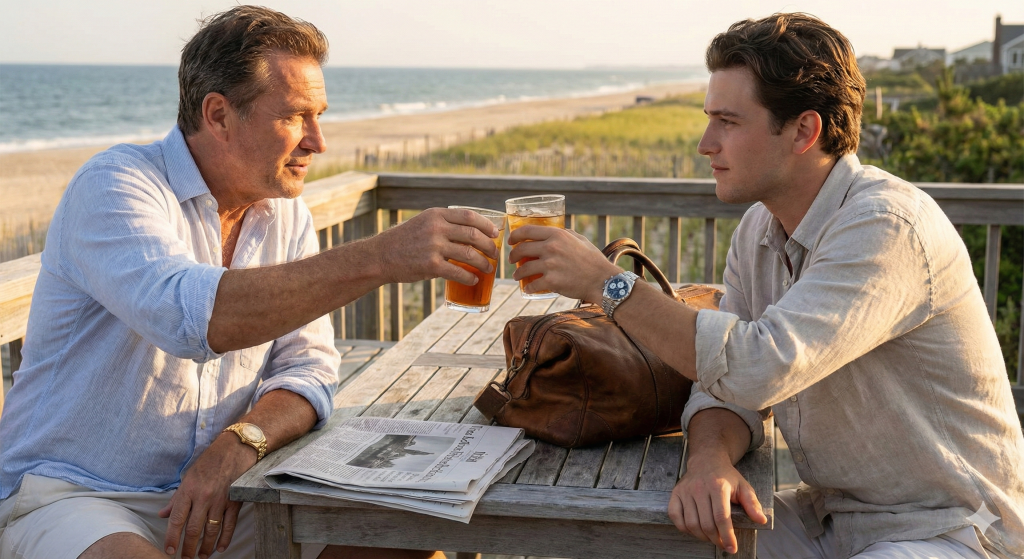
John Mayer represents the collector archetype. The musician owns reference 5517 Military Submariners, multiple Paul Newman Daytonas, COMEX-dial Submariners, and pieces with Omani Khanjar dials that most collectors will never encounter. His Hodinkee “Talking Watches” episodes reveal a depth of knowledge that commands respect in horological circles. The watches aren’t props. They’re the output of serious research and patient acquisition.
Ellen DeGeneres maintains a collection including Paul Newman Daytonas, a reference 1655 Explorer II, and “Blueberry” GMT-Masters. Eric Clapton auctioned portions of his collection over the years, including reference 6062 triple calendars in both steel and gold. These celebrities could buy anything. Their choices reflect genuine passion rather than conspicuous consumption.
In the Hamptons, vintage Rolex watches function as social currency distinct from contemporary references. The man wearing a new ceramic Submariner purchased from an authorized dealer signals purchasing power and perhaps some patience with waitlists. The man wearing a tropical-dial 1960s Submariner with faded bezel and honest patina signals something else—knowledge, taste, and the resources to compete for genuinely scarce pieces.
This distinction explains why vintage Rolex watches appreciate while contemporary models eventually reach market equilibrium. The new watch can always be manufactured again. The vintage piece exists in fixed, declining supply. One is a product. The other is an artifact.
Building a Watch Collection? Connect with our luxury lifestyle network to learn about upcoming Polo Hamptons events where serious collectors gather. Contact our editorial team for feature opportunities, or subscribe to Social Life Magazine for quarterly coverage of Hamptons collecting culture.
Related Articles
Author

Written by
Recent Posts
Amanda Peet Net Worth: The Brilliant Dinner Guest Hollywood Forgot to Invite Back
Keanu Reeves Net Worth: Infinite Losses, and the Role That Proved Kindness Compounds
Jack Nicholson Net Worth: Three Oscars, and the Role He Couldn’t Stop Playing

Diane Keaton Net Worth: The Fortune Built on Talent, Turtlenecks, and the Homes She Left Behind
Nancy Meyers Net Worth: A Filmography, an Inheritance, and the Kitchen That Sold the Hamptons
Categories
- Art
- Articles
- Beauty & Skincare
- Celebrities
- Celebrities|The Chronicles
- Chronicles
- Entertainment|Culture
- Event Photos
- Events
- Fashion
- Fashion & Style
- Featured
- Food & Beverage
- Food, Spirits, Wine
- Hamptons
- Hamptons Celebrities
- Hamptons Celebrities|Celebrities|The Chronicles
- Health
- Health & Beauty
- Lifestyle
- Luxury Lifestyle
- Movies|Hamptons Lifestyle
- Press
- Profiles
- Real Estate
- Technology
- The Chronicles
- Travel
- Uncategorized
- Weddings