
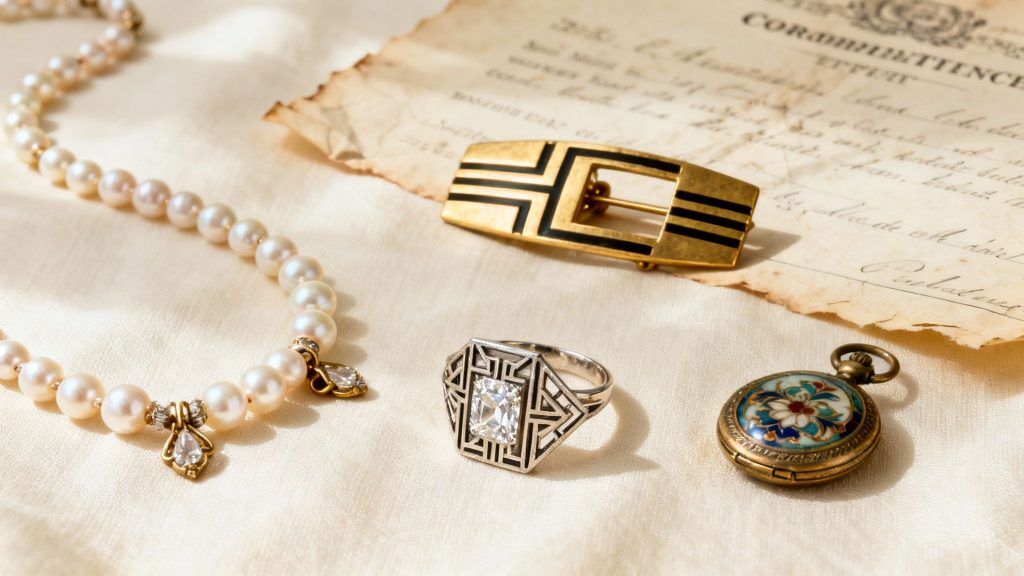
The term "estate jewelry" often evokes images of heirlooms secured within a family vault. While this is part of its definition, the reality is far more comprehensive. In essence, estate jewelry is any piece that has been previously owned, serving as an elegant, all-encompassing term for jewelry with a past.
This is not about the origins of the piece but rather its story, history, and craftsmanship. These items are best viewed not merely as accessories, but as wearable art that has journeyed through time.
What Is Estate Jewelry? A Journey Through Time
The "estate" in estate jewelry signifies that it originated from another individual's possession or "estate." The age of the piece is not the defining factor; a piece can be 10 or 100 years old. A dazzling Art Deco diamond ring from the 1920s and a bold gold necklace from the 1990s both fall under this broad category.
What distinguishes these pieces from modern, mass-produced items is their tangible connection to the past. Each ring, bracelet, or brooch carries a unique story, reflecting the design trends and masterful skills of its era. This inherent history is what transforms them from mere objects into cherished artifacts.
The appeal is substantial. The global market for estate and antique jewelry was valued at approximately $4.2 billion as of 2025, a figure that highlights the collective desire for pieces with provenance. For those interested, one can explore more about this growing market and its global segmentation.
The Allure of Pre-Owned Treasures
What motivates a consumer to choose a piece with a history over a new item? The appeal lies in several key areas where vintage and antique pieces excel.
- Unmatched Craftsmanship: Many older items were meticulously handcrafted by artisans who dedicated a lifetime of skill to their work. This results in a level of detail and quality rarely seen in contemporary mass production.
- One-of-a-Kind Designs: Estate jewelry provides an opportunity to acquire something truly unique. It offers access to distinctive styles from bygone eras—designs that are not available in modern showrooms.
- A Sustainable Choice: Opting for pre-owned jewelry is an environmentally conscious decision. It circumvents the need for new mining and manufacturing, giving a beautiful object a new life.
- A Piece of History: Owning an estate piece means becoming the next guardian of its story and preserving a small, beautiful piece of history for the future.
Ultimately, estate jewelry is more than just pre-owned; it is pre-loved. Each piece has been selected, cherished, and worn, infusing it with a character and soul that cannot be manufactured.
To navigate this world, it is helpful to understand the primary categories that fall under the "estate" umbrella.
Estate Jewelry At A Glance
This table breaks down the key distinctions, offering a quick reference for identifying different types of estate jewelry.
| Category | Defining Time Period | Key Characteristics |
|---|---|---|
| Antique | 100+ years old | Handcrafted, often uses older gem cuts (e.g., Old Mine, Rose Cut), reflects historical design eras like Georgian, Victorian, Art Nouveau. |
| Vintage | 20-99 years old | Represents distinct 20th-century styles like Art Deco, Retro, and Mid-Century Modern. Craftsmanship can be both by hand and machine. |
| Contemporary Estate | Less than 20 years old | Pre-owned modern jewelry. Often features designer names and contemporary cutting styles but has been previously owned. |
Consider "estate" as the family name, with antique, vintage, and contemporary as the specific individuals—each with its own distinct personality and timeline. Understanding this framework is the first step toward appreciating the depth and diversity of the world of pre-owned jewelry.
Distinguishing Antique from Vintage Jewelry
Entering the world of estate jewelry is akin to traveling through time. While every piece tells a story, understanding its specific chapter in history is what makes it truly special. Although both "antique" and "vintage" jewelry fall under the broader estate category (meaning they are pre-owned), they represent two distinct eras. Recognizing this distinction is the first step for any serious collector.
The most important difference is age. It is the clear line that separates one from the other.
To earn the prestigious title of antique, a piece of jewelry must be at least 100 years old. Any item crafted a century or more ago crosses this key threshold. These are the true survivors, providing a tangible link to periods like the Victorian, Edwardian, or Art Nouveau eras.
Vintage jewelry is the younger counterpart. This term generally applies to pieces between 20 and 99 years old. This category captures the creative energy of the 20th century, from the glamour of the Roaring Twenties to the bold styles of the late 1990s. While not as old, vintage pieces possess a unique retro charm that sets them apart from contemporary items.

This visual helps to place each category on a historical timeline, with antique pieces as the oldest treasures and vintage capturing the iconic styles of the more recent past.
The Artistic Signatures of Different Eras
Beyond dates, antique and vintage jewelry employ different artistic languages. Every period had its own aesthetic, shaped by the culture, technology, and art movements of the day. Learning to identify these signatures is analogous to differentiating between a Monet and a Picasso by their brushstrokes.
Antique jewelry, for instance, often showcases intricate, handcrafted details that were common before the advent of modern machinery.
- Victorian Era (1837-1901): This was a time of high romance and symbolism, featuring motifs like snakes, hearts, flowers, and bows. Jewelers often worked with materials such as jet (for mourning jewelry), seed pearls, and rose-cut diamonds.
- Art Nouveau (1890-1910): A rebellion against Victorian rigidity, this movement celebrated nature with fluid, flowing, and asymmetrical lines. Common motifs included insects, orchids, and ethereal women, often rendered in colorful enamel and moonstones.
Vintage jewelry, conversely, reflects the rapid pace of change in the 20th century, with bolder and more geometric designs as jewelers experimented with new materials and forms. To explore this topic further, this guide on the difference between vintage and antique is an excellent resource.
Comparing Iconic Vintage Styles
The vintage category itself is incredibly diverse; a piece from the 1920s looks nothing like one from the 1970s. Each decade had its own distinct personality.
To illustrate, an antique Victorian brooch is like a classical oil painting—detailed, romantic, and steeped in tradition. A vintage Art Deco ring is like a bold, geometric print—clean, confident, and reflective of a new modern age.
Here are two iconic vintage periods that demonstrate this contrast perfectly:
- Art Deco (1920-1935): A direct reaction to the soft curves of Art Nouveau, this era was defined by symmetry, sharp lines, and geometric patterns. Platinum became the metal of choice, often set with diamonds, sapphires, and emeralds in striking, architectural designs.
- Mid-Century Modern (1945-1965): In the post-war era, jewelry became wonderfully expressive and abstract. Designers favored yellow gold, creating bold, sculptural pieces where texture and form were prioritized over intricate details.
By learning to spot these stylistic clues—the type of metal, the cut of the stones, and the overall design motifs—you can begin to place any piece of estate jewelry in its proper historical context. This knowledge elevates the experience from simply shopping to embarking on a fascinating treasure hunt through design history.
How to Authenticate Estate Jewelry
How does one progress from admiring a piece to verifying its authenticity? Authenticating estate jewelry is less about detective work and more about learning to read the story a piece tells through its physical history. With practice, one can learn to identify the subtle clues that speak to its age, origin, and true value.
The small stamps and markings on a piece of jewelry are like an artist's signature on a painting. They are often overlooked but contain vital information about the maker, origin, and materials. A simple inspection with a magnifying glass can feel like a historical investigation, revealing secrets hidden in plain sight.

Decoding the Language of Markings
The best place to start is by looking for hallmarks and maker’s marks, which are usually found in discreet locations like the inside of a ring’s band or on the back of a clasp. These small stamps are packed with information.
- Hallmarks: These are official stamps that guarantee the purity of the metal. For example, "18K" or "750" indicates the piece is 18-karat gold. A small lion symbol (a lion passant) is the classic English mark for sterling silver.
- Maker’s Marks: This is the signature or logo of the jewelry house. A clear stamp from "Tiffany & Co." or "Cartier" not only authenticates the piece but can also significantly increase its value.
- Signatures: On rarer occasions, a master jeweler might have signed their work, adding a personal touch that confirms its provenance.
These marks are the first and most reliable guide. They ground a piece in a specific time and place, providing a solid starting point for research. While an unmarked piece is not automatically a counterfeit, it warrants closer, more skeptical examination.
Examining Gemstones and Construction
Beyond official stamps, the construction of a piece and the style of its gemstones offer critical clues. An antique diamond, for instance, has a different appearance and feel than a modern one.
Learning to spot these differences is crucial. An Old Mine Cut diamond, popular in the 18th and 19th centuries, has a cushion-like shape with a high crown and a small table (the flat top facet). It was cut by hand to sparkle in candlelight. Compare that to a modern Round Brilliant Cut, which is engineered with mathematical precision to create maximum fire. The presence of a modern brilliant cut in a ring purported to be from the Georgian era is a significant red flag.
Patina—the soft, warm glow that metal develops after decades of being worn—is one of the best signs of authenticity. It is a natural aging process that is nearly impossible to fake convincingly and indicates a piece has been used and cherished.
The overall construction should also be consistent with its supposed era. Look for techniques popular at the time, such as the delicate filigree of Edwardian jewelry or the bold channel settings of the Art Deco period. Even minor signs of wear, like slightly softened facet edges or small surface scratches, can be reassuring indicators of a long and authentic life.
The Tell-Tale Signs of Authenticity
Inspecting a piece is like assembling a puzzle. Every element—the marks, the stone cuts, the construction, the wear—must fit together to tell a consistent story. Here are a few factors that build a strong case for a piece’s authenticity.
- Consistent Wear: An authentic antique should show wear patterns that are logical. The prongs holding a gemstone, for example, should exhibit a similar level of wear as the back of the setting. Uneven wear can indicate a newer stone set in an older ring.
- Period-Correct Repairs: Old jewelry was worn and sometimes required repairs. A skilled, period-appropriate repair (like re-tipping a prong with the correct gold alloy) can bolster a piece's authenticity.
- Craftsmanship Quality: Using a loupe, examine the piece closely. High-quality estate jewelry will display exceptional craftsmanship, even on parts not typically visible. Look for clean solder joints, secure stone settings, and beautifully finished details on the back or underside.
By training your eye to recognize markings, stone cuts, and overall construction, you begin to see beyond the surface beauty. You start to read the piece's history, turning a simple viewing into an informed evaluation and ensuring the treasures you collect are genuinely authentic.
Understanding How Estate Jewelry Is Valued
Have you ever wondered why one vintage diamond ring commands a significant price, while another of a similar size is far more modest? Valuing estate jewelry is a complex process that extends beyond the weight of the gold and the size of the stones. It is an art form that blends science, history, and current market trends to determine a piece's true worth.
The well-known "Four Cs"—Carat, Cut, Color, and Clarity—remain the foundation of valuation, but they are viewed through a historical lens. A modern diamond is valued for its fiery brilliance, achieved with precise, mathematically-driven cuts. An antique diamond, however, is judged by different criteria. Its value is tied to the unique charm of its hand-faceted cut, such as an Old Mine or Rose Cut, which was designed to shimmer in the soft glow of candlelight.
More Than Just Metal and Gems
The raw materials—what is known as the intrinsic value—are the starting point. This is simply the melt value of the precious metal plus the market rate for the gems. For any true estate treasure, however, this is just the beginning. The factors that truly drive the price up are far more nuanced.
These key elements tell the story of a piece, transforming it from an accessory into a collectible work of art.
-
Rarity and Condition: Was this a one-of-a-kind commission or part of a small, exclusive production? Pieces from defunct design houses or those with rare gemstones will always command higher prices. Condition is equally important. A piece in pristine, original condition is always worth more than one that has been heavily repaired or altered.
-
Craftsmanship: The level of artistry is a major factor. Look for intricate hand-engraving, delicate filigree, or complex enamel work. Exceptional craftsmanship is a timeless signature of quality that indicates the piece was made by a true master.
A formal appraisal from a certified gemologist is not just advisable—it is essential for understanding the true market value of any significant piece. This document provides an unbiased, expert breakdown of every factor contributing to its worth.
The Power of Provenance and Market Trends
Perhaps the most compelling value multiplier is provenance—the documented history of ownership. Consider two identical Art Deco brooches. One has no known history. The other is accompanied by original receipts and a photograph of it being worn by a notable socialite at a famous event. The second piece, with its documented story, will be worth exponentially more.
Provenance provides a direct, tangible link to the past. It elevates a piece from being merely "old" to being historically significant, adding a layer of desirability that collectors are willing to pay for.
Of course, market dynamics also play a role. The global jewelry market was estimated at $348 billion in 2025, with fine jewelry—including many estate pieces—comprising about 68% of that total. A key part of that value is the quality and type of gemstones used. For more information on what makes some gems more sought-after than others, this guide on the best gemstones for jewelry explains the interplay between beauty, durability, and rarity. With a growing interest in sustainability and unique designs, demand is on the rise, particularly in the U.S., which accounts for nearly 25% of global consumption. You can find additional 2025 jewelry industry statistics on carattrade.com.
Similar to the art world, certain designers or eras can experience a surge in popularity. A renewed interest in Mid-Century Modern design, for instance, can cause prices for signed pieces from that period to spike. A good appraiser stays informed of these trends, ensuring their valuation reflects current buyer interest. It is this combination of material worth, historical significance, and market demand that ultimately determines the value of estate jewelry.
Where to Buy and Sell Estate Jewelry
Understanding a piece’s history is one aspect; knowing where to confidently buy or sell it is another. The market for estate jewelry is varied, offering everything from the personal experience of a trusted local jeweler to the global stage of a major auction house.
The right choice depends on your objectives. Are you searching for a specific period piece for your collection, or are you hoping to achieve the best possible return on a family heirloom? Each avenue offers a distinct experience.
This is analogous to purchasing fine art. A local gallery provides personal service and a curated selection, while a major auction house like Sotheby's or Christie's connects you with the world's most coveted pieces and most serious buyers. Today, curated online platforms have also become significant contenders, offering a vast selection.
Comparing Venues for Estate Jewelry
Deciding where to buy or sell involves weighing the pros and cons of each channel. The table below outlines what to expect from the main players—local jewelers, auction houses, and online marketplaces—to help you align your needs with the right environment.
| Venue | Best For | Key Advantages | Potential Drawbacks |
|---|---|---|---|
| Local Jewelers | Building relationships, seeing pieces in person, and receiving trusted advice. | Highly personal service, the ability to physically inspect jewelry, and access to local expertise. | Selection is often limited; prices might not be as competitive as in larger markets. |
| Auction Houses | Selling high-value, rare, or signed pieces and buying authenticated treasures. | Access to a global market of serious collectors, expert authentication, and the potential for very high sale prices. | The process can be slow, seller's premiums are high (10-25%), and there is no guarantee of a sale. |
| Online Platforms | Exploring a vast variety of styles and price points from sellers around the world. | Unmatched selection, competitive pricing, and solid buyer protection policies on reputable sites. | Inability to inspect items in person, risk of misrepresentation, and the need to carefully vet sellers. |
There is no single "best" place. A local jeweler could be the perfect source for a vintage piece with a fascinating regional history, while an online platform is ideal for a collector searching for a specific Art Deco design.
Essential Protections for Buyers and Sellers
Regardless of the venue, certain protections are non-negotiable. When buying, always insist on a detailed receipt describing the piece, its era, materials, and any known maker’s marks. For items with significant stones, a formal appraisal or a gemological report from an institution like the GIA is critical.
When selling, particularly through an auction house or on consignment, a clear contract is mandatory. This document should specify the commission structure, marketing fees, insurance coverage for your piece while in their possession, and the procedure if the item does not sell. A reputable dealer will always provide transparent paperwork to protect both parties.
Never proceed with a transaction if the seller is hesitant to provide detailed documentation or a clear return policy. Such transparency is the hallmark of a trustworthy professional.
Red Flags to Watch For in the Market
Whether you are a seasoned collector or a first-time buyer, vigilance is your best defense against a poor purchase. The excitement of finding a beautiful piece can sometimes cloud judgment, so it is important to recognize warning signs.
Keep an eye out for these common red flags:
- Vague or Hype-Filled Descriptions: Be wary of listings that use ambiguous terms like "antique style" instead of a specific era or lack details about the item's condition.
- Poor-Quality Photos: Blurry, dark, or single-angle photos can be used to hide flaws, shoddy repairs, or misrepresent the piece. Professional sellers always provide clear, high-resolution images from multiple angles.
- Prices That Seem Too Good to Be True: An authentic Cartier piece from the 1930s will not be priced like a generic modern ring. A price that is dramatically low is almost always a sign of a fake, a reproduction, or a serious, undisclosed issue.
- Lack of Documentation: A seller who cannot provide an appraisal, a certificate for a major gemstone, or any proof of provenance for a significant piece should be approached with extreme caution.
By arming yourself with knowledge of how the market operates and maintaining a healthy dose of skepticism, you can confidently navigate the world of estate jewelry and find the perfect piece of history to call your own.
Caring for Your Piece of History
When you acquire a piece of estate jewelry, you become its current guardian. It is your responsibility to preserve a small, wearable piece of history. Proper care is not just about maintenance—it is about preserving its story and craftsmanship for future generations.
It is important to remember that older jewelry can be fragile. Metals and gemstones from previous eras require a gentle touch, and some materials, like porous pearls, opals, and emeralds, can be permanently damaged by the harsh chemicals in modern cleaners or even by sudden temperature changes.
Gentle Cleaning for Timeless Treasures
Before cleaning, it is crucial to identify the materials. For most sturdy gold and platinum pieces set with hard stones like diamonds, a simple, gentle cleaning is best. Use a soft-bristled baby toothbrush, a bowl of warm water, and a few drops of mild dish soap. Brush delicately, rinse with clean water, and pat dry with a lint-free cloth.
However, more delicate materials require a different approach.
- Pearls and Opals: Never submerge these gems. A gentle wipe-down with a soft, damp cloth after wearing is sufficient to remove oils and maintain their luster.
- Enamel Work: This is essentially colored glass fused to metal and can chip or crack. Clean it with a soft cloth and avoid any harsh chemicals or abrasive materials that could scratch the surface.
- Silver: A dark patina in the crevices of antique silver is part of its character. To remove heavy tarnish from high points, use a quality silver polishing cloth rather than a liquid dip, which can strip away this desirable aged look.
A cardinal rule for collectors: avoid ultrasonic cleaners for almost all estate jewelry. The powerful vibrations are known to loosen stones from delicate old settings and can even fracture softer, more fragile gems.
Smart Storage and Professional Check-Ups
How you store your jewelry is just as critical as how you clean it. The primary concerns are scratching and tangling. Keep each piece separate, either in a fabric-lined jewelry box with individual compartments or in its own soft pouch. This simple step prevents a diamond from scratching a gold band or a softer gemstone.
Even meticulously cared-for jewelry requires professional inspection periodically. It is recommended to take pieces worn frequently, especially rings, to a trusted jeweler for an annual check-up. They can identify a loose prong or a worn clasp before it fails, preventing a potential loss. A professional tightening is far preferable to a search for a lost stone.
This commitment to preservation is not merely sentimental; it is also a wise investment. The antique and vintage jewelry market is experiencing significant activity, with a 15% increase in vintage jewelry sales as younger buyers seek unique pieces with a story. This trend is part of a larger gems and jewelry industry poised for major growth by 2030, as detailed in this report on antique marketing statistics from amraandelma.com. This demonstrates that caring for these treasures is a truly worthwhile endeavor.
Common Questions About Estate Jewelry
Exploring the world of pre-owned treasures can raise many questions. Obtaining clear, straightforward answers to these practical concerns is the best way to proceed with confidence and ensure a positive experience.
Is Estate Jewelry a Good Investment?
This is a frequently asked question. The short answer is yes, it can be an excellent investment. However, its real value extends beyond the weight of the gold or the carat of the stone.
The pieces that tend to appreciate are those with a compelling story—they are rare, exquisitely made, or historically significant. Iconic designs from the Art Deco era or signed pieces from legendary houses like Cartier or Van Cleef & Arpels often gain considerable value over time.
That being said, the best advice is to purchase a piece because you have a genuine appreciation for it. Consider its investment potential as a secondary benefit, not the primary motivation. Before making any significant purchase, obtain a professional appraisal to ensure you are paying a fair price based on its current market value.
How Can I Tell If an Online Listing Is Legitimate?
Shopping for estate jewelry online provides a world of options, but it requires a discerning approach. Only engage with sellers who have a solid track record of detailed, positive reviews and who offer a clear, straightforward return policy. A trustworthy listing will always include:
- High-Resolution Photos: You must be able to see the piece from every angle. This means sharp, clear images, with close-ups of hallmarks, signatures, and any flaws.
- Detailed Descriptions: A vague description like "nice old ring" is insufficient. A reputable seller will provide details on the era, materials, dimensions, and condition. Ambiguous descriptions are a major red flag.
- Official Documentation: For any item with a significant gemstone, documentation such as a GIA report is non-negotiable. It serves as proof of what you are buying.
Trust your judgment. If the photos are blurry or the seller is creating a high-pressure sales environment, it is best to disengage. There will always be another beautiful piece available.
The most important rule for a first-time buyer is to choose something you will genuinely enjoy wearing. The joy of estate jewelry comes from incorporating a piece of history into your personal style.
Your first acquisition need not be a major investment. It should be something that fits your lifestyle and budget. A classic pair of mid-century gold earrings, a beautiful vintage ring, or a unique brooch can be a perfect entry point. A famous designer name is not required to start a collection; a well-crafted piece that represents its era is a more interesting—and often more affordable—place to begin.
Discover the stories that define timeless elegance in the Hamptons and beyond with Social Life Magazine. Explore exclusive features on fashion, art, and the people shaping today's luxury lifestyle at https://www.sociallifemagazine.com.
Author

Written by
Recent Posts
When Should You Replace Your Furnace? Top Signs Explained
Innotox 50 Units: A Modern Botulinum Toxin for Facial Aesthetics
Why E-commerce SEO Services are Essential for Online Retail Success
When You Should Choose A Denim Jumpsuit Instead
How Professional Installation Simplifies Commercial LED Lighting Rebates and Cost Savings
Categories
- 2025 Social Life Events
- Access to Digital + Physical Magazine
- Art
- Articles
- Beauty & Skincare
- Beauty & Wellness
- Business Strategy
- Celebrities
- Chronicles
- Design History
- Design History|Hamptons
- Design Process
- Design Trends
- Event Photos
- Events
- Family
- Fashion
- Fashion & Style
- Featured
- Food & Beverage
- Food, Spirits, Wine
- Hamptons
- Hamptons Celebrities
- Hamptons Design
- Health
- Health & Beauty
- Home & Design
- Home & Living
- Lifestyle
- Luxury Home Design|Design Process
- Luxury Home Design|Design Trends
- Luxury Home Design|Hamptons Design
- Luxury Home Design|Interior Design
- Luxury Lifestyle
- Luxury Living|Design Process
- Luxury Living|Hamptons
- Luxury Living|Hamptons Design
- Press
- Profiles
- Real Estate
- Technology
- The Chronicles
- Travel
- Trending
- Uncategorized
- Weddings
- Wellness