
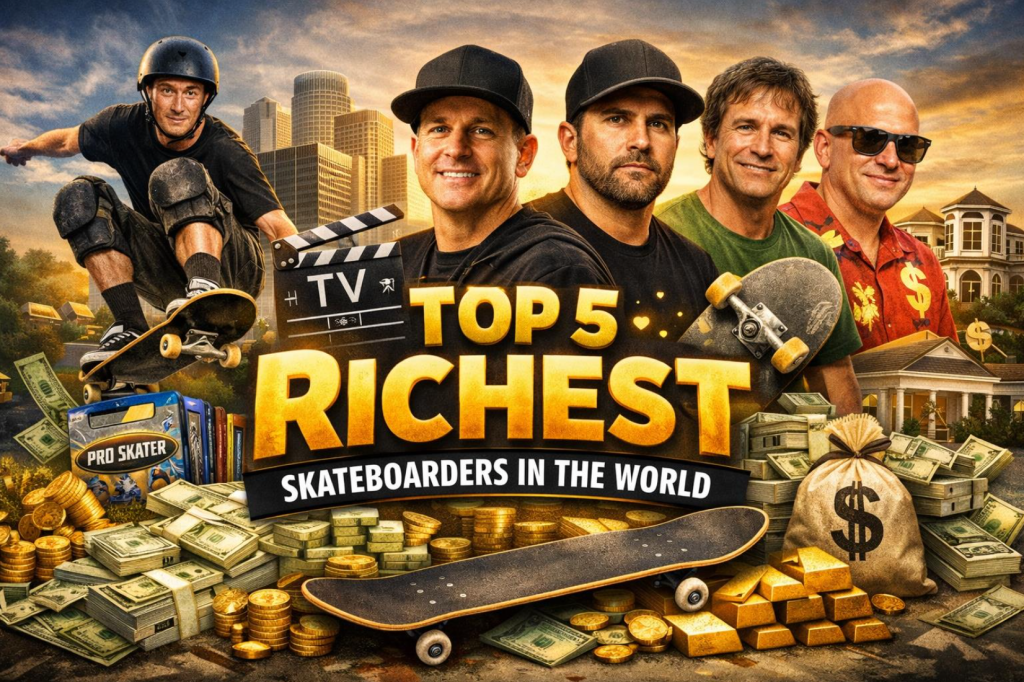
Skateboarding has come a long way from the “sidewalk surfing” days of the 1970s. What was once dismissed as a dissident group for outcasts has matured into a high-stakes global industry. For the elite few, getting the hang of a kickflip was just the beginning; the real game was played in the boardroom. Most pros rely on contest winnings and local shop sponsors. In contrast to them, there are few richest skateboarders in the world who have built diversified empires passing over media production, tech investments, and global retail franchises.
This post will accentuate the top 5 richest individuals among skateboarders. Let’s start!
Top 5 Richest Skateboarders in the World
1. Tony Hawk
- Estimated Net Worth: $140 Million
- Primary Income Sources: Video game royalties, Birdhouse Skateboards, Liquid Death (investments), The Skatepark Project.
Tony Hawk is the undisputed architect of the modern professional skateboarding career.While he dominated the vertical ramp for two decades, his nine-figure net worth was solidified by the 1999 launch of Tony Hawk’s Pro Skater. The video game franchise has generated over $1.4 billion in sales, providing Hawk with a royalty stream that remains a benchmark for athlete licensing.
Beyond gaming, Hawk co-founded Birdhouse Skateboards and has become a prolific venture capitalist, holding early stakes in brands like Liquid Death. For a deeper look at the specific business milestones and diversified assets that comprise Tony Hawk’s net worth, it becomes clear that his financial longevity is rooted in converting cultural relevance into scalable equity.
This ability to convert athletic fame into long-term business equity mirrors what we see in other sports, such as LeBron James, who has successfully expanded his influence into media, investments, and global branding.
2. Rob Dyrdek
- Estimated Net Worth: $100 Million – $200 Million
- Primary Income Sources: Media production (Superjacket Productions), Dyrdek Machine, MTV deals, real estate.
Rob Dyrdek represents the pinnacle of the “skateboarder-turned-media-mogul” evolution. After a successful career with DC Shoes and Alien Workshop, Dyrdek transitioned to television, creating hits like Rob & Big and the juggernaut Ridiculousness. Dyrdek’s strategy was unique: he didn’t just appear on screen; he owned the production rights.
According to professional profiles on Olympics, the modern skater’s value is often tied to their media footprint, and Dyrdek mastered this by building Superjacket Productions (now part of Thrill One Media). His venture studio, Dyrdek Machine, has since launched or invested in over a dozen brands, specializing in what he calls “do-or-die” entrepreneurship, a systematic approach to building companies from the ground up.
3. Jamie Thomas
- Estimated Net Worth: $50 Million
- Primary Income Sources: Zero Skateboards, Straye Footwear, Fallen Footwear, and distribution royalties.
Known as “The Chief,” Jamie Thomas leveraged the “gnarly” street skating aesthetic of the late ’90s to build Black Box Distribution. At its peak, Black Box housed Zero Skateboards, Mystery, and Fallen Footwear, controlling a significant share of the core skate market. Thomas’s wealth is rooted in his foresight to own the means of production and distribution rather than merely collecting a paycheck as a pro rider. Even as market trends shifted, his recent ventures, like Straye Footwear, continue to demonstrate his acumen for identifying gaps in the skate-shoe industry.
4. Rodney Mullen
- Estimated Net Worth: $30 Million – $40 Million
- Primary Income Sources: World Industries (sales), Tensor Trucks, public speaking, and intellectual property.
Rodney Mullen is often cited as the most influential street skater in history, having invented the flat-ground ollie, kickflip, and countless other staples. However, his wealth stems largely from his partnership with Steve Rocco in co-founding World Industries. Mullen’s technical mind translated well to equipment innovation; he holds patents in skateboard design and founded Tensor Trucks. Today, he is a high-demand keynote speaker at tech conferences, drawing parallels between the “open-source” nature of skate tricks and Silicon Valley innovation.
5. Steve Rocco
- Estimated Net Worth: $20 Million
- Primary Income Sources: World Industries (sales), Blind Skateboards, real estate.
Steve Rocco is the rogue entrepreneur who dismantled the traditional corporate structure of skateboarding in the early 1990s. By founding World Industries, he introduced a subversive, irreverent marketing style that resonated with the youth culture of the era. Rocco’s greatest financial victory came in 1998 when he sold World Industries (and its sub-brands like Blind and Plan B) for a reported $29 million. His legacy is not one of longevity in the sport, but of a high-impact “disrupter” who proved that a skater-owned company could eventually be sold to private equity for millions.
The Blueprint for Extreme Sports Wealth
As these five figures demonstrate, the path to significant wealth in skateboarding requires moving beyond the board. The common thread is ownership. Whether it is owning the footage (Dyrdek), the manufacturing (Thomas), or the brand IP (Hawk and Rocco), these athletes transitioned from being the “product” to being the “CEO.”
Author

Written by
Recent Posts
Breaking Bad Cast Net Worth. $130 Million Cooked in Five Seasons of Perfect Television

Cailee Spaeny Net Worth — From Springfield, Missouri to A24 and Alien in Three Years Flat
Wagner Moura Net Worth — He Learned Spanish to Play Escobar. Then He Learned English to Take Hollywood.
Robert Eggers Net Worth — He Made a $3.5 Million Film in Puritan English and Hollywood Listened

Brie Larson Net Worth — A $6 Million Indie Film Won Her an Oscar. Marvel Paid Her the Rest.
Categories
- Art
- Articles
- Beauty & Skincare
- Celebrities
- Celebrities|Movies
- Celebrities|The Chronicles
- Chronicles
- Entertainment|Culture
- Event Photos
- Events
- Fashion
- Fashion & Style
- Featured
- Food & Beverage
- Food, Spirits, Wine
- Hamptons
- Hamptons Celebrities
- Hamptons Celebrities|Celebrities|The Chronicles
- Health
- Health & Beauty
- Lifestyle
- Luxury Lifestyle
- Movies|Culture
- Movies|Hamptons Lifestyle
- Press
- Profiles
- Real Estate
- Technology
- The Chronicles
- Travel
- TV
- Uncategorized
- Weddings