
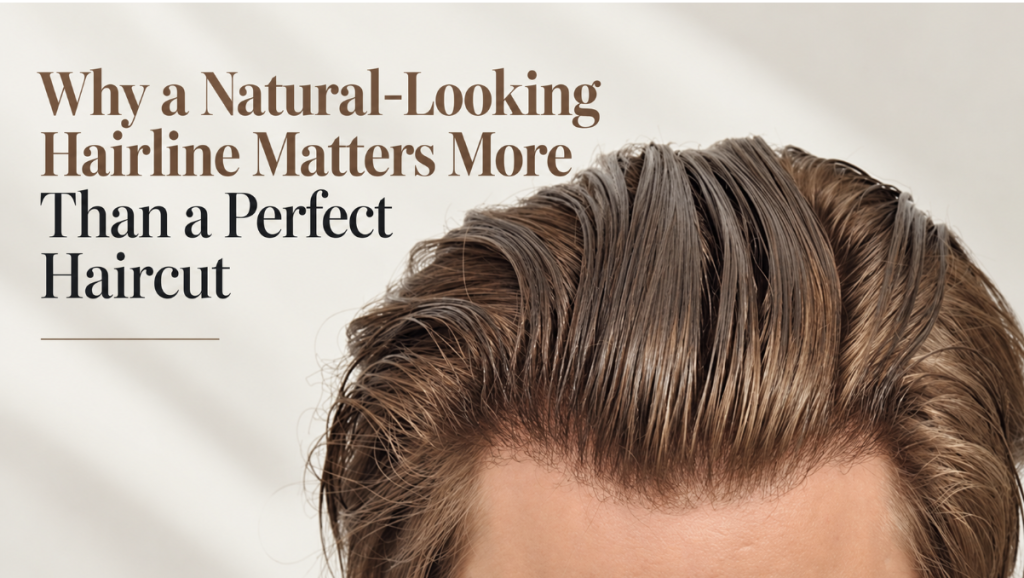
There is a particular elegance that comes from looking well-groomed without appearing overly groomed. A tailored jacket should follow the body, a good watch should complement an outfit, and a great haircut should frame a man’s face so naturally that no one pauses to consider the effort behind it.
The same principle applies to the hairline, though it rarely receives the attention it deserves. Men will debate the difference between a taper and a fade, or show their barber a photograph of a particular style. Yet the detail that determines whether the result looks convincing is not the cut itself. It is the shape, placement, and density of the hair along the forehead.
For men experiencing thinning hair or exploring modern hair replacement, this distinction matters especially. Today’s grooming options make it possible to restore coverage and experiment with new styles. But the most sophisticated result is rarely the fullest head of hair or the sharpest hairline. More often, it is the one that looks entirely at home on the person wearing it.
The Appeal of a Hairline That Isn’t Quite Perfect
Perfection can be strangely unflattering. In fashion, an outfit assembled with too much precision feels more like a display than a personal expression. Hair is no different. An unusually straight, densely packed hairline may look immaculate in a photograph, but in everyday life it can seem at odds with the subtle irregularities of a real face.
Natural hairlines are rarely symmetrical. One temple may sit slightly higher, the front may follow a gentle curve, or finer strands may soften the transition between forehead and fuller hair. These details are not flaws to correct; they are what make a hairline believable in natural light and from different angles. A man in his forties may look more distinguished with a softly matured hairline than with a low, straight one designed to recreate his teenage appearance. A slight temple recession can complement his features rather than detract from them.
Good grooming here resembles good tailoring: the objective is not to impose an ideal shape on everyone, but to work with the proportions that make an individual recognisable.
Hair, Age, and Facial Proportion
A hairline does more than mark the beginning of a hairstyle. It establishes the visual balance between the forehead, eyebrows, and upper face. Moving it even slightly can make the forehead look shorter, the features more compact, or the expression more mature.
There is no universally flattering hairline height. Foreheads vary, and a position that looks natural on one man may seem unexpectedly low on another. A skilled barber or restoration specialist considers the face as a whole rather than relying on a fixed distance from the eyebrows.
Age also shapes perception, though it should never become a rigid rule. What matters is consistency: an exceptionally thick front can look incongruous when the surrounding hair has become finer. Density matters here too. In many natural hairlines, the first few millimetres contain finer, more widely spaced strands before the hair becomes fuller. This subtle graduation creates depth and prevents the front from resembling a solid boundary.
Three Classic Hairstyles, Three Approaches to the Hairline
The Side Part remains a reliable expression of understated polish. A gently rounded or subtly receded hairline often complements it, allowing the hair to move naturally across the forehead while retaining definition around the temples. The result feels deliberate but not severe.
The Textured Crop offers a contemporary interpretation. Its shorter layers and relaxed movement soften the relationship between hair and forehead. A slightly irregular hairline works beautifully here, because the texture already introduces natural variation, creating an impression of effortless movement.
The Slick Back leaves little room for disguise. With the hair directed away from the forehead, the entire front edge becomes part of the look, making the hairline especially important. An overly dense or sharply defined front can become conspicuous, while a softer transition and believable temple shape preserve the style’s elegance.
None of these styles requires a flawless hairline. They simply demand different relationships between shape, density, and styling.
The New Discretion in Men’s Hair Restoration
The growing sophistication of men’s grooming has also changed expectations around hair replacement. Where traditional toupees were often associated with obvious density, limited styling flexibility, or an artificial front edge, modern systems offer a wider range of base constructions, hair textures, and customisation possibilities. Their success, however, still depends on the quality of the overall design rather than any single material or feature.
The most convincing results tend to be those that respect the wearer’s existing appearance. A hairpiece should complement the natural hair at the sides and back, not create an abrupt contrast in volume. The front should follow a believable shape, while the density and direction of the hair should support the intended style. For men who favour an exposed hairline, these details become particularly significant because there is little to conceal an awkward transition.
This explains why the appeal of natural-looking men’s hairpieces has less to do with creating the thickest possible hairstyle and more to do with achieving a balanced, individual result. A slightly matured hairline may be more flattering than a youthful, perfectly straight one. Moderate density may look more convincing than maximum fullness. And a carefully chosen haircut can make the entire appearance feel cohesive without drawing attention to the method used to achieve it.
The choice of hair system also deserves the same consideration as any other element of personal grooming. When exploring TopUniqueHair, for instance, the useful starting point is not simply which hairstyle looks most impressive in a product photograph, but which base construction, density, and hair characteristics are likely to complement the wearer’s own face and remaining hair. A man who prefers a relaxed Textured Crop will have different styling priorities from someone who wears a sharply defined Slick Back, even if both want an equally natural result.
Professional fitting and cutting remain important. A stylist experienced in men’s hair systems can refine the length, soften excessive bulk, and create a transition between the added hair and the natural hair surrounding it. Yet even the best haircut cannot always compensate for a front that has been positioned too low or made unnecessarily dense. As with tailoring, the underlying fit matters before the finishing touches begin.
Why Restraint Is the Ultimate Grooming Luxury
The most memorable examples of men’s style share a quality that is difficult to manufacture: ease. The clothes fit, the grooming feels appropriate, and the appearance seems like a natural extension of the person rather than a collection of carefully selected details.
Hair follows the same principle. A perfectly symmetrical hairline or sharply defined fade may look striking in isolation, but sophistication is rarely measured by how much precision is displayed. For men experiencing hair loss, this is a refreshing way to think about restoration. The objective does not have to be recovering the exact hairline of early adulthood; it can be about restoring balance, enjoying greater freedom in styling, and feeling comfortable in the mirror.
There is no single correct answer. A man with a naturally high forehead may look distinguished with a mature hairline and a classic side part; another may prefer a textured crop; someone with strong features may enjoy a slicked-back style. The most effective hairstyle is the one consistent with the individual.
A beautiful haircut will always have its place. But when the hairline is proportionate, softly defined, and suited to the face, the entire look becomes more convincing. The most refined result is not one that appears untouched by age or impossibly perfect. It is one that looks so natural that the effort behind it remains entirely unnoticed.
Author

Written by
Recent Posts
Periorbital Biorevitalization: Top Methods for Combating Dark Circles
Why a Natural-Looking Hairline Matters More Than a Perfect Haircut

Melanotan 2 and the Regulatory Grey Zone: What Research Buyers Should Understand
Discovering the Elegance and Durability of Slate Roof Tiles
Montauk Calls Itself The End Of The Road But Ushuaia Actually Is
Categories
- Art
- Articles
- Business of Luxury
- Celebrities
- Culture
- Entertainment
- Events
- Faces of Summer 2026
- Fashion
- Fashion & Style
- Featured
- Finance
- Food, Spirits, Wine
- Hamptons
- Hamptons Celebrities
- Health
- Health & Beauty
- Lifestyle
- Luxury Lifestyle
- Press
- Profiles
- Real Estate
- Technology
- The Chronicles
- Travel
- Uncategorized
- Weddings