
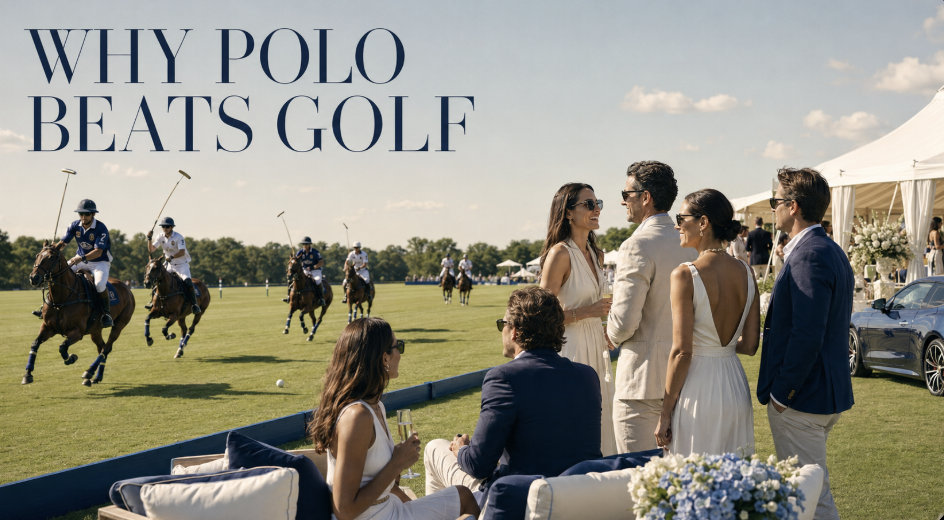
Every July, BMW writes a check to put its name over a polo field in Bridgehampton, and the horses are almost beside the point. The automaker is not sponsoring a sport. In fact, it is renting a meaning, one that took several centuries to compound and cannot be manufactured at any ad budget. Understanding why polo beats golf for luxury sponsorship is really understanding how meaning gets made, stored, and borrowed. That is the subject here, and it explains more media decisions than any planner will admit on a slide. Slides, after all, are where big numbers go to feel useful.
This piece extends why luxury brands buy prestige, where the borrowing mechanism gets its first pass, inside the market mapped by the economy of prestige. Golf partisans should stay: the argument respects your game. It just prices it honestly.
The Symbolism Ledger
Sports are storage devices for meaning, and the meaning accrues like interest. Every decade a game spends attached to a class, a landscape, or a ritual deposits something in its account. Brands cannot open their own account on this ledger, because symbolism only compounds in public and only across generations. Interest, notably, is paid in recognition. What they can do is borrow, by attaching their name to a game whose balance is already large.
Sponsorship, viewed this way, is a currency exchange from the four currencies of status: money out, meaning in. Of course, the rate depends entirely on which account you draw from. So the real due diligence on any sponsorship is an audit of the ledger, and polo’s ledger is the deepest one still open for withdrawals. Audits here are cheap: just ask what the game meant to your grandmother.
Where Polo’s Meaning Comes From
Polo is one of the oldest team sports on record, played across Persia and Central Asia before most modern nations existed. British cavalry officers adopted it in India in the nineteenth century and carried it home, where it fused with the aristocracy’s existing codes: land, horses, regiments, and estates. By the time it crossed to Long Island, the game already meant lineage. Long Island, for the record, hosted America’s polo aristocracy a century before the rosé arrived.
Indeed, every element reinforces the deposit. Horsemanship implies childhood training, which implies family money with a long memory. Equally, a string of ponies implies acreage, staff, and continuity. International society plays it in the same handful of places, so the game doubles as a passport. None of this is subtle, and none of it can be replicated, because the ingredient is accumulated time. The account, in short, predates the customer.
What Golf Means Now
Golf once held a similar account, and then the twentieth century democratized it magnificently. Municipal courses, corporate outings, and televised majors made golf the game of American professional life. That was a triumph for golf and a quiet devaluation for its symbolism, because a meaning everyone can access is a meaning nobody can rent exclusively. No insult intended. Every devaluation began as a triumph.
So read the modern connotations honestly. Specifically, golf signals a good career, a client relationship, a comfortable retirement: respectable, prosperous, and reproducible. Polo signals inherited codes that money alone has never cracked. For a brand selling attainment, golf works beautifully. For a brand selling distinction, the account is overdrawn, and everyone drawing on it knows. Reproducible, of course, is the operative word.
The Horse Premium
Part of polo’s rate is simply the animal. A horse on a field imports the entire estate economy behind it: stables, grooms, vets, trailers, and land measured in acres rather than lots. Machinery can be leased for a weekend, but a string of fit ponies cannot be faked for an afternoon, and spectators feel that authenticity without naming it. Estates, in short, do not rent by the hour.
The premium extends to the sport’s physics. Polo is fast, dangerous, and visibly expensive to stage, which makes the spectacle itself a display of resources. A brand adjacent to that display borrows its seriousness. Nobody has ever gasped at a tee shot from a cabana, and the gasp, it turns out, is part of the media buy. The gasp is also free of charge, which no other line item can claim.
The Ralph Lauren Proof
If the symbolism argument needs a commercial exhibit, one has been running for fifty years. Ralph Lauren put a polo player on a shirt and built one of the most valuable luxury businesses in American history, selling the meaning to millions who will never hold a mallet. The logo works because the game’s account is that deep. No golfer silhouette could have done it, and none has.
The lesson for sponsors is precise. The polo player sells aspiration toward a world, not participation in a sport. A title sponsorship buys the same association at event scale, with the world physically assembled on the lawn. The shirt proves the meaning travels. The field proves it converts. Fifty years of margin is a long peer review.
The Champagne Precedent
The play has precedent across every luxury category, because polo has been sponsor-tested for a century. Champagne houses attached themselves to polo classics decades ago, and the pairing became so natural that the pour now feels native to the sideline. Watchmakers went further: Piaget named an entire watch line Polo, betting a product on the association, and the bet has run since 1979.
Notice what these categories share. Each sells craftsmanship, heritage, and occasion, and each found in polo a stage that says all three without copy. By contrast, the same houses treat golf as a hospitality channel rather than an identity: useful for clients, silent on meaning. The precedent is the due diligence, in other words. The deepest brands already voted, and they voted with their names. Occasion, in fact, is the one ingredient no lab has synthesized. Follow the pours and you have found the ledger.
The Spectator Economics
The formats differ structurally, and the difference is where sponsors live. Golf disperses its audience along eighteen holes and asks for silence. Polo concentrates its audience along one sideline and asks for champagne. One format produces spectators, while the other produces a party with a match attached, and parties are where the four currencies actually trade. Silence, whatever its virtues, has never sold champagne.
The rituals compound the advantage. The divot stomp puts every guest on the field together at halftime, manufacturing the shared moment golf structurally cannot. Cabana rows turn the sideline into a street of salons, as the status machine piece details. By trophy hour, the sponsor has hosted a society, not an audience, and societies remember their hosts.
The Objection From Reach
The objection writes itself: golf’s televised audience dwarfs polo’s by any multiple you like. Correct, and irrelevant, because reach was never the product in question. A broadcast delivers millions of viewers who will not buy, while the sideline delivers a few thousand who already do. That arithmetic is half of why polo beats golf on a spreadsheet as well as a lawn.
There is also a subtler point about who watches what. Golf’s audience watches golf, but polo’s audience attends polo, and attendance is participation in the social fact. For a sponsor, presence beside participants outperforms adjacency to viewers, since participants convert and viewers scroll. Choose the sideline, then, and let the broadcasts keep their tonnage. Tonnage, as ever, flatters the slide and starves the quarter.
Which Symbols Still Transfer
An honest audit requires asking which parts of the ledger still pay out. Aristocracy, land, and lineage transfer as strongly as ever, because scarcity aged well. Tradition transfers, provided the event wears it lightly. The risk column is stuffiness: played wrong, polo reads as costume drama, and costume repels the young money every sponsor wants. Costume is meaning worn one size too proud.
The modern Hamptons version manages the risk deliberately. Rosé instead of protocol, founders alongside old families, photographers welcome, dress code confident rather than codified. That calibration is exactly why polo beats golf right now: the deep account with a contemporary interface. The meaning stays old. The afternoon stays current, and the combination is the product.
The Founder in the Grandstand
One more constituency explains the field’s pull: the newly successful, present in force every July. For them, the afternoon is partly a fluency seminar, because polo compresses the codes of old money into four observable hours. Tuition, conveniently, is an afternoon. Watching who knows the rituals, and quietly learning them, is exactly the education described in converting success into status.
Sponsors should price this crowd carefully, since it is the most commercially alive audience on the lawn. New money arrives ready to buy its way toward belonging, and a brand positioned inside the code sells belonging by the case. Golf cannot offer that classroom. Its codes were democratized away, which has been the point of this piece all along.
What the Title Sponsor Actually Buys
Assemble the pieces and the title sponsorship prices itself. The name over the field buys category ownership of the deepest symbolism account in sport, staged in front of a pre-curated audience, inside the party format where currencies trade. Add the coverage layer from editorial vs. advertising and the afternoon enters the permanent record.
BMW’s logic, reconstructed, is not about horses at all. A performance sedan borrows lineage, craftsmanship, and effortless power from a game that has meant those things for centuries. Meaning transfers at the speed of proximity. The transfer runs while guests sip and ponies thunder, and it never once requires an impression to be counted. Density does the accounting, as the death of impressions lays out.
The Calendar Argument
One more asymmetry deserves its own section: time and place. Golf happens everywhere, all year, which is convenient for players and fatal for scarcity. Polo of the kind that matters happens in a handful of postcodes for a handful of weeks. Out east, that means July, one field, and a season short enough to feel like a deadline. Deadlines, after all, are a luxury good too.
Scarcity of schedule compounds scarcity of meaning, because the market cannot defer what it cannot reschedule. A sponsor who misses the window waits a year while a competitor collects the summer. Golf offers infinite second chances, and infinite second chances discipline nobody. The polo calendar, by contrast, closes. Closing is what makes people decide, and deciding is what sponsorship desks are for.
The window also disciplines the media plan. Everything upstream, the feature, the campaign, the room, sequences backward from the field, which is why the smart houses sign in winter. By July the lawn is cast. So is the story of the summer.
Choosing Your Field
The framework generalizes to any sponsorship decision, so run the audit before signing anything. What does this event mean, and to whom? How long has the meaning compounded, and is the account still exclusive enough to rent? Does the format assemble a society or an audience? Finally, does your brand need attainment or distinction, because the two rent from different ledgers. Write the answers down, since the deck you receive will answer none of them. Most decks fail the first question.
Sailing, showjumping, vintage rallies, and court tennis all hold real accounts, and each fits certain houses. But for the combination of deep symbolism, party format, and East End address, the answer to why polo beats golf is the answer to most sponsorship questions out here. The field is the ledger. July is the withdrawal window.
Where The Conversation Continues
The field in question convenes every July at Polo Hamptons, title and category sponsorships assembled one per industry, coverage attached by design. The symbolism account is open, the interface is current, and the withdrawal window is shorter than the season. If your brand needs what horses mean, the partnerships desk holds the ledger. The name over the field is singular. So is the conversation about whose it is. Categories close in the order the calls arrive. Winter signatures get summer fields.
Author

Written by
Recent Posts
How to Measure Whether a Hair Loss Treatment Is Working
Is Online Psychiatry Covered by Insurance? What to Know Before Booking
Four Habits of Quietly Successful Entrepreneurs

The Most Common Preventable Health Concerns Doctors See Today
What Affects a Rideshare Injury Settlement?
Categories
- Art
- Articles
- Business of Luxury
- Celebrities
- Culture
- Entertainment
- Events
- Faces of Summer 2026
- Fashion
- Fashion & Style
- Featured
- Finance
- Food, Spirits, Wine
- Hamptons
- Hamptons Celebrities
- Health
- Health & Beauty
- Lifestyle
- Luxury Lifestyle
- Press
- Profiles
- Real Estate
- Technology
- The Chronicles
- Travel
- Uncategorized
- Weddings