
What Luxury Brands Should Learn From Hollywood’s Biggest Partnership Machine
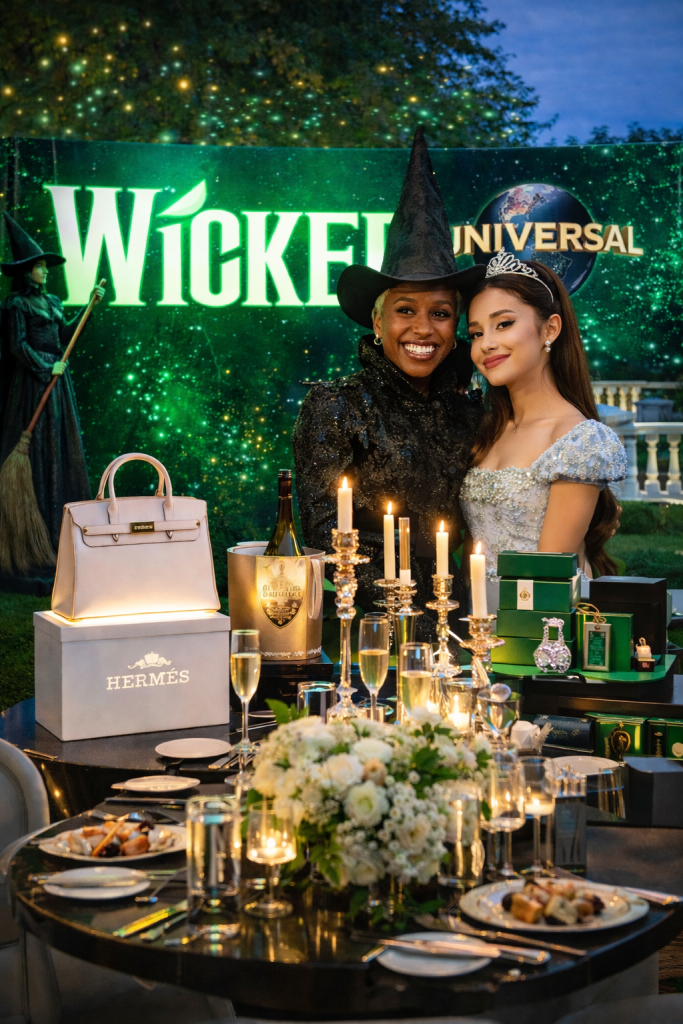
Universal Pictures did not just release a movie in November 2025. They launched a masterclass in brand partnership strategy that every luxury brand operator should be studying right now. If you are running a Hamptons-adjacent business and you are not paying attention to the Wicked playbook, you are leaving money on the table.
The numbers demand attention. Wicked: For Good opened to $150 million domestically on November 21, 2025. Combined with the first film, the franchise has generated over $1.5 billion at the global box office. But the box office is not the story. The brand partnership ecosystem is.
400+ Partnerships and $150 Million in Marketing
Universal partnered with more than 400 brands for the Wicked franchise. Industry sources estimate the studio invested approximately $150 million in global marketing. The return: 2 billion shopper interactions and 25 billion global impressions. Fashion brands alone generated $27 million in media impact value. Brand-related searches surged 60% since the campaign launched.
The partnership roster reads like a luxury consumer’s shopping list. Le Creuset created Glinda and Elphaba Dutch ovens with custom embossing at $400 price points. Swarovski produced ornaments. Kay Jewelers launched exclusive earrings, rings, and pendants. Naadam released cashmere sweaters. Puma dropped a 14-piece capsule collection. Gap, Absolut, Essie, Bombas, and American Girl all created themed product lines.
According to McKinsey & Company‘s luxury consumer research, entertainment-driven brand collaborations now outperform traditional celebrity endorsements by a factor of three in terms of consumer engagement and purchase intent. The Wicked campaign proved this at scale.
The Template for Luxury Brands
Here is what the Wicked playbook actually teaches. Break it down and you find four principles that apply directly to any luxury brand operating in the Hamptons market or targeting high-net-worth consumers.
Principle 1: Cultural alignment beats demographic targeting. Universal did not partner with brands based on customer demographics. They partnered based on cultural positioning. Le Creuset and Wicked share zero customer overlap on paper. But both occupy the same cultural space: products that signal taste, investment in quality, and membership in a community that “gets it.” Hamptons luxury brands should think the same way. Your partnership strategy should not start with “who has the same customer?” It should start with “who shares our cultural values?”
Principle 2: Price point signals commitment. The Wicked collaborations spanned from $5 Pop-Tarts to $400 cookware. But the premium products generated disproportionate media coverage and social engagement. Le Creuset’s Dutch ovens were covered by every lifestyle publication. The $5 items moved units. The $400 items moved narratives. For luxury brands, the lesson is clear: your collaboration product should be priced at a level that communicates seriousness. According to Bain & Company‘s research on luxury brand elasticity, consumers pay premiums for limited-edition products associated with cultural moments.
Principle 3: The “drop” model creates urgency. Every Wicked Wednesday, new products launched. Limited quantities. Tight windows. Depop reported searches jumped 189% as secondary market demand amplified primary market buzz. This scarcity mechanics is exactly how the Hamptons social calendar already operates. Polo matches. Benefit galas. Summer share openings. The entire Hamptons luxury ecosystem runs on limited access and time-bound experiences. Brands that formalize this into their partnership strategy win.
Principle 4: Let the content do the selling. Universal allocated their $150 million marketing budget as 40% digital, 30% partnerships, 20% traditional advertising, and 10% experiential. The partnership-heavy allocation meant that brands were creating content on Universal’s behalf. Every Le Creuset Instagram post featuring a Wicked Dutch oven was simultaneously a movie ad and a cookware ad. The integration was seamless because the cultural alignment (Principle 1) made it authentic.
What This Means for Hamptons Luxury Brands
The Hamptons market is smaller than Hollywood. But the principles scale down perfectly.
Consider a Hamptons restaurant partnering with a wine label for a limited summer pairing menu tied to a cultural event. A luxury real estate firm sponsoring a Bay Street Theater production with exclusive pre-show access for clients. A fashion boutique in East Hampton creating a capsule collection timed to Polo Hamptons weekends.
Each of these follows the Wicked template. Cultural alignment. Premium positioning. Time-limited availability. Content-first distribution.
The 29% of Wicked’s opening weekend audience aged 25 to 34, with another 20% between 18 and 24, matches exactly the demographic that Hamptons businesses need to capture for long-term growth. These are the next generation of summer renters, home buyers, and brand loyalists. Reaching them requires the kind of entertainment-adjacent marketing that Wicked perfected.
The Ariana Grande Factor
Grande’s involvement in Wicked amplified every partnership exponentially. With over 380 million Instagram followers, she carried brand collaborations to audiences that traditional luxury marketing cannot reach. Her r.e.m. beauty brand, worth an estimated $500 million, demonstrates she understands the intersection of celebrity, product, and cultural moment.
For Hamptons brands seeking celebrity partnerships, Grande’s model offers a blueprint. The celebrity must have authentic connection to the product or experience. Grande was Glinda. She did not endorse Wicked. She was Wicked. That authenticity transferred to every brand collaboration.
The same principle applies to Hamptons partnerships. A celebrity who actually summers on the East End, who genuinely uses your product, who has real relationships in your community creates partnership value that no amount of paid endorsement can replicate.
Playing the Long Game
Wicked is not a one-season play. The franchise will generate revenue for decades through streaming, merchandise, and cultural relevance. Smart brand partners structured deals that extend beyond the release window.
Hamptons luxury brands should think the same way. The summer season is three months. But brand relationships built during those months should generate returns year-round. A partnership launched at a July polo match should still drive business in January. A collaboration debuted at a September benefit should still resonate the following summer.
According to Harvard Business Review‘s research on brand partnership ROI, the highest-performing collaborations are those that create genuine cultural moments rather than transactional promotions. The Wicked campaign achieved a 46% ROI within its first week because the partnerships felt real, not forced.
That is the playbook. Take it. Adapt it. Make it work for your brand. Because the next Wicked-level cultural moment is coming. The question is whether your brand will be part of it or watching from the sidelines.
For luxury brand partnership opportunities, advertising features, and event sponsorships with Social Life Magazine, visit sociallifemagazine.com/contact. Brand activations and sponsorship packages at Polo Hamptons: polohamptons.com. Subscribe to our email list for luxury marketing intelligence. Print subscriptions and $5 contributions keep our coverage independent.
Related Reading:
Celebrities Who Live in the Hamptons You Must Know
Hamptons Real Estate Q3 2025 Market Insights
Author
Written by
Recent Posts
James Franco Net Worth — A $30 Million Career Interrupted
Selena Gomez Net Worth — How a Disney Kid Built a $1.3 Billion Empire
Spring Breakers A24 Cast Net Worth — Disney Kids Gone Dangerous
Women’s History Month
Must-Have Items for Your Wedding Gift Registry
Categories
- Art
- Articles
- Beauty & Skincare
- Celebrities
- Celebrities|Movies
- Celebrities|The Chronicles
- Chronicles
- Culture|Television
- Entertainment|Culture
- Event Photos
- Events
- Fashion
- Fashion & Style
- Featured
- Food & Beverage
- Food, Spirits, Wine
- Hamptons
- Hamptons Celebrities
- Hamptons Celebrities|Celebrities|The Chronicles
- Health
- Health & Beauty
- Lifestyle
- Luxury Lifestyle
- Movies
- Movies|Culture
- Movies|Hamptons Lifestyle
- Press
- Profiles
- Real Estate
- Technology
- The Chronicles
- Travel
- Uncategorized
- Weddings