
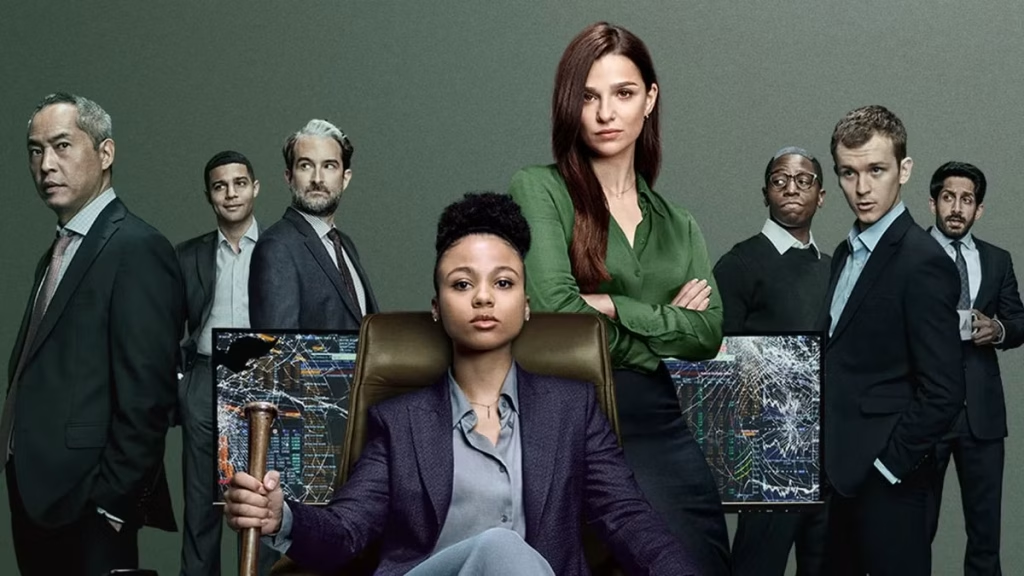
The Harper fake transcript Industry storyline begins in the show’s very first episode. Harper Stern needs to submit her college transcripts to Pierpoint & Co.’s HR department. She doesn’t have legitimate ones. She never graduated. So she texts her ex-boyfriend Todd and asks him to forge them. The scene takes less than a minute. The consequences drive the entire series.
Across four seasons and 32 episodes, that single forged document functions as the engine of Industry’s central tension. Harper’s entire career at Pierpoint rests on a lie. Every promotion, every trade, every client relationship, every personal connection exists on a foundation that could collapse the moment anyone checks the paperwork. The Harper fake transcript Industry arc isn’t just a plot device. It’s an examination of what happens when talent exists without credentials, and credentials exist without meaning.
What Harper Actually Did

The mechanics are straightforward. Harper attended a state college. She didn’t graduate. The reasons emerge gradually across multiple seasons — an abusive home environment, a brother damaged by the same dysfunction, the kind of chaotic upbringing where finishing a degree is a luxury that circumstances didn’t allow.
When Pierpoint offers her a position on their graduate scheme, the firm requires official transcripts. Harper contacts Todd Barber, an ex-boyfriend, and asks him to fabricate a transcript showing she completed her degree. Todd creates the document. Harper uploads it to Pierpoint’s HR portal. She’s in.
The Lie Nobody Checks
Here’s what makes the Harper fake transcript Industry storyline so effective: nobody checks. Pierpoint & Co. is a prestigious investment bank that manages billions in client assets. Its compliance department monitors trades for regulatory violations. Its risk management team stress-tests portfolios against market shocks. And its HR department accepts a forged college transcript without verification.
The show never explains this failure as incompetence. It explains it as indifference. Pierpoint doesn’t care whether Harper graduated. Pierpoint cares whether Harper makes money. The transcript is a checkbox. A formality. A piece of paper that allows the institution to pretend it performed due diligence while actually selecting candidates based on hunger, connections, and the ability to survive a trading floor. The system isn’t broken. The system is designed to be gamed by people bold enough to game it.
Eric Knows — and Protects Her Anyway

In Season 1, Episode 4, Eric Tao discovers the truth. His reaction defines both characters for the rest of the series. He doesn’t report Harper. He doesn’t fire her. He doesn’t even threaten her. Instead, he leans in and essentially tells her: people like us don’t belong here either. We intimidate them just by being present. Hunger is not a birthright.
Eric’s decision to protect Harper transforms the Harper fake transcript Industry arc from a simple fraud storyline into something more complex: a story about mentorship, loyalty, and the difference between institutional rules and institutional values. Eric knows Harper forged her credentials. He also knows she’s the most talented trader on his desk. The transcript doesn’t measure her ability. It measures her compliance with a system designed by and for people who look nothing like her.
The Season 2 Betrayal
For two seasons, Eric shields Harper’s secret. He watches her rise. He watches her push boundaries that would get anyone else fired. He endures her betrayals — she engineers a plan to save their jobs while throwing colleagues Rishi and Dan under the bus. He tolerates her increasingly reckless gambles because the gambles make money and money is the only metric Pierpoint respects.
Then, in the Season 2 finale, he uses the transcript against her. After Harper commits insider trading by passing information about an Amazon acquisition to client Jesse Bloom, Eric faces a choice. He can report the insider trading, which would expose both Harper and Pierpoint to criminal liability. Or he can report the fake transcript, which gets Harper fired for a lesser offense and protects the institution from the larger scandal.
He chooses the transcript. “I’m doing this for you,” he tells her, moments before the HR meeting where she’s terminated. The line is devastating because it might be true. Eric might genuinely believe he’s saving Harper from prosecution. He might also be eliminating a protégée who has grown too powerful and too dangerous to control. Mickey Down described the intention: “We wanted to leave people feeling conflicted. It’s open to interpretation.” Konrad Kay added: “When he says, ‘I’m doing this for you,’ I think 50% of the audience will think he’s doing this genuinely for her benefit.”
The Harper fake transcript Industry arc reaches its most painful moment here. The forged document that got Harper in the door becomes the weapon that pushes her out. And the mentor who protected the lie for two years becomes the person who weaponizes it — possibly out of love, possibly out of self-preservation, probably out of both.
Season 3: Freedom Through Exposure
Most shows would treat the transcript revelation as a career-ending disaster. Industry treats it as a liberation. In Season 3, set six weeks after her firing, Harper is free from Pierpoint and free from the constant fear of exposure. She joins ethical fund FutureDawn, earns the trust of investor Petra Koenig during the chaotic Lumi IPO, and co-founds her own firm, Leviathan Alpha, with backing from the mysterious Otto Mostyn.
Without the transcript hanging over her, Harper becomes more dangerous than she was at Pierpoint. She publicly humiliates Eric at an international conference. She manipulates her former mentor into allowing her new fund to be managed through Pierpoint’s infrastructure. She attempts to burn the 150-year-old institution to the ground. The AV Club called her “the most deliciously chaotic villain on TV.” The fake transcript didn’t create this person. But being freed from it unleashed her.
By Season 4, she’s running a shorts-only operation and investigating the Tender fintech fraud. Nobody asks about her degree. Nobody cares. In the world of hedge funds and independent investment firms, the only credential that matters is returns. Harper’s talent — the thing the transcript was supposed to prove — speaks for itself once she operates outside the credentialing system.
The Mirror: Whitney’s Fraud vs. Harper’s Fraud
The Parallels Get More Interesting

Season 4 introduces a mirror. Whitney Halberstram builds Tender on fabricated user data. Harper builds her career on a fabricated transcript. Both lie about fundamentals. Both succeed because the systems they operate in reward results over verification. The difference is that Harper’s lie hurts no one but herself, while Whitney’s lie defrauds investors and destabilizes a company. The show doesn’t equate the two. It asks the audience to consider where the line falls between a lie that harms and a lie that levels an uneven playing field.
Real-World Credential Fraud: How Common Is It?
The Harper fake transcript Industry storyline resonates because credential fraud is far more common than most people realize. A 2023 study found that 54.7% of admissions professionals didn’t feel confident detecting fake degrees, even though 68% had received training. The internet has made forgery easier and verification harder. Companies sell fake diplomas, transcripts, and letters of reference for any university in the world. Some forgeries are crude — storefront operations in major cities printing documents for a few hundred dollars. Others are sophisticated enough to pass casual inspection, complete with embossed seals, correct formatting, and registrar signatures.
Ghost Students and Industrial-Scale Fraud
The scale of the problem is staggering. In California alone, community colleges reported approximately 460,000 fraudulent applications in a single year — nearly 20% of all submissions. “Ghost students” enroll, collect financial aid, and vanish. A Texas woman was sentenced for running a ten-year scheme using stolen identities to pocket more than $200,000 in fraudulent aid. In New York, executives from a for-profit college were convicted of fabricating student records to collect over $7 million. The Harper fake transcript Industry plot dramatizes the individual version of what is, in reality, an industrial-scale problem.
Operation Varsity Blues, the college admissions scandal that ensnared celebrities like Lori Loughlin, revealed a different dimension of credential fraud: wealthy families paying millions to fabricate athletic credentials, cheat on entrance exams, and bribe admissions officials. The scheme operated for years before an FBI investigation exposed it in 2019. The parallel to Harper is inverted but instructive. Harper faked her way into a system designed for the privileged. The Varsity Blues parents faked their children’s way into a system designed for the meritorious. Both exploited the same vulnerability: institutions that check boxes without verifying what’s inside them.
The Finance Industry’s Credential Problem
Investment banking has a specific relationship with educational credentials that makes the Harper fake transcript Industry arc especially pointed. The major banks recruit almost exclusively from target schools: Oxbridge in the UK, Ivy League in the US. Goldman Sachs, Morgan Stanley, and JPMorgan don’t publicly admit this filtering system. Everyone in finance knows it exists. The firms don’t claim it’s meritocratic. They claim it’s efficient. Screening by university name reduces the applicant pool to a manageable size and produces candidates who share cultural assumptions about work, ambition, and hierarchy.
The problem is what the filter excludes. A student at a state university with superior analytical skills and a stronger work ethic will never get the interview because their résumé never passes the first screen. Harper’s forged transcript is a fictional shortcut around a real barrier. She doesn’t lack the ability to work at Pierpoint. She lacks the credential that Pierpoint uses to decide who deserves a chance.
Eric understands this instinctively. He also came from outside the system. He also had to fight for every inch. His decision to protect Harper isn’t charity. It’s solidarity between two people who know the system wasn’t built for them. When he finally uses the transcript against her, the betrayal cuts deeper because it comes from the one person who understood why she had to forge it in the first place.
What the Transcript Really Represents
The Harper fake transcript Industry storyline works on multiple levels simultaneously. On the surface, it’s a thriller element — will she get caught? The tension drives every scene at Pierpoint where HR is mentioned, where compliance reviews happen, where a colleague might casually ask where she went to school. The dread is constant and invisible.
Below the thriller layer sits a class commentary. Pierpoint’s graduate scheme draws candidates from Oxbridge, the Ivy League, and the European equivalents. Yasmin went to a posh school. Gus is Eton and Oxford. Robert studied geography at Oxford. Harper attended a state school she didn’t finish. The transcript isn’t just a piece of paper. It’s a class marker. It signals whether you belong to the tribe that Pierpoint considers worthy. Forging it isn’t just fraud. It’s a class insurgency.
Below the class layer sits a racial commentary. Harper is a Black American woman in a white British institution. She performs competence in a world that assumes she doesn’t belong. The transcript stands in for every barrier that Black professionals face in elite institutions — the presumption of inadequacy, the demand for credentials that prove what should be self-evident, the requirement to be “twice as good” to earn half the respect.
The Meritocracy Question
And at the deepest level, the Harper fake transcript Industry arc poses a question about meritocracy itself: if Harper is the best trader on the floor, does the transcript matter? If the system can’t tell the difference between a genuine graduate and a talented fraud, what exactly is the system measuring? And if it’s measuring compliance rather than competence, who benefits from that measurement — the institution or the people it claims to serve?
NPR’s review captured this tension precisely: “She’s a Black female TV character who’s not easy to love or easy to categorize, yet is compelling because each of her actions are at least understandable, if destructive.” The transcript is the original destructive action. Everything that follows — the insider trading, the betrayals, the reinvention, the Tender investigation — flows from that first decision to upload a forged document and bet her entire future on never getting caught.
The Show’s Creators on Harper’s Psychology

Mickey Down and Konrad Kay have discussed the psychological roots of Harper’s decision. In Season 1, Episode 5, the show reveals that Harper comes from an abusive home where ambition was placed above everything. Her brother was a victim of that dynamic. Harper absorbed the lesson differently: ambition became her survival mechanism. Forging the transcript wasn’t reckless. It was the logical extension of a worldview that says you either fight your way in or you die on the outside.
Down described the episode as “a massive swing for the fences” that explained why Harper has “this unchecked ambition.” The Harper fake transcript Industry arc connects directly to this psychology. The forgery isn’t about dishonesty. It’s about a person who learned early that the rules protect people who already have power, and that the only way to get power is to break the rules before anyone notices.
Related Articles
Industry HBO: The Complete Guide to TV’s Most Dangerous Finance Drama
Myha’la Net Worth: The Girl Who Faked It Until She Made It
Tender Explained: The Real Fintech Scandals Behind Industry
Ken Leung Net Worth: From Lost to Industry HBO
Industry Season 5: Everything We Know About the Final Season
Stay Connected
The Harper fake transcript Industry story is about who gets to sit at the table and who decides. Social Life Magazine has been asking that question for 23 years — covering the people who build careers, break rules, and rewrite the terms of their own access.
Feature your brand in Social Life Magazine — contact us at sociallifemagazine.com/contact.
Guaranteed digital placement starts at $975 via our Submit A Paid Feature page.
Join 82,000+ readers at sociallifemagazine.com.
Polo Hamptons returns July 18 and 25, 2026. BMW title sponsor.
Print subscriptions at sociallifemagazine.com/subscription.
Support independent publishing: donate here.
Author

Written by
Recent Posts

Galina Breslav: From Pension Fund to Executive Presence
Hermès Fake Authenticator: A Monopoly Mistaken for Expertise
A Real Gift: How La Scala Found Its Community in New York Through the Teatro alla Scala Association of America (TASAA)

He Sold His Company, Got Everything He Wanted, but Lost His Purpose

OUT OF LINE
Categories
- Art
- Articles
- Business of Luxury
- Celebrities
- Culture
- Entertainment
- Events
- Faces of Summer 2026
- Fashion
- Fashion & Style
- Featured
- Finance
- Food, Spirits, Wine
- Hamptons
- Hamptons Celebrities
- Health
- Health & Beauty
- Lifestyle
- Luxury Lifestyle
- Press
- Profiles
- Real Estate
- Technology
- The Chronicles
- Travel
- Uncategorized
- Weddings