
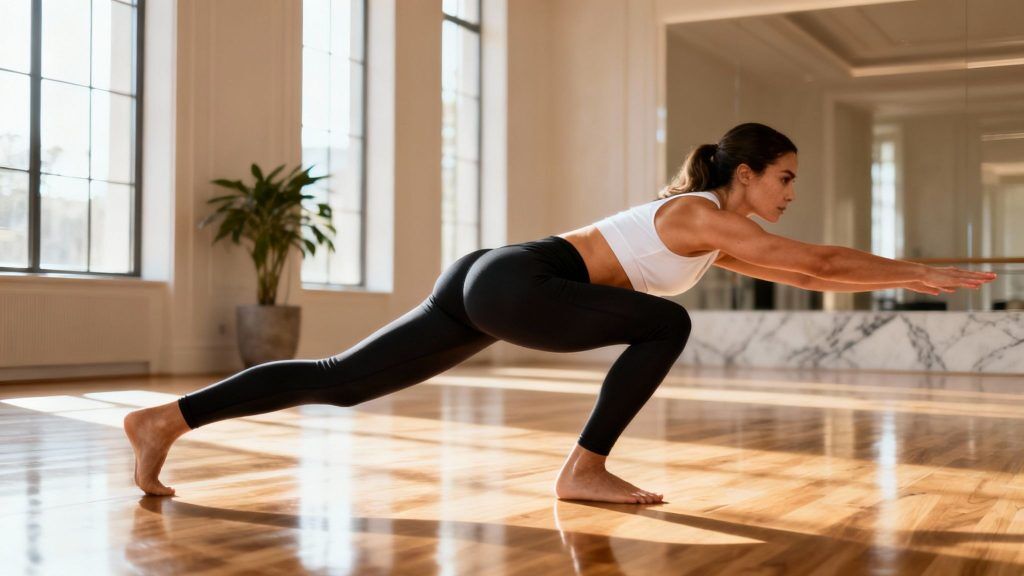
The duck walk is a dynamic movement that functions as both a demanding bodyweight exercise and an iconic performance strut. At its core, it is a low-squat shuffle that requires significant strength, mobility, and balance.
The Dual Identity of the Duck Walk
What makes the duck walk notable is its application in two distinct domains. In one context, it serves as an effective conditioning tool. In another, it is a renowned stage movement associated with confident performance.
For individuals focused on physical fitness, the duck walk presents a considerable challenge. It builds functional strength and endurance in the quadriceps, glutes, and hamstrings, while simultaneously improving hip and ankle mobility. It is a staple in military and athletic training programs because it develops a powerful, stable lower body in a way few other movements can. For those building a comprehensive routine, more information on complementary various bodyweight exercises is available.
From Stage Presence to Fitness Staple
However, the duck walk did not originate in a fitness setting. Its fame is derived from the stage, largely due to the musician Chuck Berry. During the 1950s, the rock and roll pioneer adopted this crouched, energetic strut as his signature move. It was an act of showmanship and a symbol of rebellion that countless performers have since emulated. The move reportedly stemmed from a childhood habit, a fact detailed in this exploration of its cultural impact and origins on Wikipedia.
The duck walk is more than an exercise; it is a testament to how a single movement can represent both physical power and expressive artistic style.
This duality is precisely why mastering the duck walk is so rewarding. It provides a unique bridge between athletic performance and creative expression. Whether the goal is to build formidable lower-body strength or to add an iconic flair to one's movement, understanding this exercise is an ideal starting point.
How to Perform the Perfect Duck Walk
Executing a safe and effective duck walk is not about following rigid steps, but rather about achieving a fluid, controlled motion that originates from a solid base. This foundation is the deep squat. Before attempting forward movement, one must be completely stable and engaged in this low position. In fact, correct execution is impossible without first mastering the deep squat, which is the core of this unique movement.
To begin, lower the hips down and back, as if sitting in a very low chair. The chest should remain lifted and the spine neutral—visualize a straight line from the crown of the head to the tailbone. This posture is critical for protecting the lower back from strain.
Once settled into the deep squat, engage the core. Brace the abdominal muscles as if anticipating an impact. This core engagement provides the stability required to maintain balance during movement.
Initiating the Forward Movement
With the squat position established and the core engaged, the first step can be taken. Gently shift your weight onto one leg, distributing pressure through the heel and midfoot. This subtle but essential weight transfer frees the other leg to move without compromising balance.
Lift the unweighted foot just enough to clear the floor—an inch or two is sufficient. The objective is efficiency, not a high step. Swing the leg forward in a controlled arc, landing softly on the heel before rolling through the rest of the foot. A common error is to stomp, which sends an impact through the joints and can easily disrupt balance.
The key is to seamlessly transfer weight onto the forward foot. The moment this is done, the process should begin with the other leg. This continuous, rolling transfer of weight is what defines the duck walk. It is a smooth, powerful rhythm, not a series of disconnected lunges.
Maintaining Form and Control
As you move forward, the primary focus must be on maintaining the depth and integrity of the squat. Resist the natural tendency to rise or bounce between steps. The head should remain at a consistent level, gliding forward as if on a rail.
An effective cue for clients is to imagine trying to "keep your head below a window sill." This mental image helps prevent the vertical motion that wastes energy and reduces the exercise's effectiveness.
To ensure the correct muscles are performing the work, concentrate on driving the movement from the glutes and quadriceps. When pushing off the back foot, consciously squeeze the glute on that same side. This not only propels you forward but also ensures that the large, powerful muscles are bearing the load, not the lower back.
This infographic provides a visual representation of how the duck walk evolved from a simple childhood activity into a cultural icon.

It offers a fascinating perspective on how a functional movement can be adapted for performance, ultimately becoming an unforgettable part of music and dance history.
Breathing and Pacing
Breathing serves as an anchor. An effective pattern is to inhale while preparing to step, then exhale while pushing forward. This rhythmic breathing promotes stability, prevents breath-holding—which can elevate blood pressure—and helps establish a sustainable pace.
When beginning, adhere to short distances and a slow pace. Quality over quantity is the guiding principle. Ten feet of perfect form is significantly more valuable than 30 feet of imprecise, rushed movement. As strength and confidence improve, distance and speed can be gradually increased.
A few final points to solidify form:
- Keep Your Gaze Forward: Looking down at the feet can cause the chest to drop and the back to round. Select a focal point ahead to naturally maintain a more upright posture.
- Use Your Arms for Balance: Do not let the arms hang passively. They can swing naturally at the sides or be held out in front to act as a counterbalance.
- Check Your Knees: Ensure the knees are always tracking in line with the toes. Never allow them to collapse inward, as this places undue stress on the knee joint.
By focusing on these mechanics, the duck walk can be transformed from an awkward shuffle into a graceful and powerful exercise that builds substantial lower-body strength and exceptional control.
Unlocking the Full Potential of the Duck Walk
Incorporating the duck walk into a fitness routine is about more than adding another exercise. It is a unique fusion of strength, mobility, and balance training that has a significant positive transfer to daily life and athletic performance. This is a truly functional movement that builds practical strength.
For example, when lifting a heavy object or playing with a child on the floor, power is generated from a low, stable position. The duck walk trains this exact capability. It develops strength in the glutes, quads, and hamstrings through a deep range of motion that a leg press machine cannot replicate.
More Than Just Strength: Unlocking Mobility and Stability
Beyond building raw power, the duck walk is an excellent tool for improving mobility in tight hips and stiff ankles. The deep squat position itself is an effective stretch for the adductors (inner thighs), while the walking motion challenges ankle flexibility with each step.
For individuals who spend significant time sitting, this movement is an ideal antidote. Consistent practice can lead to a greater sense of freedom in the joints and less daily discomfort. This improved mobility also corresponds with a significant enhancement in balance and coordination. Each step is a controlled weight shift that requires the core and the small stabilizing muscles around the hips and knees to activate. This process refines proprioception—the body's internal positioning system—which is critical for injury prevention.
The true value of the duck walk lies in its nature as a compound movement. It does not isolate muscles; it teaches the entire lower body to work as a single, powerful, and coordinated unit. The benefits extend to improving posture and athletic explosiveness.
The duck walk is a highly rewarding exercise that targets multiple fitness components simultaneously. Here is a brief breakdown of its benefits.
Duck Walk Key Benefits and Target Muscle Groups
| Benefit Category | Specific Advantage | Primary Muscles Targeted |
|---|---|---|
| Functional Strength | Builds power in a low, stable position applicable to real-world tasks. | Glutes (maximus, medius), Quadriceps, Hamstrings |
| Joint Mobility | Increases range of motion in the hips, knees, and ankles. | Adductors (inner thighs), Hip Flexors |
| Core Stability | Engages deep core muscles to maintain balance and posture under load. | Rectus Abdominis, Obliques, Erector Spinae |
| Balance & Coordination | Enhances proprioception and the body's ability to coordinate complex movements. | Stabilizer muscles around the hips and knees |
As illustrated, this single exercise delivers a comprehensive lower-body workout, making it a highly efficient addition to any fitness plan.
Are You Ready? A Quick Body Check
Before beginning, it is essential to ensure the body is prepared for the unique demands of this deep squatting movement. A brief self-assessment can determine readiness.
- The Deep Squat Test: First, determine if you can descend into a full, deep squat while keeping your heels flat on the floor and your back relatively straight. If your heels lift or your spine rounds excessively, it is an indication that ankle and hip mobility should be addressed first.
- The Knee Health Check: Be objective about your physical condition. Do you have any pre-existing knee pain or injuries? The duck walk places considerable stress on these joints, so caution is advised if there is any uncertainty.
Preparing the joints and muscles is crucial for a successful session. A few minutes dedicated to a dynamic warm-up can make a significant difference.
Pre-Flight Mobility Drills
These simple drills will prepare your body for the deep squat and facilitate smoother movement.
- Hip Circles: Standing on one leg, draw large, slow circles with the other knee to open the hip joint.
- Ankle Rotations: While sitting or standing, lift one foot and gently rotate your ankle clockwise, then counter-clockwise. This can greatly improve mobility.
- Goblet Squat Holds: Hold a light dumbbell or kettlebell at chest level and descend into a deep squat. Maintain this position for 20-30 seconds to acclimate the body to the deep position.
Duck Walk Variations for Every Fitness Level

The classic duck walk is a demanding movement, but its intensity does not make it exclusive to elite athletes. The exercise can be easily scaled. By adjusting key variables, one can find a version appropriate for their current fitness level, allowing for progressive and safe strength development.
For beginners, the primary goal is to become comfortable in the deep squat position without a breakdown in form. It is not advisable to attempt the full, unsupported version immediately. Instead, begin with assisted variations that provide stability and reduce the load, giving muscles and joints time to adapt.
A suitable entry point is the Assisted Wall Squat Hold, which builds isometric strength in the required position. Subsequently, one can progress to a Reduced-Depth Duck Walk, performing the motion without descending into a full squat. This variation still engages the quadriceps and glutes but with less demand on hip and ankle mobility.
Building Your Foundation
To build strength without injury, it is important to focus on modifications that offer support and control. These variations are designed to acclimate the body to the unique challenge of the duck walk.
- Wall-Supported Duck Walk: Face a wall, place your hands on it for balance, and lower into a manageable squat depth. From there, take small, controlled steps laterally or forward and backward. The wall acts as a safety measure, allowing you to concentrate fully on lower-body form.
- Box Squat Progression: Position a low box or sturdy bench behind you. Squat down until you make light contact with the box, return to standing, take one small step forward, and repeat. This reinforces the squat pattern in muscle memory while preventing you from descending deeper than you can safely manage.
The key to a successful start is patience. Mastering these foundational movements first ensures that strength is built on a solid base. This dramatically reduces the risk of injury when you are ready to attempt more advanced versions.
Once you feel strong and stable with these introductory movements, it is time to explore progressions that will challenge your strength and stability further.
Elevating the Challenge
For those already proficient in the gym, the standard duck walk is merely a starting point. By adding external resistance or changing the direction of movement, this challenging exercise can become a powerful tool for building functional, athletic strength.
One of the most direct methods of progression is to add weight. A Weighted Duck Walk—holding a kettlebell in the goblet position or a pair of dumbbells at the shoulders—adds a significant load. The core must work harder to maintain an upright posture, making it an excellent full-body stabilization exercise.
Another effective progression involves placing a resistance band just above the knees. The Banded Duck Walk forces the gluteus medius (a critical hip-stabilizing muscle) to fire constantly to prevent the knees from collapsing inward. This is particularly beneficial for athletes seeking to improve lateral stability and prevent common knee injuries.
Finally, for a true test of coordination and control, try the Lateral Duck Walk. Moving sideways challenges the body in a new plane of motion, significantly improving hip abduction strength and control.
The Duck Walk in Dance and Performance
While the duck walk is a serious strength-building exercise, its essence is most apparent in performance. Its history in this context begins with the legendary Chuck Berry, who transformed a childhood habit into an emblem of rock and roll rebellion.
That low, swaggering strut became his signature move, a physical manifestation of the raw energy in his music. It was pure attitude, a visual spectacle that perfectly captured the rebellious spirit of his sound. Berry’s duck walk was not just a dance; it was a statement that has since been emulated by countless musicians, cementing its place in music history.
From Rock and Roll to Ballroom Culture
The duck walk's influence extended beyond the concert stage. It found a powerful new identity in an unexpected setting, demonstrating its expressive potential.
The move became a foundational element in the vibrant and influential Harlem ballroom scene. The core mechanics of the duck walk—its low center of gravity, controlled glide, and undeniable confidence—were adopted and transformed by voguers. Voguing is characterized by expressive, angular, and dramatic movements that tell a story, and the duckwalk integrated seamlessly.
The voguing duckwalk, which blends athletic control with high-fashion posing, became a signature on the runway. More can be learned about how voguing masters the art of the catwalk and duckwalk on ABC News.
In this context, the duck walk evolved from a rock and roll flourish into a powerful declaration of identity, creativity, and resilience within queer cultural performance. It proves how a physical movement can carry deep cultural significance across vastly different worlds.
Performers in ballroom competitions use the duckwalk to display their balance, precision, and theatrical flair. It is often executed with sharp, punctuated movements, culminating in dramatic dips and poses that impress both the audience and the judges.
A Legacy of Self-Expression
What began as a musician's unique stage antic has blossomed into a versatile tool for artists of all kinds. The duck walk’s journey from Chuck Berry’s guitar solos to the vogue ballroom is a testament to its incredible adaptability as a form of powerful self-expression.
Whether performed with a guitar or as part of a complex choreographed battle, the move retains its essence of confidence and control. It serves as a potent reminder that physical strength and artistic expression are not mutually exclusive—they often fuel each other to create unforgettable moments in performance history.
Common Duck Walk Mistakes and How to Fix Them

Even with proper intention, subtle errors in the duck walk can undermine its effectiveness and place unnecessary strain on the joints. Correct execution is a matter of precision; minor adjustments can yield significant improvements in both safety and results. Let us examine the most common pitfalls and their solutions.
One of the most frequent errors is a rounded lower back. This almost always occurs when core engagement is forgotten. When the back curves, the load shifts from the powerful leg muscles directly to the lumbar spine, which can lead to strain and pain.
The correction involves consciously bracing the core throughout the entire movement. A useful mental cue is to brace your abdomen as if anticipating an impact. This instantly activates the deep abdominal muscles that protect the spine, keeping it strong and neutral.
Correcting Knee and Hip Alignment
Another significant error is when the knees collapse inward during the squat or step, a problem known as knee valgus. This is a serious issue because it places excessive stress on the knee ligaments, particularly the ACL. This is most often caused by weak gluteal muscles, specifically the gluteus medius, which is responsible for hip stabilization.
To correct this, actively drive the knees outward, ensuring they track directly over the feet. An effective coaching cue is to imagine you are trying to "spread the floor apart with your feet." This forces the outer hip muscles to engage, providing the stability needed to maintain a safe, powerful alignment.
Maintaining a level body position is the secret to an efficient duck walk. Constant vertical bobbing between steps wastes energy and reduces the time under tension for the muscles, which is the primary stimulus for strength development.
This habit of rising between steps is often a subconscious attempt to give the legs a brief rest. However, it defeats the purpose of the exercise, which is to build endurance in the deep squat position.
Refining Your Movement and Control
To eliminate vertical bouncing, focus on gliding forward. Visualize your head moving along a straight, horizontal line, as if walking under a low ceiling. This requires significant control and forces the muscles to remain engaged, maximizing the benefit of each step.
Finally, avoid taking excessively large steps. Over-striding is a reliable way to lose balance and rise from the low squat. Instead, keep steps short, controlled, and deliberate.
Mastering the duck walk depends on body awareness. Use these tips to refine your form:
- Film Yourself: It is not always possible to feel what your body is doing. A short video recording will immediately reveal if your back is rounding or your knees are collapsing inward.
- Reduce Your Pace: Slow the movement down significantly. Focus solely on muscle sensation and proper joint tracking. Speed can be increased later, once the form is perfected.
- Drill Your Core Tension: Before beginning the walk, hold a static squat and practice bracing your core. Become accustomed to the feeling of rock-solid stability.
By correcting these common mistakes, you can transform the duck walk from a high-risk movement into a powerhouse exercise for building real-world strength and mobility.
Answering Your Duck Walk Questions
As we have explored the details of this classic movement, several questions may have arisen. The duck walk is deceptively complex, so let us address some of the most common inquiries.
A primary concern involves the knees. A frequent question is, "Is the duck walk bad for my knees?" The answer depends entirely on form. When performed correctly—with a tight core, stable hips, and knees tracking perfectly over the feet—the exercise actually builds the muscles that protect the knee joint. However, for individuals with pre-existing knee issues or limited mobility, the deep squat can exacerbate problems. It is crucial to master the fundamentals first.
How Often Should You Duck Walk?
Another common question pertains to frequency. "How often should I perform this exercise?" The duck walk is not intended for daily training. It is an intense movement that places a significant demand on the quadriceps and glutes, and these muscles require adequate time for recovery and growth.
For most individuals, incorporating the duck walk into a lower-body workout one to two times per week is optimal. This frequency provides all the benefits without risking overtraining or excessive joint stress.
The guiding principle is to listen to your body. If you experience unusual soreness or joint discomfort, take an additional rest day.
Can It Really Help with Hip Mobility?
Finally, there is often curiosity about the mobility benefits. "Can the duck walk really improve my tight hips?" Yes, it absolutely can. The act of holding the deep squat position is an excellent hip opener, providing a beneficial stretch for the inner thighs and improving the biomechanics of the hip joint.
While a static stretch like the frog pose is effective, the duck walk adds a dynamic component. You are teaching your body to be strong and stable through an expanded range of motion. This is functional mobility—the kind that translates to improved performance in sports and daily activities. It is a powerful tool for unlocking stiff hips, especially when included as part of a well-rounded mobility routine.
At Social Life Magazine, we believe in cultivating a lifestyle that blends peak physical performance with unparalleled style and culture. To explore more on how to live your most vibrant life, from wellness trends to exclusive Hamptons events, visit us at https://www.sociallifemagazine.com.
Author

Written by
Recent Posts

What Is Estate Jewelry: A Guide to Timeless Treasures

How to Master the Duck Walk for Fitness and Style

Discover the Hamptons: A Guide to Its Towns, Culture, and Lifestyle

Designer Furniture as Cultural Artifact: A Guide to the Pieces That Defined Eras

SPV Tax Strategies: Maximizing After-Tax Returns on Private Market Investments