
By David Hornung, Co-Founder & Principal Designer, D&J Concepts
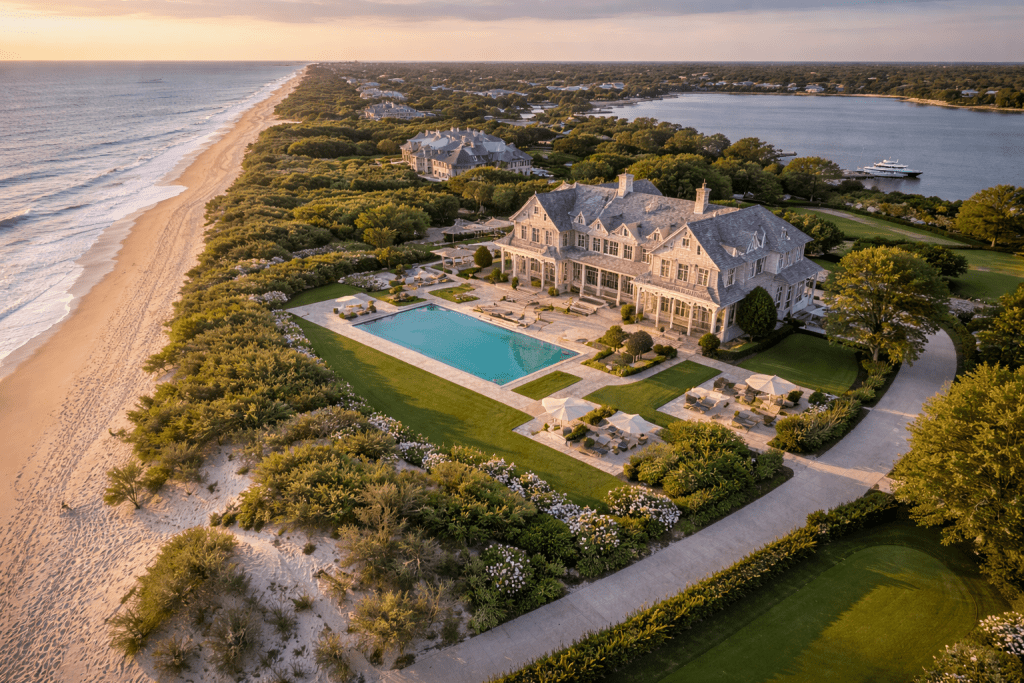
Meadow Lane runs five miles along Southampton’s oceanfront, concentrating more financial power per linear foot than any residential address in America. Ken Griffin’s $84 million acquisition of the former Calvin Klein compound. The Mylestone estate’s $112.5 million record. Robert Kraft, Henry Kravis, and Daniel Och maintaining positions along this stretch of sand and hedge. At the $50 million threshold, Hamptons real estate design enters territory where standard luxury conventions stop applying and an entirely different intelligence takes over.
D&J Concepts has designed interiors along this corridor for over two decades. The requirements at this level differ from even the highest-tier Hamptons properties elsewhere. Understanding those differences explains why Meadow Lane commands its premiums and why getting the design wrong at these numbers carries consequences that compound over decades.
The $50M Design Equation
At $50 million, you are not buying a house. You are acquiring a position on the most competitive residential street in American leisure culture. The design must serve dual purposes: creating a home that supports genuine private living while maintaining an estate that reinforces your standing among neighbors whose financial resources match or exceed your own.
This duality produces specific design requirements. Primary living spaces must be intimate enough for a Tuesday evening yet expandable for a 200-person benefit without temporary structures. Material selections must signal established wealth rather than recent acquisition. The difference is subtle but absolute: new money builds to impress visitors, established money builds to satisfy inhabitants. Architectural Digest features of Meadow Lane properties consistently reveal interiors that prioritize restraint over spectacle.
What $50M Actually Contains
A $50 million Meadow Lane property typically delivers 8,000 to 15,000 square feet of living space on 2 to 5 acres with direct ocean frontage. The land alone accounts for 60 to 75 percent of the purchase price. A 3-acre oceanfront parcel on Meadow Lane carries a raw land value approaching $30 million, meaning the structures represent $15 to $20 million of the total investment.
That structure budget, enormous by any standard, still imposes discipline. At $1,000 to $1,500 per square foot for luxury Hamptons construction, a 12,000-square-foot home consumes $12 to $18 million before furnishing, landscaping, or pool construction. Clients who fail to budget construction costs against land value discover that their $50 million acquisition requires another $5 to $10 million to bring to appropriate standard.
Knight Frank’s Wealth Report consistently ranks the Hamptons among the world’s most price-resilient luxury markets. Properties that maintain design quality at the appropriate level for their address appreciate more reliably than those where budget constraints produced compromises visible to educated buyers.
Material Intelligence at the Top
Meadow Lane estates demand materials that perform in salt air while maintaining the aesthetic standard set by neighbors who replaced everything ten years ago. This creates a material vocabulary specific to oceanfront Southampton that differs from even nearby addresses a quarter-mile inland.
Exterior cladding choices narrow to three options at this level: hand-split cedar shingles that silver naturally, mahogany clapboard that requires annual maintenance, or painted cedar that must be refinished every five to seven years. Each choice signals different values. The silver-shingle aesthetic reads as established and effortless. Painted surfaces read as maintained and deliberate. Mahogany reads as distinctive and demanding.
Interior materials follow a different logic. Stone floors in entry and public areas must withstand sand tracked from the beach without showing wear patterns. Wide-plank white oak remains the dominant flooring choice because it absorbs foot traffic gracefully while developing the warmth that engineered alternatives cannot replicate. Steve Chase’s material philosophy, which David Hornung absorbed during his training in Los Angeles, holds that natural materials earn their beauty through aging while engineered materials merely resist it.
The Renovation Trap
Many $50 million purchases on Meadow Lane are renovation candidates rather than new construction. Buyers acquire properties for their land position and then face decisions about the existing structures. The 2024 sale of 1320 Meadow Lane illustrated this dynamic perfectly: a nearly 10-acre oceanfront parcel with an abandoned construction project, last asking $49.5 million, attracting buyers who valued the land and intended to start fresh.
Renovation at this level requires forensic assessment before commitment. Salt air degrades structural elements in patterns that visual inspection cannot detect. Mechanical systems in homes built before 2010 rarely meet current performance expectations for air quality, humidity control, or energy efficiency. D&J Concepts conducts comprehensive assessments that quantify renovation costs against replacement costs, preventing clients from investing $8 million in renovating a structure that should have been replaced for $12 million.
The Privacy Imperative
Design at the $50 million level must address privacy with the same rigor applied to material selection and spatial planning. Meadow Lane properties face the ocean on one side and the road on the other, creating sight-line challenges that require architectural solutions rather than merely landscaping responses. Perimeter hedging manages road-side exposure, but interior room positioning determines whether living spaces feel protected or exposed.
D&J Concepts orients primary living spaces toward the ocean rather than the road, positioning service areas, mechanical rooms, and secondary spaces as privacy buffers along the street-facing elevation. Window placement follows a privacy hierarchy: primary bedrooms receive the most protected positions, living areas receive managed exposure that admits light and views without sacrificing seclusion, and entry sequences are designed to transition from the public road to the private interior through a series of visual screens that build anticipation while maintaining security.
Security infrastructure at this level extends beyond alarm systems. Safe rooms, reinforced entry points, camera systems integrated into the landscape, and communication redundancy that functions during power outages are standard requirements that must be accommodated during architectural planning. Retrofitting security into completed homes compromises both the security effectiveness and the aesthetic integrity that the investment demands.
Entertaining at Scale
Meadow Lane properties regularly host events ranging from intimate dinners for 12 to benefits for 300. The design must accommodate both extremes without temporary structures that signal inadequate planning. Indoor-outdoor flow through oversized door systems, covered terraces with permanent lighting and sound infrastructure, and kitchens designed to support catering operations alongside daily family use define the entertaining standard at this address.
Catering kitchens, separate from the primary kitchen, prevent event preparation from contaminating the home’s private spaces. D&J Concepts positions catering facilities with independent exterior access, allowing event staff to operate without passing through living areas. This dual-kitchen approach costs approximately $200,000 to $400,000 but eliminates the recurring disruption that single-kitchen homes endure every time the calendar demands a significant event.
Design as Investment Protection
At the $50 million level, design quality functions as investment protection. A Meadow Lane estate that falls below the aesthetic standard of its neighbors loses relative value with every season it remains unaddressed. Conversely, a property designed to the highest standard for its position appreciates more reliably than the overall market because the supply of appropriately designed oceanfront estates on this specific street will never meaningfully increase.
The Method of Visual Clarity delivers particular value at this price point because the cost of design errors scales with project size. A $50,000 mistake in a $500,000 renovation is a 10 percent overrun. The same mistake in a $5 million interior is still $50,000 but represents only one percent. At Meadow Lane budgets, however, the mistakes tend to be proportionally larger: wrong stone selection across 3,000 square feet, HVAC systems that cannot handle the thermal load of floor-to-ceiling oceanfront glass, or pool equipment positioned where it creates noise complaints from neighbors who have the resources to pursue every legal remedy available.
Start Your Design Conversation
D&J Concepts brings 25 years of luxury residential design experience to every project. The Method of Visual Clarity ensures your vision is resolved before construction begins. Contact Social Life Magazine for features, advertising, or partnership inquiries. Visit polohamptons.com for event tickets and sponsorship opportunities.
Subscribe to Social Life Magazine for ongoing design intelligence. Join our email list for exclusive content. Support independent Hamptons journalism with a $5 contribution.
Read more: The Complete Guide to Luxury Home Design and How Georgica Pond’s Residents Actually Live.
David Hornung co-founded D&J Concepts in 2001 after training under Interior Design Hall of Fame inductee Steve Chase in Los Angeles. From Southampton headquarters, D&J serves clients across the Hamptons, Manhattan, Palm Beach, and Southern California. A member of the Society of Design Administration, Hornung brings 25 years of luxury residential design experience to every project. Discover the Visual Clarity Method at dandjconcepts.com.
Author

Written by
Recent Posts

What $50M Buys on Meadow Lane

The Question Every Top Hamptons Designer Answers

Before You Break Ground: Visual Clarity for $5M+

Hamptons Bathrooms at the $15M Level

How Georgica Pond’s Residents Actually Live
Categories
- 2025 Social Life Events
- Access to Digital + Physical Magazine
- Art
- Articles
- Beauty & Skincare
- Beauty & Wellness
- Business Strategy
- Celebrities
- Chronicles
- Design History
- Design History|Hamptons
- Design Process
- Design Process|Luxury Living
- Design Trends
- Event Photos
- Events
- Family
- Fashion
- Fashion & Style
- Featured
- Food & Beverage
- Food, Spirits, Wine
- Hamptons
- Hamptons Celebrities
- Hamptons Design
- Hamptons Design|Design Process
- Hamptons Design|Luxury Living
- Health
- Health & Beauty
- Home & Design
- Home & Living
- Lifestyle
- Luxury Home Design|Design Process
- Luxury Home Design|Design Trends
- Luxury Home Design|Hamptons Design
- Luxury Home Design|Interior Design
- Luxury Lifestyle
- Luxury Living
- Luxury Living|Design Process
- Luxury Living|Hamptons
- Luxury Living|Hamptons Design
- Press
- Profiles
- Real Estate
- Technology
- The Chronicles
- Travel
- Trending
- Uncategorized
- Weddings
- Wellness