
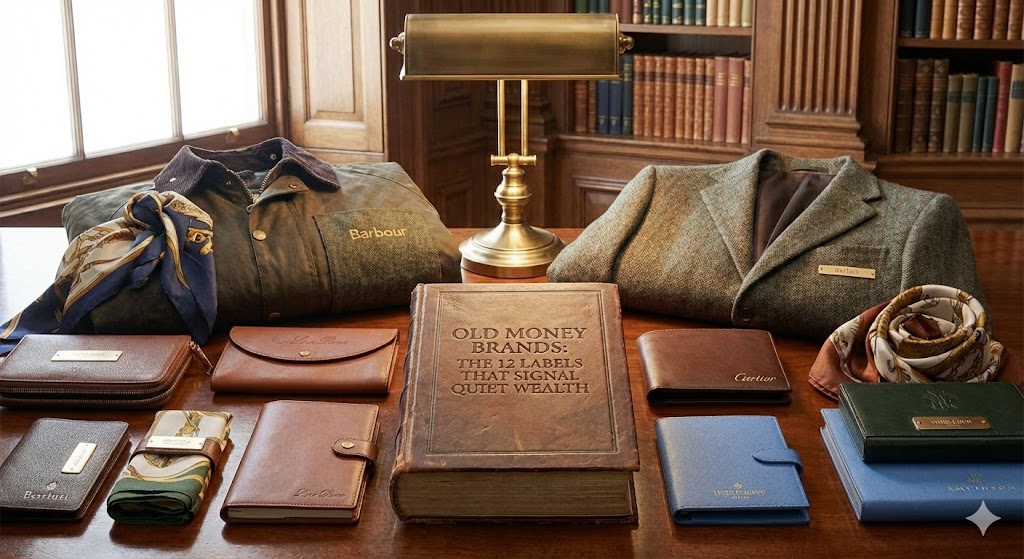
The Language of Stealth Wealth
You spot her at the Meadow Club in Southampton. There are no logos visible. No obvious designer flourishes appear anywhere. Instead, you notice a cashmere sweater the color of fog, trousers that drape like they’ve been worn for decades, and leather loafers so understated they could belong to anyone. Yet somehow, you know. Everyone knows. Clearly, she’s wearing more than most people earn in a year.
This is the paradox of old money brands. Essentially, they signal wealth precisely by not signaling at all. While fast fashion chases trends and mainstream luxury plasters logos across everything, these labels operate by a different code entirely. Moreover, they assume you already know. And if you don’t? Then you probably aren’t their customer anyway.
Admittedly, the quiet luxury movement isn’t new. However, it’s reached a cultural tipping point. HBO’s Succession introduced millions to the Loro Piana baseball cap and the particular shade of wealth that whispers rather than shouts. Meanwhile, TikTok’s obsession with “old money aesthetic” has generated billions of views. Consequently, understanding these brands has become essential cultural literacy for anyone navigating high-net-worth circles.
This guide decodes the labels that matter. First, you’ll learn why a $3,000 sweater with no visible branding commands more respect than a $500 logo-covered alternative. Additionally, you’ll understand the social calculus behind each purchase decision.
Why Old Money Brands Command the Luxury Hierarchy
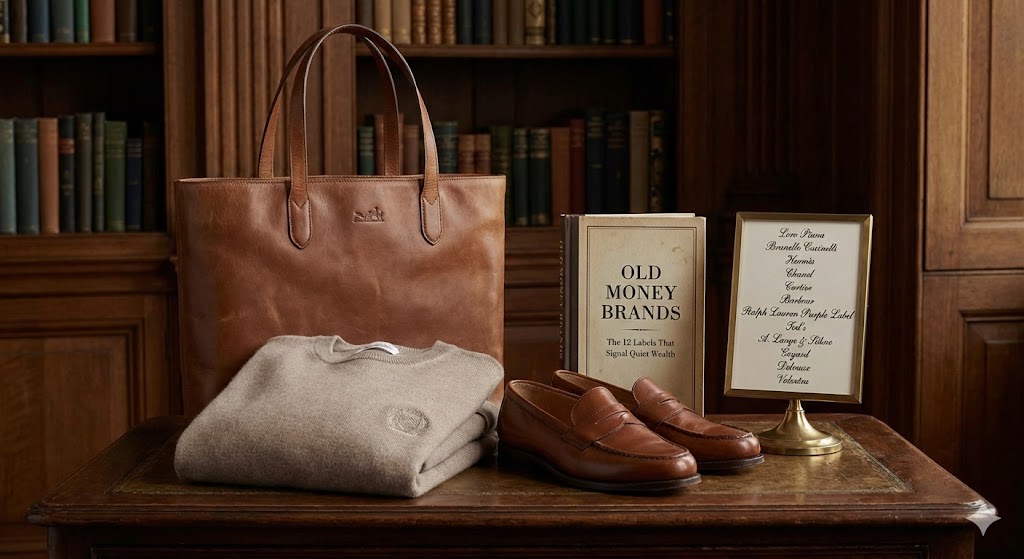
Interestingly, the distinction between old money and new money isn’t really about generational wealth. Rather, it’s about cultural capital—the accumulated knowledge, taste, and social codes that money alone cannot purchase. Therefore, old money brands serve as membership cards to this exclusive club.
Consider the economics as evidence. Brunello Cucinelli’s profits jumped 31.9% in early 2023. Similarly, Loro Piana continues posting record numbers despite—or perhaps because of—its astronomical prices. Meanwhile, logo-heavy brands struggle with oversaturation and declining prestige. Clearly, the market has spoken: quiet luxury wins.
Furthermore, these purchases function differently than typical luxury consumption. For instance, a Gucci belt depreciates the moment you wear it. In contrast, a Loro Piana cashmere jacket, properly maintained, appreciates in social value over years. It develops patina over time. Additionally, it tells a story. Ultimately, it suggests that you’ve possessed wealth long enough to know what actually matters.
The Apex: Ultra-Luxury Old Money Brands
Loro Piana: The Textile Aristocracy
When Bernard Arnault, the world’s richest person, appears in public, he often wears Loro Piana. Similarly, when the costume designers of Succession needed to dress Kendall Roy in authentic quiet luxury, they chose Loro Piana. Consequently, the Italian house has become shorthand for a particular kind of wealth—the kind that doesn’t need to prove anything.
Founded over a century ago, Loro Piana built its reputation on materials so rare they border on mythological. For example, baby cashmere, harvested once in a goat kid’s lifetime, yields approximately 30 grams per animal. Additionally, vicuña wool, sourced from wild camelids in Peru, sells for over $3,000 per yard. Remarkably, the brand established a nature reserve specifically to secure access to these materials.
Entry point: $500 (accessories). Core pieces: $2,000-$8,000. Investment items: $15,000+.
LVMH acquired 85% of Loro Piana in 2013 for $2.5 billion. Since then, the brand has cautiously expanded while protecting its exclusivity. Recently, collaborations with New Balance and Hiroshi Fujiwara signal a subtle shift toward younger wealth—though purists debate whether this dilutes the brand’s rarified air.
Brunello Cucinelli: Humanistic Capitalism
Brunello Cucinelli himself lives in Solomeo, a medieval Italian village he has restored with company profits. Notably, he pays workers 20% above market wages. Furthermore, he closes factories during August. Additionally, he donates substantial portions of earnings to cultural preservation. Ultimately, this backstory matters as much as the cashmere.
Often called the “King of Cashmere,” Brunello Cucinelli has become the poster child for quiet luxury’s commercial viability. Specifically, sales consistently grow in double digits. Moreover, the brand’s philosophy—that luxury should have a soul—resonates with consumers increasingly skeptical of corporate fashion conglomerates.
Aesthetically, Cucinelli’s designs skew slightly more relaxed than Loro Piana’s refined minimalism. Consequently, the fit accommodates American physiques better than most Italian competitors. In particular, spring and summer collections excel, offering sophisticated options beyond the expected cashmere knitwear.
Entry point: $400 (accessories). Core pieces: $1,500-$5,000. Investment items: $10,000+.
Hermès: The Original Quiet Luxury
Hermès occupies a unique position among old money brands. Admittedly, the Birkin and Kelly bags have achieved such cultural saturation that they verge on obviousness. However, the house’s clothing, leather goods beyond the iconic bags, and silk scarves remain textbook stealth wealth.
Founded in 1837 as a harness workshop, Hermès remains family-controlled—a rarity among luxury conglomerates. This independence allows the brand to maintain uncompromising quality standards and resist the volume pressures that dilute competitors. Notably, each Birkin bag requires 18-24 hours of handwork from a single artisan.
For those building old money credentials, the entry strategy is deliberate. First, start with silk—scarves, ties, pocket squares. Next, graduate to leather accessories and belts. Finally, pursue the waiting list for a bag only after establishing a purchase history. This ladder exists by design to filter serious collectors from tourists.
Entry point: $200 (silk accessories). Core pieces: $1,000-$5,000. Investment items: $10,000+ (leather goods).
Heritage Brands: Established Quiet Luxury
Ralph Lauren: American Aristocracy
Ralph Lifshitz grew up in the Bronx, the son of Jewish immigrants from Belarus. As Ralph Lauren, he invented American old money style from whole cloth. Consequently, no brand better illustrates how aspiration shapes reality. His polo players, manor houses, and Ivy League references created an aesthetic so powerful it became the aesthetic.
The brand operates in carefully tiered tiers. Purple Label competes with European luxury houses on quality and price. Polo offers accessible sophistication. RRL provides vintage Americana. Together, these lines offer entry points at virtually every price bracket while maintaining consistent DNA.
Critics argue Lauren sells fantasy to those who weren’t born into it. However, supporters counter that all style is performance. Furthermore, the fantasy has proven remarkably durable across fifty years and multiple fashion cycles. Whether authentic or aspirational, Ralph Lauren remains the definitive American old money reference.
Entry point: $100 (Polo basics). Core pieces: $500-$2,000 (Purple Label). Investment items: $3,000+ (runway pieces).
Burberry: British Heritage, Carefully Managed
Burberry demonstrates both the power and peril of heritage luxury. Thomas Burberry invented gabardine in 1879, creating the fabric that would outfit polar explorers and WWI officers. However, by the early 2000s, the iconic check had become so associated with football hooligans that the brand nearly collapsed.
The rehabilitation under creative directors Christopher Bailey and later Daniel Lee offers lessons in brand stewardship. Today, the trench coat remains a genuine old money credential. Meanwhile, the check appears sparingly, as accent rather than statement. Consequently, Burberry occupies an interesting middle ground—recognizable enough for new money, restrained enough for old.
For old money purists, the Heritage collection delivers classic pieces without trend contamination. Specifically, the Kensington and Westminster trenches remain benchmarks against which competitors are judged. Additionally, the brand’s Britishness carries particular cachet in American markets seeking Continental credibility.
Entry point: $300 (accessories). Core pieces: $1,500-$3,000 (trenches). Investment items: $4,000+ (runway pieces).
The Row: Modern Minimalism
Mary-Kate and Ashley Olsen launched The Row in 2006, and skeptics expected another celebrity vanity project. Instead, the twins created what many consider the purest expression of contemporary quiet luxury. The brand shows at Paris Fashion Week, commands four-figure price tags, and maintains waiting lists that rival Hermès.
The Row’s aesthetic represents old money values filtered through modern minimalism. Colors trend neutral. Silhouettes emphasize drape over structure. Logos simply don’t exist. Consequently, the brand appeals to women who possess the confidence to wear clothing that provides no external validation.
The 2024 opening of a boutique in Amagansett signals The Row’s understanding of its core customer. Hamptons summer residents—the quietly wealthy who summer east of the highway—represent the ideal demographic. For them, The Row serves as the feminine counterpart to the Loro Piana uniform their partners wear.
Entry point: $400 (accessories). Core pieces: $1,500-$4,000. Investment items: $6,000+ (outerwear, leather).
Accessible Old Money Brands
Max Mara: The Investment Coat
Max Mara has manufactured coats in Reggio Emilia since 1951. The brand’s camelhair and wool outerwear represents perhaps the best value proposition in quiet luxury. Moreover, the iconic 101801 coat, unchanged since 1981, offers timeless design that transcends seasonal trends.
Unlike brands that chase relevance through constant reinvention, Max Mara understands that its customer wants reliability. She needs a coat that works for the opera, the office, and the Southampton Jitney. Therefore, the brand delivers precisely that, season after season.
For younger professionals building old money wardrobes, Max Mara represents a strategic entry point. The quality genuinely compares to brands at twice the price. Additionally, the aesthetic reads as sophisticated rather than aspirational. Consequently, it functions as a credential rather than a tell.
Entry point: $300 (accessories). Core pieces: $1,500-$3,500 (coats). Investment items: $5,000+ (cashmere outerwear).
Barbour: Functional Aristocracy
Since 1894, Barbour’s waxed cotton jackets have equipped British aristocracy for outdoor pursuits. Additionally, the brand holds multiple Royal Warrants. Importantly, its products are designed for function first—hunting, fishing, walking estates—with style as a fortunate byproduct.
This utilitarian heritage distinguishes Barbour from purely aesthetic luxury brands. For instance, a properly worn Barbour jacket, re-waxed and patinated over years, signals genuine experience rather than purchased taste. Consequently, the brand remains a staple of old money wardrobes on both sides of the Atlantic.
Entry point: $200 (accessories). Core pieces: $400-$800. Investment items: $1,000+ (heritage jackets).
Brooks Brothers: American Institution
Founded in 1818, Brooks Brothers has dressed 40 American presidents. Historically, the brand invented the button-down collar after observing polo players. Furthermore, it introduced the ready-made suit to America. Consequently, this heritage runs deeper than any contemporary luxury label can claim.
Admittedly, the 2020 bankruptcy and subsequent acquisition raised questions about the brand’s future. However, the core products—oxford shirts, navy blazers, classic tailoring—remain foundational old money wardrobe elements. Therefore, for those building stealth wealth style on a budget, Brooks Brothers offers legitimate credentials at accessible prices.
Entry point: $80 (dress shirts). Core pieces: $300-$800. Investment items: $1,500+ (made-to-measure).
Building an Old Money Brands Wardrobe
Assembling a quiet luxury wardrobe isn’t about accumulating designer labels. Rather, it’s about strategic investment in pieces that compound in social value over time. Essentially, the formula is straightforward: quality over quantity, fit over fashion, materials over marketing.
The Foundational Pieces
First, start with cashmere. A single excellent sweater from Loro Piana or Brunello Cucinelli will outperform ten mediocre alternatives. Ideally, the cashmere should feel substantial yet soft. Additionally, colors should be neutral—gray, navy, cream, camel. Above all, avoid anything that screams for attention.
Next, add tailored basics. Consider a navy blazer from Ralph Lauren Purple Label or Brooks Brothers’ Golden Fleece line. Similarly, properly hemmed trousers in wool or cotton prove essential. Likewise, oxford shirts in white and light blue remain timeless. Together, these pieces mix infinitely and never date.
Finally, complete with leather goods. Specifically, acquire a quality belt and watch strap in matching leather. Additionally, invest in shoes from established makers—Church’s, Alden, or J.M. Weston. Furthermore, select a briefcase or tote that improves with age rather than deteriorating.
The Investment Calculation
Importantly, old money thinking requires old money math. For example, a $3,000 Loro Piana jacket worn 200 times over five years costs $15 per wear. Moreover, if it sells for $1,500 on resale platforms, true cost drops to $7.50 per wear. In contrast, a $200 fast-fashion jacket replaced annually totals $1,000 over five years with zero resale value.
This calculation explains why wealthy individuals buy fewer, better things. Essentially, they’re not spending more—they’re spending smarter. Furthermore, the social returns on quality compound over time in ways that cheap alternatives never match.
Old Money Brands in the Hamptons
Undoubtedly, the Hamptons serve as America’s proving ground for old money style. Here, fashion choices signal not just wealth but the right kind of wealth. Typically, new money arrives in obvious designer logos and tries too hard. Conversely, old money glides through in faded cashmere and inherited watches.
Currently, The Row’s Amagansett boutique has become a pilgrimage site for those seeking understated sophistication. Meanwhile, Kirna Zabête in East Hampton mixes established labels with emerging designers. Additionally, the Ralph Lauren flagship on Main Street offers a masterclass in American old money aesthetic.
Notably, polo matches at Bridgehampton demand particular attention. Specifically, the dress code—”country elegant”—rewards those who understand nuance. Consider a Loro Piana linen jacket over a crisp oxford. Similarly, a Barbour vest handles unpredictable weather perfectly. Likewise, classic loafers work better than trendy sneakers. Ultimately, these choices communicate fluency in codes that money alone cannot purchase.
The Final Word on Old Money Brands
Ultimately, old money brands matter because clothing has always been communication. In spaces where wealth is assumed, the question becomes: what kind of wealthy person are you? Are you desperate to prove something? Or are you comfortable enough to let quality speak for itself?
The twelve brands in this guide represent different answers to that question at different price points. Specifically, Loro Piana and Brunello Cucinelli serve those operating at the apex. Meanwhile, Ralph Lauren and Burberry provide heritage credibility. Similarly, Max Mara and Barbour offer accessible excellence. Finally, Brooks Brothers delivers foundational basics.
Master these old money brands and you master a language. However, it’s not the language of wealth—that’s easily purchased. Rather, it’s the language of taste, which remains priceless.
Continue Your Style Education
- Best Hamptons Fashion Boutiques You Must Visit — Where fashion editors actually shop on the East End.
- Rich Guy Fashion: Less is More for Wealthy Men — The complete stealth wealth wardrobe decoded.
- Luxury Fashion Trends Defining Hamptons Style in 2025 — What’s next in quiet luxury.
Stay Connected with Social Life Magazine
Author

Written by
Recent Posts

Inside the Art Collections Hidden Behind Hamptons Estate Gates

Next Holidays Makes Holiday Booking Faster, Easier, and More Convenient

The Fertility Pioneer: Inside Dr. David Smotrich’s Mission to Build Families
Beat the Summer Heat Safely: 5 Practical Styling Hacks for Boat Trips and Lake Days
First Date Outfit Ideas: Flattering and Budget-Friendly Dresses to Wear Tonight
Categories
- Art
- Articles
- Business of Luxury
- Celebrities
- Entertainment
- Events
- Faces of Summer 2026
- Fashion
- Fashion & Style
- Featured
- Finance
- Food, Spirits, Wine
- Hamptons
- Hamptons Celebrities
- Health
- Health & Beauty
- Lifestyle
- Luxury Lifestyle
- Press
- Profiles
- Real Estate
- Technology
- The Chronicles
- Travel
- Uncategorized
- Weddings