
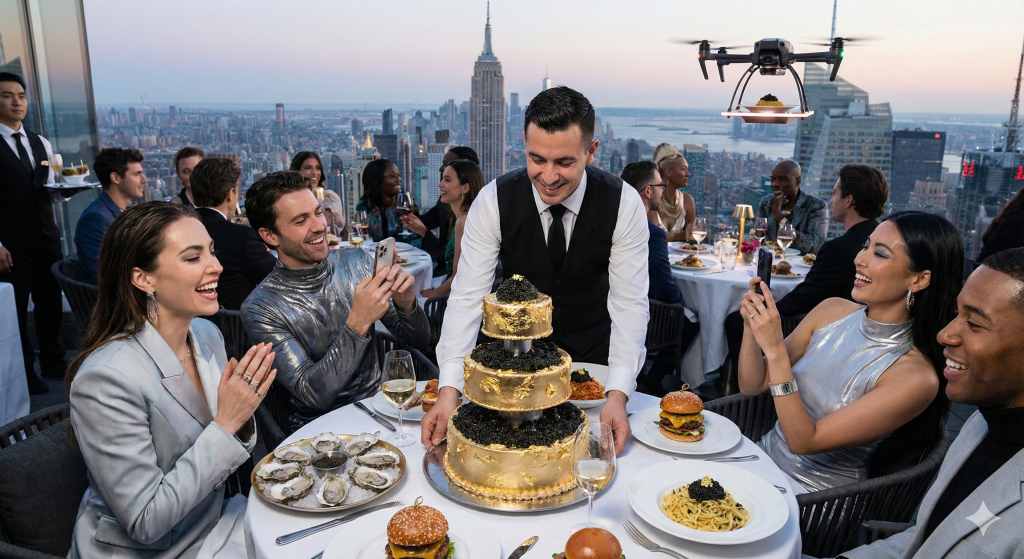
Chicken nuggets and mozzarella sticks have become “caviar chairlifts” at NYC’s hottest spots. The phrase sounds absurd until you’ve watched someone pay $85 for fried bar food crowned with Siberian sturgeon roe at a downtown restaurant that doesn’t take reservations. Then it makes perfect sense.
Welcome to NYC luxury dining trends 2026, where the question isn’t whether you can afford the caviar. It’s whether you understand why it’s there in the first place. What you order—and how you order it—has become a fluent language of status that separates the merely wealthy from the strategically positioned. The stakes are higher than a restaurant bill. They’re about who you are and who knows it.
The Hidden Game Behind NYC Luxury Dining Trends 2026
Thorstein Veblen identified conspicuous consumption over a century ago. However, what’s happening in Manhattan restaurants right now is something more nuanced. According to research published in the Journal of Marketing, luxury consumers now fall into distinct categories based on their wealth and their need for status. The wealthy who don’t crave status recognition prefer quiet signals only other elites can read. Meanwhile, the newly affluent deploy louder markers—like caviar on everything—to announce their arrival.
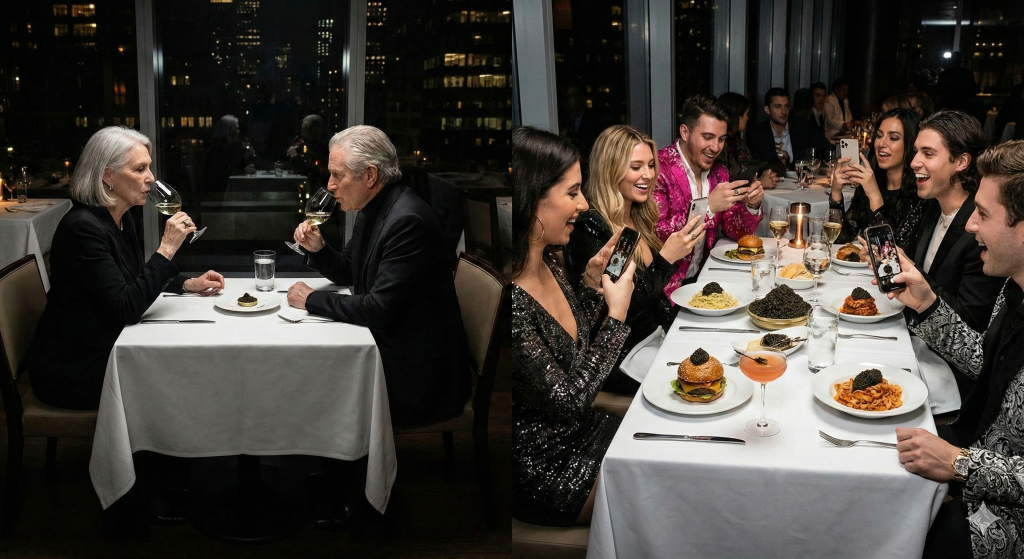
This psychological framework explains why 2026’s dining trends look the way they do. Caviar has become the perfect status accelerator. It’s expensive enough to exclude, visible enough to impress, and versatile enough to appear anywhere—from omakase counters to cocktail lounges. The truly interesting play isn’t the caviar itself. It’s the context surrounding it.
Consider the economics. A tin of quality Osetra runs $150 for 30 grams at Caviar Russe on Madison Avenue, a seven-time Michelin-starred establishment. That same amount, deployed across four courses at a restaurant where deals close, becomes an investment with compounding returns. The ROI on strategic dining has never been more calculable.
The Players Reshaping Manhattan’s Dining Landscape
Three forces have converged to create the current moment. First, a wave of post-pandemic wealth creation—SPACs, crypto liquidity events, private equity exits—deposited unprecedented capital into hands that hadn’t held it before. Second, remote work’s collapse brought finance back to Manhattan, along with the expense accounts and client entertainment budgets that fuel high-end restaurants. Third, chefs discovered that elevated comfort food—nostalgia with a luxury modifier—generates both margins and Instagram engagement.
The results are everywhere. At establishments from Tribeca to the Upper East Side, menus now feature caviar as both protagonist and supporting player. Petrossian, the century-old purveyor that introduced America to the delicacy, has expanded its Meatpacking District boutique while its flagship undergoes renovation. Caviar Russe continues its reign on Madison Avenue, where the dining room presents seasonal tasting menus built around the namesake ingredient. The message is clear: caviar has graduated from special occasion to dining language.
Yet the most revealing development isn’t happening at dedicated caviar temples. It’s happening at restaurants where caviar appears unexpectedly—on burger buns, atop deviled eggs, nestled into hand rolls. This democratization paradoxically increases caviar’s status power. When it’s everywhere, knowing where matters more than having access at all.
The Status Signals Nobody Talks About
Harvard Business Review documented the rise of “inconspicuous consumption”—elite consumers’ growing preference for discreet rather than flashy luxury. The savviest players in Manhattan’s dining scene have learned to read signals that most diners miss entirely. They know that the person ordering a quiet glass of Burgundy and the $45 chicken with caviar jus understands something the flashy table ordering towers of seafood does not.
The taxonomy works like this. Patricians—the established wealthy with low need for status display—favor restaurants where the luxury is structural rather than ornamental. They book tables at places where the chairs are expensive but not photographed, where the wine list is deep but not performative. They deploy caviar sparingly, as accent rather than announcement.
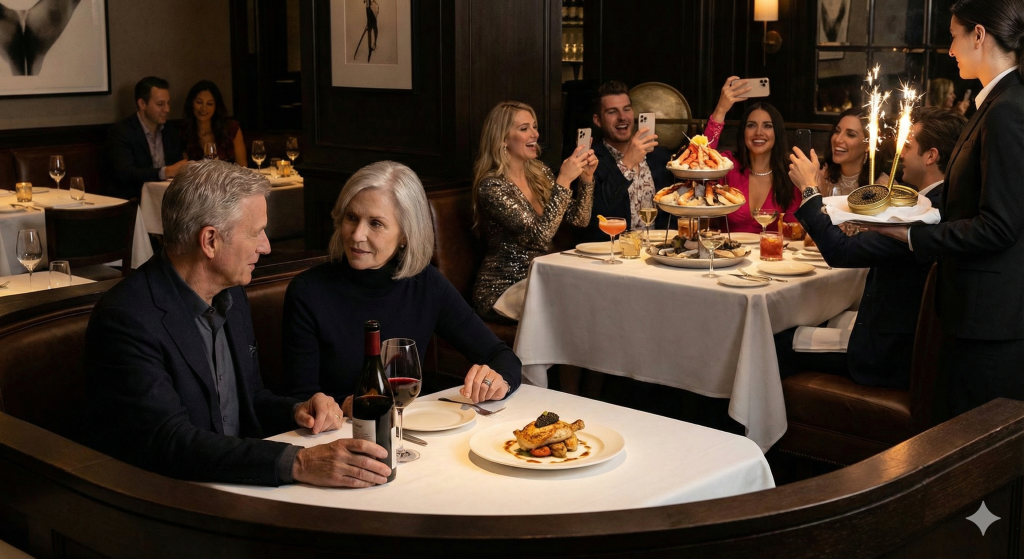
Parvenus—the newly wealthy seeking recognition—make different choices. They gravitate toward restaurants that photograph well, where the caviar arrives with ceremony, where the bill becomes a talking point. They need the luxury to be legible to observers. This isn’t wrong; it’s simply a different game with different objectives.
The genius of NYC luxury dining trends 2026 is that both groups can now sit in the same restaurant, ordering from the same menu, while playing entirely different status games. The restaurants themselves have learned to serve both audiences without alienating either.
The Insider’s Playbook for Strategic Dining
Understanding the game is only valuable if you know how to play it. Here’s what the strategically minded should know about navigating NYC’s luxury dining landscape in 2026.
First, the bar is the new dining room. At Caviar Russe, the Bar & Lounge offers the same product as the Michelin-starred upstairs, but in a context that reads as confidence rather than occasion. You’re not celebrating something; you’re simply a person who eats caviar on Tuesday. This positioning shift changes how others perceive you—and how subsequent conversations unfold.
Second, knowledge outweighs display. The person who can discuss the difference between Kaluga and Osetra, who knows that farmed American sturgeon has closed the quality gap with Caspian varieties, who mentions visiting the farm in California—this person signals differently than someone simply ordering “the most expensive one.” Investment in knowledge creates compounding status returns.
Third, timing matters enormously. The power hours at Manhattan’s elite restaurants aren’t the obvious 8pm Friday slots. They’re the 6pm Tuesday dinners, the noon Saturday lunches, the occasions that suggest you’re not working around a schedule—you’re setting one. The Hamptons cognoscenti have long understood this principle, as captured in our guide to Hamptons restaurants by village, where the same status logic applies to summer tables.
Fourth, the invite reveals the relationship. Bringing someone to your caviar spot—introducing them to a maître d’ who knows your name, ordering “the usual,” perhaps surprising them with a tin shipped to their office the following week—creates relationship asymmetry that’s difficult to achieve through conventional networking. The strategic deployment of dining equity can accelerate professional relationships by months.
What the Caviar Economy Reveals About Wealth Today
The caviar-on-everything phenomenon isn’t frivolous. It’s diagnostic. It reveals something fundamental about how contemporary wealth operates and signals itself.
According to research on luxury as costly signaling, elite consumers increasingly prefer experiences over products and subtlety over display. Nevertheless, the newly wealthy require visible markers to establish their position. Caviar threads this needle perfectly—it’s simultaneously a discreet pleasure (for those who know) and a visible signal (for those who need to show).
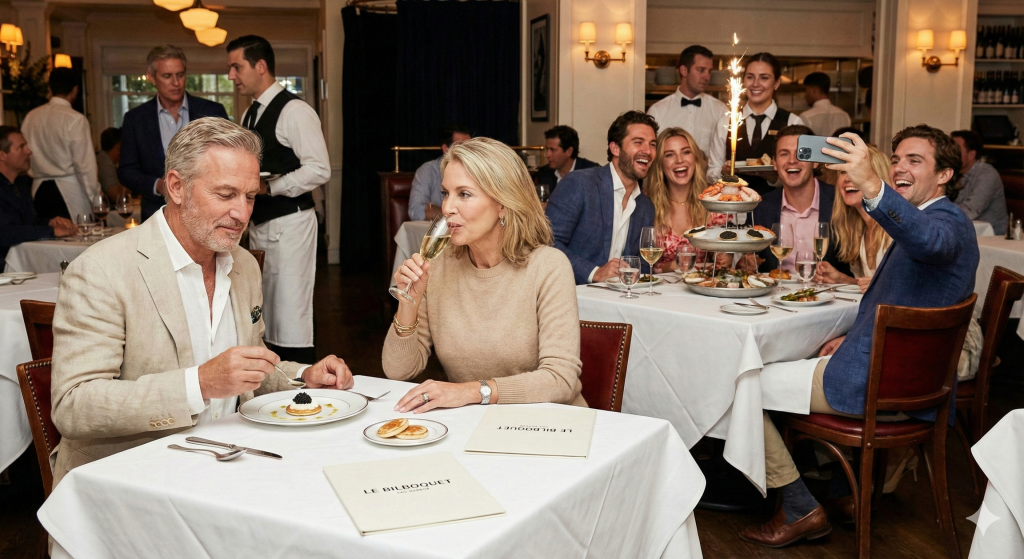
This dual functionality explains why the trend has such staying power. It also explains why the Hamptons’ restaurant scene—where much of Manhattan’s wealth summers—has mirrored these developments. From the horseshoe bar at Le Bilboquet Sag Harbor to the seasonal menus at The Maidstone in East Hampton, caviar has become a lingua franca that travels with the money.
The celebrities and executives profiled in our Hamptons celebrity guide understand this implicitly. They choose restaurants not just for the food but for the semiotics—what a venue says about them, who they’ll encounter, what transactions (social or financial) the environment facilitates.
Looking Forward: Where NYC Luxury Dining Trends Are Heading
The caviar economy shows no signs of retreating. If anything, 2025 will bring further refinement. Expect to see restaurants creating tiered experiences—the main dining room for civilians, the private spaces for principals, the unlisted phone numbers for repeat players. The research on luxury signaling suggests this stratification serves both parties: it gives the elite privacy while giving the aspirational something to aspire toward.
Additionally, expect the boundaries between dining categories to continue blurring. The “elevated comfort food” movement—chicken nuggets with caviar, truffle grilled cheese, $40 cheeseburgers—represents a bet that nostalgia combined with luxury creates emotional resonance impossible to achieve through traditional fine dining. This bet appears to be paying off.
Finally, expect geography to matter more, not less. As remote work settles into hybrid patterns, the restaurants where deals close will concentrate in specific neighborhoods, specific buildings, specific tables. Understanding NYC luxury dining trends 2026 means understanding that the physical location of consumption has become a status marker in itself. The right address validates the right people.
The chicken nuggets are still chicken nuggets. The caviar is still caviar. But together, in the right room, at the right time, with the right people watching, they become something else entirely: a language of arrival, an announcement of position, a strategic deployment of consumption as communication. Welcome to the caviar-on-everything economy. The question isn’t whether you can afford to play. It’s whether you understand the game.
Stay Connected with Social Life Magazine
Author

Written by
Recent Posts
Cynthia Erivo Net Worth: The Voice That Was Always There
Inside Out 2, Wicked, and the Emotional Blockbuster That Ate 2024
7 Mindful Meal Prep Tips for Stop Food Waste Day
Rebecca Ferguson Net Worth: The Advantage of Not Being the Lead
What Makes a Dinner Party Truly Unforgettable (Hint: It’s Not the Food)
Categories
- Art
- Articles
- Beauty & Skincare
- Celebrities
- Celebrities|Entertainment
- Celebrities|Television
- Celebrities|The Chronicles
- celebrities|the-archive
- Chronicles
- Entertainment|Culture
- Event Photos
- Events
- Fashion
- Fashion & Style
- Featured
- Food & Beverage
- Food, Spirits, Wine
- Hamptons
- Hamptons Celebrities
- Hamptons Celebrities|Celebrities|The Chronicles
- Health
- Health & Beauty
- Lifestyle
- Luxury Lifestyle
- Movies
- Press
- Profiles
- Real Estate
- Technology
- The Chronicles
- Travel
- Uncategorized
- Weddings