
Postwar America presented unprecedented opportunities for inter-class mobility. As the country emerged from the Depression and World War II into a period of expanding prosperity, wealth and status became newly attainable beyond the old elite. Women and class in postwar America were part of this transformation: in the 1950s, American women developed a new language of status — one spoken through cashmere and cocktails, consumption and the careful curation of taste.
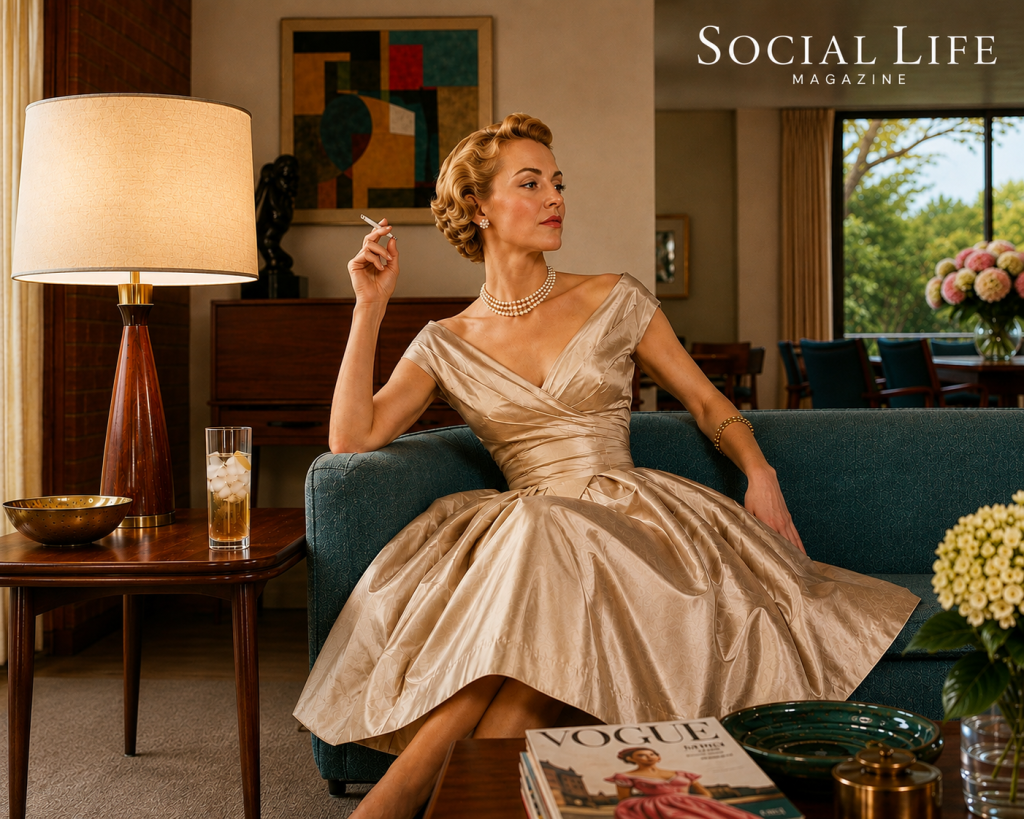
At a friend’s home in the Hamptons, I found myself lingering over a framed photograph that seemed to be straight out of a 1950s magazine spread on “modern living”. It captured a woman in a living room in a suburban home, perched on a Danish modern sofa, wearing a taffeta Dior dress, with a cigarette balancing between her fingers and a highball resting on the teak side table.
This woman was performing her upper-class position with remarkable confidence. And, in retrospect, we can see that the performance was becoming part of the position itself. In postwar America, where women remained largely excluded from the traditional avenues to wealth and institutional power, many learned to navigate status through a different medium.
Luxury was never only about economics; it was also about semiotics. Fashion, interiors, etiquette, and consumption became instruments with which women did more than signal status. They administered it.
This is the story of American class that rarely makes it into our history books. It is not the story of men climbing the corporate ladder. It’s the story of women who quietly reshaped the way class was expressed. And it’s the story of how their daughters — the women we’re sitting with in the Hamptons today — inherited that blueprint and turned it into a form of cultural capital that still shapes the American elite.
Power, Served at Home
The greatest expansion of women’s authority in postwar America did not happen in Congress or the boardroom. It happened in the living room.
Before World War II, most of the routes to status remained firmly in men’s hands. Men built businesses, made partner, inherited firms, sat on corporate boards. Women had access to wealth through family fortunes and marriage, but they were passengers in that system, far less likely to control the institutions that produced it. The war briefly expanded women’s economic roles, but it did very little to change who held institutional power.
The postwar boom transformed something else. It turned millions of middle-class Americans into aspirational elites. The new symbols of success weren’t limited to bigger paychecks. They included country club memberships, weekends at the shore, modern architecture, and cocktail parties in beautifully appointed homes. Americans had more money than ever before—but prosperity also demanded a new vocabulary. Taste became the difference between having wealth and belonging to the world wealth inhabited.
Women and Class in Postwar America
Money could buy a beautiful house. Taste told everyone what kind of person lived inside it.
The shift had begun during the Great Depression, when conspicuous display of wealth became mauvais ton among the upper classes. The American elite stopped distinguishing itself by owning more and started distinguishing itself by knowing more. Knowledge became the ultimate luxury good.
The trend accelerated after the war. Class was no longer expressed only through inherited silver, family portraits, and old-money addresses. It could be assembled through choices: a Danish modern sofa instead of an overstuffed Victorian one, a perfectly cut dress instead of an obviously expensive one. The objects mattered. What mattered far more was the knowledge behind them.
You didn’t need to inherit a Chippendale secretary. You could buy a Knoll chair. The status symbol wasn’t the chair itself but knowing why it was a Knoll chair. If you understood the meaning of that choice, you were demonstrating taste. More precisely, you were demonstrating membership in a class that had supposedly never needed the choice explained to it.
This is where the arrangement becomes something more interesting than snobbery. A woman with money could buy things. A woman with taste, a woman who understood that a certain kind of simplicity indicated breeding, that authentic materials indicated authenticity of person, that knowing the right designer meant you were the right kind of woman, was doing something else. She was operating a filing system for human beings. Luxury had become less about displaying wealth than about demonstrating fluency, and fluency is a thing you can test people for without ever announcing that a test is underway.
The Housewife Academy
Men climbed through credentials. Women climbed through a curriculum that no school offered, and no institution would admit existed.
Men in postwar America advanced through business schools, professional degrees, and the right firms. Their path was institutional; the requirements were published. Women were expected to advance through the mastery of aesthetic knowledge. You did not learn it in a classroom. You got it by reading, by watching other women, by going into department stores and paying attention. It required an almost anthropological attention to detail. What does a woman wear who is that kind of woman? What does she read? What does she drink? How does she speak about money?
You could move through the world and educate yourself. And it gave women a greater sense of agency.
The instruction was handled largely in magazines. House Beautiful and House & Garden taught the domestic vocabulary. Harper’s Bazaar, where Diana Vreeland arrived in 1936, and Vogue, which she took over in 1963, taught the personal one. These were not shopping guides. They were textbooks in a subject the universities did not offer. The magazines taught readers not simply what to buy, but how to see.
Vreeland put the entire discipline into nine words: “You must always be a rose, that is where it all begins.” She was not talking about looking nice. She was describing a philosophy of self-presentation, and behind it a conviction that how you appear in the world is a continuous statement about which world you belong to.
Art de Fête: Entertaining and Influence
By the 1960s, few rituals revealed more about women and class in postwar America than the dinner party.
They had become a central feature of middle and upper-class life. And women understood this explicitly: the dinner party was a performance. It was a stage on which you demonstrated your taste, your knowledge, your class position. A successful hostess curated far more than the menu. She selected the wines, arranged the flowers, balanced the guest list, and created an atmosphere. Every choice communicated something about the household.
The skills required were substantial. Hosting demanded organizational ability, aesthetic judgment, social intelligence, and a deep familiarity with the rituals of entertaining. These weren’t merely domestic tasks; they were forms of cultural expertise. And a woman who was good at this — who understood the codes, who could execute the performance flawlessly — gained something valuable: authority.
In a world where institutional power was closed to her, she could build a parallel power structure based on aesthetic knowledge and her Rolodex.
The Economics of Status
Here’s where the story gets more interesting. The rise of female taste-making wasn’t just about aesthetics or psychology. It was economic.
Women controlled the bulk of consumer spending. They bought the furniture, clothes, groceries. The housewives were the economic engine of postwar consumer capitalism.
And the luxury industry knew it.
Fashion houses, design companies, jewelry makers, advertisers — they all understood if you could convince a woman that a particular brand or aesthetic choice was a marker of her class and worth, she would buy it. She would invest in it. She would believe it was an investment in herself.
And then there was the cost of her performing status, usually left out of this story, an omission that makes the whole enterprise look like a hobby.
The women’s work at home was continuous and expert and appeared in no ledger of the period. A woman running a household at an upper-class level was performing procurement, design, scheduling, catering management, and diplomacy, frequently for gatherings that shaped her husband’s career and her children’s marriages. And she was expected to make the entire operation look like an afternoon’s pleasure. The economy of the era recorded none of it as labor. Her compensation was her position in society.
Finally, some women started transforming their cultural fluency into professional authority. Fashion editors, interior decorators, event planners, boutique owners, and jewelry designers translated expertise in taste into careers. Postwar prosperity dramatically expanded their influence. They were earning money from teaching other women how to present themselves. Taste had become both cultural capital and, increasingly, economic capital.
The Blueprint We Still Follow
Here’s what’s crucial to understand about women and class in postwar America: the blueprint women created in this era did not disappear with it. It became the blueprint we still follow today.
More women today possess economic power in their own right. Their grandmothers often used taste to gain agency in a world that denied them institutional authority. Today’s women are better positioned to earn the wealth that their taste once merely signaled.
A woman in the Hamptons who wears an Oscar de la Renta dress, has the right furniture, knows the right restaurants, and speaks about wine with authority isn’t simply performing status but expressing a class position she has earned. She is still participating in a cultural system pioneered by her grandmother’s generation, one that she has transformed through her own economic success.
The psychological blueprint remains the same: the understanding that how you present yourself is an investment in your own position. That taste is a form of currency. The curation of your own appearance and environment is a legitimate strategy for economic and social advancement.
And then look at who is thriving in the contemporary market of luxury goods and services — the medspa owners, the fashion designers, the interior decorators, the hospitality entrepreneurs — so many of them are women.
The woman in the 1950s photograph, sitting on her Danish modern sofa in her Dior dress, invented a new language of class. Her granddaughter didn’t just inherit that language. She learned to speak it fluently. And now she’s using it to build something her grandmother couldn’t have imagined: a world where that language translates directly into cultural power and economic authority.
Yuliya Barycheuskaya is a historian at the CUNY Graduate Center. Her work explores the intersections of class, gender, and media across societies in transition, with a particular interest in women and class in postwar America and postwar Eastern Europe. She is currently researching the role of taste-making in women’s economic and social mobility.
Author

Written by
Recent Posts
The Two-House Year: What Seasonal Residents Learn After the First Season
Trade Show Booth Decisions: What to Rent, What to Build, and What to Skip
Find Your Ideal Solar Battery Size in Minutes

How to Explore Rome Comfortably Between Check-In and Departure

Beyond the Beauty Template: Why Modern Cosmetic Surgery Is Moving Beyond the One-Size-Fits-All Face
Categories
- Art
- Articles
- Business of Luxury
- Celebrities
- Culture
- Entertainment
- Events
- Faces of Summer 2026
- Fashion
- Fashion & Style
- Featured
- Finance
- Food, Spirits, Wine
- Hamptons
- Hamptons Celebrities
- Health
- Health & Beauty
- Lifestyle
- Luxury Lifestyle
- Press
- Profiles
- Real Estate
- Technology
- The Chronicles
- Travel
- Uncategorized
- Weddings