
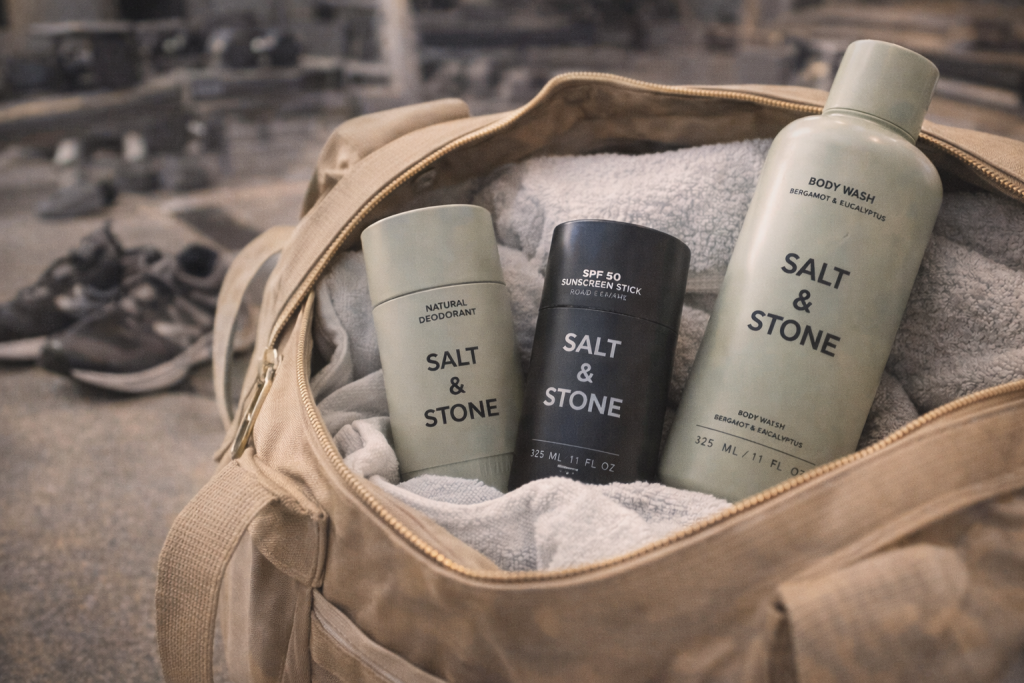
The scent hits you before you see the bottle. Santal and Vetiver. Warm, woody, and unmistakably expensive. At SoulCycle Southampton and Barry’s Bootcamp Bridgehampton, a curious pattern emerged over the past year. The minimalist white tubes tucked into Lululemon totes weren’t the usual drugstore suspects. They were Salt and Stone, a premium body care brand projecting $140 million in revenue by the end of 2025.
Founded in 2017 by former professional snowboarder Nima Jalali, Salt and Stone has pulled off something the beauty industry rarely sees. The brand dominates both Amazon’s mass marketplace and Sephora’s prestige counters simultaneously. This dual-channel mastery explains why those distinctive deodorants now appear in every Southampton spin studio and Hamptons tennis club locker room.
From Snowboard Slopes to Bathroom Shelves
Jalali’s path to body care entrepreneurship wound through the mountains first. As co-founder of goggle label Ashbury in 2007 and gloves brand Howl Supply in 2014, he understood how to build brands that resonated with active, discerning consumers. When he launched Salt and Stone with SPF products in 2017 and deodorant in 2018, he brought that same sensibility to a category dominated by crunchier natural alternatives.
The strategy wasn’t about appealing to granola crowds. Jalali positioned Salt and Stone as a sophisticated alternative for wellness-minded consumers who refused to sacrifice efficacy for clean ingredients. The result attracted everyone from NASCAR driver Toni Breidinger to golfer Charley Hull to ultra-runner Max Jolliffe. When professional athletes stake their performance on your deodorant, the product speaks for itself.
The Numbers Behind the Phenomenon
Salt and Stone’s growth trajectory reads like a venture capital fever dream. Sales multiplied four times in both 2022 and 2023. The brand maintains profitability on first purchase through direct-to-consumer channels, which still drive approximately 80 percent of revenue. Industry sources confirm the company has operated profitably since inception without requiring significant external funding, though strategic partners have made undisclosed investments.
The 2023 Sephora launch proved transformative. As body care exploded across the beauty market, Salt and Stone rode the wave while competitors like Sol de Janeiro captured Gen Z with tropical gourmand scents. Millennials seeking elevated alternatives gravitated toward Salt and Stone’s minimalist aesthetic and sophisticated fragrance profiles. The positioning worked. Today the brand ranks as the number one deodorant partner at every major retail account it serves.
Private equity interest has intensified. Work with a leading mergers and acquisitions banker sparked acquisition speculation following high-profile deals in the body care and premium fragrance sectors. Whether Jalali sells or continues building independently, the brand’s trajectory points toward continued expansion.
What Makes the Formula Different
Salt and Stone’s extra-strength deodorant formula contains no aluminum, parabens, or phthalates. The proprietary blend features seaweed extracts for moisture and prebiotics that help neutralize odor for up to 48 hours. The Leaping Bunny certification confirms cruelty-free production, while vegan ingredients satisfy increasingly conscious consumers.
Five signature scents anchor the collection. Santal and Vetiver delivers warm, woody notes. Bergamot and Hinoki offers citrus with woodsy undertones. Saffron and Cedar brings sweet amber warmth. Neroli and Basil creates crisp, green freshness. Black Rose and Oud presents dark, floral complexity. Each fragrance extends across the full product line, enabling complete scent layering from shower to evening out.
The product catalog has expanded strategically. Beyond the bestselling $20 deodorant, body wash retails at $36, body mist at $32, and the full skincare range includes facial cleansers and hand creams. Discovery sets allow customers to sample multiple fragrances before committing to full sizes. The body wash and body mist discovery sets particularly appeal to gift-givers seeking elevated everyday luxury.
Why Hamptons Consumers Chose Premium
The natural deodorant category has exploded as consumers question aluminum compounds in traditional antiperspirants. But early natural alternatives often failed under pressure, leaving converts sweaty and skeptical. Salt and Stone solved the efficacy problem while maintaining clean formulations. The brand specifically targets active consumers who demand performance without compromise.
For the Hamptons demographic, the brand’s aesthetic matters as much as function. Those minimalist white and sand-colored tubes look intentional on marble bathroom counters. The packaging photographs beautifully for Instagram. The price point, while premium for deodorant, remains accessible enough for regular repurchasing. A $20 deodorant feels luxurious without requiring justification.
Temperature inside race cars reaches 130 degrees Fahrenheit. If Salt and Stone keeps professional drivers fresh under those conditions, it handles Hamptons humidity and Southampton pilates classes without issue. That athlete validation resonates with consumers who view wellness as performance optimization rather than compromise.
The Retail Expansion Strategy
Salt and Stone’s distribution growth accelerated dramatically over the past year. The brand expanded from 25 to 95 countries with placement in 27,000 retail locations globally. Key partnerships include Selfridges and Boots in the United Kingdom, Shoppers Drug Mart in Canada, Sephora across Asia, and Mecca in Australia. Each retail relationship receives custom product assortments tailored to that retailer’s customer base.
The direct-to-consumer foundation remains crucial. Maintaining 80 percent DTC sales enables first-purchase profitability while building the customer relationships that drive repeat purchasing. The brand’s Instagram presence connects consumers with the active lifestyle positioning, while email marketing converts samplers into loyalists.
Gender-neutral positioning expands the addressable market. Men currently represent only 30 percent of customers, suggesting significant growth opportunity. Marketing efforts increasingly target male consumers who seek sophisticated grooming alternatives beyond traditional men’s offerings.
Market Context and Competition
The global deodorant market reaches $26.64 billion in 2025, growing at 3.51 percent annually. Natural and aluminum-free segments significantly outpace overall category growth as health-conscious consumers trade up from conventional options. The body care segment broadly expands at 6 percent through 2028, creating tailwinds for brands positioned at the premium end.
Salt and Stone competes against established natural deodorant brands like Native and Schmidt’s, as well as luxury body care houses extending into the category. The brand’s unique advantage lies in bridging prestige positioning with mass accessibility. Winning simultaneously at Sephora and Amazon requires operational sophistication most brands lack.
Consumer interest in fragrance-forward body care shows no signs of slowing. The explosive success of Sol de Janeiro’s Brazilian Bum Bum Cream demonstrated appetite for scented body products that deliver both skincare benefits and fragrance experiences. Salt and Stone captures more sophisticated consumers seeking woody and ambery alternatives to tropical sweetness.
The Southampton Test
Watch the locker rooms at any premium Hamptons fitness studio. The Salt and Stone count reveals something about where prestige body care is heading. Consumers increasingly reject the false choice between natural ingredients and reliable performance. They expect both, along with sophisticated aesthetics and sustainable practices.
At $20 for deodorant that actually works, Salt and Stone delivers accessible luxury for the wellness-conscious Hamptons crowd. The brand made premium body care feel attainable rather than precious. That positioning, combined with demonstrated efficacy and elegant design, explains why those minimalist tubes appear in every Southampton gym bag this season.
For those ready to upgrade their body care routine, Salt and Stone products are available at saltandstone.com, Sephora locations, and select Hamptons retailers. Discovery sets offer the perfect introduction to the collection’s sophisticated scent profiles.
Interested in more luxury lifestyle coverage? Contact our editorial team about features and partnerships. Join us at Polo Hamptons for exclusive events celebrating East End style.
Related Articles:
Author

Written by
Recent Posts
Behind the Scenes of Weddings Involving Long-Distance Relationships
Why Karaoke Is the Ultimate Entertainment Choice for a Hen Party
Easy Recipes That Feed A Crowd Without The Stress
The Influence Of Social Media On Interior Style Trends
Where Can You Find the Best Made-to-Measure Bespoke Suits in NYC
Categories
- Art
- Articles
- Beauty & Skincare
- Celebrities
- Celebrities|Movies
- Celebrities|The Chronicles
- Chronicles
- Entertainment|Culture
- Event Photos
- Events
- Fashion
- Fashion & Style
- Featured
- Food & Beverage
- Food, Spirits, Wine
- Hamptons
- Hamptons Celebrities
- Hamptons Celebrities|Celebrities|The Chronicles
- Health
- Health & Beauty
- Lifestyle
- Luxury Lifestyle
- Movies|Culture
- Movies|Hamptons Lifestyle
- Press
- Profiles
- Real Estate
- Technology
- The Chronicles
- Travel
- Uncategorized
- Weddings