
Your waiting room has a waitlist. Think about what that means: vetted, referred, credit-card-on-file people have agreed to wait for access to you. Meanwhile, Classpass competitors are running flash sales. Per-visit averages are climbing. Retention would make a SaaS CFO emotional. By every internal metric that matters, this practice is exactly what eleven years of work was designed to build.
And yet. The press coverage is not there. The feature in the magazine your best clients read on the jitney has not materialized. When the editor of a publication that reaches exactly your clientele searches for wellness brands this summer, your name does not come up. Consequently, the credibility gap between what you have built and what the culture knows stays open. It is costing you, clients you will never know you lost.1
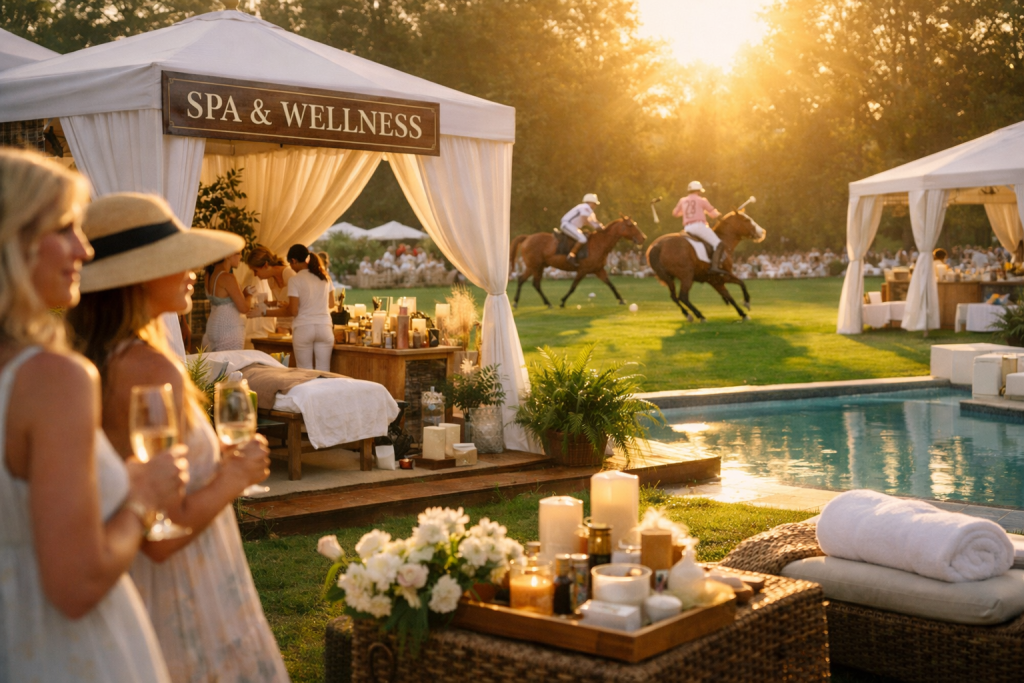
Luxury Hamptons events for wellness brands exist for precisely this reason. Specifically, Polo Hamptons 2026 on July 18 and July 25 in Bridgehampton is where that gap closes. Not through an ad. Not through a PR retainer with a six-month runway. Rather, through the specific social alchemy of being in the right room at the right moment of the right summer afternoon.
Luxury Hamptons Events and the Prestige Gap No Ad Spend Closes
First, let’s name the actual problem, because it is not the problem most marketing consultants will name for you. The problem is not awareness. Your waitlist is proof of awareness. Rather, the problem is positioning — the specific vertical distance between what you charge and what the culture believes a practice at that price point looks like.
There is a specific tier of clientele that matters most here. These are the women who summer in Bridgehampton, whose dermatologists are on Park Avenue, whose concept of wellness predates the word becoming a category. They make referral decisions based on one largely unconscious calculation. They ask themselves: is this the kind of place I would mention at dinner? Notably, the answer has almost nothing to do with your outcomes, which are excellent. It has everything to do with your cultural placement.2
Why Peer Visibility Outperforms Paid Media
Furthermore, Harvard Business Review’s research on luxury brand trust confirms that peer visibility in high-context social environments outperforms digital advertising for premium service conversion. The margin surprises most practitioners when they see it as a number. The mechanism is not complicated. Seeing a brand in a trusted room recalibrates its credibility ceiling — upward, immediately, without a media budget line item.
Additionally, the recalibration is permanent. An ad impression expires when the feed refreshes. By contrast, the memory of your brand at a Bridgehampton polo match in July does not expire. It compounds.
What Actually Happens at Polo Hamptons 2026
Polo Hamptons 2026 runs on July 18 and July 25 at 900 Lumber Lane in Bridgehampton, from 4 to 7 PM. The guest profile is specific and consistent across multiple summers. Attendees are 57% women, with a core demographic of 35 to 54. Average household income is $315,000. Average net worth exceeds $3.6 million. Additionally, 91% identify as active fine jewelry buyers.3
Moreover, 93% of attendees shop the Hamptons market directly. Meanwhile, 93% also shop Madison Avenue. These are not two different groups. They are the same group in two different contexts — and your best clients, the ones who refer without being asked, are almost certainly in it.
The Room That Self-Selects
Furthermore, the self-selection mechanism of a polo match in Bridgehampton in July is worth understanding. Unlike a trade show or wellness expo, this audience is not assembled by registration. They come because they want to be there. Consequently, the commercial receptivity in that field is categorically different from any room you have purchased access to through a media buy.
In practice, your branded tent, your product display, your presence in the Social Life Magazine feature — all of it lands in a context of genuine interest. Not advertised interruption. The distinction sounds philosophical. In terms of conversion, it is structural.
Additionally, McKinsey’s luxury consumer research identifies event-based brand encounters as the highest-trust acquisition channel for premium wellness and beauty services. Higher than influencer placement. Higher than editorial. Significantly higher than paid social. The trust is not manufactured. It is borrowed from the room.
The Social Life Magazine Component — Why Editorial Placement Matters
Social Life Magazine reaches 370,000 monthly readers. More precisely, it reaches the 370,000 who pick up a print magazine in the Hamptons in July, who read it with the specific attention that people give physical objects in rooms without phone service. These are your clients and your referral network in the same place, at the same moment, in exactly the mental state that luxury wellness messaging is designed for.
The Polo Hamptons 2026 sponsorship packages include editorial placement in Social Life Magazine’s highest-circulation summer issues. Notably, this is not an ad adjacent to editorial. It is editorial — a feature that positions your brand within the cultural context of the Hamptons season, written with the same editorial voice that your clients already trust.
What Google Sees When the Feature Runs
Furthermore, the feature is indexed. When the client who heard your name at polo searches for you the following Tuesday, the Social Life placement is among the first things she finds. Consequently, the credibility signal that began in Bridgehampton continues to operate in every search result and every referral conversation. It is present every time someone decides whether your practice is the kind of place they would mention at dinner.
Together, the event presence and the editorial placement form a two-part signal: you were in the room, and the room was worth being in. That combination is what luxury brand trust is actually built from. Forbes has documented how luxury wellness brands that combine physical event presence with editorial placement achieve client acquisition costs 40% lower than brands relying on digital channels alone.
Polo Hamptons 2026 Sponsorship Tiers for Wellness Brands
For wellness brands ready to close the prestige gap, Polo Hamptons 2026 offers three tiers built around different stages of market commitment.
Platinum: Own the Category
The Platinum Sponsorship at $35,000 per date or $50,000 for both is built for the brand ready to own the room. It includes a 15×15 branded tent, a private cabana, and category exclusivity. No competing wellness brand can enter your category once you commit. Additionally, it includes 12 VIP invitations, step-and-repeat logo placement, and gift bag rights. Social Life Magazine runs two-page ads in the Memorial Day, July 4th, and August issues. A two-page editorial feature runs in the July 17th issue. An exclusive email blast reaches 82,000 readers. Category exclusivity is the detail that matters most: the Bridgehampton wellness client at Polo Hamptons will not encounter your direct competitor there.
Gold and Corporate Cabana Options
The Gold Sponsorship at $14,000 per date or $22,000 for both includes a 9×9 branded tent, six VIP invitations, and four announcer mentions. Furthermore, it includes full-page ads in the Memorial Day and July 4th issues, a full-page editorial feature in the July 17th issue, and the 82,000-reader email blast. Gold is the most efficient entry point for brands that want editorial coverage and event presence without Platinum’s full footprint.
The Corporate Cabana at $6,500 per date or $12,000 for both is the honest option. It is for the brand that wants to experience the room before committing to owning a piece of it. Ten guests get a private cabana, food, bar service, a dedicated staff member, and photos with polo players. One full-page ad runs in the Memorial Day Weekend issue. Indeed, if you cannot identify three prospective clients from that afternoon, the problem is not the afternoon. Sponsorship inquiries: [email protected].
Additionally, Bloomberg has covered the accelerating concentration of luxury wellness spend in the Hamptons corridor — a trend that accelerated post-2020 and shows no structural signs of reversing. The clients are there. The question is whether your brand is.
The Prestige Gap Closes One Room at a Time
The waitlist is real. Outcomes are excellent. What you built over eleven years is, by every internal measure, exactly what it was designed to be. However, the culture does not know this yet — not at the level that drives referrals from women who summer in Bridgehampton and make wellness decisions the way they make all luxury decisions: through trusted, proximate social proof.
Luxury Hamptons events for wellness brands exist because that social proof has a specific address: 900 Lumber Lane, Bridgehampton, July 18 and July 25, 2026. The clients your practice needs are already planning to be there. Together, a Polo Hamptons presence and a Social Life Magazine editorial feature do what eleven years of excellent outcomes cannot do alone. They make the culture’s understanding of your brand catch up to what your waiting room already knows.
Ultimately, the prestige gap is not a marketing problem. It is a room problem. And the room has dates.
Notes — for the practitioners who read the fine print, which is everyone who built something real:
1 The clients you lose to the credibility gap are not clients who chose a competitor with better outcomes. These are clients who, in the absence of cultural placement for your brand, defaulted to the brand they had already heard of in the right context. Rather than evaluating options and choosing differently, evaluation never happened at all. Your name simply did not enter the consideration set. This is the specific cruelty of the prestige gap: it operates below the threshold of conscious decision-making, which makes it invisible to the metrics that would otherwise tell you where your growth ceiling is.
2 The dinner-mention test is not a frivolous heuristic. It is, in fact, an extremely efficient proxy for the kind of social trust that drives referral behavior among high-net-worth consumers. A brand that clears the dinner-mention threshold has achieved something that no ad spend can directly purchase: it has been placed, by a trusted peer, in a context of genuine endorsement. After all, the endorsement happens not because the brand paid for it but because the endorser’s social capital is attached to it. The mechanism is ancient. The Hamptons is simply one of the places where it operates most visibly.
3 The 91% fine jewelry figure is included not because fine jewelry is adjacent to wellness, but because it is the clearest available proxy for a consumer who makes high-consideration luxury purchases as a matter of course. A woman who buys fine jewelry without extensive deliberation has internalized a relationship with luxury spending that makes premium wellness services — at your price point, with your positioning — a natural category extension rather than a stretch. She is not deciding whether to spend. She is deciding where.
Feature your wellness brand in Social Life Magazine or Polo Hamptons:
sociallifemagazine.com/contact
Polo Hamptons 2026 — Tickets & Sponsorships:
polohamptons.com
Subscribe to Social Life Magazine — Print & Digital:
sociallifemagazine.com/subscription
Support independent luxury journalism — Donate $10:
paypal.com/donate
Author

Written by
Recent Posts
4th Annual Catwalk Furbaby
Thomas J. Henry and Dr. Elena Alvarez-Henry Join Forces for Cancer Care
How an Emergency 24/7 Plumber Resolves Sudden Drain Backups Fast
Best Free Location Tracking Apps for Everyday Family Safety: iSharing and HeyPolo Compared
How Disney Channel Stars Become Pop Powerhouses: The Sabrina Carpenter Blueprint
Categories
- Art
- Articles
- Business of Luxury
- Celebrities
- Culture
- Entertainment
- Events
- Faces of Summer 2026
- Fashion
- Fashion & Style
- Featured
- Finance
- Food, Spirits, Wine
- Hamptons
- Hamptons Celebrities
- Health
- Health & Beauty
- Lifestyle
- Luxury Lifestyle
- Press
- Profiles
- Real Estate
- Technology
- The Chronicles
- Travel
- Uncategorized
- Weddings