
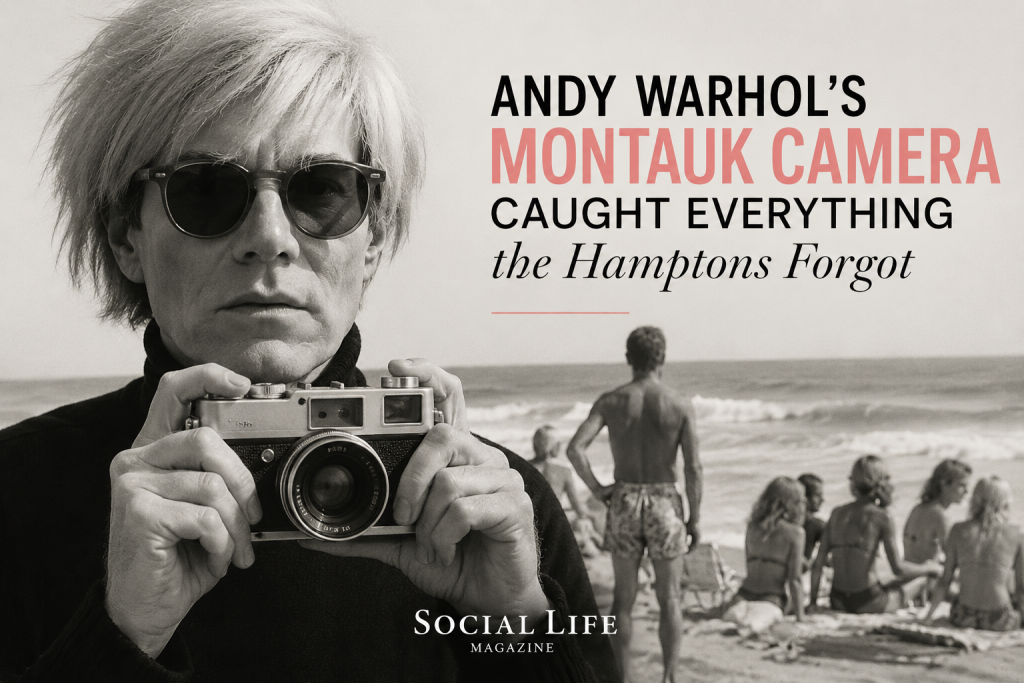
The camera was always out. Not posed, not announced, not negotiated the way celebrity photographers negotiate access today. Andy Warhol simply arrived at Eothen each summer with a camera in one hand and a tape recorder in the other, and the people around him learned to ignore both because ignoring them was the only way to get through dinner.
That decision, to document rather than perform, produced something the Andy Warhol Montauk years are rarely credited for: the most complete social archive of East End life in the 1970s that anyone ever assembled. Not a commissioned project. Not an editorial assignment. A sustained act of observation carried out across sixteen summers by a man who understood that the camera was the only honest guest at any party.
The Tape Recorder Nobody Mentions
Every account of Eothen focuses on who showed up. Mick Jagger, Lee Radziwill, Peter Beard, Truman Capote, the rotating cast of cultural royalty that made Warhol’s Montauk compound the most interesting address on the East End through most of the 1970s. The full story of those gatherings lives in our companion piece on the Montauk years that changed everything.
What that story doesn’t capture is the methodology behind the memory.
Warhol carried a Sony tape recorder he called his “wife.” The nickname was not entirely a joke. He documented conversations the way other people made small talk, recording exchanges over dinner, arguments on the beach, the particular cadence of famous people talking to each other when they believed no one important was listening. He believed the most revealing version of any person appeared in the gaps between their public performances, and Montauk, with its deliberate distance from Manhattan’s audience infrastructure, produced gaps everywhere.
Bob Colacello, then editing Interview magazine and present for most of the significant summers, functioned as Warhol’s institutional memory in a more formal sense. Where Warhol documented instinctively, Colacello wrote deliberately. His memoir Holy Terror remains the closest thing to a verbatim record of what Eothen actually sounded like from the inside. What he describes is not a series of events but a continuous atmosphere, a salon that reconstituted itself each summer with a slightly different cast and exactly the same underlying energy.
The tape recorder and the notebook together produced more usable material than either could alone. Warhol supplied the visual archive and the raw audio. Colacello supplied the context, the names, the social architecture that explained why any given conversation mattered. Between them, they caught the East End at a moment it did not yet know it was being caught.
Peter Beard and the Parallel Lens

Warhol was not the only photographer working the scene. Peter Beard occupied a property near the Montauk lighthouse and operated with a camera the same way Warhol did: constantly, casually, and with an eye trained specifically on the moments between moments.
The overlap produced something unusual. Two of the most significant documentary photographers of their generation spent portions of each summer photographing each other photographing other people. The resulting images are a hall-of-mirrors record of a world that understood its own significance and didn’t much care whether you understood it too.
Beard’s Montauk archive is rawer than Warhol’s. Where Warhol’s photographs tend toward composition, even in candid frames, Beard shot with the urgency of a man who had spent years photographing wildlife in Kenya and never fully adjusted his methodology for social situations. His images from Eothen and its surrounding properties show people the way animals appear in field photographs: caught mid-gesture, unperformed, occasionally alarmed.
Together the two archives form a stereoscopic record of the same summers. Warhol’s version is curated, conscious of its own eventual use. Beard’s version is instinctive, chaotic, and often more revealing precisely because of it. Neither archive alone tells the complete story. Both together explain why people who were present in Montauk during those years describe the experience as unlike anything that came before or after.
What Interview Magazine Owed to Eothen
Interview magazine launched in 1969 as a film-focused publication and evolved, partly because of what happened at Eothen each summer, into the defining celebrity document of its era. The connection is more direct than most cultural histories acknowledge.
The magazine’s signature format, the unedited celebrity conversation, grew from Warhol’s tape recorder methodology. What he developed at Eothen, the practice of recording famous people talking to each other in unstructured settings, translated directly into editorial product. Conversations that began over dinner on the Montauk bluffs occasionally continued into the pages of Interview with minimal alteration.
Colacello’s editorship ran in parallel with the Eothen summers, and the cross-pollination moved in both directions. The magazine’s aesthetic, its particular combination of glamour and irony and deliberate refusal to explain the joke, reflected the atmosphere of the compound: insider address, outsider intelligence, the specific confidence of people who did not need to announce their own relevance.
Elizabeth Taylor, who stayed at Eothen during the Halston years, appeared in Interview during the same period. The connection was not coincidental. Warhol’s social network and his editorial network were the same network, and Montauk was where that network came to exist outside its own performance.
The Observer at His Own Party

Accounts of Warhol at Eothen converge on a consistent image. He circulated the edges of his own gatherings, asked questions, and let other people generate the answers. He’d photograph guests rather than dance with them. He played with children while the adults competed for the room’s attention.
This was not shyness, though he occasionally described it that way. It was methodology. Warhol understood that the most interesting position at any social event is the one from which you can see everyone else. The host who stands in the center of his own party sees a fraction of what the host who stands at the wall sees. He chose the wall consistently, camera up, tape recorder running.
Colacello observed that Warhol had an almost scientific interest in status dynamics, in who deferred to whom and why, in the specific social mechanics that governed how famous people behaved when surrounded by other famous people. Eothen, with its concentration of cultural capital on a remote cliff above the Atlantic, was a controlled environment for that kind of observation. Remove the usual audience. Strip away the Manhattan context that explained everyone’s relative position. Watch what happened when the pecking order had to reconstitute itself from scratch each weekend.
What happened, consistently, was interesting. The tape recorder caught most of it.
The Geography the Camera Mapped
 g=”1″ /> Warhol Compound Montauk[/caption]
Warhol moved through the East End with the same systematic attention he applied to everyth
ing else. Gurney’s Inn functioned as neutral ground for meetings that required a degree of public visibility. The Shagwong Tavern in downtown Montauk provided the kind of local atmosphere that Warhol, despite his Factory mythology, genuinely preferred to hotel bars. Gosman’s Dock, where the Jagger contingent occasionally dined, appears in his photographs more than once.
But the real geography was relational. Warhol’s Montauk was a network of houses connected by the same small group of people moving between them, and what the camera documented was movement as much as it documented moments. Who arrived from the city together and was still at Eothen on Monday morning. Who had materialized Saturday night without a clear invitation and been absorbed into the weekend anyway because the social logic worked out.
 casey-and-elizabeth-montauk
That documentation has outlasted almost everything else from the era. The parties ended. The seasons closed. The compound changed hands multiple times, eventually selling for figures that measured cultural capital as precisely as any economic index. What remained constant was the archive: Warhol’s photographs, Beard’s photographs, Colacello’s notebooks, the tape recordings that fed the magazine that defined the decade.
The East End has never looked like that again, and it’s partly because no one since has been as committed to catching it while it was happening.
What the Lens Chose Not to Show
Warhol was a selective documentarian. The photographs he published, the conversations that made it into Interview, the material that entered the official record, represent a curated fraction of what the camera and tape recorder actually captured.
He was particularly careful with the genuinely powerful. People whose names appeared in the guest lists of Eothen’s most significant summers sometimes appear not at all in the published archive. This was not oversight. Warhol understood that the most valuable thing you could offer certain people was the protection of their absence from the record, and he extended that protection deliberately, to those who had earned it through some combination of actual power and mutual understanding.
What the lens chose to protect is, in its own way, as revealing as what it published. The archive’s silences map the social architecture of the era as accurately as its images do. Warhol photographed everyone. He published strategically. The gap between those two facts is where the real intelligence lived.
Where The Conversation Continues
Social Life Magazine has covered the East End for 23 summers. We’ve watched the scene evolve from the Warhol era’s raw salon energy into something more curated, more visible, more thoroughly documented by everyone simultaneously. The paradox is that total documentation has somehow produced less of a record than one man with a camera choosing carefully what to catch.
If you’re building a brand, a business, or a presence that belongs in this conversation, the place to start is with people who understand what the East End actually means and have covered it long enough to know the difference between what’s happening and what matters.
Author

Written by
Recent Posts
Choosing Scratching Furniture for a British Shorthair
Bile Reflux vs. Acid Reflux: Why Your Antacid Isn’t Working
Annie Watt Photography Agency 20th Anniversary Celebration and Exhibition in NYC | New York, NY
Denise Fraile: Connecting People, Inspiring Purpose
Victoria Justice Kicks Off Halloween Early with Love Zombie Bash in Hollywood
Categories
- Art
- Articles
- Business of Luxury
- Celebrities
- Culture
- Entertainment
- Events
- Faces of Summer 2026
- Fashion
- Fashion & Style
- Featured
- Finance
- Food, Spirits, Wine
- Hamptons
- Hamptons Celebrities
- Health
- Health & Beauty
- Lifestyle
- Luxury Lifestyle
- Press
- Profiles
- Real Estate
- Technology
- The Chronicles
- Travel
- Uncategorized
- Weddings