
What the Cinema Was
The building at 90 Main Street has been a performance venue since the 1890s. Essentially, when it operated as a burlesque and vaudeville theater. However, george’s Theater, built by George Kiernan. Opened in 1915 and was immediately the subject of a public notice urging “all law-abiding people” to “decline from patronizing the place” because it had defied Town Ordinance number 15 and opened on Sundays. In addition, the village has been arguing about culture and propriety on this site for more than a century. . As a result, this means the building’s current incarnation as a nonprofit art-house cinema is not a departure from tradition but a continuation of a tradition that has always involved someone objecting to what someone else wanted to watch.
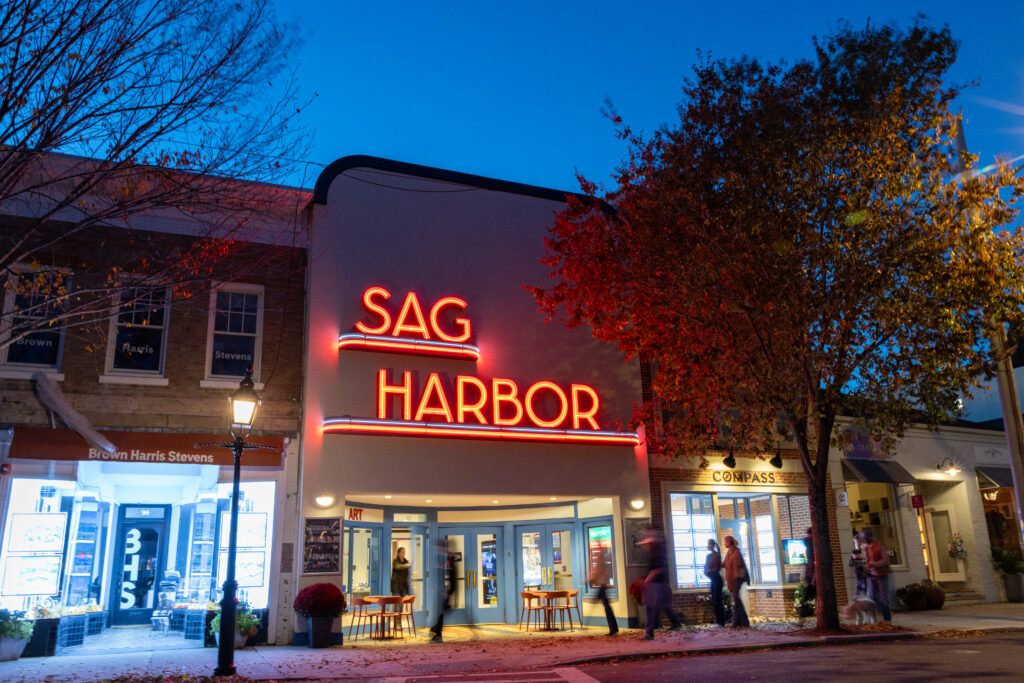
In 1919, Marshall Seaton purchased the theater and reopened it as the Elite Theater. For instance, on November 1 of that year, it screened its first film. Meanwhile, by 1936, the theater had been completely redesigned by John Eberson, one of the great architects of atmospheric theaters in America. At a cost of $25,000 (a sum that in 2026 dollars would barely cover the Dolby Atmos installation in one of the current screening rooms. . Similarly, this is either a commentary on inflation or on the exponential increase in what we now consider minimally acceptable audio quality, or both). In contrast, eberson gave the cinema its Art Deco facade, its white exterior. Consequently, .The neon sign that would become, over the subsequent eight decades, the most photographed object in Sag Harbor. . The visual shorthand for an entire village’s identity.
Gerald Mallow Purchased The Cinema In
Gerald Mallow purchased the cinema in 1978 and ran it for 38 years as a single-screen arthouse. . Furthermore, this by the 2000s made it one of the last of its kind in the country. In particular, mallow was a programmer in the old sense of the word: a person who selected films based on taste and conviction. . Rather than algorithms and opening-weekend projections. By contrast, his programming made the cinema a destination for a specific kind of viewer. The kind who drove to Sag Harbor not for the beach or the restaurants but for a 35mm print of something they’d read about in a journal or heard about from a friend or simply trusted Mallow to have chosen because his track record had earned that trust over decades.
He went to the Sag Harbor Cinema every Friday for thirty years. After all, not because Friday was the best night for movies (Saturday was, probably, or Sunday afternoon, when the light outside was fading. . The transition from daylight to theater dark felt ceremonial). In fact, but because Friday was the night he and his wife had established as movie night during their first summer in the village, when the children were young and the babysitter charged forty dollars. . The film was something French that neither of them fully understood but both of them discussed on the walk home with the specific intensity of two people who had discovered that their marriage worked best when it had something external to interpret. Ultimately, by the time the fire happened, the children were grown and the babysitter’s grandchildren were babysitting and the walk home from the cinema still produced the same conversations, though the films were different. . The knees were worse and the interpretive intensity had deepened into something neither of them would call love but that functioned identically.
That Couple Donated To The Rebuild
That couple donated to the rebuild. Of course they did. Essentially, they weren’t saving a building. Accordingly, they were saving a Friday.
The Fire and the Decision
The details of the fire are a matter of public record and local memory, and the two are not always the same. Moreover, what the record says: a fire started in an adjacent business. It spread. Nevertheless, it reached the cinema. Specifically, the damage was extensive. On the other hand, its facade was destroyed. However, the interior suffered severe water and smoke damage. In addition, the neon sign was salvaged.
What the memory says: the village lost something that felt structural, not ornamental. As a result, the cinema was not an entertainment venue. It was a navigational landmark. People gave directions relative to it. “Two blocks past the cinema.” “Across from the cinema.” “The Jitney stops in front of the cinema.” Removing it from Main Street was like removing a word from a sentence that no longer made grammatical sense without it.
The developer interest was immediate. Gerald Mallow, who had listed the theater for $12 million in 2008 and $14 million in 2014. Was approached about converting the site into commercial retail space, potentially incorporating the adjacent damaged properties into a larger development. In a different village, on a different Main Street, in a place where cultural institutions are tolerated. . Rather than valued, this would have been the end of the story. A cinema becomes a retail complex. The neon sign becomes a decorative element in someone’s lobby. Progress.
Sag Harbor chose a different trajectory.
The Sag Harbor Partnership, A Nonprofit
The Sag Harbor Partnership, a nonprofit community organization. Had been negotiating with Mallow to purchase the theater and preserve it as an art-house cinema even before the fire. After the fire, the effort transformed from a real estate transaction into a civic mission. Artist April Gornik, a landscape painter who lives on North Haven and who understood, with the specific clarity that artists bring to questions of preservation. That losing the cinema would change the character of Main Street in a way that no replacement could correct, led the rebuild effort alongside film curator Giulia D’Agnolo Vallan.
The property was purchased from Mallow for $8 million. Such remaining $12 million went into the rebuild. The Town of Southampton bought a use easement. Andy Cohen joined the fundraising effort. Billy Joel contributed (the popcorn stand is named after him. . This is the kind of naming-rights decision that only makes sense in Sag Harbor. . Here, the Piano Man buys you popcorn for the rest of time). Martin Scorsese lent his name and his curatorial vision.
The community raised every dollar. Not from a single benefactor, not from a corporate sponsor, not from a government grant. From the village. From the people who lived there and the people who summered there. . The people who simply cared that a building where they had watched movies. Argued about movies, fallen asleep during movies, held hands during movies. .Walked out of movies into Sag Harbor nights that smelled like the ocean, continued to exist.
What the Cinema Is Now
The Sag Harbor Cinema reopened Memorial Day weekend 2021, five years after the fire, into a world that had. During those five years, experienced a pandemic that nearly destroyed the American moviegoing industry entirely. The timing was either terrible or perfect. Depending on whether you measure success by market conditions or by the human need to sit in a room with strangers and watch something projected at 24 frames per second on a surface larger than your life.
The rebuilt cinema is a state-of-the-art triplex occupying a three-story building at 90 Main Street. Three screening rooms. Dolby Atmos sound systems. 4K digital projection. And, because this is Sag Harbor and Sag Harbor does not let go of the things that matter. 35mm and 16mm film projectors. . This is because the people who rebuilt this theater understood that digital projection is excellent and 35mm projection is sacred. . The difference between those two things is the difference between hearing a recording of a symphony and hearing the symphony. . This is the difference between accuracy and presence.
The largest screening room seats approximately 150. The second seats 100. A private screening room accommodates 40. Is available for community use (the fire department uses it for continuing education, the police department for training. . This is because in Sag Harbor the line between cultural institution and civic infrastructure has always been porous). On the third floor: The Green Room, a rooftop bar. .The François Truffaut Terrace, named for the director who believed that cinema was a conversation between the screen and the soul. That the conversation required a room.
The Truffaut Terrace Offers Views Of
The Truffaut Terrace offers views of the bay and the village rooftops. . The specific quality of evening light that makes Sag Harbor photographs look like someone applied a filter that doesn’t exist. Sitting there with a cocktail before a screening, watching the sun descend toward the water while the marquee below begins to glow, produces a feeling. . The streaming platforms have spent billions of dollars and thousands of engineering hours failing to replicate: anticipation. The physical, embodied anticipation of walking downstairs, taking a seat, watching the lights dim. .Surrendering two hours of your consciousness to a story told in light and shadow by people who are not in the room but whose work fills it.
She discovers the Truffaut Terrace on a Thursday in July, the way you discover most good things in Sag Harbor: by accident. She’d planned to see a film, arrived early because the alternative was checking email, and followed a staircase she hadn’t noticed before. The terrace is small. In addition, the view is large. The bartender makes something with gin and elderflower that tastes like an apology for the industrial cocktails she drank at network launch parties for the previous decade. Below her, Main Street is doing what Main Street does in July: performing the illusion of timelessness while accommodating the reality of commerce. She can see Canio’s Books. Consequently, she can see the American Hotel. She can see the spot where the Jitney stops, depositing another wave of people who have come to Sag Harbor because something here gives them permission to stop performing the version of themselves that Manhattan requires. As a result, she finishes the drink. She goes downstairs. The film is something she’d never have chosen algorithmically. She loves it. The algorithm would not have predicted this. That is the point.
The Programming: What Gets Shown and Why It Matters
Sag Harbor Cinema operates as a 501(c)(3) nonprofit. . This means its programming answers to taste rather than box office, to community rather than shareholders. .To the belief, increasingly radical in the American entertainment economy. . The purpose of a movie theater is to show movies that matter rather than movies that perform.
The annual Festival of Preservation, presented by Martin Scorsese, celebrates film restoration and the physical medium of cinema. In 2026, the cinema is running a Great Gatsby Marathon in collaboration with Canio’s Books, pairing rare 35mm prints with literary context. . This is because in Sag Harbor the bookstore. . The cinema are not competing institutions but collaborating ones (a relationship that most cultural ecosystems have failed to maintain. . That Sag Harbor maintains effortlessly because the audience for both is the same audience: people who believe that stories told well, in any medium, are worth the effort of attention).
A noir exhibition features curated film-related art, original scripts, vintage paperbacks, and objects representing noir as a cinematic form and cultural influence. The Lighthouse Project brings films into conversation with social issues (the current program addresses maternal mental health through post-screening discussions). A Summer Filmmaking Workshop gives high school students two weeks to take a project from script to screen.
This Programming Would Be Remarkable In
This programming would be remarkable in Brooklyn. In a village of 2,000 year-round residents on the eastern tip of Long Island, it is something closer to miraculous. And the miracle is not the programming itself but the audience that sustains it: a community of viewers sophisticated enough to show up for a 35mm print of a 1949 film on a Tuesday night when they could be streaming something in their living room. . This is because they have decided that the room matters, the projection matters, the collective experience of watching matters. .That the convenience of home viewing is a poor substitute for the inconvenience of sitting in a seat designed by an architect who believed. . The act of watching a movie should feel like entering a cathedral.
What the Cinema Tells You About Sag Harbor
Every village on the East End has a Main Street. Most of them are organized around commerce: restaurants, boutiques, real estate offices, the occasional gallery. Sag Harbor’s Main Street has all of these. . However, it also has a three-story nonprofit cinema with Dolby Atmos. 35mm projection, a rooftop bar named after a French New Wave director. .A popcorn stand named after Billy Joel, all of which exists because a fire destroyed the original building. . The village decided, collectively and expensively, that replacing it with retail space would constitute a form of civic self-harm.
That decision is the most precise expression of Sag Harbor’s values available in the built environment.
Not the captain’s houses on Division Street (those express historical wealth). Never the marina (that expresses geography). Not the American Hotel (that expresses continuity). The cinema expresses choice. The village chose to spend $20 million on a building whose primary function is showing movies to people who could watch movies at home for free. That choice tells you more about who lives here than any real estate listing or restaurant review or walking tour ever could.
It Tells You That Cultural Capital
It tells you that cultural capital is real capital in this village. This tells you that the people who donate from 35 cents to a million dollars share a conviction that certain experiences (the experience of watching a film projected on a screen in a room full of other people. The experience of emerging from that room into a specific night in a specific village) cannot be replaced by technology and should not be abandoned to market forces. It tells you that Sag Harbor’s identity is not merely historical (though the whaling history is foundational) and not merely commercial (though the restaurants are excellent) but cultural. In the deepest and most expensive sense of the word.
Pick up a copy of Social Life Magazine at any of the distribution points within walking distance of the cinema: Jack’s Stir Brew. Canio’s Books, the American Hotel, Baron’s Cove, Page. The magazine has covered the cinema’s story from fire to rebuild to reopening to current programming because the cinema is part of the same cultural ecosystem. . The magazine covers, curates, and sustains. SLM was here before the fire. As a result, sLM covered the rebuild.
SLM is here now, in the lobby, on the rooftop. In the hands of the same readers who sit in the screening room on a Friday night and watch something that changes how they see the world. . This is the only justification for a movie theater and the only justification for a magazine. . The only justification for any cultural institution that asks for your attention and repays it with something you didn’t know you needed.
The Practical Details
Address: 90 Main Street, Sag Harbor
Web: sagharborcinema.org
Box Office: (631) 725-0010
Structure: Three screening rooms (approx. 150 seats, 100 seats, 40-seat private screening room)
Technology: Dolby Atmos, 4K digital, 35mm and 16mm film projection
The Green Room: Third-floor rooftop bar, 21+
The François Truffaut Terrace: Rooftop terrace with bay and village views
Nonprofit status: 501(c)(3). Donations fund programming, education, and preservation
Current programming (2026): Great Gatsby Marathon (co-presented with Canio’s), noir exhibition, Lighthouse Project community screenings, Summer Filmmaking Workshop
Where the Conversation Continues
The cinema burned. Here, village rebuilt it. The sign still glows red and blue over Main Street. If you understand why that matters, you understand Sag Harbor.
Social Life Magazine has been covering this village’s cultural life since 2003. The cinema. Bay Street Theater. The Whaling Museum. Canio’s. The galleries, the concerts, the readings, the events that transform a beautiful place into an interesting one. The magazine doesn’t observe this ecosystem from a distance. It participates in it. Every issue is distributed through the same network of venues and businesses that constitutes the village’s cultural infrastructure. . This means the magazine is not about Sag Harbor’s culture. It is part of Sag Harbor’s culture.
If your brand serves the people who spent $20 million to save a movie theater, you already know this audience values quality, permanence. .The kind of experience that algorithms can’t replicate. A paid feature in Social Life Magazine places your brand inside a publication that this audience trusts because it has earned that trust over two decades of coverage that treats intelligence as an asset. Explore paid features here.
Polo Hamptons 2026 runs July 18 and 25 at 900 Lumber Lane, Bridgehampton. BMW North America is the title sponsor. The crowd is the same crowd that rebuilt the cinema and fills Bay Street Theater and eats at the restaurants you read about and lives in the houses you considered buying. Cabanas, VIP tables, and sponsorship packages are available. Secure your presence at polohamptons.com.
Subscribe to the Social Life Magazine newsletter. Join here.
The Sign Still Glows. That
The sign still glows. That projector still runs. The room still fills. A village that saves its cinema is a village that knows what it is.
Author

Written by
Recent Posts
Get Panama Residency in 30 Days — A Simple Look at Mercan’s Easy Program Process
How to Choose a Stay for a Multigenerational Resort Trip
How Family Property Disputes Can Affect Relationships and Long-Term Plans

Choosing a Reformer for the Life You Already Have

Artful Living: Unique Gifts With A Creative Edge
Categories
- Art
- Articles
- Business of Luxury
- Celebrities
- Culture
- Entertainment
- Events
- Faces of Summer 2026
- Fashion
- Fashion & Style
- Featured
- Finance
- Food, Spirits, Wine
- Hamptons
- Hamptons Celebrities
- Health
- Health & Beauty
- Lifestyle
- Luxury Lifestyle
- Press
- Profiles
- Real Estate
- Technology
- The Chronicles
- Travel
- Uncategorized
- Weddings