
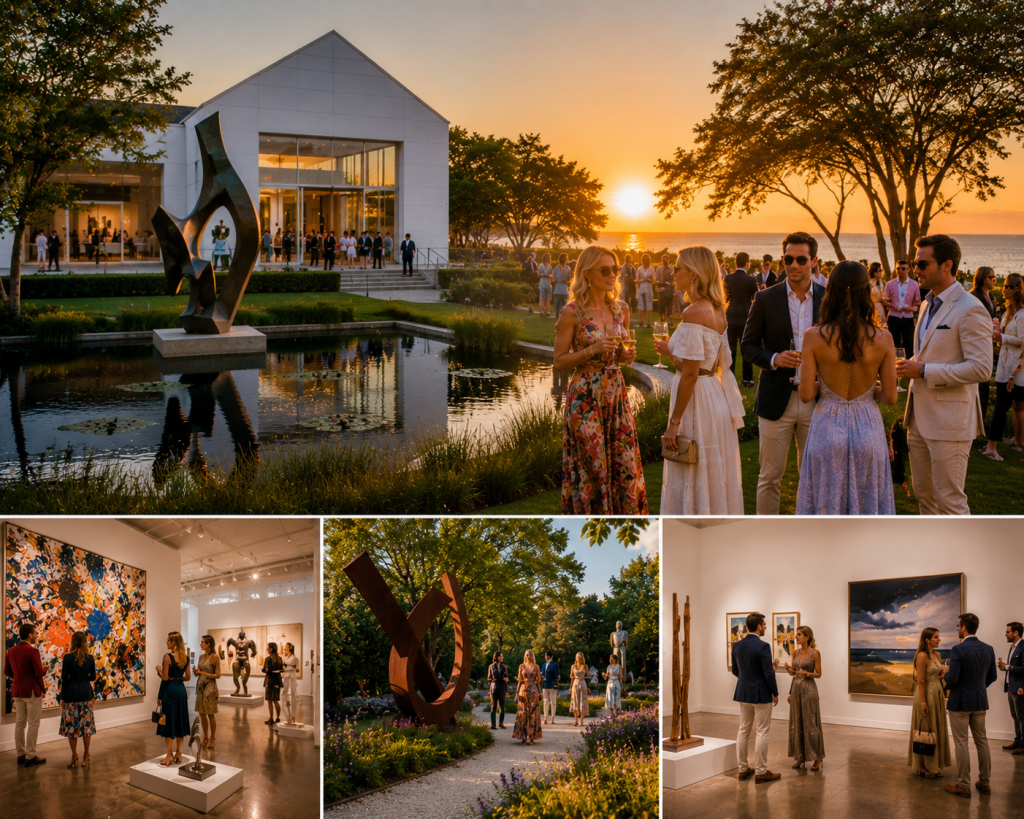
The Museum as Social Architecture
There is a particular kind of person who visits the Parrish Art Museum in Southampton (technically Water Mill, but Southampton claims it). They come not because they love art, though they may. Rather, they understand that cultural fluency is a form of capital on the East End. It compounds faster than anything in their portfolio. Knowing the name Fairfield Porter at a dinner party on Ox Pasture Road opens a door. Knowing that Porter painted in Southampton for decades opens a second. Mentioning that you attended the Midsummer Gala opens the third.
She represents a fashion house that has been trying to break into the Hamptons market for three seasons. The trunk shows at Southampton boutiques yielded polite interest and zero follow-through. The beach club sponsorship felt transactional. Then her director told her to attend the Parrish Midsummer Gala. She bought a table for $10,000. She sat next to a woman whose family had been summering in Southampton since the Eisenhower administration. By dessert, the woman had invited her to a private studio tour. By September, the fashion house had a two-page feature in Social Life Magazine. The art opened the door that commerce could not.
What This Guide Covers
This guide maps the Parrish Art Museum and the broader Southampton cultural landscape. It is written for the brand, the executive, and the culture-forward reader. On the East End, art is not decoration. It is infrastructure.
The Parrish Art Museum: 128 Years of Making Southampton Serious
The Origin: Samuel Parrish and the Shinnecock Summers
The Parrish Art Museum was founded in 1898 by Samuel Longstreth Parrish, a wealthy New York lawyer and art collector who summered in Southampton. The original museum occupied a Grosvenor Atterbury building on Jobs Lane in the village center, a graceful Italianate structure that housed Parrish’s personal collection alongside the work being produced by the artists who had followed William Merritt Chase to the South Fork.
Chase’s presence was the catalyst. His Shinnecock Hills Summer School of Art (1891 to 1902), America’s first plein air painting school, had turned Southampton into a genuine artists’ colony. The wealthy summer residents who commissioned portraits and purchased landscapes from Chase and his students needed a place to see the work. Parrish gave them one. In essence, the museum was both a cultural institution and a social one from its inception. Art world and money world could recognize each other here without pretending the other did not exist.
Over the next century, the collection grew to more than 2,600 works. It spans the full arc of American art on the East End: Chase’s Impressionist landscapes, Fairfield Porter’s mid-century realism, Willem de Kooning’s Abstract Expressionism, Pollock and Krasner, Dan Flavin, Roy Lichtenstein, and contemporary work by Chuck Close, Eric Fischl, April Gornik, and Elizabeth Peyton.
The Building: Herzog and de Meuron’s Concrete Poem
By the early 2000s, the Atterbury building on Jobs Lane could no longer accommodate the collection or the programming. Subsequently, after an aborted attempt to expand, the museum purchased a 14-acre site in Water Mill. Following a search of 65 architect candidates, Pritzker Prize winners Herzog and de Meuron were selected to design a new building.
Originally, the plan called for an $80 million cluster of pavilions modeled on the studios of Chase, Lichtenstein, and de Kooning. When construction bids exceeded the budget, the design was reconceived. The result is a single 34,400-square-foot horizontal structure resembling a concrete barn, a minimalist chapel, or a very expensive pencil case. It opened in November 2012 at approximately $50 million.
Indeed, the building works. Seven skylit galleries allow natural light to shift across the paintings throughout the day. Most museums filter this out. The Parrish, following Chase’s obsession with natural light, deliberately amplifies it. An untitled Esteban Vicente abstraction viewed at noon presents different colors than the same painting viewed at three in the afternoon. This is not a design flaw. Rather, it is the thesis.
A 6,000-square-foot porch functions as an outdoor gallery. Naturally, the café offers decent coffee. Meanwhile, the gift shop sells art books that signal cultural seriousness when left on a coffee table in the estate section.
Address: 279 Montauk Highway, Water Mill, NY 11976
Hours: Thursday through Monday, 11 AM to 5 PM. Closed Tuesday and Wednesday.
Admission: $15 adults. Free for members and children under 18.
The 2026 Exhibition Calendar: USA250
The Parrish has organized its 2026 programming under a yearlong theme: PARRISH USA250: Life, Liberty, and the Pursuit of Happiness, marking America’s semi-quincentennial. The exhibitions rotate throughout the year and collectively represent the museum’s most ambitious calendar in a decade.
Currently on view:
Sanford Biggers: Drift (opened May 21, 2026). A multidisciplinary solo exhibition by one of America’s most important contemporary artists, featuring Biggers’ signature use of textiles, symbolism, and layered cultural references. Chief Curator Corinne Erni organized the exhibition with curator Scout Hutchinson. If you attend one show at the Parrish this summer, this is the one that will give you something to say at dinner.
Regeneration: Long Island’s History of Ecological Art and Care (through June 14). An exhibition exploring the East End’s environmental history through art, featuring work by Maya Lin, Sara Siestreem (Hanis Coos), and Michelle Stuart. The ecological angle gives the show a contemporary urgency that connects the Parrish’s landscape-painting heritage to the climate conversation.
Coming this summer:
Tony Bechara: An Artist of Many Worlds (June 27 through November 1). The first comprehensive survey of this Puerto Rican artist, exploring his career-long dedication to color theory and abstraction. Works from his later years receive museum treatment for the first time.
Abstract Expressionism on the East End. A themed exhibition featuring James Brooks, Elaine de Kooning, Willem de Kooning, Lee Krasner, and Jackson Pollock. It connects the museum’s permanent collection to the living geography of the artists’ studios. Many of those studios still stand within a thirty-minute drive.
Coming this fall:
William Merritt Chase and Walter Granville-Smith: American Impressionists of the East End (November 16, 2026, through March 21, 2027). Two American Impressionists who helped create the myth of the East End summer, presented in dialogue. This is the show that closes the circle Chase opened 135 years ago.
Fresh Paint, the seventh iteration of the Parrish’s collaboration with The FLAG Art Foundation, features a new diptych by Will Whitehorse.
The Midsummer Gala: The Event That Matters Most
The Parrish Midsummer Gala, held annually in mid-July, is the cultural event on the East End social calendar. It is not the largest (that is the Watermill Center benefit). Nor is it the most expensive (Guild Hall’s Summer Gala features tables at $100,000). Yet it is the most strategically important for any brand seeking cultural credibility on the South Fork.
Naturally, the Gala attracts art collectors, museum trustees, fashion executives, and gallery owners. It draws the specific tier of Southampton society that defines itself through cultural engagement. Each phase of the evening (dinner, live auction, after-party on the museum’s porch) functions as a different kind of introduction. In turn, the summer benefits follow a predictable calendar. Bay Street Theater opens in early July, followed by the Parrish Midsummer in mid-July, then LongHouse Reserve and Watermill Center in late July, with Guild Hall closing the sequence in early August. The Parrish occupies the strategic center.
For the fashion brand seeking East End positioning: a table at the Midsummer Gala costs a fraction of a seasonal advertising campaign. Moreover, it delivers something advertising cannot: proximity to the people who decide what matters.
Beyond the Parrish: Southampton’s Cultural Ecosystem
Southampton Arts Center
25 Jobs Lane, Southampton. 631-283-0967. southamptonartscenter.org.
Specifically, the Southampton Arts Center occupies the original Parrish building, the 1897 Grosvenor Atterbury Italianate structure that housed the museum for over a century. The building carries architectural weight that newer cultural spaces spend decades trying to manufacture. In addition, the SAC’s programming leverages that history with exhibitions, performances, film screenings, and community events.
Recent exhibitions have included “Second Skin,” showcasing works by 17 international artists positioning clothing as a medium for articulating identity. For the fashion brand, this is the kind of programming that creates natural alignment between product and cultural context.
Southampton Cultural Center
25 Pond Lane, Southampton. 631-287-4377. scc-arts.org.
The Cultural Center serves both the summer population and the year-round community with affordable classes, art exhibitions, and live performances. The Levitas Center for the Arts hosts the performing arts programming. This is the institution that proves Southampton’s cultural life extends beyond the gala circuit and into the village’s daily life.
The Watermill Center
39 Watermill Towd Road, Water Mill.
Founded by theater visionary Robert Wilson, the Watermill Center is an interdisciplinary laboratory for the arts. It hosts artists-in-residence, exhibitions, and workshops throughout the year. Particularly, the annual summer benefit (late July) is one of the most creatively ambitious events on the East End.
For brands seeking alignment with the experimental and contemporary end of the cultural spectrum, the Watermill Center benefit is the event.
The Peter Marino Art Foundation
Southampton.
Architect and collector Peter Marino (whose clients include Louis Vuitton, Dior, Chanel, and Bulgari) operates a private art foundation in Southampton. It is open to the public by appointment. Essentially, the connection between luxury fashion and contemporary art is the foundation’s explicit thesis. For fashion brands seeking East End credibility, this may be the most directly relevant cultural institution.
The Gallery Landscape
Southampton and its surrounding villages support a gallery ecosystem. Notably, it includes Keszler Gallery, Lex Weill Gallery, J. Oscar Molina, and Ric Michel Fine Art, among others. The broader East End gallery scene extends through Bridgehampton (Dan Flavin Art Institute at Dia) and Sag Harbor (Grenning Gallery, Sara Nightingale Gallery, The Church). Similarly, East Hampton hosts Eric Firestone Gallery, Harper’s, Halsey McKay Gallery, and Jack Hanley Gallery.
Summer gallery openings function as social events where the art is the occasion and the networking is the purpose. For brands, sponsoring an opening (or hosting one at a gallery) creates cultural proximity. Ultimately, this achieves the goal without the cost of a museum gala table.
The Art Colony That Never Ended
From Chase to de Kooning to Now
Essentially, the lineage that connects William Merritt Chase painting in the Shinnecock Hills in 1891 to Sanford Biggers exhibiting at the Parrish in 2026 runs through a century of artists.
Chase (1891 to 1902) established the template: a prominent artist teaching and painting on the South Fork, attracting students who would become the next generation of American masters (O’Keeffe, Hopper, Bellows, Stella, Kent).
Fairfield Porter (1949 to 1975) carried the realist tradition from Chase into the postwar era. He painted Southampton’s landscape with a precision that the Abstract Expressionists around him considered anachronistic. Eventually, the market rewarded it.
The Abstract Expressionists and After
Willem de Kooning moved to Springs (near East Hampton) in 1963 and worked there until the late 1980s. Jackson Pollock and Lee Krasner lived in Springs from 1945 until Pollock’s death in 1956. Elaine de Kooning worked in East Hampton. James Brooks lived in Springs.
In the postwar decades, the East End became the most important concentration of American artists outside of Manhattan. As a result, the Parrish Art Museum’s permanent collection is the institutional memory of that concentration.
Today, working artists continue to live and produce on the South Fork. The studio tour circuit, the residency programs at the Watermill Center, the galleries in Sag Harbor and East Hampton: all of these are descendants of the summer that Chase set up his easel in the dunes and refused to use an umbrella.
He stands in the Parrish on a Thursday afternoon in June. The gallery is nearly empty. Light from the skylights moves across a Fairfield Porter landscape so slowly he almost misses it. He is forty-seven years old and has spent twenty years building a brand. Never once has he stood in front of a painting for more than two minutes. This one holds him for eleven. He does not know why. On the way out, he buys a membership. His wife will ask him why. He will say he liked the light. This is the correct answer.
The Brand Strategy: How Culture Converts on the East End
Why Art Works When Advertising Doesn’t
The Hamptons audience that fashion brands covet (household income above $500,000, net worth above $5 million, frequent travelers, early adopters of luxury goods) is also the audience most resistant to traditional advertising. They skip the ads. Of course, they also mute the commercials. And they recognize sponsored content in the first sentence.
What they do not resist is cultural experience. For instance, a brand that sponsors the Parrish Midsummer Gala is not advertising. It is participating. A brand that hosts a private collectors’ dinner at a Southampton gallery is not selling. It is convening. The distinction is not semantic. It is the difference between being in the conversation and being the interruption.
The Cultural Calendar as Brand Calendar
June: Parrish spring exhibitions in full swing. Gallery openings accelerate. Private studio tours begin.
Early July: Bay Street Theater benefit in Sag Harbor. Cross-village cultural engagement.
Mid-July: Parrish Midsummer Gala. The season’s most important art-world evening. Polo Hamptons July 18 at 900 Lumber Lane, Bridgehampton, with BMW North America.
Late July: Watermill Center benefit. LongHouse Reserve summer benefit. Polo Hamptons July 25.
Early August: Guild Hall Summer Gala in East Hampton. Tables from $2,500 to $100,000.
September through November: Fall exhibitions open. The collectors return without the summer crowds. Programming continues year-round.
Social Life Magazine covers every major cultural event across the East End. It has done so for twenty-three years. In total, the magazine’s five summer issues (25,000 copies each) function as the printed record of the cultural season.
Where the Conversation Continues
The Parrish Art Museum is the institution that proves Southampton is more than hedgerows and real estate. It is the argument for the village’s intellectual seriousness, the counterpoint to every assumption that the East End is all surface. The Southampton Village Dossier places the museum in the context of the village’s full social, culinary, and residential landscape.
If your brand belongs in this cultural conversation, Social Life Magazine’s paid feature program places your story alongside coverage of the exhibitions, galas, and gallery openings where Southampton’s cultural identity gets written every summer.
Polo Hamptons 2026 (July 18 and 25, Bridgehampton) runs the same weeks as the Parrish Midsummer Gala and the Watermill Center benefit, creating a three-event corridor that concentrates the East End’s cultural and social audience in a two-week window. BMW North America sponsors. Christie Brinkley hosts. The cabana is where the collector meets the brand that sponsored the gala that featured the artist whose work hangs in the museum that Chase built.
To receive Social Life Magazine delivered to your door, visit our subscription page.
Chase refused to use an umbrella because he wanted all the light he could get. The Parrish, 128 years later, still lets the light in. Skylights shift. Paintings change. And the audience, seated on the porch with decent coffee and an art book that will look good on the table in the estate section, understands that this is the point: the light was always the point.
Author

Written by
Recent Posts

50 Cent X ZOI NoMad

How to Read Your Brokerage Statement (and Spot What It’s Costing You)

IRA or Taxable Account? Where Your Next Dollar Should Go

How to Move a Brokerage Account Without Losing a Dime

The Credit Cards That Pay You in Stock
Categories
- Art
- Articles
- Business of Luxury
- Celebrities
- Culture
- Entertainment
- Events
- Faces of Summer 2026
- Fashion
- Fashion & Style
- Featured
- Finance
- Food, Spirits, Wine
- Hamptons
- Hamptons Celebrities
- Health
- Health & Beauty
- Lifestyle
- Luxury Lifestyle
- Press
- Profiles
- Real Estate
- Technology
- The Chronicles
- Travel
- Uncategorized
- Weddings