
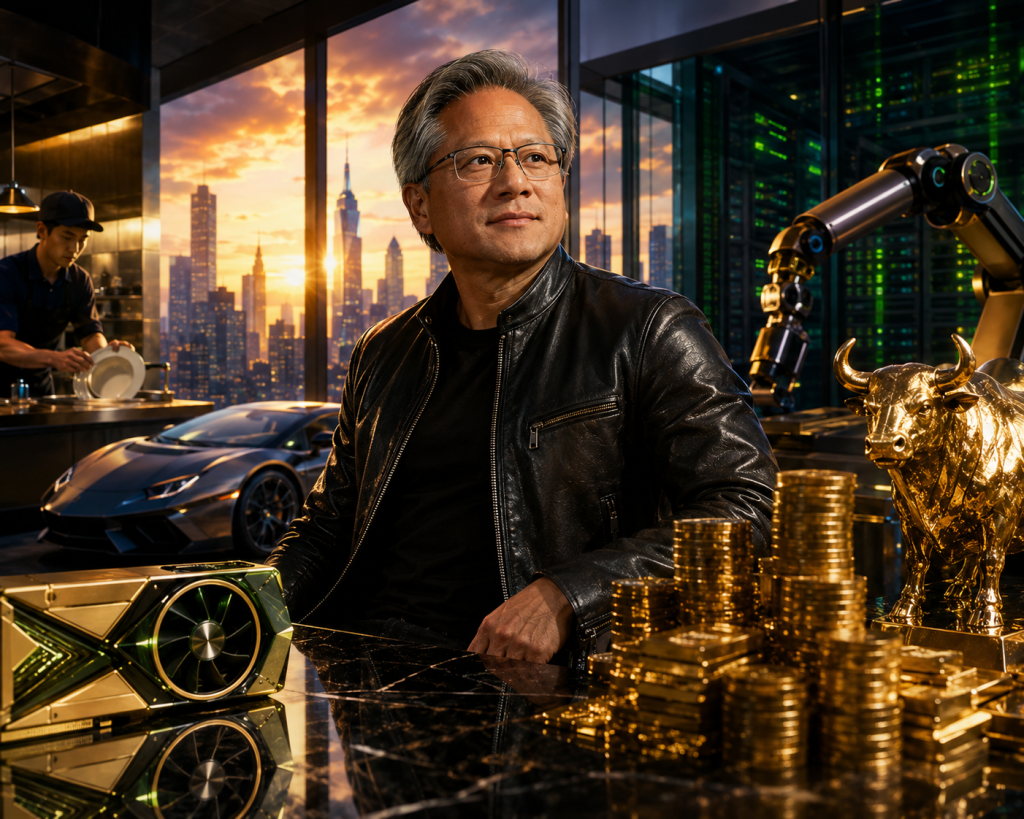
Jensen Huang Net Worth 2026: From Denny’s Dishwasher to a $165 Billion Fortune
Jensen Huang net worth 2026 sits between $165 billion and $181 billion, depending on the day Nvidia’s stock decides to breathe. That range makes him the eleventh or twelfth richest person on earth, ahead of most royal families and behind only the handful of men who built platforms that billions of people touch every day. His fortune traces to a single asset: approximately 3.5% of Nvidia, a company now valued above $5 trillion. Roughly 97% of everything Jensen Huang owns exists as shares in the company he cofounded in a Denny’s booth thirty-three years ago. Huang is the central figure in the AI billionaires reshaping American wealth.
One number clarifies everything. Nvidia reported $215.9 billion in revenue for fiscal year 2025. Not market capitalization. Revenue. Actual money paid by actual customers for actual chips. When a company generates that kind of cash and trades at a $5 trillion valuation, the founder who held his stake becomes something the financial world had not previously imagined: a semiconductor engineer worth more than the GDP of most nations. He sits atop the chip throne that powers every AI fortune.
Before the Fortune: Taiwan to Kentucky to a Denny’s Counter
Jensen Huang was born in Tainan, Taiwan, in 1963. His parents sent him and his brother to the United States when he was nine. They landed in Tacoma, Washington, with an uncle. That uncle, misunderstanding the American school system, enrolled them at Oneida Baptist Institute in Kentucky, a reform school where Jensen’s roommate was covered in knife wounds. He was nine years old, washing dishes and mopping floors, surrounded by teenagers who had been expelled from everywhere else.
Most origin stories in tech start at Stanford or a garage in Palo Alto. This one starts with a child scrubbing pans in rural Appalachia. Huang has said publicly that the experience taught him something he never forgot: work does not care about your feelings. Work gets done or it does not. Sentiment is irrelevant.
His family eventually relocated to Oregon. Huang enrolled at Oregon State University, studied electrical engineering, and met Lori Mills in a lab. They married. He earned a master’s degree at Stanford, where the proximity to Silicon Valley’s nascent chip industry shaped everything that followed. He worked at LSI Logic and then Advanced Micro Devices, learning the semiconductor business from the inside. By 1993, at thirty years old, he was ready to build something of his own.
Nvidia: The Company That Kept Pivoting Until History Showed Up
Huang cofounded Nvidia with Curtis Priem and Chris Malachowsky in January 1993. They wrote the business plan at a Denny’s in San Jose, which Nvidia later commemorated with a plaque. Priem designed the original chip architecture. Malachowsky handled hardware engineering. Huang ran everything else. Early funding came from Sequoia Capital and others who saw a play in graphics processing for the emerging PC gaming market.
For two decades, Nvidia was a gaming company. Its GPUs powered the graphics in video games, professional visualization software, and cryptocurrency mining. Respectable business. Not world-changing. Then researchers at the University of Toronto discovered that Nvidia’s graphics chips, designed to render explosions in Call of Duty, happened to be perfect for training neural networks. Parallel processing architecture designed for pixels turned out to be ideal for matrices. That discovery, published in 2012, changed the trajectory of both artificial intelligence and Nvidia’s stock price.
Huang saw it before anyone else in the semiconductor industry. Intel chased mobile. Qualcomm chased phones. AMD fought for survival. Nvidia pivoted its entire R&D operation toward artificial intelligence. CUDA, the company’s parallel computing platform, had been quietly building a developer ecosystem since 2006. By the time OpenAI launched ChatGPT in November 2022 and the entire world suddenly needed AI accelerator chips, Nvidia had a ten-year head start and effectively zero competition. That head start is worth $5 trillion.
The Money: How $165 Billion Actually Works
Jensen Huang’s compensation from Nvidia in fiscal 2025 totaled $49.8 million. That includes base salary, stock awards, and other compensation. It sounds like a lot until you realize it represents roughly 0.00003% of his total net worth. His real wealth creation is not salary. It is ownership.
Huang holds approximately 78.7 million shares of Nvidia common stock plus millions of vested restricted stock units. At $280 per share (a representative 2026 price), that stake is worth roughly $22 billion in directly held shares alone. Additional wealth comes through trusts and family entities that hold separate Nvidia positions. Total package, depending on the stock price on any given Tuesday, ranges from $165 billion at conservative estimates to $181 billion at peaks.
Here is the critical fragility: 97% of that fortune is Nvidia stock. Zero meaningful diversification. No massive real estate portfolio relative to net worth, no hedge fund allocation, no bond ladder. If Nvidia drops 30%, Jensen Huang’s net worth drops 29%. That is not a typo. It is the mathematical reality of concentrated single-stock wealth. Every billion he has is a bet on the AI infrastructure buildout continuing at its current pace. When analysts debate whether AI spending will sustain, they are, whether they know it or not, debating whether Jensen Huang stays in the top fifteen richest people alive.
Real Estate: $53 Million Across Three States
For a man worth $165 billion, Jensen Huang’s real estate portfolio is almost comically modest. His primary residence is a $38 million mansion in San Francisco’s Pacific Heights neighborhood, on the Gold Coast stretch where views of the Golden Gate Bridge come standard. He owns a $6.9 million estate in Los Altos Hills, the quiet suburb where half of Silicon Valley’s founding class lives behind hedges and eucalyptus trees. A third property in Maui cost approximately $8 million.
Total real estate: roughly $53 million. That represents 0.03% of his net worth. For comparison, the average American homeowner has approximately 70% of their net worth tied up in their primary residence. Huang has 0.03% in all three houses combined. His home is his stock certificate. His mansion is his cap table. Everything else is decoration.
No East End property has surfaced publicly, though brokers on the South Fork report that representatives of major technology principals have made inquiries about oceanfront parcels in recent seasons. Whether Huang is among them remains private. What is not private is the broader trend: AI wealth is the fastest-growing buyer segment in East End ultra-luxury real estate, and Nvidia employees with vested RSUs are leading that migration.
The Leather Jacket: Status Signaling in the AI Age
Jensen Huang wears a black leather jacket to nearly every public appearance. Not a motorcycle jacket. Not a bomber. A custom or near-custom Tom Ford piece that retails for approximately $9,000. He wears it to keynotes, earnings calls, meetings with heads of state, and trade show floors. It has become so iconic that Nvidia employees reportedly gave him a custom version for his birthday.
In the semiotics of wealth, the leather jacket performs a specific function. It says: I am not a banker. I am not finance. I am something you do not have a category for yet. Mark Zuckerberg had the gray t-shirt. Steve Jobs had the black turtleneck. Huang has the leather jacket, and it communicates the same thing all tech-founder uniforms communicate: I am too important to think about clothes, but I have thought about this exact outfit more carefully than you realize.
Lucy Guo, by contrast, shops at Shein and drives a Honda Civic with a net worth of $1.3 billion. Sam Altman wears anonymous normcore. Elon Musk fluctuates between costume and carelessness. Each wardrobe choice is a position statement in the status economy, and Huang’s leather jacket is the most deliberate of all. It says: I built the foundation everything else runs on, and I look good doing it.
Family, Philanthropy, and the 97% Problem
Jensen and Lori Huang have two children. Both are adults. Lori has remained almost entirely out of public life, a notable achievement given that she is married to a man whose keynote speeches are watched by millions and whose stock price moves markets. Their relationship predates the fortune by over a decade. They were lab partners before they were spouses, collaborators before they were billionaires.
Philanthropically, the Huangs have given $50 million to Oregon State University, funding the Jen-Hsun and Lori Huang Collaborative Innovation Complex. Additional gifts have gone to Stanford and various STEM education initiatives. Relative to net worth, the giving is modest. Warren Buffett has pledged to give away 99% of his fortune. Bill Gates has given away $59 billion through the Gates Foundation. Huang has given away roughly 0.03% of his. Whether that ratio changes as the fortune matures, and as public scrutiny of tech billionaire philanthropy intensifies, remains to be seen.
The 97% concentration problem deserves its own paragraph. Nearly all of Huang’s wealth is Nvidia stock. He has not diversified in any meaningful public way. Zero art auctions at Christie’s. No sports franchise acquisition, no media company purchase, no luxury yacht documented by maritime trackers. Compare this to Jeff Bezos, who used Amazon wealth to buy the Washington Post, Blue Origin, and a $500 million yacht. Or Larry Ellison, who bought an entire Hawaiian island. Huang’s financial identity is Nvidia. Full stop. That is either supreme confidence in his company’s future or supreme concentration risk. History will decide which.
What Built the Fortune: Timing, Monopoly, and the Courage to Wait
Three factors explain why Jensen Huang is worth $165 billion and not $16.5 billion.
First, timing. Nvidia invested in AI computing architecture a full decade before the market demanded it. CUDA launched in 2006. For years it was a niche tool used by a small community of machine learning researchers. When deep learning exploded after 2012, and then ChatGPT detonated the consumer market in 2022, Nvidia was the only company with mature AI-ready hardware. Timing is often described as luck. In Huang’s case, it was a multi-billion-dollar bet placed in 2006 that did not pay off until 2023.
Second, monopoly. Nvidia controls approximately 80-90% of the AI accelerator chip market. Lisa Su’s AMD is a distant second. Intel’s AI chip efforts have been largely unsuccessful. Google designs its own TPU chips but does not sell them commercially at scale. Every major AI company (OpenAI, Anthropic, Meta, Google, Amazon) runs on Nvidia hardware. That monopoly position translates directly into pricing power, margin expansion, and the $215.9 billion revenue figure that underpins the entire valuation.
Third, the courage to hold. Curtis Priem, Nvidia’s other cofounder, sold his stake in 2006. If Priem had held, that position would be worth over $600 billion today. Huang held. Through the dot-com crash and the 2008 financial crisis. Through the crypto winter that cratered GPU demand. Past every analyst who said Nvidia was overvalued. He held, and holding is the hardest thing any founder can do when the numbers on the screen already show more money than your grandchildren could spend. Priem’s decision was reasonable in 2006. Huang’s decision to stay was irrational by any conventional risk framework. Both decisions were human. Only one of them produced $165 billion.
The Insider Angle: From Denny’s to the Gold Coast
Stand outside 2920 Broadway in San Francisco’s Pacific Heights. The $38 million mansion sits on a street where Pacific Union brokers quote prices per square foot that would make a Manhattan co-op board blush. Jensen Huang lives here. Forty-five years ago, he was washing dishes at a Denny’s in rural Kentucky for $2.65 an hour. That Denny’s still exists. The one in San Jose where Nvidia’s business plan was written has become a minor pilgrimage site for tech tourists who want to sit in the booth where a $5 trillion company started on a napkin.
Silicon Valley loves its origin myths, and Huang’s is better than most because it resists the usual Stanford-dropout-in-a-garage formula. Zero family money. No early venture capital connections through prep school classmates, no Ivy League pedigree. Oregon State and a Denny’s booth. Everything that followed was built, not inherited, not networked into existence, not manufactured by an accelerator program. It was engineered, chip by chip, cycle by cycle, for thirty-three years.
On the East End, new money arrives without the social infrastructure that old money spent generations constructing. Zero legacy memberships, no family names on hospital wings, no ancestral claim to a table at any particular restaurant. What there is: a wire transfer large enough to bypass every waiting list that matters. Jensen Huang has not, to anyone’s public knowledge, bought Out East. But the people who trained on his chips, who got rich on his platform, who vested their Nvidia RSUs at exactly the right moment? They are already here. The landlord’s tenants arrived before the landlord did.
Where the Conversation Continues
You are reading this because the mechanics of exceptional wealth creation are not abstract to you. They are the current you swim in. Jensen Huang’s fortune is not just a number. It is a map of where technology, capital, and timing converge to produce outcomes that rewrite the rules of who has money and what money means. Understanding that map is how you stay ahead of the next convergence.
If you are building something that belongs in this conversation, if your brand, your property, your event, or your company should be part of the editorial ecosystem that covers this world, we want to hear from you. Reach us directly through our contact page.
For brands and businesses seeking premium editorial visibility in the publication that has covered East End luxury for twenty-three years, explore our paid feature submission process. Your story, told with the authority and reach of Social Life Magazine.
Stay inside the conversation before it moves without you. Subscribe to our newsletter at sociallifemagazine.com/enflyer for weekly updates on the people, properties, and power moves shaping the East End.
Polo Hamptons returns July 18 and 25 at 900 Lumber Lane, Bridgehampton. BMW is the title sponsor. The field is where finance meets technology meets culture in real time. Full details at polohamptons.com.
Never miss an issue. Social Life Magazine publishes five summer issues (Memorial Day through Labor Day, Westhampton to Montauk, 25,000 copies each) plus Fall and Winter editions delivered to Upper East Side doorman buildings. Subscribe at sociallifemagazine.com/subscription.
If this publication has earned your attention and you want to support independent luxury journalism on the East End, contributions help keep the work going. Every dollar funds the editorial coverage that no algorithm can replace.
Author

Written by
Recent Posts
hiTechMODA Season 16
How to Keep Your Personal Number Private When Booking Events, Rentals and Services
Understanding Compensatory Damages in a Personal Injury Case

When Online Family Therapy Makes Sense for Modern Families

Carrier Oils, Essential Oils, and Oil Blends: What Beauty Brands Need to Know
Categories
- Art
- Articles
- Business of Luxury
- Celebrities
- Culture
- Entertainment
- Events
- Faces of Summer 2026
- Fashion
- Fashion & Style
- Featured
- Finance
- Food, Spirits, Wine
- Hamptons
- Hamptons Celebrities
- Health
- Health & Beauty
- Lifestyle
- Luxury Lifestyle
- Press
- Profiles
- Real Estate
- Technology
- The Chronicles
- Travel
- Uncategorized
- Weddings