
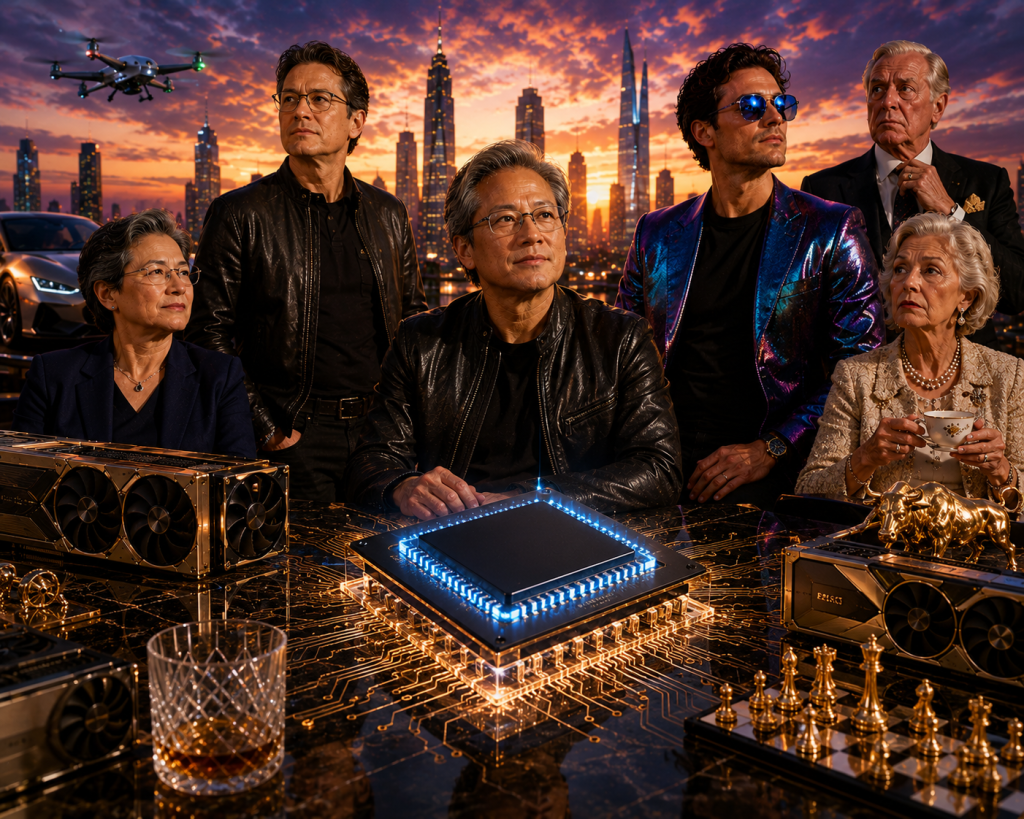
AI Chip Billionaires: The Hardware Fortunes Powering Every AI on Earth
Every large language model runs on silicon. Chatbots, autonomous vehicles, image generators. From research labs in San Francisco to data centers from Santa Clara to Singapore. Before a single word of code touches the intelligence layer, before a single training run begins, someone has to build the chip. The AI chip billionaires who sit at the hardware layer of the artificial intelligence economy are not the flashiest names in the AI billionaires 2026 story. They are the most durable.
The global semiconductor industry is projected to generate $1.3 trillion in revenue in 2026, according to Bank of America, up from a $1 trillion forecast issued just four months earlier. Gartner estimates 64% growth for the year. The PHLX Semiconductor Sector index has climbed 70% in 2026 alone. Behind those numbers sits a simple structural fact: artificial intelligence requires physical infrastructure, and the people who build that infrastructure, who design the chips, manufacture the wafers, and ship the accelerators, control the foundation on which every other AI fortune rests.
This is the story of three people who shaped that foundation. Huang held his stake and became worth $165 billion. Priem sold early and left $600 billion on the table. Su walked into a dying company and turned it into the only credible challenger. Three engineers, three decisions, three radically different outcomes from the same industry, the same decade, the same technology.
Jensen Huang: The Man Who Owns the Picks and the Shovels and the Mine
Jensen Huang’s net worth fluctuates between $165 billion and $181 billion on any given trading day, making him the eleventh or twelfth richest person on earth. That fortune traces to a single concentrated bet: approximately 3.5% of Nvidia, the company he cofounded in a Denny’s booth in San Jose in 1993. Nvidia now commands a market capitalization exceeding $5 trillion and holds roughly 80-81% of the AI accelerator chip market. No company in the history of semiconductors has ever achieved that kind of monopoly position during an industry expansion of this magnitude.
Huang’s story is an immigrant narrative that resists every Silicon Valley cliche. Born in Tainan, Taiwan, sent to the United States at nine, enrolled accidentally in a Kentucky reform school where his roommate was covered in knife wounds, washing dishes at Denny’s for $2.65 an hour. He met his wife Lori in an engineering lab at Oregon State. Earned a master’s at Stanford. Worked at LSI Logic and AMD. Cofounded Nvidia at thirty with Curtis Priem and Chris Malachowsky. Then ran the company for thirty-three consecutive years without interruption, through the dot-com crash, through the 2008 crisis, through the crypto winter, while 97% of his personal wealth remained locked in Nvidia stock.
The Conviction to Hold
The conviction required to hold a single-stock position for three decades while the market offered dozens of reasons to diversify is not merely financial. It is temperamental. Every wealth advisor in America would have told Huang to sell at least half his position after the first $10 billion. The shares stayed. His real estate portfolio, a $38 million Pacific Heights mansion, a $6.9 million Los Altos Hills estate, and an $8 million Maui compound, totals roughly $53 million. That is 0.03% of his net worth. His home is his cap table. Everything else is a leather jacket and a keynote stage.
Nvidia reported $215.9 billion in revenue for fiscal year 2026. Data center revenue alone reached $194 billion. These are not speculative projections. They are receipts. Huang built the landlord’s position in the AI economy, and every tenant, OpenAI, Anthropic, Meta, Google, Amazon, pays rent in the form of chip purchases that generate billions in quarterly cash flow. The picks and shovels metaphor from the Gold Rush understates what Huang actually built. He owns the picks, the shovels, and the mine. And he is still digging.
Curtis Priem: The Architect Who Walked Away from the Cathedral
Curtis Priem’s net worth is approximately $30 million. That number is factual and misleading in equal measure. Priem cofounded Nvidia alongside Huang and Malachowsky, served as its first Chief Technology Officer for a decade, filed nearly 200 patents that form the technical bedrock of the company’s chip architecture, and held a 12.8% stake at the 1999 IPO. If he had held that stake through every split and every market cycle, it would be worth more than $600 billion today. Enough to make him the second-richest person alive.
He did not hold. Shortly after the IPO, Priem established the Priem Family Foundation and transferred the majority of his Nvidia shares into it, describing the wealth as “an excessive amount of money.” He sold his remaining shares by 2006, when they traded between $3.50 and $6 per share. He donated $275 million to Rensselaer Polytechnic Institute, accounting for 40% of the school’s total gifts over two decades. His $75 million gift in 2023 brought the first IBM Quantum System One to a university campus. Then he moved off the grid to a $6 million house near Fremont, California, named his Gulfstream G450 “Snoopy,” and started writing unpublished manifestos about repairing the earth.
The Most Expensive Rational Decision in History
The easy reading of Priem’s story is regret. He told Forbes he thinks about Nvidia at least twice a day. He admitted, “I did a little crazy thing.” But the deeper reading is more complicated. In 2006, holding a concentrated position in a $20 billion gaming company was not visionary. It was reckless by every standard financial metric. AI was a niche academic discipline. ChatGPT would not exist for sixteen years. Priem made a decision that was entirely rational in 2006 and entirely catastrophic by 2026, and the gap between those two assessments is the most expensive lesson in modern finance.
His legacy exists in two places simultaneously. At RPI, the Curtis R. Priem Experimental Media and Performing Arts Center and the Cognitive and Immersive Systems Constellation bear his name. Inside every Nvidia chip, his original architecture still runs. The cathedral’s architect left the building, but his blueprints are still in the walls. Every AI model trained on Nvidia hardware owes a fraction of its capability to patents filed by a man now worth 0.005% of what his stake would have been.
Lisa Su: The Surgeon Who Saved the Patient Everyone Else Had Pronounced Dead
Lisa Su’s net worth stands between $1.3 billion and $1.6 billion, nearly all of it in AMD stock. She holds approximately 3.77 million shares as of May 2026. The raw dollar figure places her well below Huang on any wealth ranking. The ratio of value created to personal investment places her in a category of her own. When Su became CEO of AMD in October 2014, the stock traded at $3. The company’s market capitalization was $2 billion. Analysts debated not whether AMD would decline but when it would disappear.
Su’s turnaround is measured in multiples that most CEOs would consider fictional. AMD stock has risen more than 14,000% under her leadership. Market capitalization climbed from $2 billion past $250 billion. Revenue grew from $4 billion to over $26 billion annually. AMD’s stock outperformed Nvidia’s in 2026, surging 114% compared to Nvidia’s 15% gain, as Wall Street began pricing in AMD’s accelerating AI chip business. The MI300X became the company’s fastest-ramping product in history. Meta deployed it for live AI traffic. OpenAI signed a multi-year supply deal. AMD’s data center segment hit a record $5.8 billion in Q1 2026 alone, up 57% year over year.
The Cousin Rivalry
The biographical parallel with Huang is almost too precise to be coincidence, and it is not coincidence. It is genealogy. Su and Huang are first cousins once removed, both born in Tainan, Taiwan, both immigrants, both electrical engineers, both running semiconductor companies that design the chips powering artificial intelligence. They did not meet until an industry event well into their careers. “No family dinners,” Su told Bloomberg. “It is an interesting coincidence.” That dryness is characteristic. Su does not perform. She executes. WIRED described her as “out for Nvidia’s blood.” Time named her CEO of the Year. MIT invited her to deliver its 2026 commencement address. Her competitor and distant cousin received none of those honors.
AMD’s 10% share of the AI accelerator market does not sound threatening until you consider trajectory. Four months ago, that figure was 5%. AMD’s MI350 chips offer 35 times the inference performance of predecessors. The MI450, launching this year, is what Su calls “a huge step function.” Nvidia’s monopoly has never faced a challenger with this combination of technical credibility, hyperscaler partnerships, and capital market momentum. Su saved the patient, and now she is prepping for the next operation. The patient is aiming at the throne.
The Hardware Layer: What the Chip Throne Means for Everyone Else
Every fortune documented in the broader AI billionaires story depends on this layer. Sam Altman’s OpenAI runs on Nvidia and AMD chips. Elon Musk’s xAI trains Grok on GPU clusters. Alexandr Wang’s Scale AI processes data that feeds models running on silicon designed by Huang and Su. Dario Amodei’s Anthropic purchases Nvidia hardware in quantities that represent meaningful fractions of quarterly revenue. The model builders, the data labelers, the investors, every other layer of the AI economy pays tribute to the hardware layer. Without chips, there are no models. Absent models, there is no artificial intelligence. And absent artificial intelligence, the $2.9 trillion in combined AI wealth documented in 2026 does not exist.
The Chip Throne is not a metaphor. It is a description of economic structure. Nvidia and AMD sit at the foundation of a $1.3 trillion semiconductor industry that is projected to double to $2 trillion by 2030. The people who control the hardware control the economics. Huang controls the monopoly. Su controls the only credible alternative. Priem designed the original architecture and walked away before it became the most valuable technology on earth.
Three engineers. Three decisions about timing, conviction, and risk tolerance. Between them, they account for roughly $167 billion in current net worth and over $600 billion in hypothetical wealth that evaporated through a single act of early liquidation. Their stories converge on one truth that applies far beyond semiconductors: the people who build the physical infrastructure of a technology revolution capture the most durable wealth. Software valuations fluctuate. Model architectures become obsolete. But the chips endure. The Chip Throne endures. And the question of who sits on it next will determine the financial architecture of the AI economy for the next decade.
Where the Conversation Continues
You are reading this because the infrastructure layer of artificial intelligence is not something you observe from a distance. It is the foundation beneath every AI investment, every technology partnership, and every strategic bet your business makes. Understanding who controls the chips is understanding who controls the future.
If you are building something that belongs in this conversation, if your brand, your property, your event, or your company should be part of the editorial ecosystem that covers this world, reach us through our contact page.
For brands and businesses seeking premium editorial visibility in the publication that has covered East End luxury for twenty-three years, explore our paid feature submission process.
Stay inside the conversation. Subscribe to our newsletter at sociallifemagazine.com/enflyer for weekly updates on the people, properties, and power moves shaping the East End.
Polo Hamptons returns July 18 and 25 at 900 Lumber Lane, Bridgehampton. BMW is the title sponsor. Full details at polohamptons.com.
Never miss an issue. Social Life Magazine publishes five summer issues (Memorial Day through Labor Day, Westhampton to Montauk, 25,000 copies each) plus Fall and Winter editions delivered to Upper East Side doorman buildings. Subscribe at sociallifemagazine.com/subscription.
If this publication has earned your attention, contributions help keep the work going. Every dollar funds editorial coverage that no algorithm can replace.
Author

Written by
Recent Posts
How Latino Players Have Helped Shape Modern Basketball Culture
10 Best Designer iPhone 18 Pro Cases to Choose From

AI for personal finance: where PennyGuard fits

How to Pick a Homecoming Dress for Your Body Type (and Feel Amazing in It)

World Cup Injury Attorney for Vancouver Events
Categories
- Art
- Articles
- Business of Luxury
- Celebrities
- Culture
- Entertainment
- Events
- Faces of Summer 2026
- Fashion
- Fashion & Style
- Featured
- Finance
- Food, Spirits, Wine
- Hamptons
- Hamptons Celebrities
- Health
- Health & Beauty
- Lifestyle
- Luxury Lifestyle
- Press
- Profiles
- Real Estate
- Technology
- The Chronicles
- Travel
- Uncategorized
- Weddings