
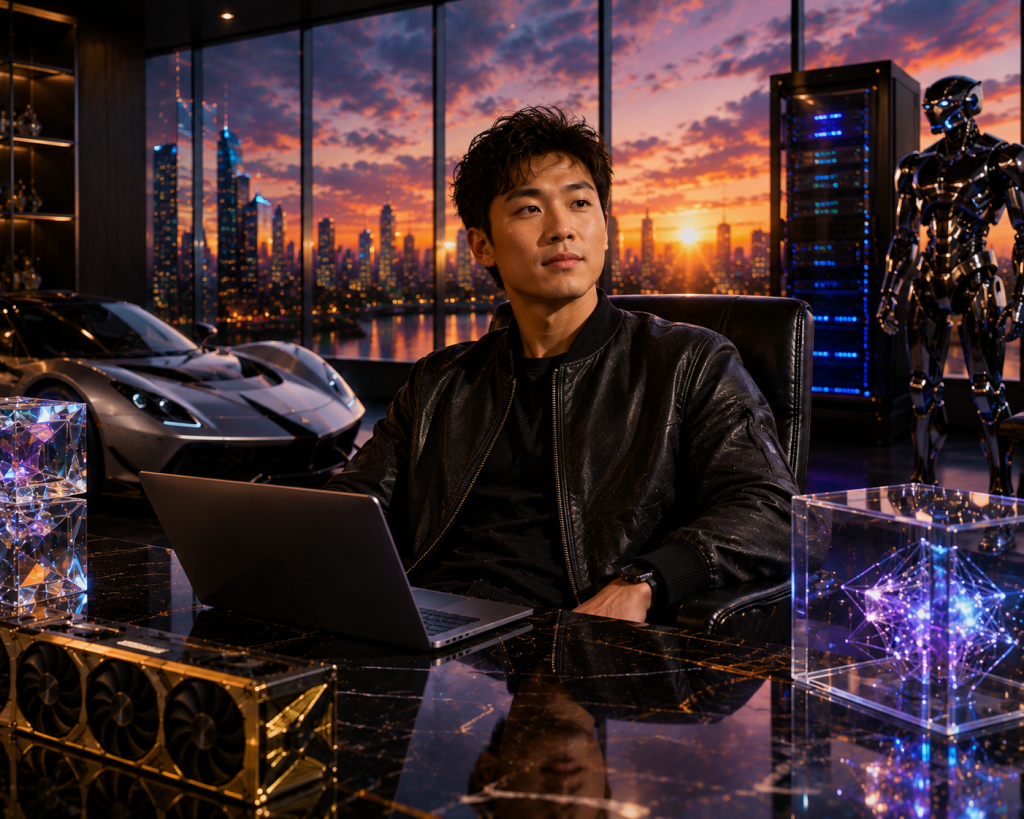
Alexandr Wang Net Worth 2026: MIT Dropout to Meta’s $3.6 Billion AI Chief
Alexandr Wang net worth 2026 is estimated between $3.2 billion and $3.6 billion, built almost entirely from the company he cofounded at nineteen and the deal that sent him to Meta at twenty-eight. Wang dropped out of MIT after his freshman year to build Scale AI, a data labeling company that became the unsexy infrastructure layer every major AI model depends on. By 2021, he was the world’s youngest self-made billionaire. By 2025, he had sold 49% of Scale to Meta for $14.3 billion and walked into Mark Zuckerberg’s building as Chief AI Officer. He is one of the defining figures in the AI billionaires reshaping American wealth.
That trajectory, from a nuclear physicist’s kid in Los Alamos to the person Zuckerberg hired to build superintelligence, compresses into nine years what most founders spend thirty trying to achieve. And unlike the chip billionaires who control the hardware layer, Wang’s fortune was built on something less tangible but equally essential: the training data without which no large language model can learn anything at all.
Before Scale: Los Alamos, MIT, and the Premium of Naivete
Alexandr Wang was born in January 1997 in Los Alamos, New Mexico. Both parents were Chinese immigrants who worked as physicists at Los Alamos National Laboratory. Growing up in a town built to house the Manhattan Project, surrounded by scientists who understood what happens when technology outpaces governance, shaped a worldview that would later lead Wang to co-author a paper with former Google CEO Eric Schmidt arguing that superintelligent AI “would amount to the most precarious technological development since the nuclear bomb.”
Wang was a math prodigy who enrolled at MIT to study machine learning and computer science. During his freshman year, he interned at Quora and Addepar, where he noticed a recurring bottleneck: every company building AI models needed massive amounts of labeled data, and the process of generating that data was slow, expensive, and fundamentally manual. Someone had to look at an image and tag it “cat,” then had to read a sentence and mark the sentiment. Someone had to draw a bounding box around a pedestrian so an autonomous vehicle would know not to hit them.
Wang saw a company in that bottleneck. After one year at MIT, he dropped out. “I believe there’s a huge premium to naivete,” he later told an interviewer. “Approaching industries with a totally blank slate and without a fine-grain understanding of what makes things hard is actually part of what allows you to accomplish things.” That sentence is either profound or reckless depending on whether the company works. Scale AI worked.
Scale AI: Building the Plumbing of the AI Revolution
Wang cofounded Scale AI in 2016 with Lucy Guo, a designer and engineer he had met at Quora. They entered Y Combinator and built a platform that solved the data labeling problem at industrial scale. Their initial investors included Dragoneer Investment Group, Tiger Global Management, and Index Ventures. Revenue by 2024 reached $870 million.
The business model was straightforward: AI companies needed labeled training data to build their models. Scale provided that data through a network of over 240,000 contract workers who annotated images, text, and video. The company also built evaluation tools that let AI developers test model performance against human baselines. In the language of the gold rush, if Nvidia made the picks and the shovels, Scale AI trained the miners how to swing them.
See also: data barons of AI.
Government Contracts and Geopolitical Weight
Scale’s client list extended beyond Silicon Valley. The company signed contracts worth over $110 million with the U.S. Air Force and Army, providing AI data infrastructure for defense applications. Wang testified before U.S. House Armed Services committees and wrote directly to President Trump declaring the strategic importance of AI dominance. He met with the UK Prime Minister and the Indian Prime Minister. PR Week named him to their “AI 25” Class of 2026. At twenty-eight, Wang carried more geopolitical weight than most diplomats twice his age, because the technology he built was not optional for any nation that intended to compete in artificial intelligence.
The Meta Deal: $14.3 Billion and a New Title
In June 2025, Meta announced a $14.3 billion investment for a 49% stake in Scale AI, more than doubling the company’s valuation to $29 billion. As part of the deal, Wang stepped down as CEO and joined Meta as Chief AI Officer, leading the newly created Superintelligence Labs. Jason Droege, a former Uber vice president and Scale’s chief strategy officer, was named interim CEO. Wang retained a board seat at Scale.
The deal was the largest AI hiring transaction in history. Meta was not buying a product. It was buying a person. Zuckerberg’s company had projected between $115 billion and $135 billion in AI capital expenditure for 2026. The person hired to direct that spending was a twenty-eight-year-old college dropout whose company had started by paying humans to draw boxes around objects in photographs.
Wang’s departure memo to Scale employees captured the tension: “I started this company right out of freshman year of MIT and never looked back. I wouldn’t change a minute of it.” He acknowledged the offer was initially “unimaginable” but said he recognized “a deeply unique moment, not just for me, but for Scale as well.” Then he took a small group of Scale employees with him to Meta. He did not name them publicly. The transition was clinical, efficient, and worth $14.3 billion.
The Money: How $3.6 Billion Breaks Down
Wang’s net worth derives from multiple sources. His retained equity in Scale AI, now valued at $29 billion, represents the largest component. His compensation package at Meta, while not publicly disclosed, is reported to be among the largest in the company’s history, likely structured around long-horizon AI performance metrics tied to Meta’s massive capital expenditure program. Additional wealth comes from earlier venture investments and the liquidity events associated with Scale’s various funding rounds.
Forbes estimated his net worth at approximately $3.2 billion as of early 2026, while other estimates placed it closer to $3.6 billion immediately after the Meta transaction. The range reflects the difficulty of valuing a private company stake combined with an undisclosed compensation package at a public company. What is certain: Wang became the world’s youngest self-made billionaire at 24 in 2021, and his wealth has roughly tripled since then.
Personal Life: Dating Sally Draper
Wang is reportedly dating Kiernan Shipka, the actress best known for playing Sally Draper on Mad Men. One builds artificial superintelligence for the company that runs Facebook and Instagram. The other played a child learning to read the power dynamics of adults in a world defined by status, ambition, and performance. Whether they discuss the parallels is unknown. That the parallels exist is undeniable.
Wang lives in the San Francisco Bay Area. Personal spending and lifestyle details remain largely private, consistent with someone who built his career in the backend infrastructure of AI rather than the consumer-facing products that generate celebrity. He speaks at global summits (the India AI Summit 2026, the Breakthrough Prize Ceremony) and testifies before congressional committees, but his public persona is that of an engineer who happens to control billions of dollars in AI infrastructure rather than a billionaire who happens to know engineering.
The Cofounder He Left Behind
Wang cofounded Scale AI with Lucy Guo in 2016. Guo was fired in 2018 after disagreements with Wang, reportedly including a clash over whether the company’s 240,000 contract workers were being paid on time. “I was like, ‘we need to focus on making sure they get paid out on time,'” Guo later told TIME. Wang was more focused on growth. The disagreement was both philosophical and personal, and it ended with Guo’s departure.
Guo kept her approximately 5% stake. When the Meta deal valued Scale at $29 billion, that stake became worth roughly $1.3 billion. Fortune described them as “estranged business partners.” Guo became the youngest self-made woman billionaire at 30, dethroning Taylor Swift. She got richer from leaving Scale AI than many founders get from staying and running their companies for decades. The cofounder dynamic, the breakup, and the divergent financial outcomes are a story that deserves its own treatment. It has one.
The Insider Angle: The Nuclear Physicist’s Son Goes to Washington
Stand in Los Alamos, New Mexico, and you are standing in the town that built the atomic bomb. Walk the same streets Alexandr Wang walked as a child, past the national laboratory where his parents worked, through a landscape defined by the intersection of science and government power. Los Alamos produced the most consequential technology of the twentieth century. Wang grew up surrounded by people who understood what that meant.
Now he builds the technology that multiple national governments consider the most consequential of the twenty-first century. The paper he co-authored with Eric Schmidt frames AI as a weapon-grade capability. Congressional testimony treats data infrastructure as national security infrastructure. The move to Meta gives Zuckerberg’s company the strategic advisor it needs to navigate a world where AI chip exports are regulated, AI model capabilities are monitored, and the line between corporate R&D and national defense is dissolving.
On the East End, where AI wealth is reshaping the real estate market, Wang’s fortune represents a new category of buyer: young, liquid, geopolitically connected, and building technology that governments treat as critical infrastructure. The nuclear physicist’s son is now the person Mark Zuckerberg trusts to build superintelligence. What that means for the South Fork real estate market is a question brokers are already answering with appointment books that fill faster than they can print them.
Where the Conversation Continues
You are reading this because the people building artificial intelligence infrastructure are not abstractions. They are the buyers, the investors, and the strategic partners reshaping every industry you operate in. Alexandr Wang’s story is a map of where power, capital, and technology converge at the highest levels.
If your brand, property, event, or company belongs in this conversation, reach us through our contact page.
For premium editorial visibility in the publication that has covered East End luxury for twenty-three years, explore our paid feature submission process.
Subscribe to our newsletter at sociallifemagazine.com/enflyer for weekly updates on the people, properties, and power moves shaping the East End.
Polo Hamptons returns July 18 and 25 at 900 Lumber Lane, Bridgehampton. BMW is the title sponsor. Full details at polohamptons.com.
Never miss an issue. Subscribe at sociallifemagazine.com/subscription.
Contributions help keep independent luxury journalism on the East End going. Every dollar funds editorial coverage that no algorithm can replace.
Author

Written by
Recent Posts
hiTechMODA Season 16
How to Keep Your Personal Number Private When Booking Events, Rentals and Services
Understanding Compensatory Damages in a Personal Injury Case

When Online Family Therapy Makes Sense for Modern Families

Carrier Oils, Essential Oils, and Oil Blends: What Beauty Brands Need to Know
Categories
- Art
- Articles
- Business of Luxury
- Celebrities
- Culture
- Entertainment
- Events
- Faces of Summer 2026
- Fashion
- Fashion & Style
- Featured
- Finance
- Food, Spirits, Wine
- Hamptons
- Hamptons Celebrities
- Health
- Health & Beauty
- Lifestyle
- Luxury Lifestyle
- Press
- Profiles
- Real Estate
- Technology
- The Chronicles
- Travel
- Uncategorized
- Weddings