
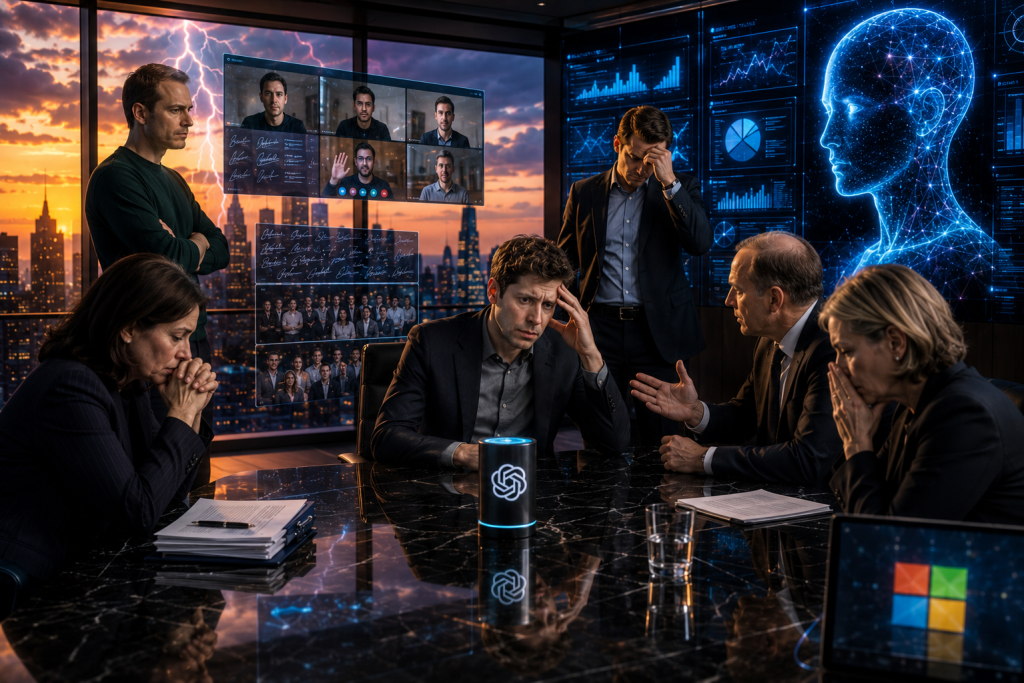
OpenAI Boardroom Drama: The Five Days That Nearly Destroyed a $730 Billion Company
On a Friday afternoon in November 2023, Sam Altman joined a video call with OpenAI’s board of directors. Co-founder Ilya Sutskever informed him he was fired. Within five days, Altman was reinstated, the board was dissolved, Sutskever was removed, Microsoft was threatening to build a competing division, and over 700 employees had signed a letter demanding the board resign. The OpenAI boardroom drama was the most consequential corporate crisis in the history of artificial intelligence, and it unfolded at a company now valued at $730 billion that belongs to the AI billionaires reshaping American wealth.
Friday: The Firing
November 17, 2023. Altman joined the video call expecting a routine board meeting. Sutskever, OpenAI’s chief scientist and co-founder, told him the board had voted to remove him. Four of the six board members voted for termination. The company published a blog post stating that Altman “was not consistently candid in his communications with the board, hindering its ability to exercise its responsibilities.” Chief Technology Officer Mira Murati was named interim CEO within hours.
The firing was executed via Google Meet. Zero severance negotiation, no transition period, no warning to Microsoft, which had invested over $13 billion in the company. Satya Nadella, Microsoft’s CEO, learned about the firing from the press release. The lack of advance notice to a $13 billion investor was itself a governance failure that would fuel the backlash.
The Weekend: Chaos, Loyalty, and a Microsoft Counterstrike
Saturday and Sunday became a rolling crisis. Murati’s interim CEO tenure lasted approximately 48 hours before the board replaced her with Twitch co-founder Emmett Shear. The staff was in revolt. Brockman, OpenAI’s co-founder and president, had been removed from the board simultaneously with Altman’s firing. Microsoft, blindsided and furious, announced that Altman and Brockman would join the company to lead a new AI research division.
The Microsoft announcement was both genuine and tactical. It gave Altman an alternative that made his reinstatement at OpenAI urgent rather than optional. If the best AI talent in the world followed Altman to Microsoft, OpenAI would become a shell with a board, a blog post, and no employees. Leverage was total.
The Letter That Ended It
On Monday, over 700 of OpenAI’s approximately 770 employees signed an open letter to the board. The letter demanded the board’s resignation, called for Altman’s reinstatement, and stated that signatories would join Altman at Microsoft if the board did not comply. Sutskever, who had orchestrated the firing, signed the letter asking for Altman’s return. The reversal from firing to begging took 72 hours. The letter represented roughly 91% of the company’s workforce publicly repudiating their own board of directors.
Tuesday: The Reinstatement
By Tuesday night, the board capitulated. Altman was reinstated as CEO. The original board was dissolved and replaced with a temporary three-person board that included Bret Taylor (Salesforce), Larry Summers (former Treasury Secretary), and Adam D’Angelo (Quora CEO, the sole survivor from the old board). Sutskever was removed from the board and eventually left OpenAI entirely in May 2024, founding his own company, Superintelligence Inc.
See also: trillion-dollar model builders.
Altman’s description of the aftermath was characteristically blunt. “All those people that I feel like really fucked me and fucked the company were gone, and now I had to clean up their mess,” he told Bloomberg. “It felt so unfair. It was just a crazy thing to have to go through and then have no time to recover, because the house was on fire.”
What the Crisis Revealed
The OpenAI crisis exposed three structural vulnerabilities in the AI industry that remain unresolved.
First, the governance of the most consequential AI companies is fragile. OpenAI’s nonprofit board had the legal authority to fire its CEO without warning, without cause disclosure, and without consulting the company’s largest investor. That authority was structurally correct and operationally catastrophic. The lesson: governance models designed for nonprofit research laboratories do not survive contact with $730 billion valuations.
Second, talent concentration creates existential risk. When 91% of a company’s workforce threatens to leave with the CEO, the board has no leverage. Altman was not reinstated because the board changed its mind. He was reinstated because the alternative was organizational death. Power in AI companies resides not in board seats but in the employees who know how to build the models.
Third, Elon Musk’s absence from OpenAI’s founding story is itself a plot point. Musk co-founded OpenAI in 2015, left the board in 2018, built a competing AI company (xAI) in 2023, and sued OpenAI for abandoning its nonprofit mission in 2024. Drama at the board level mirrored a deeper philosophical schism: should AI be developed as a nonprofit research endeavor or as a capped-profit (and eventually for-profit) commercial enterprise? That question remains unanswered. Capital has already decided.
The Aftermath: Amazon Makes a Movie
Amazon Studios announced a film based on the OpenAI boardroom crisis. Casting discussions reportedly included Andrew Garfield as Altman and Yura Borisov as Sutskever. The fact that a five-day corporate governance dispute at an AI research laboratory warranted a Hollywood production tells you everything about how the world perceives the stakes.
OpenAI has since shipped products at a pace that left competitors scrambling. The company began building a product that directly competes with GitHub, Microsoft’s $7.5 billion developer platform, creating tension with the same partner that rescued it during the crisis. The relationship between OpenAI and Microsoft, always complex, has become adversarial in ways neither side fully anticipated. Altman consolidated power. Safety teams were restructured. The for-profit conversion advanced. The house that was on fire was rebuilt. Whether the new structure is more stable than the old one remains the most important governance question in artificial intelligence.
The Deeper Read
Consider the speed. Friday afternoon: fired. Saturday: interim CEO replaced. Sunday: Microsoft announces competing division. Monday: 700 employees sign the letter. Tuesday night: reinstated. Five business days. In five business days, the most valuable AI company on earth went from functioning organization to existential crisis to restructured entity with a new board and a reinstated CEO who was, by his own account, “fucking depressed and tired” and also, by every objective measure, more powerful than he had been before the crisis began. The speed is the point. At the velocity AI companies operate, governance crises compress into timeframes that traditional corporate theory considers impossible. A Fortune 500 CEO firing involves months of board deliberation, legal review, succession planning, and stakeholder management. Altman’s firing involved a Google Meet call and a blog post. The reinstallation involved a letter and a phone call. The entire arc, from termination to triumph, fit inside a single work week.
What the Board Did Not Understand About Power
The fundamental error the OpenAI board made, and this is an error that has been made by every governing body in the history of institutions that confuse legal authority with actual power, was believing that the right to fire the CEO was the same as the power to fire the CEO. Legally, the board had every right. The nonprofit’s governance structure gave it unilateral authority to remove officers for any reason or no reason. Structurally, the board had no power at all, because power in a knowledge-economy organization does not reside in the board resolution. It resides in the people who know how to do the work. And 91% of the people who knew how to do the work told the board, in writing, that they would leave if the board did not reverse its decision.
This is not a failure of governance. It is a revelation about where governance ends and influence begins. The board governed. Altman influenced. Governance said: you are fired. Influence said: 700 people will follow me out the door and the organization you govern will be an empty building with a blog post and a tax-exempt status. The board’s legal authority was technically intact throughout the entire crisis. That board’s practical authority evaporated the moment the employees chose sides, which took approximately 48 hours, which in the context of a $730 billion organization is less time than it takes to process a termination through HR.
The Deeper Read
The lesson the board learned, and the lesson that every board of every AI company should study with the intensity usually reserved for regulatory filings and indemnification clauses, is that talent concentration creates ungovernable organizations. When 91% of your workforce is willing to walk for one person, that person is not your employee. That person is your organization. The board thought it was firing a CEO. It was attempting to amputate the central nervous system of a body that had no backup nervous system. The body rejected the amputation. The board was absorbed. And Altman emerged from the crisis with more power than he had before, which is the invariable outcome when an institution attempts to destroy someone who is more valuable than the institution itself.
Where the Conversation Continues
You are reading this because corporate governance in AI is not an abstract concern. It is the mechanism that determines who builds the most powerful technology in human history, under what constraints, and for whose benefit.
If your brand, property, event, or company belongs in this conversation, reach us through our contact page.
For premium editorial visibility, explore our paid feature submission process.
Subscribe at sociallifemagazine.com/enflyer for weekly updates.
Polo Hamptons returns July 18 and 25. BMW is the title sponsor. Details at polohamptons.com.
Subscribe at sociallifemagazine.com/subscription. Contributions help keep independent luxury journalism going.
Author

Written by
Recent Posts
hiTechMODA Season 16
How to Keep Your Personal Number Private When Booking Events, Rentals and Services
Understanding Compensatory Damages in a Personal Injury Case

When Online Family Therapy Makes Sense for Modern Families

Carrier Oils, Essential Oils, and Oil Blends: What Beauty Brands Need to Know
Categories
- Art
- Articles
- Business of Luxury
- Celebrities
- Culture
- Entertainment
- Events
- Faces of Summer 2026
- Fashion
- Fashion & Style
- Featured
- Finance
- Food, Spirits, Wine
- Hamptons
- Hamptons Celebrities
- Health
- Health & Beauty
- Lifestyle
- Luxury Lifestyle
- Press
- Profiles
- Real Estate
- Technology
- The Chronicles
- Travel
- Uncategorized
- Weddings