
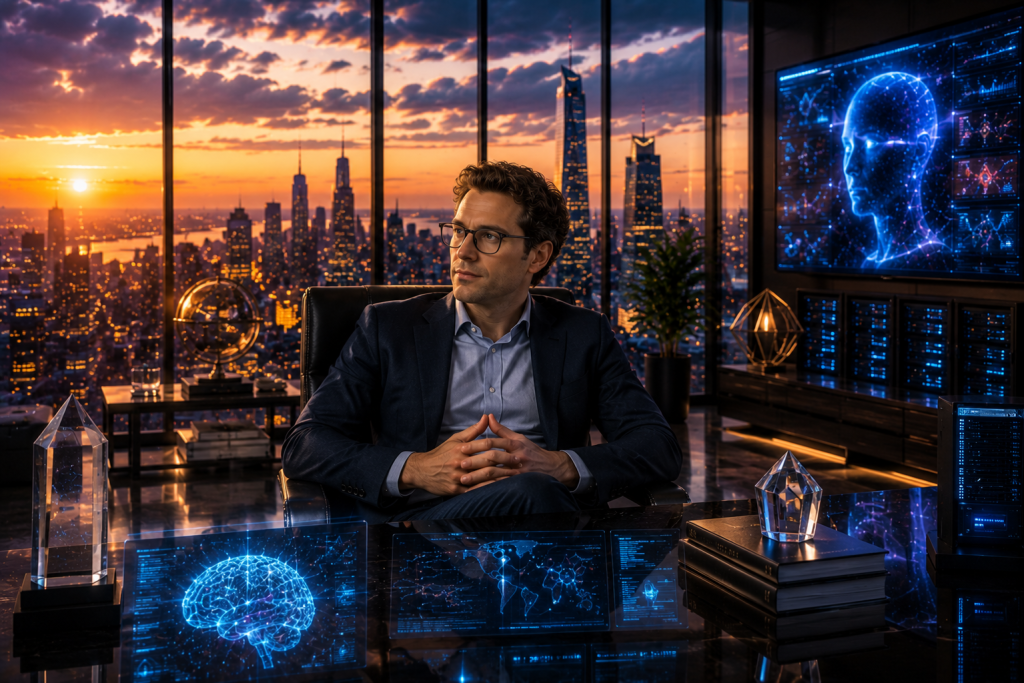
Dario Amodei Net Worth 2026: The $7 Billion Man Building AI He Believes Might Be Dangerous
Dario Amodei net worth 2026 is approximately $7 billion according to Forbes, ranking him #536 among global billionaires. That fortune comes almost entirely from his equity stake in Anthropic, the AI safety company he co-founded in 2021 after leaving his position as Vice President of Research at OpenAI. Anthropic’s valuation reached $380 billion in February 2026, with annual revenue of $14 billion and a run rate approaching $30 billion by April. The company raised a $30 billion Series G that attracted Singapore’s GIC, Coatue, Abu Dhabi’s MGX, Microsoft, and Nvidia. A pending round could push Anthropic’s valuation to $900 billion. Amodei is the Pivot in the AI billionaires story: the man who left the most powerful AI company because he thought it was moving too fast, then built a competitor worth hundreds of billions.
Before Anthropic: OpenAI and the Safety Schism
Dario Amodei was born in 1983 in San Francisco. He built his career in AI research, rising to Vice President of Research at OpenAI, where he oversaw the development of the large language models that would eventually power ChatGPT. His sister Daniela Amodei held a senior operational role at the same company. Together, they had a front-row seat to the tension between commercial ambition and safety research that would eventually fracture the organization.
Amodei’s research interests centered on the alignment problem, the technical challenge of ensuring that AI systems do what their creators intend rather than what their training data implies. It is the kind of problem that sounds abstract until a model starts generating medical advice or legal precedents, at which point abstraction becomes malpractice.
In 2021, Dario and Daniela left OpenAI alongside several other senior researchers. Their departure was driven by a conviction that the company was prioritizing product launches over alignment research. They founded Anthropic with a specific thesis: AI safety and commercial viability are not opposites, but building a company around that thesis requires putting safety into the architecture from the beginning rather than bolting it on after the products ship.
Anthropic and Claude: $380 Billion in Four Years
Anthropic’s growth has been extraordinary by any measure. From founding in 2021 to a $380 billion valuation in February 2026, the company compressed a trajectory that took Google twenty years into four. The Claude family of AI models competes directly with OpenAI’s ChatGPT and Google’s Gemini. More than 500 corporate clients spend over $1 million annually on Anthropic’s tools. Revenue reached $14 billion by early 2026, with the run rate climbing toward $30 billion by April.
See also: AI investor class.
The company’s “constitutional AI” approach, embedding ethical guidelines directly into the training process rather than applying them as filters, became a competitive differentiator. Organizations handling legal documents, government materials, and sensitive research data chose Claude specifically because its guardrails were structural rather than cosmetic. Trust translated into adoption. Adoption translated into revenue. Revenue supported a valuation that now places Anthropic alongside OpenAI and SpaceX as one of the three largest IPO candidates on earth.
Machines of Loving Grace: The Philosophical Wager
Amodei published a 15,000-word essay called “Machines of Loving Grace” arguing that AI could cure cancer, reverse climate change, uplift developing nations, and transform mental health treatment. He wrote it while simultaneously building safety systems designed to prevent AI from doing the opposite. That duality, building the most powerful technology in history while publicly arguing for constraints on its deployment, defines his position in the model builders hierarchy.
See also: Marc Andreessen’s a16z.
Compared to Sam Altman, who owns no equity in his $730 billion company, Amodei’s $7 billion fortune makes the philosophical difference concrete. Altman built the more commercially dominant company but cannot financially benefit from its success. Amodei built the safety-first competitor and is worth more than twice as much. The market, whatever its limitations, has priced Amodei’s approach higher than Altman’s compensation structure permits.
The Insider Angle: What Safety-First Wealth Looks Like
Amodei maintains a low public profile relative to his net worth. He speaks at Davos, testifies on AI governance, and publishes long-form essays that get read by policymakers in Washington and Brussels. He does not cultivate the celebrity persona that attaches to Altman or Musk. His sister Daniela serves as Anthropic’s president and co-manages the organization’s growth. The sibling dynamic is unusual among AI companies and provides a governance structure that most startups lack: two cofounders who share values, genetics, and a vested interest in the company surviving its own technology.
On the East End, where AI wealth is the fastest-growing segment of the luxury buyer profile, Amodei’s fortune represents a specific category: the researcher-turned-billionaire whose wealth stems from building technology he publicly worries about. Whether that worry is performance, conviction, or some combination of both is the open question that makes Anthropic the most philosophically interesting company in artificial intelligence and Amodei the most complicated character in the AI wealth story.
The Deeper Read
Anthropic’s client list, over 500 companies spending more than $1 million annually, represents something the AI industry rarely discusses: the demand for constrained intelligence. These are not companies buying the most powerful model available. They are companies buying the most trustworthy model available, and the premium they are willing to pay for trustworthiness tells you something about the market’s real preferences that benchmarks and capability scores cannot capture. When a law firm chooses Claude over ChatGPT for contract review, the choice is not about which model generates better prose. It is about which model is less likely to hallucinate a precedent that does not exist and expose the firm to malpractice liability. The safety-first approach creates a competitive moat built not on capability but on reliability, and reliability, unlike capability, does not become a commodity as models improve. It becomes more valuable, because the stakes of unreliability increase with every new application domain.
The Moral Arithmetic of Profitable Fear
There is something uncomfortable about Amodei’s position, and the discomfort is worth sitting with rather than resolving prematurely, because premature resolution is what press releases do and this is not a press release. The discomfort is this: Amodei believes, genuinely and articulately and at 15,000-word length, that artificial intelligence could be the most dangerous technology humans have ever built. He also runs a company that builds artificial intelligence and is worth $7 billion because that company has been extraordinarily successful at building artificial intelligence. The revenue is $14 billion. That valuation is $380 billion. The pending round could value Anthropic at $900 billion. Every dollar of that valuation is a dollar bet on the proposition that Anthropic will build AI systems that are more capable than the AI systems that currently exist, and more capable AI systems are, by Amodei’s own published argument, more dangerous AI systems.
For related coverage, explore Masayoshi Son’s Vision Fund pivot.
Continued
A standard resolution to this apparent contradiction, and it is a resolution Amodei himself has articulated in interviews and essays and Davos panels, is that building AI safely is better than not building AI at all, because if Anthropic does not build it, someone else will build it less safely. The logic is coherent. It may even be correct. But it produces a financial structure in which the person most publicly concerned about AI danger profits most directly from AI’s expansion, and that structure, regardless of the moral reasoning that supports it, looks from the outside like a pharmaceutical company that warns about drug addiction while selling opioids. The analogy is imperfect. It is imperfect in ways that matter. But it captures the essential tension: Amodei’s wealth is a measure of AI’s commercial success, and AI’s commercial success is, by his own argument, correlated with increased existential risk.
The Deeper Read
What makes Amodei genuinely different from other AI executives who invoke safety as a marketing differentiator is that his concern appears to be structural rather than performative. The constitutional AI approach embeds ethical constraints into the training process rather than applying them as content filters after the model is built. That architectural decision has real engineering costs, real performance tradeoffs, and real implications for how Claude behaves compared to models that optimize for capability without constraint. Whether architectural safety scales at the same rate as architectural capability is the $380 billion question. Amodei is betting his company, his reputation, and $7 billion in personal wealth that the answer is yes. The market is pricing that bet at $380 billion. The stakes are the entire future of artificial intelligence, which is to say the entire future, and Amodei is the person whose financial incentives most perfectly align with his stated fears, which is either the most sophisticated form of risk management in corporate history or the most expensive form of cognitive dissonance.
Where the Conversation Continues
You are reading this because the relationship between building powerful technology and constraining it is the central tension of the AI era. Dario Amodei’s $7 billion fortune is the market’s answer to whether safety sells.
If your brand, property, event, or company belongs in this conversation, reach us through our contact page. For premium editorial visibility, explore our paid feature submission process. Subscribe at sociallifemagazine.com/enflyer. Polo Hamptons returns July 18 and 25 at 900 Lumber Lane, Bridgehampton. BMW is the title sponsor. Details at polohamptons.com. Subscribe at sociallifemagazine.com/subscription.
Author

Written by
Recent Posts
hiTechMODA Season 16
How to Keep Your Personal Number Private When Booking Events, Rentals and Services
Understanding Compensatory Damages in a Personal Injury Case

When Online Family Therapy Makes Sense for Modern Families

Carrier Oils, Essential Oils, and Oil Blends: What Beauty Brands Need to Know
Categories
- Art
- Articles
- Business of Luxury
- Celebrities
- Culture
- Entertainment
- Events
- Faces of Summer 2026
- Fashion
- Fashion & Style
- Featured
- Finance
- Food, Spirits, Wine
- Hamptons
- Hamptons Celebrities
- Health
- Health & Beauty
- Lifestyle
- Luxury Lifestyle
- Press
- Profiles
- Real Estate
- Technology
- The Chronicles
- Travel
- Uncategorized
- Weddings