
Why the best-dressed women out East are trading heavy labels for breezy, vintage-inspired anonymity.
I drove out on a Thursday this summer, deliberately. The Jitney is fine for people who can read in moving vehicles; I cannot. And the Friday afternoon crawl on the LIE has, over the past decade, transitioned from inconvenient to genuinely deranged. By the time you’ve cleared Manorville the rosé you packed has gone warm, your spine has compressed by half an inch, and you have begun to nurse a low private resentment toward whoever invented the word “weekend.” Anyone who tells you they “love the drive out” is either lying or in love with a person they’re driving toward.
I was driving toward a house, not a person, which I think might be a kind of progress. My friend Marin — who edits a newsletter that more people read than admit to reading — had handed me her keys back in May with the casual generosity of someone who genuinely does not care about her stuff. “There’s a fan in the upstairs closet that sounds like a small plane taking off,” she’d said. “Just ignore it. Also, the espresso machine hates Americans.” Her house is in Amagansett, on a quiet road off Cross Highway, the kind of place that’s been added onto over decades by various owners with various visions. The bathroom tile is from 1978. There is a screen door that doesn’t quite close. I love it there.
What I didn’t bring was anything I’d worn to a single benefit dinner this year. I left it all on the rack in my apartment on West 11th: the structured Balmain blazer that makes me look like I’m running for Congress, the Zimmermann set I bought during a weak moment last March, that one Cult Gaia dress that I now believe ruined a small portion of 2023 for everyone who owned it. I packed three slip dresses, two cotton tanks, my late grandmother’s cashmere cardigan (oatmeal, with elbows that have pilled into something almost lichen-like), a pair of flat woven sandals from a trip to Puglia in 2019, and a dress I’d ordered on impulse three weeks earlier from a brand I’d never heard of called Rihoas.
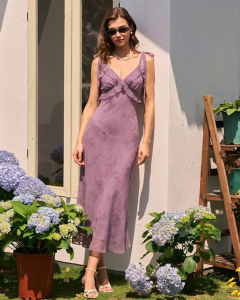
I’m not going to pretend I bought it for any virtuous reason. I’d been on my laptop late one night, going down a YouTube rabbit hole that began with a clip from Le Genou de Claire — Rohmer, 1970, which I rewatch every two or three years and increasingly understand — and ended, as these things do, somewhere I didn’t intend. A brand I’d never seen, a dress I couldn’t stop looking at. Cowl neck, gentle, not theatrical. Bias cut. The kind of drape you usually only get from actual seventies vintage, which has become almost impossible to find in good condition because every twenty-six-year-old stylist in Brooklyn is hoarding it. I clicked. I paid. I forgot about it for ten days, and then it showed up in a slim envelope on a Tuesday afternoon when I was already in a bad mood about something else entirely.
The first thing I noticed was the hand of the fabric. Matte, weighty, faintly textured — not the slippery polyester satin that has flooded the market and that always feels, somehow, like wearing a damp napkin. The straps were thin without being apologetic. The hem hit just below mid-calf, which is the most flattering and least photographed length in womenswear. It looked like something Catherine Deneuve might have thrown on for a lunch at the Hôtel du Cap and then donated to her cleaning woman the following spring.

I wore it twice in the first week.
The first time was a Saturday dinner at the American Hotel in Sag Harbor, with Marin and her husband Peter and a couple I’d met once before whose names I will not invent here because they were forgettable. The bar at the American is one of the few places out east that still feels like a real place — the wine list is too long, the lighting is too dim, the bartender does not pretend to remember you. I had a glass of something Austrian. A woman at the next table — older than me, beautifully grey, wearing a navy linen shirtdress she had clearly owned for fifteen years — looked over at one point and just nodded at me. That’s all. A nod. From one person who is tired of Hamptons performance dressing to another. It was the best review I’ve ever gotten.
The second time was at a barbecue in Montauk, on a deck overlooking nothing in particular, where someone’s dog ate three-quarters of a sourdough loaf while everyone pretended not to notice. A buyer I’d been seated next to — she works for a multi-brand boutique on Bleecker, the kind that stocks Khaite and three brands you’ve never heard of and one that’s about to be everywhere — leaned over halfway through dinner and asked, with that specific buyer’s intensity, where the dress was from. She’d assumed it was vintage. When I told her it was new, from a small label out of Hong Kong, she actually squinted. “The proportions are too good for new,” she said. “New things never get the proportions right.”
She has a point, and it’s a point worth dwelling on. Most contemporary brands that reference seventies silhouettes get the shape and miss the soul. They over-engineer. They add a ruffle, a bow, a contrast piping, as if they don’t trust the cut to carry itself. This dress trusted the cut. The founders, apparently three women in Hong Kong who came up bonding over European art-house cinema — Rohmer, Varda, the looser end of Antonioni — seem to understand something a lot of bigger labels have either forgotten or never knew: that the most romantic thing a dress can do is move well, and the second-most-romantic thing it can do is shut up.
I wore it again, with a denim jacket, to the Hampton Classic the following weekend — an event I find I can now only attend ironically, as a kind of sociological field study. The fascinators were out in force. Several women had clearly committed to outfits at six in the morning that they were regretting by noon, their stilettos sinking inch by inch into the grass. I stood near the rail eating a pretzel that cost nine dollars and felt — for the first time in I genuinely cannot remember how long — that I was wearing the right thing. Not the right thing for the occasion. The right thing for me.
I want to be careful here, because this is the moment in the essay where it would be easy to slip into the rhetoric of “quiet luxury” — a phrase I have come to actively dislike, the way one comes to dislike a song that was fine the first hundred times you heard it. The “quiet luxury” conversation, after Succession, became cover for selling people the same expensive things in beige. There was nothing quiet about $5,000 Loro Piana cashmere. It was simply a different costume, and we all paid for it.
What I’m describing is not that. What I’m describing is closer to the way my mother and her friends dressed in the late seventies, before the industry convinced everyone that effort and elegance were the same thing. A linen shirt you’ve owned for a decade. A skirt you found at a flea market in Saint-Ouen and wore until the lining gave out. A dress you genuinely love because the neckline reminded you of a film, not because an algorithm served it to you between videos of golden retrievers stealing food.
The women I admire most out east — the year-rounders, the ones who stay through the grey February when the IGA in Amagansett is the only thing open and the wind off the Atlantic feels personal — have always dressed this way. They know something the weekenders are slowly figuring out: that performance dressing is exhausting, and that the most enduringly chic thing a person can do is to simply stop performing.
The Sunday before I drove back to the city, I went for a walk on Indian Wells Beach around six in the evening, alone, sandals in my hand. I was wearing the dress, my grandmother’s cardigan, no jewelry but my watch. The light was that particular East End light that makes everyone look fifteen percent better than they actually are. Two women walked past me going the other direction. Neither of them looked at what I was wearing. I don’t think they registered me at all. It was perfect.
I drove back on Monday morning, traffic light, the radio low. The dress went into the back of my closet on West 11th, and it is hanging there now, waiting for next summer. It does not know it changed my mind about anything. It is just a dress. But sometimes, as it turns out, that is enough.
The dress mentioned can be found through Rihoas’s summer edit.
Author

Written by
Recent Posts

Jetsetter Style: Castello del Sole

The First Decision After a Collision Can Be the Most Important One
Two Weeks in Rome and Beyond: Turkish Airlines Itineraries from Boston, Chicago and Onward to India

Top 10 Hair Transplant Clinics in Turkey 2026

Artist Alley to Online Store: How Convention Artists Can Keep Selling After the Event
Categories
- Art
- Articles
- Business of Luxury
- Celebrities
- Culture
- Entertainment
- Events
- Faces of Summer 2026
- Fashion
- Fashion & Style
- Featured
- Finance
- Food, Spirits, Wine
- Hamptons
- Hamptons Celebrities
- Health
- Health & Beauty
- Lifestyle
- Luxury Lifestyle
- Press
- Profiles
- Real Estate
- Technology
- The Chronicles
- Travel
- Uncategorized
- Weddings