
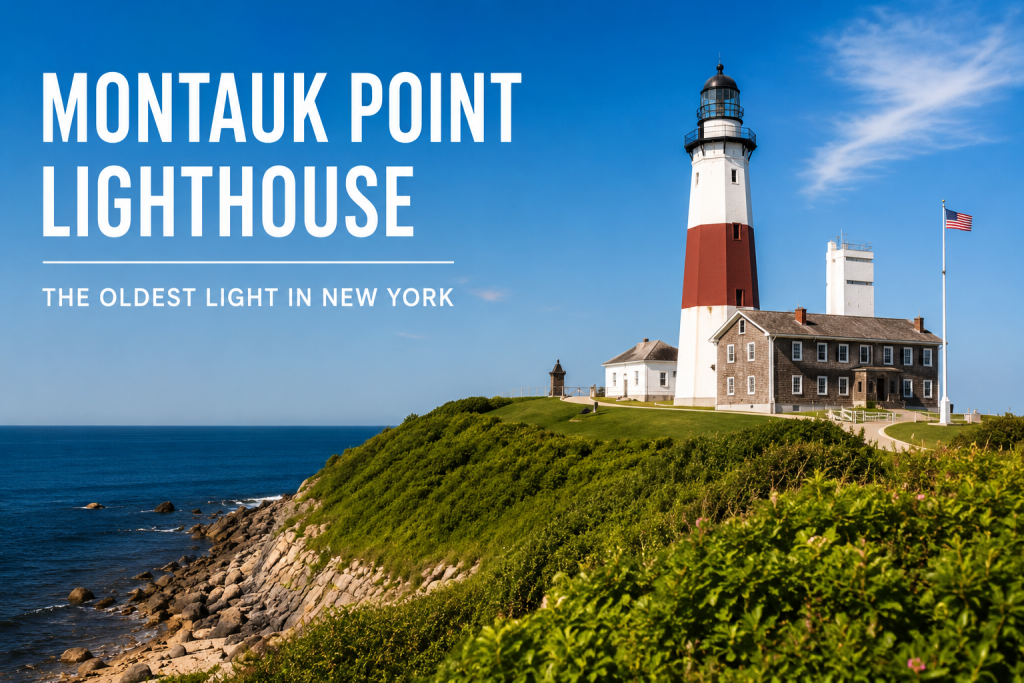
The Montauk Point Lighthouse is the oldest lighthouse in New York State, the fourth oldest in the nation, and arguably the most significant standing structure on the East End. George Washington approved its construction. Thomas Jefferson signed the authorization. The tower was completed in 1796. It has survived 230 years of nor’easters, hurricanes, erosion, and a conspiracy theory that the military base next door was conducting time travel experiments. Through all of it, the beam has continued flashing every five seconds, visible for 19 nautical miles. At Montauk, where nothing is permanent except the landscape, this building has outlasted every institution in every other Hamptons village.
The Commission: Washington, Jefferson, and $22,300
In 1792, the Second Congress authorized a lighthouse at the eastern tip of Long Island. Ships navigating the passage between Block Island Sound and the Atlantic needed a fixed point of reference. After all, wrecks were common. The coastline was treacherous. President Washington approved the appropriation of $22,300 for construction, a sum that covered the tower, a keeper’s dwelling, and the oil to light the lantern.
Construction began in 1795 under the supervision of builder John McComb Jr., who would later design New York’s City Hall. The tower rose 110 feet from a foundation of locally quarried sandstone. By November 1796, the light was operational. Washington reportedly promised the lighthouse would stand for 200 years. Of course, he underestimated it by at least 30 years and counting. The original tower remains structurally sound, although the cliff beneath it has been a different story entirely.
The Erosion Battle: 297 Feet to the Edge
When the lighthouse was completed in 1796, it stood approximately 297 feet from the edge of the bluff. Two centuries of Atlantic storms have reduced that distance considerably. At one point in the late twentieth century, the cliff edge was approaching fast enough that engineers feared the lighthouse might need to be moved or abandoned. Then a textile designer from New York City arrived with an idea involving reeds. She was not an engineer. She saved the lighthouse anyway.
Giorgina Reid developed a terracing technique using reeds and other natural materials to stabilize the bluffs. Beginning in the 1970s, she volunteered her method at the lighthouse, building terraces that slowed erosion dramatically. Her work bought decades of time. Still, the fundamental problem remained. The Atlantic was eating the cliff.
In 2023, the U.S. Army Corps of Engineers completed a $44 million coastal resiliency project at the site. The project installed a stone revetment designed to protect the lighthouse and the surrounding cultural resources for another century. Governor Kathy Hochul attended the reopening ceremony. The Montauk Historical Society, which oversees the lighthouse, celebrated the restoration of both the tower and the keeper’s residence. As a result, visitors today see the lighthouse in better condition than it has been in decades.
What You See from the Top
The view from the top of the Montauk Point Lighthouse is the only place in the Hamptons where you can see three states simultaneously. On clear days, Connecticut is visible to the north across Long Island Sound. Block Island, Rhode Island, sits to the northeast. The full sweep of the Atlantic stretches south and east toward nothing except open water and, eventually, Portugal. To the west, the moorlands of Camp Hero State Park roll away toward the village.
Admission to the museum is $14 for adults, $7 for seniors, and $4 for children. Parking at the state park is $8 per car. The museum operates daily through the summer season. Exhibits cover the lighthouse’s maritime history, the Montaukett people, the military history of Camp Hero, and the erosion battle. A gift shop occupies the ground floor. Climbing the tower requires navigating a narrow iron staircase that is not recommended for visitors with mobility limitations. At the top, the wind hits hard. So does the perspective.
The Lighthouse in History
Before Washington’s lighthouse, the Montaukett people lit signal fires on the bluffs to guide canoes home. In that sense, the lighthouse continues a tradition that predates European settlement by centuries. The point itself has witnessed an extraordinary range of historical events. According to local legend, Captain Kidd buried treasure somewhere nearby in the late 1690s. The slave ship Amistad ultimately came ashore at the point after its famous rebellion. During both World Wars, the military used the lighthouse grounds for coastal observation.
Adjacent to the lighthouse, Camp Hero operated as a WWII coastal defense station and later a Cold War Air Force base. The 126-foot SAGE radar tower, visible from the lighthouse grounds, is the last of its kind in America. Together, the lighthouse and Camp Hero compose a layered historical site that spans from the eighteenth century to the Cold War. In fact, few places on the East Coast compress that much history into such a small footprint.
The Keeper’s Life
For nearly two centuries, lighthouse keepers lived at the point with their families. The keeper’s residence, a modest stone building attached to the tower, housed generations of men who maintained the oil lamp (later electrified), trimmed the wick, cleaned the lens, and kept the light burning through every storm. Indeed, their isolation was real. Before Carl Fisher built roads in the 1920s, the trip from the lighthouse to the nearest settlement took hours by horse. In winter, the keepers and their families were essentially alone at the edge of the continent.
The Coast Guard automated the light in 1987. The Montauk Historical Society took over the property and opened it to the public. Today, the keeper’s residence functions as part of the museum. But the original structure, with its thick stone walls and small windows built to withstand Atlantic gales, still conveys the scale of the commitment. Keeping a light burning at the end of the world is not a metaphor here. It was a job description.
Why the Lighthouse Matters Now
In a village where everything is contested (who was here first, who changed what, who owns the cultural narrative), the lighthouse is the one thing nobody argues about. It was here before the fishing fleet, before Carl Fisher and Andy Warhol. This tower predates the Surf Lodge, Ditch Plains surfing culture, $17 million real estate records, and $98 lobster cobb salads. In short, it predates every narrative about Montauk except the Montaukett narrative, which predates everything.
The lighthouse also functions as a geographic truth. Certainly, you can debate whether Montauk is part of the Hamptons or separate from them. You can debate whether it is a surf town, a fishing village, or a celebrity retreat. But you cannot debate where it is. The lighthouse marks the spot. Land ends here. Water begins. The beam flashes every five seconds, and it will continue flashing after every other debate has been resolved or forgotten.
Where the Conversation Continues
Social Life Magazine has covered the East End for 23 years. The lighthouse has been here for 230. We are catching up.
For brands and tastemakers: explore our paid features program.
Polo Hamptons 2026 returns July 18 and 25 at 900 Lumber Lane in Bridgehampton, with BMW North America as title sponsor and Christie Brinkley as host. Details at polohamptons.com.
Subscribe: sociallifemagazine.com/subscription.
The beam flashes every five seconds. It has not missed one since 1796.
Author

Written by
Recent Posts

5 Mindful Wellness Trends Redefining Modern Self-Care This Season

What to Look for in a Hairdresser on the Gold Coast

hiTechMODA Season 16
How to Keep Your Personal Number Private When Booking Events, Rentals and Services
Understanding Compensatory Damages in a Personal Injury Case
Categories
- Art
- Articles
- Business of Luxury
- Celebrities
- Culture
- Entertainment
- Events
- Faces of Summer 2026
- Fashion
- Fashion & Style
- Featured
- Finance
- Food, Spirits, Wine
- Hamptons
- Hamptons Celebrities
- Health
- Health & Beauty
- Lifestyle
- Luxury Lifestyle
- Press
- Profiles
- Real Estate
- Technology
- The Chronicles
- Travel
- Uncategorized
- Weddings