
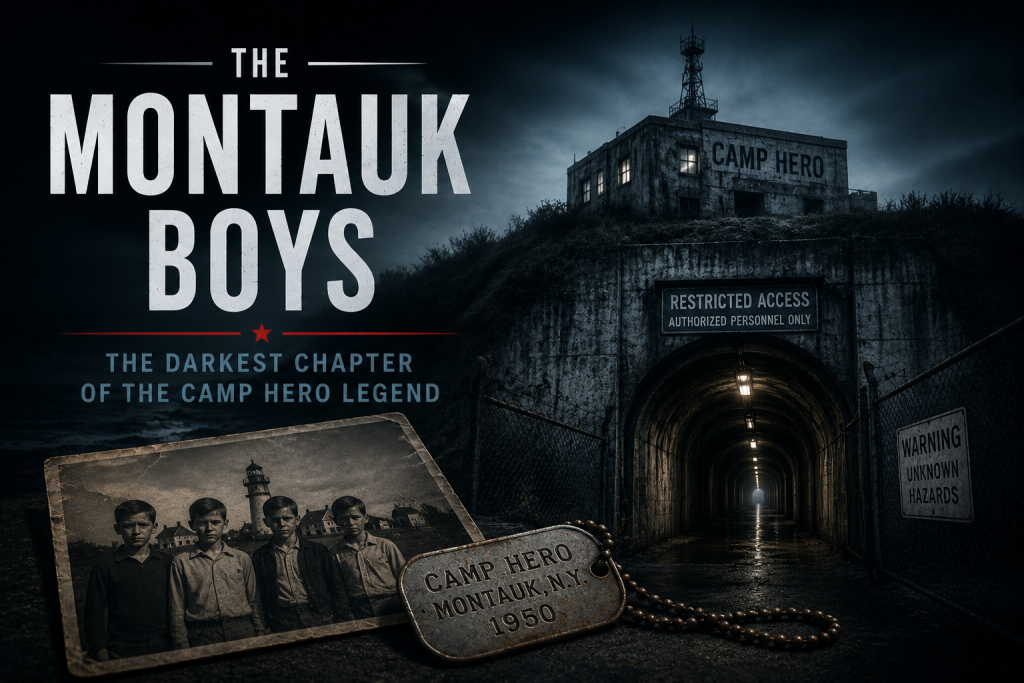
The Children at the Center of the Conspiracy
Of all the claims made about the Montauk Project, none is more disturbing than the allegation that children were used as test subjects. According to Preston Nichols, the self-described electronics engineer who published The Montauk Project: Experiments in Time in 1992, children from surrounding Long Island communities were abducted and brought to underground laboratories beneath Camp Hero. There, they were allegedly subjected to electromagnetic frequency experiments designed to activate psychic abilities. These children became known as the Montauk Boys.
Yet no credible evidence has ever substantiated the Montauk Boys claim. Not a single abduction was reported to local police. No parents came forward, and no child was ever identified by name in any independently verifiable source. Nichols himself acknowledged that the memories were “recovered” after years of alleged suppression. The recovery process involved techniques whose reliability is disputed by mainstream psychology.
Yet the Montauk Boys narrative has proven to be the single most influential element of the conspiracy. It is the element that the Duffer Brothers adapted most directly into Stranger Things. In fact, Eleven is, structurally and narratively, a Montauk Boy. Her origin story is the Montauk Boys allegation rewritten for a streaming audience. And the emotional power of that story, a child weaponized by a government that views her as an asset rather than a human being, is the reason Stranger Things became the cultural phenomenon it did.
What Nichols Claimed
According to Nichols’ account, the Montauk Boys program operated within the broader Montauk Project during the late 1970s and early 1980s. Specifically, children were selected based on unspecified criteria related to psychic potential. They were allegedly brought to Camp Hero through methods that Nichols described vaguely, sometimes suggesting kidnapping and other times implying that the children were recruited through intermediaries who posed as youth program leaders or counselors.
After arriving inside the underground facility, the children were reportedly subjected to a process Nichols called “programming.” This involved exposing them to electromagnetic frequencies generated by the modified AN/FPS-35 radar tower. Nichols claimed the tower had been repurposed to operate at 410-420 MHz for psychotronic purposes. The frequencies allegedly altered the children’s neural pathways, activating latent psychic abilities including telepathy, remote viewing, and in rare cases, the ability to manipulate physical matter with their minds.
Of these subjects, the most talented, according to Nichols, was a young man named Duncan Cameron. Nichols described Cameron as possessing extraordinary psychic potential that the program’s scientists had never encountered before. Cameron allegedly became the program’s primary asset, capable of opening portals to other dimensions through concentrated mental focus. It was Cameron’s abilities, pushed beyond safe limits during a critical experiment, that supposedly caused the catastrophic event that ended the project.
Duncan Cameron: The Psychic at the Center
Duncan Cameron occupies a unique position in the Montauk mythology. He is simultaneously the conspiracy’s protagonist, its most tragic figure, and its least verifiable element. Nichols described Cameron as a young man brought into the program through his father. That father had allegedly worked on the Philadelphia Experiment in 1943. This family connection, if true, would make Cameron a second-generation participant in government electromagnetic research spanning four decades.
According to the narrative, Eventually, Cameron’s abilities exceeded what the program’s scientists could safely control. In the climactic experiment, Cameron was placed in the “Montauk Chair,” a device allegedly derived from technology recovered from an alien spacecraft. The chair amplified Cameron’s psychic abilities to the point where his thoughts became physically manifest. Instead of opening a controlled portal, Cameron’s subconscious produced a creature, a beast from his own nightmares that materialized inside the underground laboratory.
As a result, the creature reportedly caused significant destruction before it was contained. In the aftermath, the decision was made to shut down the entire project. The underground levels were flooded with cement. All participants, including Cameron, had their memories erased using the same electromagnetic technology that had powered the experiments. Cameron, according to Nichols, eventually recovered fragments of his memories and became a reluctant collaborator in documenting the project’s history.
In fact, a man identifying himself as Duncan Cameron has appeared at conspiracy conferences and in documentary films about the Montauk Project. Still, his accounts have been inconsistent across appearances, and no independent verification of his identity or his alleged participation in any government program has been established. Whether the Duncan Cameron who appears publicly is the same person Nichols described in his book remains an open question within the conspiracy community itself. Nobody has resolved it. Nobody may ever resolve it.
The MKUltra Precedent
The Montauk Boys claim would be easier to dismiss outright if not for MKUltra. The CIA’s documented mind control program, which ran from approximately 1953 to 1973, established a verified precedent for exactly the kind of abuse the Montauk conspiracy describes. Declassified documents confirm that MKUltra tested drugs, hypnosis, and electroshock therapy on unwitting subjects. Some of those subjects were children.
At McGill University in Montreal, Dr. Donald Ewen Cameron conducted experiments that effectively erased patients’ memories using a combination of drugs, electroshock, and sensory deprivation. His subjects included minors. The experiments were funded by the CIA through front organizations. When the program was exposed in the 1970s, most of the operational files had already been destroyed on the orders of CIA Director Richard Helms. The surviving budget documents revealed the program’s scope but not its full operational details.
In addition, the Stargate Project (1978-1995) demonstrated that the government maintained interest in psychic research well into the era when the Montauk Project allegedly operated. For 17 years, the CIA paid professional psychics to conduct remote viewing sessions at Fort Meade, Maryland. That program was declassified in 1995.
Together, MKUltra’s documented abuse of children and Stargate’s documented investment in psychic research create a factual framework within which the Montauk Boys allegation becomes less implausible than it would otherwise seem. After all, the government did experiment on children. It did fund psychic research. And the Montauk Boys narrative simply extends both documented programs into a single, more extreme claim set at a specific location on the East End.
How the Duffer Brothers Used It
In fact, the adaptation of the Montauk Boys narrative into Stranger Things is the most commercially significant act of conspiracy-to-entertainment translation in television history. The structural parallels are exact. Children abducted and brought to a government facility in the mythology become Eleven, born into captivity at Hawkins National Laboratory. Electromagnetic experiments that develop psychic abilities become sensory deprivation and conditioning. And the program’s most gifted subject who opens a portal to another dimension becomes Eleven opening the gate to the Upside Down.
Even the naming convention mirrors the conspiracy. The Montauk Boys were never given individual identities in Nichols’ account. They were referred to by numbers or by their function within the program. Eleven is identified only by a number tattooed on her wrist. She has no birth name until Season 2, when she learns her mother called her Jane. For the first season, she is simply a number, a designation, an asset. This is precisely how the Montauk Boys were described.
In fact, the emotional core of Stranger Things derives almost entirely from this adaptation. In particular, Eleven’s struggle to become a person rather than a weapon, to have a name rather than a number, to form genuine human connections after a childhood defined by exploitation is the Montauk Boys narrative refracted through the lens of 1980s Spielberg warmth. The Duffer Brothers took the conspiracy’s darkest element and made it the show’s most human story.
The Unresolved Question
The Montauk Boys allegation sits in a category that defies simple classification. This claim is not documented history, like MKUltra. Nor is it a declassified program, like the Stargate Project. And it is not a physical anomaly, like the Montauk Monster. It is an unverified claim made by a single source, supported by no independent evidence, about events that allegedly took place in sealed underground laboratories that have never been independently inspected.
And yet. Indeed, the documented history of government programs involving children and psychic research makes outright dismissal intellectually uncomfortable. The fact that Operation Paperclip brought Nazi scientists to Long Island, that MKUltra experimented on children, that the CIA destroyed its own files, and that Camp Hero’s underground infrastructure has never been publicly surveyed creates a context in which even the most extreme allegations find soil to grow in.
The Montauk Boys may never be proven or disproven. Underground levels are sealed. Files, if they ever existed, are gone. And the participants, if they were real, had their memories erased (according to the only source who claims to know). Yet what remains is a story powerful enough to launch a billion-dollar franchise and a question uncomfortable enough to keep people searching for answers at a state park at the end of Long Island.
Where the Conversation Continues
The Montauk Boys narrative is the darkest chapter of the Montauk Dossier and the emotional engine of Stranger Things. Social Life Magazine has covered the East End for 23 years. The stories that define the South Fork land here first.
If you have a story, a brand, or a project that belongs in these pages, reach out at sociallifemagazine.com/contact.
For brands looking for premium editorial placement, our paid feature submission portal is open at sociallifemagazine.com/submit-a-paid-feature/.
Stay in the loop with our weekly email blast covering events, openings, and who’s doing what Out East. Sign up at enflyer.sociallifemagazine.com.
Polo Hamptons 2026 returns to Bridgehampton on July 18 and July 25 with BMW as title sponsor. For event details and sponsorship opportunities, visit polohamptons.com.
Never miss a feature, a profile, or a party recap. Subscribe to Social Life Magazine at sociallifemagazine.com/subscription.
If the work we do matters to you, you can support independent East End journalism directly via PayPal.
Author

Written by
Recent Posts

hiTechMODA Season 16
How to Keep Your Personal Number Private When Booking Events, Rentals and Services
Understanding Compensatory Damages in a Personal Injury Case

When Online Family Therapy Makes Sense for Modern Families

Carrier Oils, Essential Oils, and Oil Blends: What Beauty Brands Need to Know
Categories
- Art
- Articles
- Business of Luxury
- Celebrities
- Culture
- Entertainment
- Events
- Faces of Summer 2026
- Fashion
- Fashion & Style
- Featured
- Finance
- Food, Spirits, Wine
- Hamptons
- Hamptons Celebrities
- Health
- Health & Beauty
- Lifestyle
- Luxury Lifestyle
- Press
- Profiles
- Real Estate
- Technology
- The Chronicles
- Travel
- Uncategorized
- Weddings