
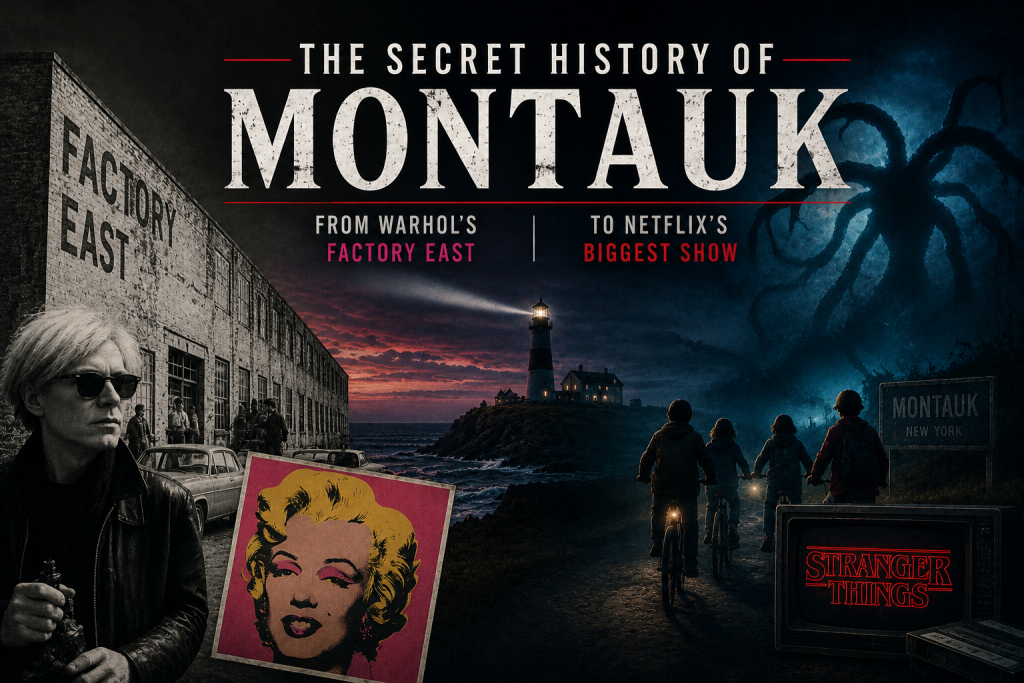
Before the Conspiracy, Before the Show, Before the Monster
Of course, the temptation when writing about Montauk is to start with the conspiracy. Or with Stranger Things. Or with the creature that washed ashore at Ditch Plains in 2008. These are the stories that generate search traffic and drive visitors to the end of the road. But they are not where the story begins. The story begins with a fishing village at the tip of a peninsula that has been accumulating cultural density for over three centuries, layer upon layer, each one making the next one possible, until the place became so narratively saturated that a self-published book about underground experiments could seem, to millions of people, almost plausible.
The secret history of Montauk is not the conspiracy. It is the sequence of events that made the conspiracy possible. It starts with the military installations that normalized government secrecy in the community. And the celebrity visitors who proved that famous people came here to disappear. Or the real estate trajectory that turned a $225,000 fishing compound into an $85 million cultural landmark. And it is the geographic fact of a peninsula that ends in a lighthouse commissioned by George Washington, where the land runs out and the Atlantic begins and there is, quite literally, nowhere left to go.
This is the complete cultural history of Montauk, from the quarantine camps of the Spanish-American War to the Montauk Dossier you are reading now.
The Military Foundation
Montauk’s relationship with the U.S. military predates every other element of its modern identity. In 1898, during the Spanish-American War, thousands of American soldiers returning from Cuba were quarantined at Montauk because of malaria and yellow fever outbreaks. Camp Wikoff, as the quarantine site was known, housed approximately 30,000 troops at its peak. Theodore Roosevelt and his Rough Riders passed through the camp. Soldiers died there. The remote location at the tip of Long Island, the same quality that would later attract Andy Warhol and the Rolling Stones, was chosen precisely because it kept sick troops as far from population centers as geography allowed.
The full military history of Montauk spans four distinct eras: the Spanish-American War quarantine, the World War II coastal defense installation (when the base was disguised as a fishing village to avoid aerial detection), the Cold War radar surveillance program (which produced the AN/FPS-35 tower that now defines Camp Hero‘s silhouette), and the post-decommissioning period that began in 1981 and continues today. Each era left behind infrastructure, questions, and a community accustomed to government secrecy. By the time Preston Nichols published his book in 1992, Montauk had been hosting classified operations for nearly a century. The town didn’t ask questions about the military base because the military base had been there longer than most of the town’s residents.
The Warhol Era
In 1972, Andy Warhol and Paul Morrissey purchased Eothen, a five-cottage compound on 20 acres of oceanfront cliff, for $225,000. In fact, the purchase marked the beginning of Montauk’s transformation from military outpost to cultural destination. Notably, Warhol didn’t come for the surfing or the restaurants (there were almost no restaurants). He came, according to his friend and realtor Tina Fredericks, because he was attracted to the eccentric architecture of the nearby Memory and Ronjo Motels. The oddness of the built environment registered before the beauty of the natural one. This tells you something essential about how Warhol’s aesthetic apparatus worked, and it tells you something about Montauk, which has always rewarded people who notice what’s strange before they notice what’s pretty.
Eothen became the stage for a social experiment that Warhol had been refining at the Factory but could execute with more precision in Montauk’s isolation. Put extraordinary people in close proximity. Remove the option of leaving (the drive back to Manhattan was three hours minimum). Observe what happens. Indeed, the guest list that resulted reads like an index of late-twentieth-century American fame.
Jackie and Lee
In the summer of 1972, Jackie Kennedy Onassis spent several weeks at Eothen with her children, Caroline and John Jr. Her sister, Lee Radziwill, had rented the main house from Warhol. Jackie was, at that point, the most photographed woman in America. Yet she spent weeks in Montauk without a single paparazzi photograph being taken. The cultural surveillance apparatus that made her Manhattan life a perpetual performance simply hadn’t reached that far east. Montauk offered her something close to freedom. For a woman who had been a symbol since November 22, 1963, that was worth more than the ocean view.
Jonas Mekas, the Lithuanian-born filmmaker, documented the summer with his camera. His footage surfaced publicly in the 2017 documentary That Summer. The film captures Jackie and her children in casual, unguarded moments at the compound. It is, as far as anyone knows, the only intimate footage of the Kennedy children at Eothen, shot two miles from a classified military installation that was still operational at the time.
The Rolling Stones
Three years later, in the summer of 1975, the Rolling Stones rented the main house at Eothen to rehearse for their upcoming tour, the first with Ronnie Wood replacing Mick Taylor. Charlie Watts, Mick Jagger, Keith Richards, Wood, Bill Wyman, and Billy Preston occupied the property for several weeks. Photographer Ken Regan documented the sessions. Groupies filled the local motels. Two bald women with black cats on leashes followed the band from the city and stood at the edge of the compound. The estate’s caretaker, Mr. Winters, found fans hiding in the bushes.
The Memory Motel, a bar on Old Montauk Highway, became the Stones’ after-hours hangout. Jagger and Richards reportedly wrote the track “Memory Motel” during or shortly after their Montauk residency. The bar is still open. The jukebox still works. And the song remains one of the most autobiographically specific tracks in the Rolling Stones catalog: a postcard from a specific place and time, when the biggest band in the world chose the end of Long Island to get their sound right.
The Real Estate Transformation
Montauk’s real estate trajectory tracks the broader transformation of the town from working village to luxury destination. Warhol’s $225,000 purchase in 1972 was considered eccentric at the time. The compound is now valued at approximately $85 million. The broader market has followed: median home prices reached approximately $1.9 million in early 2026, up roughly 13.6% year over year.
In fact, the escalation occurred in waves. First, the military era put Montauk on the map. Then the Warhol era established its cultural credentials. And the hospitality boom of the 2000s and 2010s (Gurney’s, the Surf Lodge, Duryea’s) commercialized the destination. And the Stranger Things era, which began in 2016 and continues through the spinoffs currently in production, provided name recognition on a global scale. Inevitably, each wave increased demand. Each increase in demand raised prices. And each price increase attracted a new stratum of buyer who, in turn, accelerated the transformation of the built environment from working infrastructure to amenity infrastructure.
As a result, the conspiracy mythology is, in real estate terms, a permanent amenity. Camp Hero‘s 755 acres will never be developed. The park’s conservation status guarantees ocean views, hiking trails, and a radar tower for adjacent property owners in perpetuity. The Montauk Monster, the Montauk Project, and the Netflix franchise collectively generate cultural attention that no marketing budget could replicate. And cultural attention, in a luxury real estate market, is indistinguishable from value.
The Conspiracy Layer
The Montauk Project conspiracy did not emerge from thin air. It emerged from a landscape already saturated with military secrecy, celebrity mythology, and geographic isolation. Preston Nichols published his book in 1992, 11 years after Camp Hero was decommissioned, at a moment when the Cold War had ended and military bases across the country were being transferred to civilian use. Sealed buildings at Camp Hero were visible from Route 27. The radar tower loomed over the park. And nobody explained what had happened inside the fences. Nichols walked into that vacuum with a story that explained everything.
Ultimately, whether his story was true is, at this point, almost beside the point. The Montauk Project mythology has been absorbed into the town’s identity. Camp Hero is now simultaneously a state park and a conspiracy tourism destination. Ditch Plains is simultaneously a surf break and the beach where the Monster washed ashore. Eothen is simultaneously a celebrity compound and the property that sat two miles from alleged government experiments. In Montauk, every location operates on at least two frequencies. The secret history is the story of how those frequencies accumulated over 130 years until the signal became too dense for the rest of the world to ignore.
Secret History of Montauk
What makes the secret history of Montauk unusual is not any single element. Military bases exist across the country. Celebrity compounds exist across the Hamptons. Conspiracy theories exist across the internet. Real estate booms exist across every desirable coastline. What makes Montauk unusual is the density. All of these elements occupy the same geographic space: a peninsula roughly eight miles long and two miles wide, terminating at a lighthouse that George Washington commissioned and a radar tower that the conspiracy community believes was used to control minds. The density creates narrative gravity. Stories accumulate. Each new layer draws from and reinforces the ones beneath it. The military history made the conspiracy plausible. The conspiracy made the Netflix franchise possible. The franchise made the real estate premium global. And the real estate premium attracted the kind of visitor who wants to understand why this particular strip of coastline costs what it costs, which brings them back to the military history, which brings them back to the conspiracy, which brings them back to the show.
The cycle is self-reinforcing. It has been self-reinforcing since 1898, when the first quarantine camp established Montauk as a place where the government sent people who needed to be separated from the rest of the world. One hundred and twenty-eight years later, the separation is still the selling point. It is just that the price has changed. And the reasons people come to the end of the road, while more various than they were in 1898, all share a common quality: the sense that Montauk contains something that exists nowhere else. That sense is correct. What it contains is layers. And the Montauk Dossier is the map of those layers.
Where the Conversation Continues
The secret history of Montauk runs from the quarantine camps of 1898 to the Netflix franchise of 2026. Social Life Magazine has covered this territory for 23 years. Five summer issues from Memorial Day through Labor Day. The stories that define the South Fork land here first.
If you have a story, a brand, or a project that belongs in these pages, reach out at sociallifemagazine.com/contact.
For brands looking for premium editorial placement, our paid feature submission portal is open at sociallifemagazine.com/submit-a-paid-feature/.
Stay in the loop with our weekly email blast covering events, openings, and who’s doing what Out East. Sign up at enflyer.sociallifemagazine.com.
Polo Hamptons 2026 returns to Bridgehampton on July 18 and July 25 with BMW as title sponsor. For event details and sponsorship opportunities, visit polohamptons.com.
Never miss a feature, a profile, or a party recap. Subscribe to Social Life Magazine at sociallifemagazine.com/subscription.
If the work we do matters to you, you can support independent East End journalism directly via PayPal.
Author
Written by
Recent Posts
How to Measure Whether a Hair Loss Treatment Is Working
Is Online Psychiatry Covered by Insurance? What to Know Before Booking
Four Habits of Quietly Successful Entrepreneurs

The Most Common Preventable Health Concerns Doctors See Today
What Affects a Rideshare Injury Settlement?
Categories
- Art
- Articles
- Business of Luxury
- Celebrities
- Culture
- Entertainment
- Events
- Faces of Summer 2026
- Fashion
- Fashion & Style
- Featured
- Finance
- Food, Spirits, Wine
- Hamptons
- Hamptons Celebrities
- Health
- Health & Beauty
- Lifestyle
- Luxury Lifestyle
- Press
- Profiles
- Real Estate
- Technology
- The Chronicles
- Travel
- Uncategorized
- Weddings