
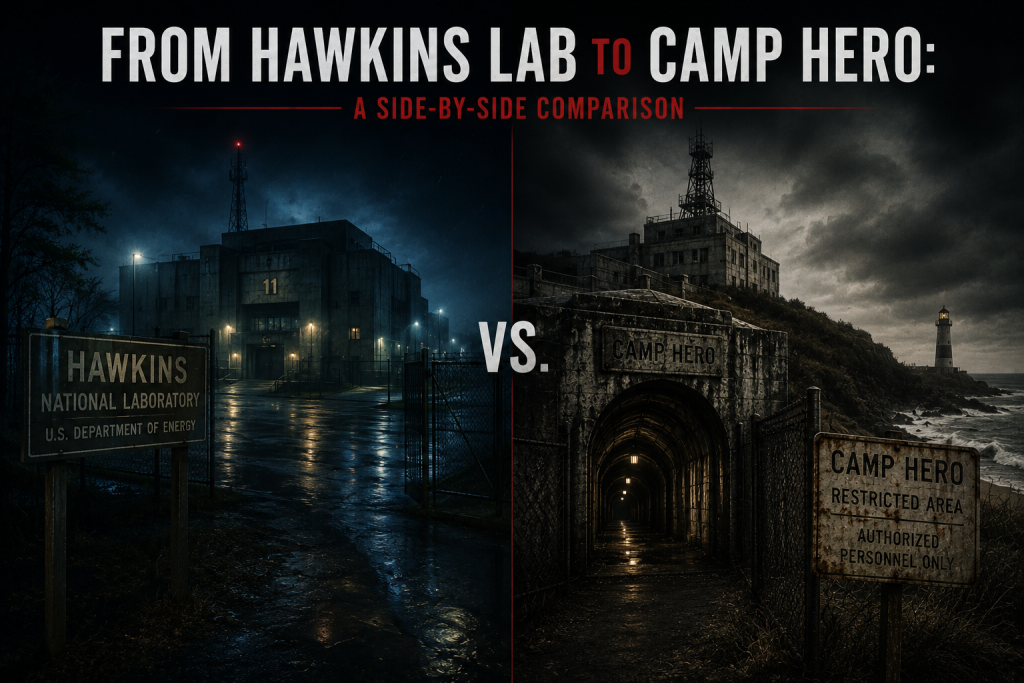
A Side-by-Side Comparison That Stops Being Comfortable
There is a particular kind of unease that settles in when you place Hawkins Lab and Camp Hero next to each other and start comparing features. Not because the similarities are surprising (they’re not, if you’ve been paying attention) but because the precision of the overlap suggests something more deliberate than creative borrowing. The Duffer Brothers didn’t just take inspiration from the Montauk Project conspiracy. They mapped it. Specifically, they studied its architecture, its personnel structure, its operational logic, and its failure mode. Then they rebuilt it in fictional Indiana with enough cosmetic changes to avoid a lawsuit and not one change more.
What follows is a structural comparison between Hawkins National Laboratory, the fictional government facility in Stranger Things, and Camp Hero, the very real decommissioned Air Force station at the eastern tip of Montauk that inspired the conspiracy the show is built on. Indeed, the parallels are organized by category. By the time you reach the end, the question will have shifted from “Did the Duffers borrow from the Montauk mythology?” (yes, obviously, they’ve said so publicly) to “Is there a single structural element of Hawkins Lab that doesn’t have a direct counterpart at Camp Hero?” The answer, as far as anyone has been able to determine, is no.
Location and Community Relationship
Camp Hero sits on 755 acres at Montauk Point, the easternmost tip of the South Fork of Long Island. Specifically, during its operational years (World War II through 1981), the base existed at the edge of a small, relatively isolated community. At that time, Montauk was a fishing village, not the luxury destination it has since become. The base was the town’s largest employer and its most prominent physical feature, yet most residents had only a vague understanding of what happened inside the fenced perimeter. Its military operators didn’t explain. The town didn’t ask. This arrangement was, by all accounts, considered normal.
Hawkins Lab occupies a similar position in the fictional geography of Hawkins, Indiana. It sits on the outskirts of a small, relatively isolated Midwestern town. The facility is the community’s open secret: everyone knows it exists, nobody knows what happens inside, and the social contract dictates that asking too many questions is both impolite and potentially dangerous. It employs local residents in support roles (security, maintenance, administration) who understand their jobs require not understanding their employer.
Still, the relationship between facility and community is, in both cases, defined by a particular kind of willful ignorance that is more interesting than it initially appears. It is not that the residents of Montauk (or Hawkins) were incurious. It is that the presence of a classified government facility had been normalized to the point where curiosity itself felt inappropriate, the way asking someone’s salary at a dinner party feels inappropriate. Crucially, the secrecy wasn’t enforced through threats. It was enforced through social convention. Which, if you think about it, is considerably more effective.
Physical Architecture
Without question, Camp Hero’s most distinctive physical feature is the AN/FPS-35 radar tower, a structure standing roughly 90 feet tall with a 40-foot steel dish that is the last of its kind in America and is now a National Historic Landmark. The tower dominates the landscape. It is visible from every trail in the state park. In fact, it is impossible to visit Camp Hero without confronting it, which is presumably why it has become the de facto symbol of the Montauk Project conspiracy despite having no confirmed connection to any classified program beyond standard Cold War radar surveillance.
By contrast, Hawkins Lab doesn’t have a radar tower (the Duffers opted for a more generic institutional aesthetic), but it shares Camp Hero’s fundamental architectural logic: a visible surface structure concealing an invisible underground facility. At Camp Hero, for instance, the above-ground buildings (barracks, mess hall, bowling alley) are mundane military infrastructure. In fact, the conspiracy happens below. Similarly, at Hawkins Lab, the above-ground building is a nondescript government office. The experiments happen in the basement levels. In both cases, the architecture is designed to bore the casual observer into looking away.
The Underground Levels
According to Preston Nichols, Camp Hero’s underground facilities extended as many as 12 levels beneath the radar tower. These levels allegedly housed laboratories, living quarters for researchers, holding areas for test subjects, and the equipment used to generate the electromagnetic frequencies that powered the experiments. The underground tunnels were supposedly sealed with cement after the project was shut down.
Similarly, Hawkins Lab features an extensive underground facility that grows deeper and more dangerous with each season of the show. The gate to the Upside Down opens in the lowest level. Its corridors are institutional, fluorescent-lit, and increasingly labyrinthine as characters descend. Indeed, the vertical architecture (surface normality concealing underground horror) is borrowed directly from the Montauk mythology, and the Duffers have never pretended otherwise.
The Experiments
The Montauk Project conspiracy describes a program that combined electromagnetic frequency manipulation with human experimentation. The AN/FPS-35 radar array was allegedly modified to operate at 410-420 MHz, frequencies that Nichols claimed could directly influence human consciousness. Test subjects (the Montauk Boys) were exposed to these frequencies in controlled settings. The goal was to develop psychic abilities: telepathy, remote viewing, and eventually the ability to open portals to other dimensions.
At Hawkins Lab, Dr. Martin Brenner conducts experiments on children with psychic potential, using sensory deprivation tanks, electromagnetic equipment, and conditioning techniques derived from MKUltra (which the show references by name). The goal is identical: develop psychic abilities that can be weaponized for intelligence purposes. Of course, the methods differ in surface detail (sensory deprivation tanks versus radar arrays) but share the same operational logic: isolate the subject, manipulate the environment, amplify the ability, weaponize the result.
In fact, there is something almost taxonomic about the way the parallels accumulate. Indeed, each element of the Montauk conspiracy maps onto a corresponding element of the show. Not approximately. Precisely. As if the Duffers had created a spreadsheet with two columns (Montauk / Hawkins) and systematically ensured that every row had an entry in both.
The Test Subjects
The Montauk Boys were, according to Nichols, children selected for psychic potential and subjected to electromagnetic programming in Camp Hero’s underground facilities. They were identified by function rather than name. They had no agency, no advocates, and no apparent legal protections. When the project ended, their memories were allegedly erased. They were, in the terminology of the conspiracy, assets rather than persons.
Eleven is a Montauk Boy. Her gender changed. Her number changed. The location changed. But the structural identity is the same: a child raised in captivity, identified by a designation rather than a name, subjected to experiments that develop abilities the child did not choose to develop, used as a weapon by people who view the child’s humanity as, at best, an inconvenience and, at worst, a liability. In fact, the emotional power of Stranger Things derives almost entirely from this premise. And the premise is Preston Nichols‘.
The Catastrophic Event
In the Montauk mythology, the project ends when Duncan Cameron, the program’s most gifted psychic subject, loses control during a critical experiment. His subconscious materializes a creature inside the underground laboratory. The creature causes destruction. The facility is sealed. Everyone’s memories are erased. The project is over.
In Stranger Things, Eleven opens the gate to the Upside Down during a sensory deprivation experiment. The Demogorgon enters the physical world through the gate. Hawkins Lab loses control of the situation. The facility is eventually compromised. Officials cover up the incident. And the narrative arc is structurally identical: a gifted subject pushed beyond safe limits accidentally opens a door that should have stayed closed, and something comes through.
Even the emotional register of the catastrophic event is the same. In both versions, the disaster is not caused by malice but by ambition. The scientists didn’t intend to summon a creature. They intended to push the boundaries of human capability. Instead, the horror emerges from the gap between intention and result, between what the experiment was supposed to do and what it actually did. This is, incidentally, the same emotional register that defines the real history of MKUltra. The CIA didn’t intend to destroy Frank Olson’s mind with LSD. They intended to develop interrogation techniques. The destruction was a side effect of ambition applied without ethical constraint. Which is exactly what happens at both Camp Hero and Hawkins Lab.
The Cover-Up
At Camp Hero, the cover-up is total. According to the Montauk mythology, the underground levels were flooded with cement. Participants had their memories erased. The military then transferred the property to New York State, which opened it as a park. Yet the sealed buildings and “Do Not Enter” signs remain. Yet no engineering survey of the underground infrastructure has been published. The official position is that nothing happened.
At Hawkins Lab, the cover-up follows the same pattern. The government denies the existence of the Upside Down. Witnesses are silenced. Records are destroyed. Eventually, the laboratory is shut down. The community is told a cover story (a chemical leak in Season 1, an earthquake in Season 4). In both cases, the mechanism of denial is identical: not active suppression but institutional erasure, the conversion of an event into a non-event through the simple refusal to acknowledge that it occurred.
This mechanism, it is worth noting, is also how MKUltra was actually covered up. CIA Director Richard Helms ordered the destruction of all program files in 1973. If not for 20,000 misfiled budget documents discovered through a FOIA request in 1977, the program might never have been publicly confirmed. In other words, the cover-up in Stranger Things isn’t fiction borrowing from conspiracy. It is fiction borrowing from documented fact.
What the Comparison Reveals
The exercise of comparing Hawkins Lab and Camp Hero feature by feature ultimately reveals something about the nature of the show’s creative process that goes beyond the usual “inspired by” acknowledgment. The Duffer Brothers didn’t simply take a vibe from the Montauk mythology. They conducted what appears to be a systematic adaptation of the conspiracy’s architecture, translating each structural element into its fictional equivalent with a precision that suggests deep familiarity with the source material.
Ultimately, this matters because it means Stranger Things is not merely a show about a small town with a secret. It is a show about a specific conspiracy theory, set in a specific location, involving specific claims about specific government programs. The Indiana setting and the Spielberg tone are cosmetic layers applied over a narrative infrastructure that is, at every level, pure Montauk. And that infrastructure connects, through MKUltra and the Stargate Project and the Philadelphia Experiment, to documented history.
As a result, visitors to Camp Hero State Park who have watched Stranger Things will experience a particular kind of vertigo. The sealed buildings look like the show’s sets. Its radar tower looks like it belongs in Hawkins. The “Do Not Enter” signs feel like props. But they’re not props. They’re real. And the question of what’s behind them remains, as of this writing, unanswered.
Where the Conversation Continues
Hawkins Lab is fiction. Camp Hero is not. Social Life Magazine has covered the space between the two for 23 years. Five summer issues from Memorial Day through Labor Day. The stories that matter Out East land here first.
If you have a story, a brand, or a project that belongs in these pages, reach out at sociallifemagazine.com/contact.
For brands looking for premium editorial placement, our paid feature submission portal is open at sociallifemagazine.com/submit-a-paid-feature/.
Stay in the loop with our weekly email blast covering events, openings, and who’s doing what Out East. Sign up at enflyer.sociallifemagazine.com.
Polo Hamptons 2026 returns to Bridgehampton on July 18 and July 25 with BMW as title sponsor. For event details and sponsorship opportunities, visit polohamptons.com.
Never miss a feature, a profile, or a party recap. Subscribe to Social Life Magazine at sociallifemagazine.com/subscription.
If the work we do matters to you, you can support independent East End journalism directly via PayPal.
Author

Written by
Recent Posts

The First Decision After a Collision Can Be the Most Important One
Two Weeks in Rome and Beyond: Turkish Airlines Itineraries from Boston, Chicago and Onward to India
Top 10 Hair Transplant Clinics in Turkey 2026

Artist Alley to Online Store: How Convention Artists Can Keep Selling After the Event
When an 18-Wheeler Crash Leaves Lasting Consequences
Categories
- Art
- Articles
- Business of Luxury
- Celebrities
- Culture
- Entertainment
- Events
- Faces of Summer 2026
- Fashion
- Fashion & Style
- Featured
- Finance
- Food, Spirits, Wine
- Hamptons
- Hamptons Celebrities
- Health
- Health & Beauty
- Lifestyle
- Luxury Lifestyle
- Press
- Profiles
- Real Estate
- Technology
- The Chronicles
- Travel
- Uncategorized
- Weddings