
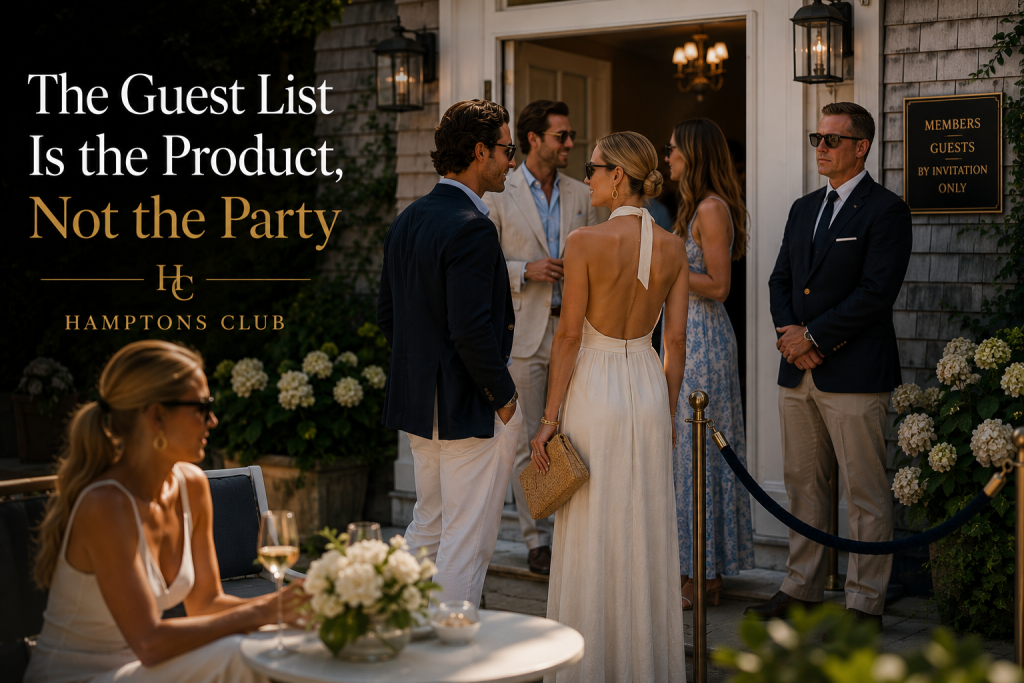
Two brands spent the same money in the Hamptons last August. One bought a banner over a tent and a thousand cocktails for whoever wandered in. The other bought a single seat at a thirty-person dinner. By Labor Day, only one of them had a deal, a magazine cover, and a standing invitation. The seat won, because the guest list was the real prize, and it was not close.
This is the thing the banner brand never understood. At a real event the guest list is the product, and the party is only the delivery truck. People do not come for the band or the passed tuna. They come for the other people, because the other people are the value, and the value is who else said yes.
So the question for any brand is not how many faces will see the logo. The question is whose face will be standing next to it. That single shift, from reach to adjacency, is the difference between money spent and money placed.
Out here the guest list runs the whole economy of an evening. Master that one idea and the rest of the season gets cheaper and sharper at the same time. Miss it and you will keep buying tents nobody remembers by Monday.
You’re Not Buying Eyeballs, You’re Buying Adjacency
Reach is a number anyone can buy. Adjacency is a position only a few can earn. So a brand at the right table borrows the standing of everyone at it, while a brand on a banner borrows nothing at all.
Think about how taste actually travels. It does not move through impressions. It moves through proximity, since the room decides a brand is serious the moment it sees serious people near it. Because that judgment is social, no media buy can fake it.
Adjacency also has a memory. The collector who met your founder at a small dinner remembers the founder, not the impression count. So one good seat plants a relationship, while a million views plant nothing you can call later.
So picture the same dollar two ways. Spread thin across a tent, it becomes a banner nobody recalls by Tuesday morning. Spent narrow on one seat, it becomes a presence the room remembers all season, since attention dies fast and a relationship keeps paying. That is the whole case for adjacency over reach, and the room proves it every weekend.
This is the same logic that runs the rope at the beach club cold open. The door sells adjacency too, just one body at a time. So the event and the rope are the same machine at different scales, and both trade the company you keep rather than the thing you bought.
The Curated Room Is the Asset
A great room does not happen. It gets built, name by name, by someone who says no far more than yes. Because the editing is the work, the host who curates hardest produces the most valuable list.
So the open party is the cheap one, every time. Anyone can fill a tent if the bar is free. Filling a tent with the right thirty people is the rare skill, and rare skill is what sets the price. By contrast, the crowded free party signals only that the host stopped choosing.
The curation is also why the list holds its value across a whole summer. A room edited once teaches the regulars who belongs, and they police the edge of it for free. So the host builds an asset that maintains itself, since the guests guard the standard they were chosen for.
A brand that grasps this stops asking for attendance figures. Instead it asks who else is in the room, and it treats that answer as the real spec sheet. The mechanics behind why the refusal creates the value get taken apart in the art of the no.
So a brand should fall for the host who is hardest to please. The pickiest room is the most valuable room, because every no the host issued quietly raised the worth of your eventual yes. Chase the easy invitations and you collect cheap ones. Chase the hard ones and you collect the ones that compound.
Why the List Beats the Logo
The logo is a claim. The list is a verdict. A claim says the brand thinks it belongs, while a verdict says the room agrees, and only one of those moves a needle out here.
So a logo printed on a step-and-repeat is a brand talking about itself. A founder placed beside the right collector is the room talking about the brand. Because the second one comes from outside the brand, it carries the weight a banner never can.
This is why the smartest fashion houses out here barely print their names anymore. They dress the right ten people and let the room do the rest. After all, the quiet placement reads as confidence, and confidence is the most expensive look a brand can wear.
So measure it by who repeats your name once you leave the room. A logo cannot be repeated, since it only ever said its own line. But a seat beside the right person gets quoted for weeks, because the room does the talking and the room is trusted.
The Banner Was Built to Reassure the CMO
So why do smart brands keep buying banners? Because reach is legible to a finance team, while adjacency is not. The banner produces a number, and a number survives the budget review, even when the number means nothing on the ground.
This is the quiet trap. The safest spend on the spreadsheet is the weakest spend in the room, since the room does not count impressions. Because the two scoreboards disagree, the brand that optimizes for the meeting loses the party.
The fix is to change what you report, not just what you buy. So track the introductions, the callbacks, the invitations that arrive unasked. Those are the real returns, and they all trace back to one place. They trace back to the list.
So hand the finance team a better number to chase. Count the seats earned at rooms that turned other brands away, not the impressions bought at rooms that turned no one away. Because the first number tracks standing and the second tracks noise, that single swap finally aligns the spreadsheet with the season. The brave brand reports the seat and lets the banner go.
The List Forms in June, Not July
The lists worth joining close earlier than anyone expects. By the time a brand sees a party on the calendar, the seats that matter are already spoken for. So the season is really decided in June, in texts and quiet asks, long before the tents go up.
This timing is itself a filter. The brand that plans around the public date is planning around the leftovers, since the host filled the core of the room weeks ago. By contrast, the brand that moves early gets to shape the list rather than squeeze onto it.
So the calendar rewards the prepared and punishes the reactive. A founder who builds the relationship in winter walks into summer with a seat waiting. Because that seat was earned off-season, it costs less and means more than any last-minute banner.
How a Brand Earns a Seat
Earning a seat is not the same as paying for one. So a brand has to bring something the room actually wants, since the room can buy its own cocktails. Bring access, bring taste, bring a reason the list improves because you are on it.
The brands that get invited back tend to do three things. First, they make the host look generous rather than sponsored. Second, they show up small and well, never loud and everywhere. Third, they treat the guest list as a relationship, not an impression that ends when the tent comes down.
So the seat is a trade, and the currency is contribution. A brand that adds to the room earns a permanent place in it, while a brand that only takes gets the banner and the door. The same trade runs at every party worth attending, including the ones at the parties you can’t get into.
So the fastest way in is to make the host’s job easier. Bring the guest they wanted but could not reach. Solve a problem the room has, and the room hands you a chair, since usefulness is the one credential that never expires.
The Math on Access
Here is the part the finance brain will like. Adjacency compounds and reach does not. A banner buys one night and then expires, while a seat at the right table buys a relationship that pays out for years.
So the real return is not measured in views. It is measured in the calls you get afterward, the introductions, the next invitation that arrives without a request. Because those outcomes come from the list, the list is the only line item worth fighting for.
This is exactly how a curated event sells access at scale. The cabana row at the cabana index publishes the list as a seating ladder, and a brand can buy onto the right rung if it reads the room first. So the spend stops being an expense and starts being a position.
So run the comparison honestly. Put one banner, gone by Monday, against one relationship that introduces you for years. Framed that way, the cheap-looking seat is the expensive asset, while the expensive banner is the throwaway.
What the List Says About the Host
The list is a portrait of the person who made it. A scattered list says the host will take anyone, while a tight list says the host has standards money cannot move. So the guest list grades the host before it grades the guest.
This is why hosts protect the list like a recipe. Give it away and the value evaporates, since a list everyone can join is a list nobody brags about. Because scarcity is the whole point, the good hosts would rather under-fill a room than dilute it.
A brand should read the host the same way the host reads the guests. So check who they said no to, not just who they let in. The nos tell you what the list is worth, and that worth is the entire reason your seat means anything at all. This whole grammar sits inside the broader map of luxury status codes.
So a brand reads a host best by the absences. The names that are missing tell you the standard, since a standard is defined by what it excludes. Read the gaps in a list and you read its real value, because the gaps are where the host spent the most nos. Those nos are exactly what your seat is borrowing from.
Where the Conversation Continues
A fish does not notice the water, and the banner brand never notices it is buying the one thing the room ignores. The seat brand crossed that water and stopped paying for attention. Reading the difference is the whole game, and it is the one we play for a living.
If you want the room rather than the reach, start with the contact page. We place brands beside the people who make a list worth joining.
For the version that puts your story inside the magazine itself, look at a paid feature. Because it is editorial, it earns a seat a banner never could.
Want to see which lists are forming before they close? Get on the insider list. So far it is the earliest read on the season we share.
For the curated room itself, there is Polo Hamptons on July 18 and 25 in Bridgehampton. Since the list is the product, the seat beside it is the offer.
Readers who want the rooms decoded all year can take a subscription. After all, the best lists are the ones you hear about early.
And if you have ever watched a logo get ignored at a great party, you can support the work. Of course the list still decides. We just want yours on it.
Author

Written by
Recent Posts

Custom Pins And Patches: Creative Celebrity Merch Gift Ideas with GS-JJ
How to Choose the Right Wall Bed for Your Bedroom

Is It Possible to Travel to Ukraine in 2027? A Practical Guide for International Visitors
Why Are Truck Accident Cases So Difficult? The benefits of working with a truck accident lawyer
Hudson County DUI Attorney: What to Know After a DWI Arrest
Categories
- Art
- Articles
- Business of Luxury
- Celebrities
- Culture
- Entertainment
- Events
- Faces of Summer 2026
- Fashion
- Fashion & Style
- Featured
- Finance
- Food, Spirits, Wine
- Hamptons
- Hamptons Celebrities
- Health
- Health & Beauty
- Lifestyle
- Luxury Lifestyle
- Press
- Profiles
- Real Estate
- Technology
- The Chronicles
- Travel
- Uncategorized
- Weddings