
A man sold his company in March for a number with nine digits. By June he had the house on Ox Pasture Road, a chef on call, and a standing table at the loud new place in Sag Harbor. Still, on the first real Saturday of the season, a dinner he wanted did not want him. The host never returned the text. That silence was his first hard lesson in the art of the no, and it cost more than the house did.
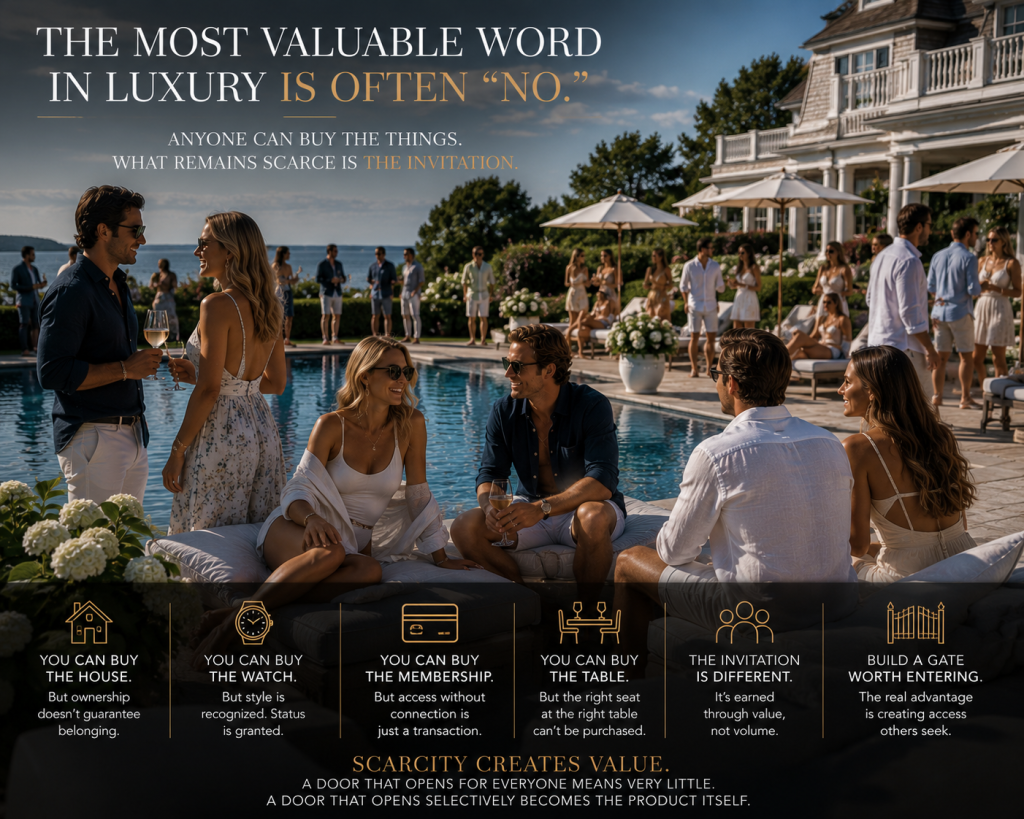
This is the art of the no, and out here it stays the one luxury money cannot reach by itself. Anyone can buy the property. Anyone can buy the car, the watch, the pallet of rosé. But the invitation hangs just out of reach, because the people who issue it are guarding the only thing their world still treats as scarce. So the no becomes the product. The yes is only the receipt.
Out here, that lesson lands early or it lands expensive. The season is short, the rooms are small, and the rope is everywhere once you learn to see it. So this is a field guide to the no, the codes behind it, and the people who profit from saying it. Read it as anthropology, because that is what it actually is.
Why the No Costs More Than the Yes
Out East the yes has been getting cheaper for a decade. Money is everywhere now. There is hedge fund money, crypto money, founder money, the kind that arrives in one wire and reorders a life by Memorial Day. Because the yes is abundant, it has lost its power to mean much at all.
The no went the other direction. Refusal is the asset that did not inflate. A closed door still says what an open wallet cannot, since the closed door is the last signal that was never for sale. So the value migrated to the gatekeeper. Think of the host who declines, the club that does not call back, the table that stays full for everyone but you.
Picture it as a simple swap. The newly rich arrive holding economic capital, which means cash and the things cash buys. But what they want is the other kind, the symbolic sort that turns a stranger into a regular. That conversion has an exchange rate, and the rate gets set by people who collect nos the way others collect art.
Look at how the season prices itself. A dinner reservation can be bought, so it signals little. A weekend share can be bought, so it signals less. But the seat at the table where the deals and the marriages actually form has no public price, because pricing it would ruin it. The minute a no becomes purchasable, it stops being a no, and the value drains out overnight.
The Door Is the Brand
Every serious house out here runs a door, even the ones with no actual door. The dinner in Water Mill has a door. The Sunday lunch in Sagaponack has a door. So does the table at the back that nobody points to. The door is not wood. The door is a decision someone makes about you before you arrive.
That decision is the whole brand. A place known for letting anyone in has no brand at all, since the brand is the editing. Of course the editing has to look effortless. The host who works too visibly at the guest list reads as anxious, and anxiety is the one tell the room never forgives.
This is also why a hard no travels further than a warm yes. When word gets around that a door turned someone away, the door gains value. Each rejection is free advertising for the people still inside. The cold open at the beach club rope works on exactly this logic, and the rest of the season borrows it.
Notice how the good doors never explain themselves. There is no posted policy, no tier sheet taped to the wall, no email that spells out the rules. Ambiguity is the point, since a rule can be satisfied and a vibe cannot. So the newcomer is left to guess, and the guessing is the toll. That uncertainty is not poor communication. It is the most precise message the room ever sends.
Who Holds the Pen
Behind every great no stands a person with a pen. Sometimes she is the hostess who has run the same August lunch for twenty years. Sometimes he is the fixer nobody photographs, the one who quietly seats the room. Either way, the pen is social capital made physical, and the holder guards it like a deed.
These people are not gatekeepers for sport. They are protecting the value of their own yes, since a yes that goes to everyone is worth nothing to anyone. So they spend nos generously and yeses rarely. That ratio is the entire job, and the best of them make it look like warmth.
You cannot buy the pen. But you can become legible to the person holding it, which is a slower and far more durable thing. Bring something the room actually wants, whether that is taste, talent, or real generosity, and the pen starts to move. Until then, the polite distance you feel is not an accident. It is the system working exactly as designed.
Money Buys the House, Not the Invitation
The newly rich tend to make one honest mistake. They assume the Hamptons works like every other market they have ever beaten. So they spend. They buy the bigger lot, the better architect, the wine consultant, the membership with the waitlist they paid to skip. Still, the invitation does not come, and they cannot understand the holdup.
The holdup is structural. An invitation is not a thing you purchase. It is a thing other people decide to extend, and they extend it as a bet on your social value, not your balance sheet. Because the bet is about belonging, money alone reads as the wrong currency. It is a little like showing up to a black-tie dinner waving a forklift certification.
Consider the membership that everyone games. Someone pays to skip the waitlist, then wonders why the regulars stay cool. The regulars know the difference between a member and a belonger, and the waitlist was the test he paid to fail. Because he treated time as a thing to buy out, he announced that he had no time invested at all.
Here is the part nobody says out loud. The room is happy to take your sponsorship, your charity table, your wine. But the room reserves the right to keep you adjacent rather than inside, and that gap is precisely where the status lives. The whole grammar behind it sits in the broader map of luxury status codes that runs the East End.
What the Newly Rich Get Wrong
First mistake: treating access as a transaction with a closing date. Access out here is a relationship with no closing date, and the people who get it stop counting. By contrast, the man who asks what a seat costs has already told the room he does not have one.
Second mistake: chasing the loudest party. The loud party is usually the open one, since open is what makes it loud. The quiet lunch with eight people is the room that actually sorts the season. After all, the guest list is the product there, not the food, a point laid out in full at the guest list is the product.
Third mistake: resenting the no. The no is not an insult. It is information, and it is the most useful information the season hands you for free. Once you stop chasing the parties you cannot reach, you can start reading why they hold their value. Those mechanics get taken apart inside the parties you can’t get into.
Fourth mistake: performing the wealth instead of placing it. The room can read a bought entrance from across the lawn. So the watch comes off, the logo goes quiet, the spending moves where only insiders can clock it. That instinct gets unpacked in the wider grammar of old money tells, where restraint reads louder than any receipt.
Scarcity Is a Strategy, Not an Accident
Nobody out here stumbles into exclusivity. Scarcity is engineered, maintained, and defended like waterfront. The club that caps its membership is not running low on chairs. It is running the math on what each chair is worth once the next one gets denied. By contrast, the place that keeps adding tables is quietly telling the room it has stopped saying no.
Brands learn this lesson late and expensive. A label floods the market, the logo turns up on every wrist, and the prestige evaporates inside a single season. The fix is always the same. Pull supply, raise the rope, let the waiting list do the talking. Because the want lives in the wait, not in the thing itself.
The East End simply runs this playbook at the scale of a whole region. Lanes stay private. Beaches stay stickered. Tables stay full. So the value compounds year over year, and the people who control the rope compound right along with it. That is the quiet fortune nobody lists on a tax return.
Even the calendar plays along. The good nights are never advertised, since advertising would widen the door. Word moves by text, by who tells whom, by the small thrill of being told at all. So the quiet invite outranks the printed one every time. And the printed one is usually a sign you were not the first call.
The Refusal Economy of the East End
Zoom out and the whole region runs on managed scarcity. Beaches gate by sticker. Clubs gate by sponsor. Lanes like Meadow and Further gate by deed. Because scarcity is the engine, the smart operators do not fight the rope. Instead they build their own and decide who clears it.
That is the move worth copying. Stop buying your way toward other people’s doors. Start a door of your own, then make it mean something by being honest about who does not get through. A brand can do this too, which is why the cabana row at the cabana index reads as a published ranking rather than a seating chart.
Watch where the money actually flows. It flows toward the operators who control a door, not the ones who knock on every door in town. A magazine that decides who appears in it holds a door. An event that decides who sits cabana-side holds a door. So the advantage is never in the spending. It is in the editing, and the editing is what the East End pays a premium to control.
Refusal, done well, is generous. It tells everyone who is inside that the inside still means something. So the art of the no is not cruelty. It is curation, and curation is the last thing out here that has held its price. Master the no and you stop renting status. You start issuing it, the way Polo Hamptons does every July.
Where the Conversation Continues
A fish does not know it is wet. The newly rich who chase every yes never feel the water they are swimming in, while the people issuing the nos feel nothing else. Reading the difference is the whole game, and reading it well is what the season rewards.
If you want to be on the right side of the rope this summer, start a conversation with us through the contact page. We answer the people who already understand the difference.
Brands and founders who want the room rather than the banner can look at a paid feature. Because placement here is editorial, not a billboard, the piece does the work a logo never could.
Want the invitations before everyone else hears about them? Get on the insider list. It is the closest thing to a standing yes we hand out.
For the room where the rope works in your favor, there is Polo Hamptons on July 18 and 25 in Bridgehampton. So few seats clear that the seat itself is the signal.
Readers who want the season decoded all year can take a subscription. Since the best nos happen quietly, the subscription is how you hear about them at all.
And if this read like a map of your own summer, you can support the work. Of course the no still applies. We just hope yours is a yes.
Author

Written by
Recent Posts

Everyone Called Him a Genius. But He Felt Like a Fraud.
The Two-House Year: What Seasonal Residents Learn After the First Season
Trade Show Booth Decisions: What to Rent, What to Build, and What to Skip
Find Your Ideal Solar Battery Size in Minutes

How to Explore Rome Comfortably Between Check-In and Departure
Categories
- Art
- Articles
- Business of Luxury
- Celebrities
- Culture
- Entertainment
- Events
- Faces of Summer 2026
- Fashion
- Fashion & Style
- Featured
- Finance
- Food, Spirits, Wine
- Hamptons
- Hamptons Celebrities
- Health
- Health & Beauty
- Lifestyle
- Luxury Lifestyle
- Press
- Profiles
- Real Estate
- Technology
- The Chronicles
- Travel
- Uncategorized
- Weddings